Segmentation Quick Reference
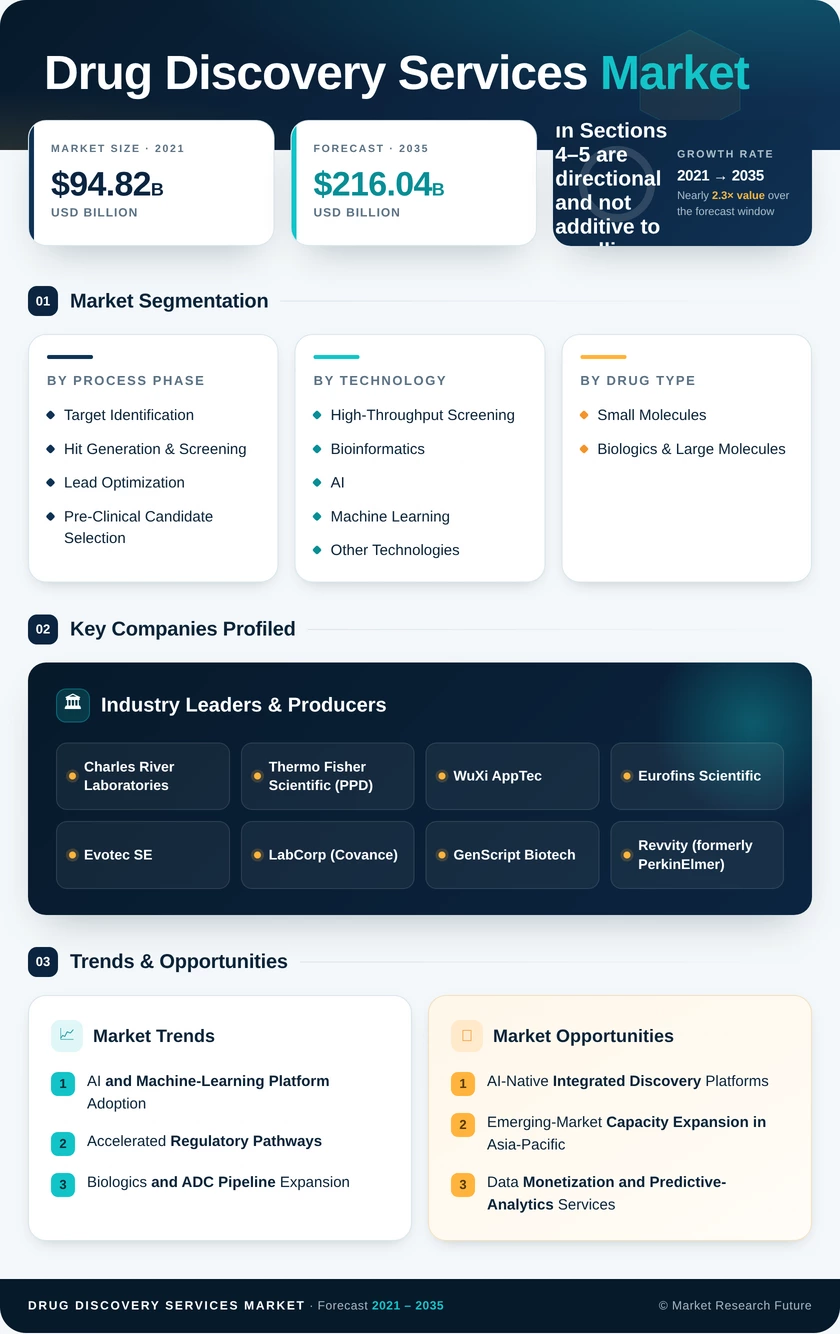
| Dimension | Sub-Segments | Dominant Segment | Fastest Growing Segment |
| Process Phase | Target Identification, Hit Generation & Screening, Lead Optimization, Pre-Clinical Candidate Selection | Hit Generation & Screening | Pre-Clinical Candidate Selection |
| Technology | High-Throughput Screening, Bioinformatics, AI and Machine Learning, Other Technologies | High-Throughput Screening | AI and Machine Learning |
| Drug Type | Small Molecules, Biologics & Large Molecules | Small Molecules | Biologics & Large Molecules |
| Therapeutic Area | Oncology, Central Nervous System, Metabolic Disorders, Infectious Diseases, Other Therapeutic Areas | Oncology | Metabolic Disorders |
| End User | Pharmaceutical & Biotechnology Companies, Contract Research Organizations, Academic & Research Institutions | Pharmaceutical & Biotechnology Companies | Contract Research Organizations |
| Geography | North America, Europe, Asia-Pacific, South America, Middle East & Africa | North America | Asia-Pacific |
Market Segmentation Overview
By Process Phase
| Sub-Segment | Key Trend |
| Target Identification | Multi-omic profiling and CRISPR functional genomics are replacing single-gene approaches |
| Hit Generation & Screening | DNA-encoded libraries and automated compound management drive throughput gains |
| Lead Optimization | AI-guided medicinal chemistry shortens design-make-test-analyze cycles |
| Pre-Clinical Candidate Selection | IND-enabling study bundles from CROs reduce sponsor handoff complexity |
Process-phase segmentation reflects the sequential workflow of drug discovery. The shift toward integrated CRO engagements that span multiple phases in a single contract is blurring traditional phase boundaries and increasing per-program contract values.
By Technology
| Sub-Segment | Key Trend |
| High-Throughput Screening | Miniaturization to 1536-well and 3456-well formats increases throughput while reducing reagent costs |
| Bioinformatics | Cloud-native bioinformatics platforms enable real-time target-disease association mining |
| AI and Machine Learning | Generative molecular design tools accelerate virtual screening and reduce physical-screening dependence |
| Other Technologies | Fragment-based drug design and cryo-EM structural biology gain traction for challenging targets |
Technology adoption is the primary differentiator among top-tier CROs. Providers that combine screening infrastructure with proprietary AI platforms command higher per-project fees and longer-duration contracts.
By Drug Type
| Sub-Segment | Key Trend |
| Small Molecules | Targeted protein degraders and molecular glues expand the druggable proteome |
| Biologics & Large Molecules | ADCs, bispecifics, and mRNA platforms require specialized discovery workflows |
Small molecules remain the volume leader, but biologics are driving incremental growth as novel modalities demand new assay development, formulation screening, and immunogenicity assessment capabilities from CROs.
By Therapeutic Area
| Sub-Segment | Key Trend |
| Oncology | Immuno-oncology combinations and targeted degraders dominate pipeline activity |
| Central Nervous System | Alzheimer's antibody approvals renew CNS discovery investment |
| Metabolic Disorders | GLP-1 agonist commercial success funds next-generation oral and combination programs |
| Infectious Diseases | AMR and pandemic-preparedness mandates sustain antiviral and antibacterial screening programs |
| Other Therapeutic Areas | Autoimmune, rare disease, and ophthalmology pipelines grow through orphan-drug incentives |
Therapeutic-area distribution in the Drug Discovery Services Market tracks pipeline investment trends. Oncology has held the largest share for over a decade, but metabolic and CNS programs are gaining ground rapidly.
By End User
| Sub-Segment | Key Trend |
| Pharmaceutical & Biotechnology Companies | Large pharma externalizes discovery to focus internal resources on clinical and commercial operations |
| Contract Research Organizations | Tier-one CROs sub-contract niche computational and assay services to specialized providers |
| Academic & Research Institutions | Government translational grants increasingly require CRO partnerships for IND-enabling work |
The end-user landscape reflects a broad outsourcing trend in which even large pharmaceutical companies now rely on external partners for the majority of their early discovery activities.