Research Methodology on Dry Transformer Market
INTRODUCTION
The need for power solutions has increased significantly in recent years due to the rapid growth in the industrial sector. The rising demand for uninterrupted, reliable, and efficient electricity supply is creating a need for power transformers. This need is driving the dry transformer market. Dry-type transformers are more compact in size, efficient, and reliable. They are also suitable for indoor installations because of their non-flammability and minimal emissions. This has resulted in increased penetration of dry-type transformers in various end-use industries such as oil and gas, metals and mining, residential and commercial, and utilities.
The global dry transformer market is expected to gain an appreciable CAGR by the end of 2030. The report evaluates the market dynamics, competitive landscape, market size and future trends in the global dry transformer market for the forecast period from 2023 to 2030.
RESEARCH METHODOLOGY
This study on the global dry transformer market has been conducted with the help of both macro and micro approaches. The first step was to carry out secondary research, which included gathering data from market reports, company websites, white papers, industry periodicals, and various industry databases. This data was then used to get a better understanding of the global dry transformer market’s current state.
The next step of the research was to collect primary data through interviews with senior executives of major global companies in the dry transformer market. These interviews provided insights into the market trends and strategies adopted by leading companies. The primary data was then validated with the help of secondary research.
An in-depth analysis of both, the Global market for dry transformers and the region-wise markets entailed the assessment of the market definition, market size, drivers and restraints, analysis of Porter’s Five Forces, value chain analysis, and supply chain analysis. Furthermore, market analysis was also done for understanding the market for dry transformer product types, environmental regulations, the latest technology, market structure, and market dynamics.
Subsequently, extensive primary research was conducted to understand the current market landscape in the dry transformer segment. The research was carried out through primary survey activities that included interviews and questionnaires, and secondary survey activities that included industry reports, investor presentations, and expert opinions. During the research, secondary survey activities revealed that the current market size of dry transformers is very large.
The next step of the research was to identify and evaluate the key segments within the dry transformer market. This involves the analysis of the market across various verticals such as key players, product categories, applications, regions, and end-users. Based on the evaluation of these segments, the market segments were then further divided into sub-segments. This was done to gain a more granular understanding of the dry transformer market.
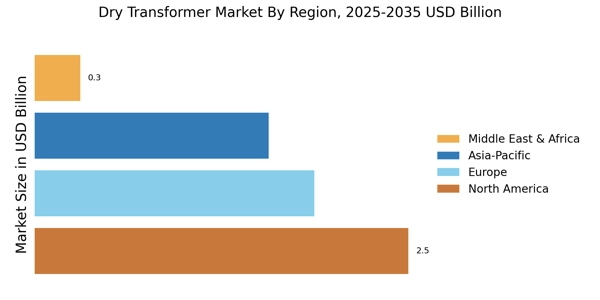
The research methodology also included a detailed study of the regional markets for dry transformers. This involved the analysis of the global dry transformer market in North America, Europe, Asia-Pacific, Latin America, and the Middle East & Africa. This was complemented by a regional market assessment of the dry transformers across all global regions.
The research data was further analysed through systemic and statistical methods. This included the use of statistical tests such as T-test and Z-test. This further enabled researchers to calculate the probability of accepting or rejecting various hypotheses under different market scenarios.
Moreover, a rigorous in-depth analysis of the major players in the market for dry transformers was carried out. This included market share analysis, an assessment of their product portfolio and development strategies, and their positioning in the global dry transformer market.
Finally, the research was further complemented with detailed interviews with key opinion leaders and industry experts, who validated the conclusions and findings of the research. Overall, extensive primary and secondary research was conducted to arrive at the final market size and market segmentation.
CONCLUSION
Overall, this research methodology has enabled an understanding of the market size and growth prospects of the dry transformer market. This has been done through a comprehensive analysis of various drivers and restraints present in the global markets. The research has also provided insight into the market attractiveness of each of the segments present in the dry transformer market. This has been done through detailed regional analysis and by assessing the product categories, end-users, and major players operating in the dry transformer market. The data obtained from this research will help companies to make more informed decisions about their investments and market strategies.