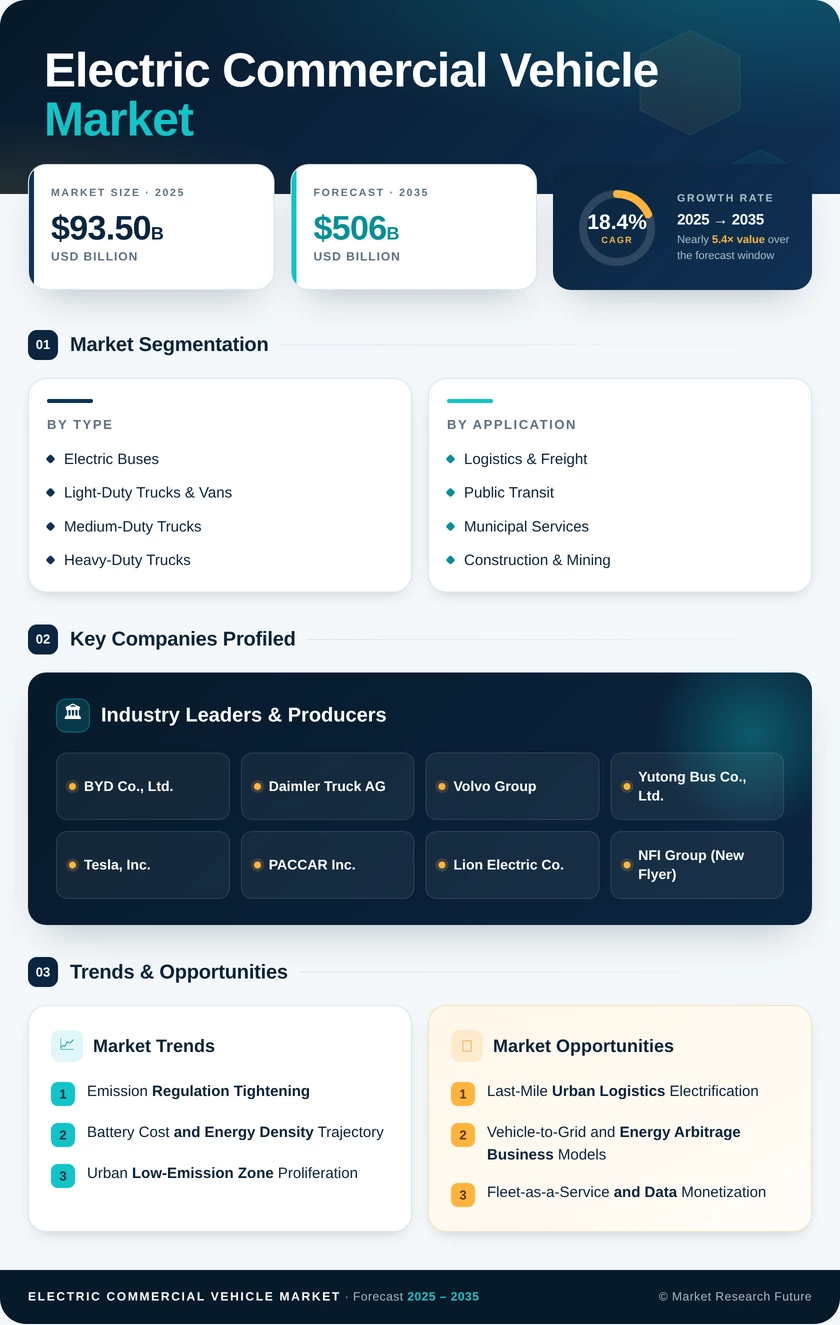
Electric Commercial Vehicle Market (2026 - 2035)

ID: MRFR/AT/5456-CR
128 Pages
Shubham Munde
Last Updated: August 24, 2026
Electric Commercial Vehicle Market Research Report By Propulsion Type (Battery Electric Vehicle (BEV), Plug-in Hybrid Electric Vehicle (PHEV), Fuel Cell Electric Vehicle (FCEV)), By Vehicle Type (Electric Buses, Light-Duty Trucks & Vans, Medium-Duty Trucks, Heavy-Duty Trucks), By Application (Logistics & Freight, Public Transit, Municipal Services, Construction & Mining) and By Regional (North America, Europe, South America, Asia Pacific, Middle East and Africa) - Forecast to 2035
Electric Commercial Vehicle Market
Market Size
Forecast Period2026-2035
CAGR (2026-2035)18.4%
2025 Market SizeUSD 93.5 Billion
2035 Market SizeUSD 506.0 Billion
Key Players
BYD Co., Ltd.
Daimler Truck AG
Volvo Group
Yutong Bus Co., Ltd.
Tesla, Inc.
PACCAR Inc.
Opportunities
  • Last-Mile Urban Logistics Electrification
  • Vehicle-to-Grid and Energy Arbitrage Business Models
  • Fleet-as-a-Service and Data Monetization
  1. 1 Market Overview |
    1. 1.1 Study Assumptions & Market Definition |
    2. 1.2 Scope of the Study |
    3. 1.3 Research Methodology
  2. 2 Market Summary & Key Takeaways
  3. 3 Market Dynamics |
    1. 3.1 Market Drivers Analysis | |
      1. 3.1.1 Tightening Emission Regulations (EU, U.S., China) | |
      2. 3.1.2 Battery Cost Decline and Energy Density Gains | |
      3. 3.1.3 Urban Low-Emission Zone Proliferation | |
      4. 3.1.4 ESG-Linked Procurement Mandates | |
      5. 3.1.5 Total Cost of Ownership Parity with Diesel | |
      6. 3.1.6 Charging Infrastructure Buildout | |
      7. 3.1.7 Government Purchase Subsidies and Tax Incentives |
    2. 3.2 Market Restraints Analysis | |
      1. 3.2.1 High Upfront Vehicle Acquisition Cost | |
      2. 3.2.2 Charging Infrastructure Gaps (Rural and Highway) | |
      3. 3.2.3 Battery Raw Material Supply Chain Volatility | |
      4. 3.2.4 Limited Model Availability for Class 7–8 Long-Haul | |
      5. 3.2.5 Grid Capacity Constraints at Scale |
    3. 3.3 Market Opportunity Analysis | |
      1. 3.3.1 Last-Mile Urban Logistics Electrification | |
      2. 3.3.2 Vehicle-to-Grid and Energy Arbitrage Business Models | |
      3. 3.3.3 Emerging Markets in Southeast Asia and Latin America | |
      4. 3.3.4 Fleet-as-a-Service and Data Monetization | |
      5. 3.3.5 Hydrogen Fuel Cell Heavy-Duty Corridors |
    4. 3.4 Industry Value Chain Analysis |
    5. 3.5 Porter's Five Forces Analysis
  4. 4 Global Electric Commercial Vehicle Market Size & Forecast (2021–2035) |
    1. 4.1 Historical Market Size (2021–2025) |
    2. 4.2 Current & Forecast Market Size (2026–2035) |
    3. 4.3 Market Size by Revenue (USD Billion) |
    4. 4.4 Year-over-Year Growth Analysis
  5. 5 Segmentation Analysis |
    1. 5.1 By Propulsion Type | |
      1. 5.1.1 Battery Electric Vehicle (BEV) | |
      2. 5.1.2 Plug-in Hybrid Electric Vehicle (PHEV) | |
      3. 5.1.3 Fuel Cell Electric Vehicle (FCEV) |
    2. 5.2 By Vehicle Type | |
      1. 5.2.1 Electric Buses | |
      2. 5.2.2 Light-Duty Trucks & Vans | |
      3. 5.2.3 Medium-Duty Trucks | |
      4. 5.2.4 Heavy-Duty Trucks |
    3. 5.3 By Application | |
      1. 5.3.1 Logistics & Freight | |
      2. 5.3.2 Public Transit | |
      3. 5.3.3 Municipal Services | |
      4. 5.3.4 Construction & Mining
  6. 6 Regional Analysis |
    1. 6.1 Asia-Pacific | |
      1. 6.1.1 China | |
      2. 6.1.2 India | |
      3. 6.1.3 Japan | |
      4. 6.1.4 South Korea | |
      5. 6.1.5 Australia | |
      6. 6.1.6 Rest of Asia-Pacific |
    2. 6.2 Europe | |
      1. 6.2.1 Germany | |
      2. 6.2.2 United Kingdom | |
      3. 6.2.3 France | |
      4. 6.2.4 Netherlands | |
      5. 6.2.5 Norway | |
      6. 6.2.6 Rest of Europe |
    3. 6.3 North America | |
      1. 6.3.1 United States | |
      2. 6.3.2 Canada | |
      3. 6.3.3 Mexico |
    4. 6.4 South America | |
      1. 6.4.1 Brazil | |
      2. 6.4.2 Chile | |
      3. 6.4.3 Colombia | |
      4. 6.4.4 Rest of South America |
    5. 6.5 Middle East & Africa | |
      1. 6.5.1 UAE | |
      2. 6.5.2 Saudi Arabia | |
      3. 6.5.3 South Africa | |
      4. 6.5.4 Rest of Middle East & Africa
  7. 7 Competitive Landscape |
    1. 7.1 Market Share Analysis (2025) |
    2. 7.2 Competitive Benchmarking Matrix |
    3. 7.3 Company Profiles | |
      1. 7.3.1 BYD Co., Ltd. | |
      2. 7.3.2 Daimler Truck AG | |
      3. 7.3.3 Volvo Group | |
      4. 7.3.4 Yutong Bus Co., Ltd. | |
      5. 7.3.5 Tesla, Inc. | |
      6. 7.3.6 PACCAR Inc. | |
      7. 7.3.7 Hyundai Motor Company | |
      8. 7.3.8 Lion Electric Co. | |
      9. 7.3.9 NFI Group (New Flyer) | |
      10. 7.3.10 Zhongtong Bus Holding
  8. 8 Future Outlook & Strategic Recommendations (2026–2035) |
    1. 8.1 Autonomous Electric Freight Corridors |
    2. 8.2 Solid-State Battery Integration |
    3. 8.3 Circular Battery Economy and ESG Reporting |
    4. 8.4 Megawatt Charging and Grid Modernization
  9. 9 Recent Developments & News
  10. 10 Frequently Asked Questions (FAQs)
  11. 11 Report Scope & Methodology |
    1. 11.1 Study Period & Base Year |
    2. 11.2 Data Sources & Citations |
    3. 11.3 Abbreviations
  12. 12 LIST OF TABLES |
  13. TABLE 1 Global Electric Commercial Vehicle Market Size & Forecast, by Revenue (USD Billion), 2021–2035 |
  14. TABLE 2 Global Electric Commercial Vehicle Market – Year-over-Year Growth Analysis, 2021–2035 |
  15. TABLE 3 Global Electric Commercial Vehicle Market – Driver Impact Analysis |
  16. TABLE 4 Global Electric Commercial Vehicle Market – Restraint Impact Analysis |
  17. TABLE 5 Global Electric Commercial Vehicle Market Size, by Propulsion Type, 2021–2035 (USD Billion) |
  18. TABLE 6 Global Electric Commercial Vehicle Market Size, by Vehicle Type, 2021–2035 (USD Billion) |
  19. TABLE 7 Global Electric Commercial Vehicle Market Size, by Application, 2021–2035 (USD Billion) |
  20. TABLE 8 Global Electric Commercial Vehicle Market Size, by Region, 2021–2035 (USD Billion) |
  21. TABLE 9 Asia-Pacific Electric Commercial Vehicle Market Size, by Country, 2021–2035 (USD Billion) |
  22. TABLE 10 Europe Electric Commercial Vehicle Market Size, by Country, 2021–2035 (USD Billion) |
  23. TABLE 11 North America Electric Commercial Vehicle Market Size, by Country, 2021–2035 (USD Billion) |
  24. TABLE 12 South America Electric Commercial Vehicle Market Size, by Country, 2021–2035 (USD Billion) |
  25. TABLE 13 Middle East & Africa Electric Commercial Vehicle Market Size, by Country, 2021–2035 (USD Billion) |
  26. TABLE 14 Competitive Benchmarking Matrix – Global Electric Commercial Vehicle Market, 2025 |
  27. TABLE 15 Company Profiles – Key Players, Global Electric Commercial Vehicle Market |
  28. TABLE 16 Recent Developments & Strategic Announcements, 2023–2025 |
  29. TABLE 17 Report Scope & Methodology Summary |
  30. TABLE 18 Detailed Sources and Citations |
  31. TABLE 19 Asia-Pacific Electric Commercial Vehicle Market Size, by Propulsion Type, 2021–2035 (USD Billion) |
  32. TABLE 20 Asia-Pacific Electric Commercial Vehicle Market Size, by Vehicle Type, 2021–2035 (USD Billion) |
  33. TABLE 21 Asia-Pacific Electric Commercial Vehicle Market Size, by Application, 2021–2035 (USD Billion) |
  34. TABLE 22 Europe Electric Commercial Vehicle Market Size, by Propulsion Type, 2021–2035 (USD Billion) |
  35. TABLE 23 Europe Electric Commercial Vehicle Market Size, by Vehicle Type, 2021–2035 (USD Billion) |
  36. TABLE 24 Europe Electric Commercial Vehicle Market Size, by Application, 2021–2035 (USD Billion) |
  37. TABLE 25 North America Electric Commercial Vehicle Market Size, by Propulsion Type, 2021–2035 (USD Billion) |
  38. TABLE 26 North America Electric Commercial Vehicle Market Size, by Vehicle Type, 2021–2035 (USD Billion) |
  39. TABLE 27 North America Electric Commercial Vehicle Market Size, by Application, 2021–2035 (USD Billion) |
  40. TABLE 28 South America Electric Commercial Vehicle Market Size, by Propulsion Type, 2021–2035 (USD Billion) |
  41. TABLE 29 South America Electric Commercial Vehicle Market Size, by Vehicle Type, 2021–2035 (USD Billion) |
  42. TABLE 30 South America Electric Commercial Vehicle Market Size, by Application, 2021–2035 (USD Billion) |
  43. TABLE 31 Middle East & Africa Electric Commercial Vehicle Market Size, by Propulsion Type, 2021–2035 (USD Billion) |
  44. TABLE 32 Middle East & Africa Electric Commercial Vehicle Market Size, by Vehicle Type, 2021–2035 (USD Billion) |
  45. TABLE 33 Middle East & Africa Electric Commercial Vehicle Market Size, by Application, 2021–2035 (USD Billion) |
  46. TABLE 34 China Electric Commercial Vehicle Market Size, by Propulsion Type, 2021–2035 (USD Billion) |
  47. TABLE 35 China Electric Commercial Vehicle Market Size, by Vehicle Type, 2021–2035 (USD Billion) |
  48. TABLE 36 China Electric Commercial Vehicle Market Size, by Application, 2021–2035 (USD Billion) |
  49. TABLE 37 India Electric Commercial Vehicle Market Size, by Propulsion Type, 2021–2035 (USD Billion) |
  50. TABLE 38 India Electric Commercial Vehicle Market Size, by Vehicle Type, 2021–2035 (USD Billion) |
  51. TABLE 39 India Electric Commercial Vehicle Market Size, by Application, 2021–2035 (USD Billion) |
  52. TABLE 40 Japan Electric Commercial Vehicle Market Size, by Propulsion Type, 2021–2035 (USD Billion) |
  53. TABLE 41 Japan Electric Commercial Vehicle Market Size, by Vehicle Type, 2021–2035 (USD Billion) |
  54. TABLE 42 Japan Electric Commercial Vehicle Market Size, by Application, 2021–2035 (USD Billion) |
  55. TABLE 43 South Korea Electric Commercial Vehicle Market Size, by Propulsion Type, 2021–2035 (USD Billion) |
  56. TABLE 44 South Korea Electric Commercial Vehicle Market Size, by Vehicle Type, 2021–2035 (USD Billion) |
  57. TABLE 45 South Korea Electric Commercial Vehicle Market Size, by Application, 2021–2035 (USD Billion) |
  58. TABLE 46 Australia Electric Commercial Vehicle Market Size, by Propulsion Type, 2021–2035 (USD Billion) |
  59. TABLE 47 Australia Electric Commercial Vehicle Market Size, by Vehicle Type, 2021–2035 (USD Billion) |
  60. TABLE 48 Australia Electric Commercial Vehicle Market Size, by Application, 2021–2035 (USD Billion) |
  61. TABLE 49 Germany Electric Commercial Vehicle Market Size, by Propulsion Type, 2021–2035 (USD Billion) |
  62. TABLE 50 Germany Electric Commercial Vehicle Market Size, by Vehicle Type, 2021–2035 (USD Billion) |
  63. TABLE 51 Germany Electric Commercial Vehicle Market Size, by Application, 2021–2035 (USD Billion) |
  64. TABLE 52 United Kingdom Electric Commercial Vehicle Market Size, by Propulsion Type, 2021–2035 (USD Billion) |
  65. TABLE 53 United Kingdom Electric Commercial Vehicle Market Size, by Vehicle Type, 2021–2035 (USD Billion) |
  66. TABLE 54 United Kingdom Electric Commercial Vehicle Market Size, by Application, 2021–2035 (USD Billion) |
  67. TABLE 55 France Electric Commercial Vehicle Market Size, by Propulsion Type, 2021–2035 (USD Billion) |
  68. TABLE 56 France Electric Commercial Vehicle Market Size, by Vehicle Type, 2021–2035 (USD Billion) |
  69. TABLE 57 France Electric Commercial Vehicle Market Size, by Application, 2021–2035 (USD Billion) |
  70. TABLE 58 United States Electric Commercial Vehicle Market Size, by Propulsion Type, 2021–2035 (USD Billion) |
  71. TABLE 59 United States Electric Commercial Vehicle Market Size, by Vehicle Type, 2021–2035 (USD Billion) |
  72. TABLE 60 United States Electric Commercial Vehicle Market Size, by Application, 2021–2035 (USD Billion) |
  73. TABLE 61 Canada Electric Commercial Vehicle Market Size, by Propulsion Type, 2021–2035 (USD Billion) |
  74. TABLE 62 Canada Electric Commercial Vehicle Market Size, by Vehicle Type, 2021–2035 (USD Billion) |
  75. TABLE 63 Canada Electric Commercial Vehicle Market Size, by Application, 2021–2035 (USD Billion) |
  76. TABLE 64 Brazil Electric Commercial Vehicle Market Size, by Propulsion Type, 2021–2035 (USD Billion) |
  77. TABLE 65 Brazil Electric Commercial Vehicle Market Size, by Vehicle Type, 2021–2035 (USD Billion) |
  78. TABLE 66 Brazil Electric Commercial Vehicle Market Size, by Application, 2021–2035 (USD Billion)
  79. 13 LIST OF FIGURES |
  80. FIGURE 1 Global Electric Commercial Vehicle Market Dynamics — Drivers, Restraints, Opportunities |
  81. FIGURE 2 Industry Value Chain — Electric Commercial Vehicle Market |
  82. FIGURE 3 Porter's Five Forces Analysis — Electric Commercial Vehicle Market |
  83. FIGURE 4 Global Electric Commercial Vehicle Market Size Trend (USD Billion), 2021–2035 |
  84. FIGURE 5 Global Electric Commercial Vehicle Market Share, by Propulsion Type (%), 2025 |
  85. FIGURE 6 Global Electric Commercial Vehicle Market Share, by Vehicle Type (%), 2025 |
  86. FIGURE 7 Global Electric Commercial Vehicle Market Share, by Application (%), 2025 |
  87. FIGURE 8 Global Electric Commercial Vehicle Market Share, by Region (%), 2025 |
  88. FIGURE 9 Asia-Pacific Electric Commercial Vehicle Market Size Trend (USD Billion), 2021–2035 |
  89. FIGURE 10 Europe Electric Commercial Vehicle Market Size Trend (USD Billion), 2021–2035 |
  90. FIGURE 11 North America Electric Commercial Vehicle Market Size Trend (USD Billion), 2021–2035 |
  91. FIGURE 12 South America Electric Commercial Vehicle Market Size Trend (USD Billion), 2021–2035 |
  92. FIGURE 13 Middle East & Africa Electric Commercial Vehicle Market Size Trend (USD Billion), 2021–2035 |
  93. FIGURE 14 Competitive Landscape — Market Share Analysis, Electric Commercial Vehicle Market, 2025 |
  94. FIGURE 15 Competitive Positioning Map — Key Players, Electric Commercial Vehicle Market

SEGMENTATION QUICK REFERENCE

DimensionSub-SegmentsDominant SegmentFastest Growing Segment
By Propulsion TypeBEV, PHEV, FCEVBEV (~72% share, 2025)Construction & Mining application FCEV adoption
By Vehicle TypeElectric Buses, Light-Duty Trucks & Vans, Medium-Duty Trucks, Heavy-Duty TrucksElectric Buses (~41% share, 2025)Light-Duty Trucks & Vans (CAGR 21.2%)
By ApplicationLogistics & Freight, Public Transit, Municipal Services, Construction & MiningLogistics & Freight (~38% share, 2025)Construction & Mining (CAGR 22.4%)
By RegionAsia-Pacific, Europe, North America, South America, Middle East & AfricaAsia-Pacific (~48% share, 2025)North America (CAGR 20.6%)


MARKET SEGMENTATION OVERVIEW

By Propulsion Type

Sub-SegmentKey Trend
Battery Electric Vehicle (BEV)LFP cell cost below USD 63/kWh driving urban fleet conversion
Plug-in Hybrid Electric Vehicle (PHEV)Bridge technology for mixed urban-highway duty cycles
Fuel Cell Electric Vehicle (FCEV)Hydrogen corridor investment enabling heavy-duty long-haul viability


BEV remains the default powertrain for the majority of commercial electrification programs globally, benefiting from mature supply chains and straightforward depot charging infrastructure. FCEV is gaining targeted traction on high-utilization, long-distance routes where battery weight and recharging time penalties make BEV impractical.

By Vehicle Type

Sub-SegmentKey Trend
Electric BusesNear-complete electrification of Chinese municipal fleets; expanding in LatAm and Europe
Light-Duty Trucks & VansE-commerce last-mile delivery driving record order volumes
Medium-Duty TrucksUrban freight zone regulations accelerating Class 4–6 electrification
Heavy-Duty TrucksOEM platform launches (eActros 600, Tesla Semi, Volvo FH Electric) targeting regional haul


Electric buses are the most mature vehicle segment, while light-duty trucks and vans represent the highest near-term growth vector due to e-commerce logistics expansion and relatively modest range requirements.

By Application

Sub-SegmentKey Trend
Logistics & FreightShipper Scope 3 reporting obligations creating contractual electrification requirements
Public TransitMunicipal decarbonization targets driving multi-year bus procurement programs
Municipal ServicesRefuse and utility fleet replacement cycles aligning with EV product availability
Construction & MiningUnderground ventilation cost savings and ESG mandates accelerating adoption


Logistics and freight leads by revenue due to the sheer volume of goods movement, while construction and mining is emerging as a high-growth application area where electrification delivers operational savings beyond emission reduction.


 

Download PDF ×

We do not share your information with anyone. However, we may send you emails based on your report interest from time to time. You may contact us at any time to opt-out.