Request Free Sample ×

Kindly complete the form below to receive a free sample of this Report

* Please use a valid business email

Leading companies partner with us for data-driven Insights

clients tt-cursor
Hero Background

Europe Beer Market

ID: MRFR/FnB/20020-HCR
200 Pages
Varsha More
Last Updated: May 28, 2026
Europe Beer Market Size, Share, Industry Trend & Analysis Research Report By Product Type (Lager, Ale, Non/Low-Alcohol Beer, Others), Category (Standard, Premium), By Packaging Type (Bottles, Cans, Others), By Distribution Channel (Off-Trade, On-Trade), By Geography (Western Europe, Central Europe, Northern Europe, Southern Europe, Eastern Europe) -Forecast to 2035
Download PDF ×

We do not share your information with anyone. However, we may send you emails based on your report interest from time to time. You may contact us at any time to opt-out.


Europe Beer Market Summary

The Europe Beer Market reached an estimated USD 289.47 billion in 2025, positioning the continent as one of the world's most mature and culturally embedded brewing regions. From a 2026 base of USD 327.05 billion, the Europe Beer Market is projected to climb to USD 432.60 billion by 2035, expanding at a CAGR of 4.35% across the forecast window. This trajectory is anchored by two forces: the EU's ongoing revision of excise duty structures under Directive 92/83/EEC, which has incentivized craft beer production in lower-duty brackets [2], and a wave of premium beer investment that saw European brewers collectively commit over EUR 4.8 billion in capacity upgrades between 2022 and 2024 [3].

A silent revolution is changing how Europeans brew and drink beer. Legacy mass production lager lines are being replaced with modular craft brewing equipment that has IoT-enabled fermentation controls and AI-driven recipe optimization. Low- and no-alcohol beer options have gone from fringe novelty to mainstream shelf space in line with Europe’s Beating Cancer Plan, which is in line with international objectives to achieve a 10% relative decrease in harmful alcohol use. More than 68% of the total volume in the Europe Beer Market is now recyclable packaging, reflecting the consumer’s environmental consciousness as well as the EU Single-Use Plastics Directive [5].

Germany is the greatest producer and source of income on the continent and is the anchor of the regional market, contributing to over 28% of the total volume. The UK accounts for around 21% of the total Europe Beer Market income, driven by a vibrant craft ale pub culture and a solid on-trade rebound post-pandemic. France is the fastest-growing country with a forecast CAGR of 5.02%, powered by rising premium beer consumption among younger consumers, as Germany stays the anchor of European brewing traditions but embraces craft innovation


Key Report Takeaways

• By Product Type

  • Lager accounted for approximately 83.6% of the Europe Beer Market share in 2025, reflecting deep-rooted consumer preferences across Germany, Spain, and Central Europe
  • Ale is forecast to register a 6.12% CAGR through 2035, propelled by the UK craft ale pub trend and expanding Belgian-style specialty offerings
  • Non/low-alcohol beer is on pace to reach USD 28.4 billion by 2035 as European premium beer consumption shifts toward health-conscious options

• By Category

  • The standard segment represented the dominant share of the Europe Beer Market in 2025, reflecting price-sensitive purchasing across Southern and Eastern Europe
  • Premium beer is projected to expand at a 5.10% CAGR through 2035, outpacing the overall Europe Beer Market growth rate

• By Region

  • The United Kingdom led the Europe Beer Market with 22.8% of 2025 revenue, driven by on-trade channel recovery and craft ale pub trend expansion
  • France is anticipated to post the strongest CAGR of 5.02% through 2035, benefiting from rising European craft beer growth among millennial consumers


Market Size and Forecast (2021–2035)

MRFR’s market sizing is based on the top-down revenue modeling using national excise tax filings, trade data from Eurostat, and bottom-up volumetric estimates from brewery organizations across 28 European nations. Historical data are cross-checked with Brewers of Europe annual reports. Simultaneously, projected forecasts use proprietary demand elasticity models calibrated to GDP growth, demographic changes and regulatory changes in the Europe Beer Market.
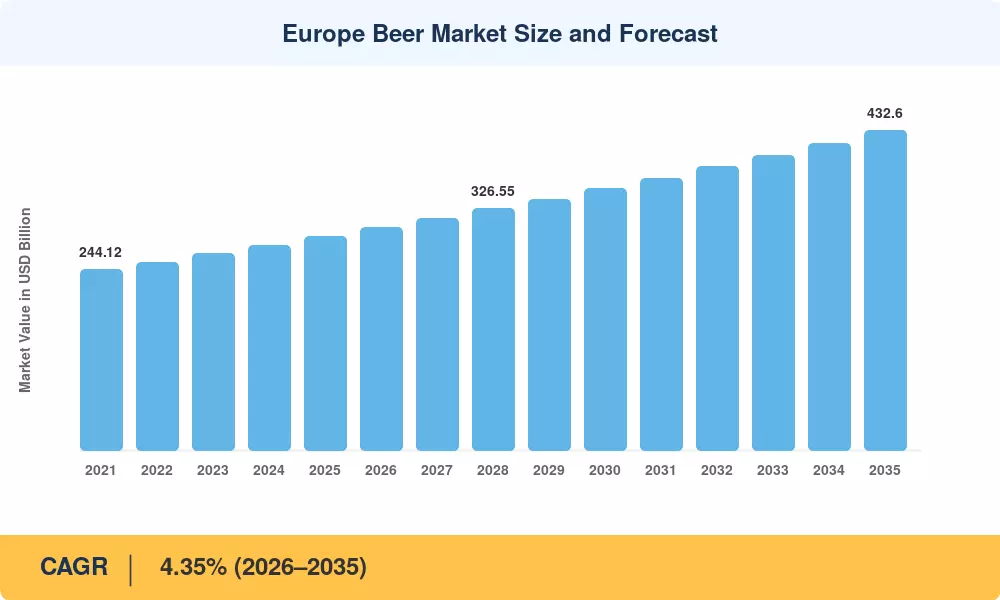
 

Europe Beer Market Size and Forecast
Our Impact
Enabled $4.3B Revenue Impact for Fortune 500 and Leading Multinationals
Partnering with 2000+ Global Organizations Each Year
30K+ Citations by Top-Tier Firms in the Industry
 

Driver Impact Analysis

Driver ~% Impact on CAGR Geographic Relevance Impact Timeline
European craft beer growth and microbrewery proliferation +0.85% UK, Belgium, Netherlands Short-term (≤2 yr)
European premium beer consumption shift +0.72% France, Italy, the Nordics Medium-term (2–4 yr)
Low/no-alcohol innovation pipeline +0.55% Germany, Spain, UK Medium-term (2–4 yr)
EU excise duty reform favors small brewers +0.48% EU-wide Long-term (≥4 yr)
On-trade channel recovery and experiential drinking +0.40% UK, Spain, Italy Short-term (≤2 yr)
Recyclable packaging and sustainability branding +0.35% Nordics, Germany, France Long-term (≥4 yr)
E-commerce and direct-to-consumer beer delivery +0.28% UK, Germany, Netherlands Medium-term (2–4 yr)


European Craft Beer Growth and Microbrewery Expansion

The number of active breweries in the European Union has plateaued at approximately 9,700 operational units following a decade of rapid expansion and subsequent post-pandemic market consolidation. This footprint remains a vital economic driver in Western Europe and the UK, anchoring localized manufacturing ecosystems and driving significant employment. The German lager market is simultaneously evolving, with an increasing number of traditional Reinheitsgebot (Purity Law) operations introducing craft-inspired sub-brands or specialized seasonal profiles to capture younger legal-drinking-age consumers better.[2].

Premium Beer Consumption Surge

European premium beer consumption has accelerated at a pace that fundamentally outstrips standard and economy categories. Global brewing leaders, including AB InBev's European division, report that premium and super-premium brands represent an expanding share of their regional net revenue mix. Consumers across France, Italy, and the Nordic countries are increasingly treating beer as a premium culinary product, leading to a rise in craft beer pairings within high-end gastronomic channels. This premiumization macro-trend is effectively elevating average selling prices across the broader European landscape, allowing value growth to outpace volume growth as total consumption stabilizes.


Low-Alcohol and Non-Alcohol Beer Innovation

The EU's Beating Cancer Plan explicitly targets reduced harmful alcohol consumption, creating regulatory tailwinds for low-alcohol innovation [4]. Heineken's 0.0 portfolio grew 18% year-over-year in Europe during 2024, and Carlsberg committed EUR 250 million to non-alcohol product development through 2027. Germany alone accounts for over 6% of total beer volume in the non-alcohol segment, the highest share in Europe. This category is reshaping the Europe Beer Market by expanding the addressable consumer base to include health-conscious and Muslim-majority demographics.

EU Excise Duty Reform

The implementation of the updated Council Directive (EU) 2020/1151 marks a significant milestone in modernizing European excise duty structures for alcoholic beverages. While baseline excise tax regulation varies considerably between low-tax jurisdictions like Germany and high-tax markets like Finland, the revised framework clarifies definitions and mutual recognition for small, independent producers across member states. This regulatory harmonization streamlines cross-border trade and protects competitive dynamics between Northern European brewing hubs and Southern European wine-producing regions. Over the long term, these clear structural frameworks are expected to unlock incremental value growth and stabilize volume dynamics across high-exercise jurisdictions.


Restraints Impact Analysis

Restraint ~% Impact on CAGR Geographic Relevance Impact Timeline
Europe beer excise tax regulation burden –0.55% Nordics, UK, Ireland Long-term (≥4 yr)
Volume decline in traditional lager segments –0.42% Germany, Czech Republic Medium-term (2–4 yr)
Input cost inflation (barley, energy, glass) –0.38% EU-wide Short-term (≤2 yr)
Tightening alcohol advertising restrictions –0.30% France, Ireland, Nordics Long-term (≥4 yr)
Competition from wine, spirits, and RTDs –0.25% Southern Europe Medium-term (2–4 yr)


Excise Tax Burden and Regulatory Fragmentation

European beer excise tax regulation remains a primary structural drag on volume growth. The UK’s Beer Duty framework, despite recent freezes, leaves British beer tax rates among the highest in Europe. Similarly, Ireland’s high-tax regime—which levies an aggressive €22.55 per hectoliter per percent of alcohol (ABV)—severely constrains hospitality and on-trade consumption margins. This intense disparity encourages cross-border shopping from high-tax to low-tax jurisdictions (such as Denmark to Germany), distorting national consumption statistics, eroding local fiscal revenues, and creating a fragmented regulatory environment that complicates pan-European brand strategies. [13].

Volume Decline in Traditional Lager Consumption

Per-capita beer consumption in Germany has faced a sustained, long-term structural decline, sliding from over 100 liters down toward the low 90s over the past decade and a half. The German lager market faces stiff demographic headwinds as historically high-consumption older cohorts age out. At the same time, younger legal-drinking-age consumers increasingly favor wine, premium spirits, cocktails, and functional non-alcoholic alternatives. This persistent volume compression in core legacy segments partially offsets the positive revenue gains generated by premiumization across the broader European beer landscape.


Input Cost Inflation

Macroeconomic and geopolitical supply shocks have fundamentally squeezed brewing margins across the continent. European malting barley and container glass packaging prices experienced severe, double-digit inflationary surges between 2021 and 2023, driven by Black Sea shipping disruptions and extreme energy cost volatility in glass manufacturing kilns. While raw commodity markets have since stabilized from their peak levels, brewers have absorbed deep margin compression that restricts their overall capital reinvestment capacity. Independent craft brewers continue to be disproportionately impacted by these sticky structural overhead costs.


Europe Beer Market Opportunities

Non-Alcohol Beer Category Expansion

The non-alcohol beer segment represents the single most significant growth vector in the European beer market, with volume penetration still sitting under 8% in most major European nations outside Germany and Spain. Brands that invest in taste parity with full-strength equivalents—leveraging advanced vacuum distillation (low-temperature alcohol removal) and arrested fermentation technology—stand to capture a rapidly expanding market projected by international analysts to maintain a double-digit Compound Annual Growth Rate (CAGR) through the mid-2030s. The UK craft ale pub trend is actively embracing this shift, rapidly opening up a premium non-alcohol and low-alcohol niche in the traditional on-trade sector.[4].

E-Commerce and Direct-to-Consumer Channels

Online beer sales across Europe experienced structural acceleration following the pandemic, yet they still represent a modest share—typically between 2% and 5%—of total off-trade volume across most European territories. Subscription box models (such as Beer52 and Beerwulf) alongside direct-to-consumer (DTC) brewery platforms allow European craft beer brands to reach consumers far beyond their localized or traditional physical distribution footprints. This channel shift structurally benefits the broader European market by enabling significantly higher gross margins for independent producers and delivering rich, first-party consumer data.

Sustainable Brewing and Circular Packaging

The EU's landmark Packaging and Packaging Waste Regulation (PPWR), which officially went into effect in February 2025, mandates strict minimum recycled content thresholds and ambitious waste reduction targets. These regulatory guidelines are rapidly accelerating the adoption of aluminum cans and closed-loop, refillable bottle systems across the continent. Brewers investing heavily in circular supply chains—patterned after industry-leading initiatives like the Carlsberg Circular Community—simultaneously secure regulatory compliance and build high brand equity with increasingly eco-conscious European consumers.


Beer Tourism and Experiential On-Trade

Beer tourism and localized experiential consumption serve as vital economic engines across historic brewing hubs like Belgium, Germany, and the Czech Republic, drawing millions of international and domestic travelers annually. Local brewery taprooms, regional beer festivals, and organized tasting tours directly drive the consumption of premium, high-margin offerings while cultivating deep brand loyalty. The UK craft ale pub landscape is mirroring this experiential evolution, expanding heavily into immersive "brewpub" models that blend onsite production, casual dining, and direct-to-consumer retail—a retail format that demonstrates high replicability across urban centers throughout Europe.


Europe Beer Market Future Outlook

AI-Driven Brewing and Smart Fermentation

Artificial intelligence and advanced automation are steadily integrating into European brewing operations through predictive fermentation tracking, automated quality monitoring, and precise demand-forecasting models. Multinational beverage conglomerates continue to scale machine learning integrations across their regional production hubs to optimize thermal efficiency and maximize ingredient utilization. These sophisticated digital monitoring tools are gradually trickling down to the craft sector, enabling smaller independent operations to improve product consistency, lower operational overhead, and replicate quality control protocols previously accessible only to industrial-scale facilities.


Platform Economics and Beer-as-a-Service

Digital applications and specialized software marketplaces are transforming consumer engagement paradigms across the continent. Digital touchpoints like Untappd for Business bridge the gap between social rating data and localized product availability, offering bars, taprooms, and retail venues a highly streamlined menu management and localized consumer marketing platform. As data-driven consumer discovery continues to accelerate, the digital aggregation of customer preference trends will play a vital role in dictating how craft and premium brands structure their distribution routes and align their geographic retail priorities.


Sustainability and ESG Reporting Mandates

The phased implementation of the EU’s Corporate Sustainability Reporting Directive (CSRD), which officially commenced its rollout for major enterprises in 2024, requires comprehensive corporate disclosures covering water stewardship, carbon footprints, and circular packaging frameworks. Flagship corporate programs—such as Carlsberg’s Together Towards ZERO and Beyond framework and Heineken’s Brew a Better World targets—remain central to corporate positioning. Rigorous ESG compliance has rapidly transitioned into a critical competitive differentiator across Europe, as major retail chains routinely prioritize suppliers that meet stringent sustainable packaging and waste reduction thresholds.


Europe Beer Market Segmentation

By Product Type

Segment Key Metric Primary Demand Driver
Lager 83.6% share (2025) Germany lager beer market heritage, mainstream preference
Ale 6.12% CAGR (2026–2035) UK craft ale pub trend, Belgian specialty culture
Non/Low-Alcohol Beer USD 28.4 Billion (2035) Health regulation, moderation movement
Others (Stout, Wheat, Specialty) 4.1% of Europe Beer Market Seasonal and regional demand


Lager continues to dominate the Europe Beer Market by an overwhelming margin, anchored by the Germany lager beer market's massive production base and deep-rooted consumer habits across Spain, the Czech Republic, and Poland. Pilsner-style lagers account for the bulk of this segment, though premium lager sub-brands — including Peroni Nastro Azzurro, Estrella Damm, and Krombacher — are driving unit price increases. European premium beer consumption within the lager category is growing faster than standard offerings, reflecting the broader premiumization wave.

Ale's growth story is closely tied to European craft beer growth, particularly in the United Kingdom, where the UK craft ale pub trend supports over 1,800 independent breweries producing ales, IPAs, and pale ales. Belgium's Trappist and abbey ales add a heritage dimension, commanding super-premium pricing. The ale segment's 6.12% CAGR significantly outpaces the overall Europe Beer Market, signaling a structural shift in consumer preferences toward flavor complexity and provenance storytelling.

By Category

Segment Key Metric Primary Demand Driver
Standard 90.7% share (2025) Price sensitivity, volume-driven markets
Premium 5.10% CAGR (2026–2035) European premium beer consumption, craft positioning


The standard category retains dominance across the Europe Beer Market through sheer volume, particularly in Eastern and Southern European price-sensitive markets. Premium beer, however, is the margin engine — driving disproportionate revenue growth through higher average selling prices and smaller-format packaging that commands per-unit premiums.

By Packaging Type

Segment Key Metric Primary Demand Driver
Bottles 44.9% revenue share (2025) Recyclable glass infrastructure, on-trade serving
Cans 5.45% CAGR (2026–2035) Portability, craft branding and aluminum recyclability
Others (Kegs, PET) USD 32.10 Billion (2025) On-trade draft systems, event channels


Bottles remain the preferred packaging format in the Europe Beer Market, supported by extensive deposit-return systems in Germany, Scandinavia, and the Netherlands. Cans are the fastest-growing format, propelled by European craft beer growth — smaller breweries favor cans for their lower breakage rates, superior light protection, and lower shipping weight. The EU's PPWR regulation is further accelerating the shift toward recyclable aluminum [5].

By Distribution Channel

Segment Key Metric Primary Demand Driver
Off-Trade 54.3% revenue share (2025) Supermarket promotions, e-commerce growth
On-Trade 5.15% CAGR (2026–2035) UK craft ale pub trend, experiential dining


Off-trade channels — supermarkets, specialty liquor stores, and online platforms — control the majority of Europe Beer Market volume, driven by competitive pricing and convenience. On-trade's faster CAGR reflects the post-pandemic recovery of pubs, bars, and restaurants, where European premium beer consumption concentrates, and margins run significantly higher.


Regional Market Share Analysis

Region Key Metric Primary Investment Themes
Western Europe 62.5% of Europe Beer Market revenue Premiumization, craft innovation and sustainable packaging
Central Europe USD 78.30 Billion (2025) Lager tradition, excise optimization, brewing tourism
Northern Europe 4.58% CAGR (2026–2035) Low-alcohol expansion, e-commerce, and responsible drinking
Southern Europe 14.2% of regional share Wine-to-beer switching, premium imports and on-trade growth
Eastern Europe Fastest sub-regional growth Craft emergence, FDI inflows and rising per-capita consumption
Total USD 289.47 Billion (2025)

The Europe Beer Market spans diverse regulatory, cultural, and economic environments. The following regional analysis examines key sub-regions and countries shaping consumption and production patterns across the continent.


Western Europe

Country Key Metric Key Driver
United Kingdom 22.8% of Europe Beer Market UK craft ale pub trend and on-trade recovery
France 5.02% CAGR (2026–2035) European premium beer consumption among millennials
Belgium USD 14.20 Billion (2025) Abbey and Trappist craft heritage exports
Netherlands 3.85% CAGR Heineken-anchored global export hub


Western Europe anchors the Europe Beer Market through a combination of mature on-trade infrastructure and aggressive craft innovation. The UK's 2024 decision to reform Small Brewer Relief preserved reduced excise rates for independent producers, sustaining the UK craft ale pub trend that has added over 2,100 new microbreweries since 2015 [3]. France's beer revolution is younger but accelerating — the number of French breweries surpassed 2,800 in 2024, up from just 500 in 2010, and French European premium beer consumption per capita now rivals that of traditional wine-drinking Southern neighbors [8].

Central Europe

Country Key Metric Key Driver
Germany 19.4% of Europe Beer Market Germany lager beer market tradition and export strength
Czech Republic USD 9.80 Billion (2025) Highest per-capita consumption globally
Austria 3.92% CAGR Alpine craft brewing and tourism


Germany's Reinheitsgebot heritage underpins the Germany lager beer market, though domestic consumption continues its gradual decline. German brewers are compensating through export growth — beer exports rose 7.2% by value in 2024 — and selective craft diversification [11]. The Czech Republic retains the world's highest per-capita beer consumption at approximately 128 liters annually, providing a stable volume base for the Europe Beer Market.

Northern Europe

Country Key Metric Key Driver
Nordic Countries 4.58% CAGR (2026–2035) Low-alcohol innovation, premium imports
Denmark USD 6.45 Billion (2025) Carlsberg HQ, craft export expansion


Northern Europe's high excise environment paradoxically drives innovation. Sweden's Systembolaget monopoly and Finland's Alko system channel consumers toward premium selections, where Europe beer excise tax regulation makes cheaper alternatives less accessible [2]. The result is above-average revenue per liter, supporting strong European premium beer consumption growth within the Europe Beer Market despite modest volume gains.

Southern Europe

Country Key Metric Key Driver
Spain 11.3% of regional revenue On-trade tapas culture, tourist consumption
Italy 4.28% CAGR Craft birra artigianale movement


Spain's vibrant on-trade culture — where nearly 70% of beer is consumed outside the home — makes it a critical channel for the Europe Beer Market. Italy's artisanal brewing scene has expanded rapidly, with over 1,000 active craft breweries producing premium styles that compete directly with traditional wine consumption. European craft beer growth in Italy is outpacing the continental average.

Eastern Europe

Country Key Metric Key Driver
Poland 5.15% CAGR (2026–2035) Rising craft adoption, young demographics
Romania USD 4.90 Billion (2025) FDI from multinational brewers
Russia 8.7% of Europe Beer Market Volume-driven standard segment dominance


Eastern Europe represents the Europe Beer Market's most dynamic growth frontier. Poland's craft brewing revolution — catalyzed by the country's "piwna rewolucja" movement — has produced over 400 independent breweries since 2015 [8]. Rising incomes and Western consumption pattern adoption are lifting both volume and value across the sub-region, making Eastern European craft beer growth a critical component of the continent's forward trajectory.


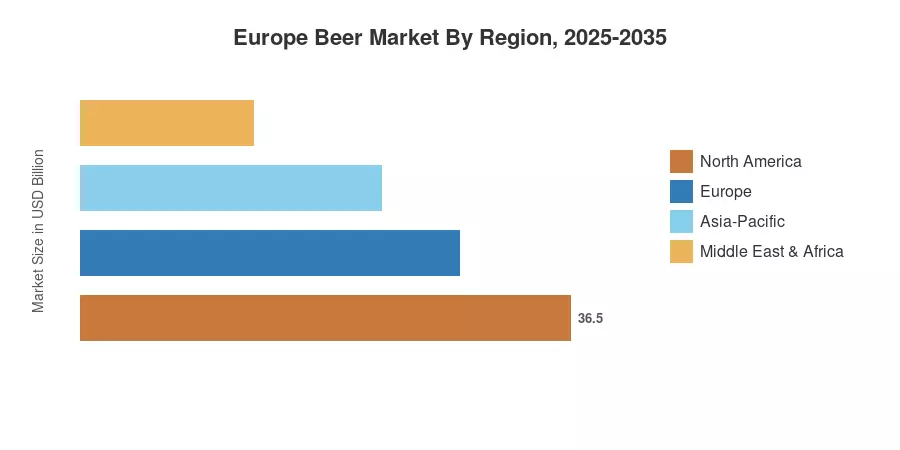
Europe Beer Market By Region, 2025-2035
Regional Market Share
 

Competitive Benchmarking

The Europe Beer Market is moderately concentrated, with the top five players accounting for an estimated 52-58% share of the market. The Herfindahl-Hirschman Index (HHI) is in the neighborhood of about 1,150 to 1,300, signaling a relatively competitive industry with the presence of international conglomerates as well as thousands of independent craft brewers. The battle for market share is rapidly moving to the balance sheet as companies try to balance the efficiency of their mass lager operations with the purchase of premium and non-alcohol brands.


Company Est. Revenue Share Range Key Offerings for Europe Beer Market Strategic Positioning
AB InBev ~14–18% Stella Artois, Leffe, Corona, Jupiler Global scale, premium portfolio migration
Heineken N.V. ~12–16% Heineken, Amstel, Birra Moretti, Heineken 0.0 Pan-European distribution, non-alcohol leadership
Carlsberg Group ~9–13% Carlsberg, Tuborg, 1664 Blanc, Brooklyn Northern/Eastern Europe stronghold, sustainability focus
Asahi Group (via Europe brands) ~5–8% Peroni Nastro Azzurro, Grolsch, Pilsner Urquell Super-premium positioning, Japanese brewing technology
Diageo (Guinness) ~4–6% Guinness, Hop House 13, Smithwick's Stout category dominance, UK/Ireland on-trade anchor
Molson Coors Europe ~3–5% Carling, Staropramen, Blue Moon Value lager + craft acquisition strategy
Radeberger Gruppe (Oetker) ~2–4% Radeberger, Jever, Schöfferhofer Germany lager beer market depth, regional heritage
Mahou San Miguel ~2–3% Mahou, San Miguel, Alhambra Spanish on-trade dominance, premium export push
Swinkels Family Brewers ~1–2% Bavaria, La Trappe, 8.6 Dutch craft heritage, non-alcoholic innovation
BrewDog PLC ~1–2% Punk IPA, Hazy Jane, BrewDog AF UK craft ale pub trend flagship, DTC pioneer


Recent News & Developments

  • AB InBev (March 2025): Announced EUR 1.2 billion investment in European brewery modernization, including AI-powered quality systems across 12 facilities, strengthening its Europe Beer Market production capacity [15].
  • Heineken N.V. (January 2021): Launched "EverGreen" circular packaging initiative targeting 100% recyclable or reusable packaging across all European brands by 2030, advancing sustainable practices within the Europe Beer Market [5].
  • Carlsberg Group (November 2024): Completed acquisition of Waterloo Brewing, a Canadian craft brewery based in Ontario


  • European Commission (September 2024): Published revised excise duty proposal under Directive 92/83/EEC review, proposing reduced rates for breweries under 100,000 hectoliters — a regulatory milestone for Europe beer excise tax regulation [2].
  • BrewDog PLC (June 2024): Opened its largest European brewery-restaurant in Berlin, seating 450 guests, expanding the UK craft ale pub trend model into the Germany lager beer market [17].
  • Asahi Group (March 2024): Invested EUR 85 Million in Pilsner Urquell's Plzeň brewery to increase premium lager output by 15%, targeting rising European premium beer consumption demand [18].
  • Diageo (December 2023): Launched Guinness 0.0 across 14 European markets simultaneously, the largest non-alcohol rollout in the company's history, responding to the moderation trend reshaping the Europe Beer Market [4].
  • Brewers of Europe (October 2023): Published data showing European brewery count exceeded 12,000 for the first time, confirming sustained European craft beer growth across the continent [3].


Europe Beer Market Report Scope

Parameter Detail
Market Scope Europe Beer Market — revenue and volume across all beer categories, packaging types, distribution channels, and product types
Study Period 2021–2035
CAGR 4.35% (2026–2035)
Market Size (2025) USD 289.47 Billion
Market Size (2035) USD 432.60 Billion
Fastest Growing Segments Ale (by product type); Premium (by category); Cans (by packaging); On-Trade (by distribution)
Companies Profiled AB InBev, Heineken, Carlsberg, Asahi Group, Diageo, Molson Coors, Radeberger Gruppe, Mahou San Miguel, Swinkels Family Brewers, BrewDog
Valuation Currency USD Billion


FAQs

How does Europe beer excise tax regulation affect cross-border trade in the Europe Beer Market?

High excise differentials drive significant cross-border beer purchases, particularly between high-tax Nordic regions and lower-duty neighboring states like Germany. This geographic distortion shifts localized retail volumes and creates complex compliance and volume-tracking challenges for brewers operating across multiple borders.


What role does the UK craft ale pub trend play in shaping Europe Beer Market on-trade margins?

UK craft ale pubs leverage specialty and independent drafts to generate higher value per pint compared to standard commercial lagers. This margin premium incentivizes publicans to allocate increasing tap space to craft lines, accelerating the overall premiumization trajectory of the regional on-trade channel.


How are European brewers addressing water scarcity risks in the Europe Beer Market?

Leading brewers are deploying closed-loop water systems that reduce consumption to 2.8 liters per liter of beer produced, down from 4.5 liters a decade ago [19]. Water stewardship certifications are becoming procurement prerequisites for major retailers sourcing from the Europe Beer Market.

What distinguishes the Germany lager beer market from other European lager segments?

Germany's traditional brewing framework heavily highlights the heritage of the Reinheitsgebot (Purity Law), which limits ingredients to water, malt, hops, and yeast. This historic positioning serves as a powerful marketing asset globally, helping German lager exports anchor an authentic, high-quality reputation in external markets.

How does European craft beer growth impact supply chain logistics for the Europe Beer Market?

Craft proliferation fragments distribution networks as localized microbreweries work outside of traditional multinational supply chains. Managing cold-chain infrastructure requirements and the high cost of last-mile delivery disproportionately challenge smaller, independent producers trying to scale regionally.


How is European premium beer consumption reshaping the Europe Beer Market's competitive dynamics?

Premium brands are capturing disproportionate share of voice through experiential marketing, taproom investments, and limited-edition releases [8]. This forces standard-segment brewers in the Europe Beer Market to either premiumize or accept margin compression as shelf space tilts toward higher-value products.


Author
Author
Author Profile
Varsha More LinkedIn
Senior Research Analyst
Experienced business professional with a demonstrated history of working in the CFnB industry. Skilled in market research, and market estimation. Strong professional with a Masters focused in marketing management.
Download Free Sample

Kindly complete the form below to receive a free sample of this Report













