Request Free Sample ×

Kindly complete the form below to receive a free sample of this Report

* Please use a valid business email

Leading companies partner with us for data-driven Insights

clients tt-cursor
Hero Background

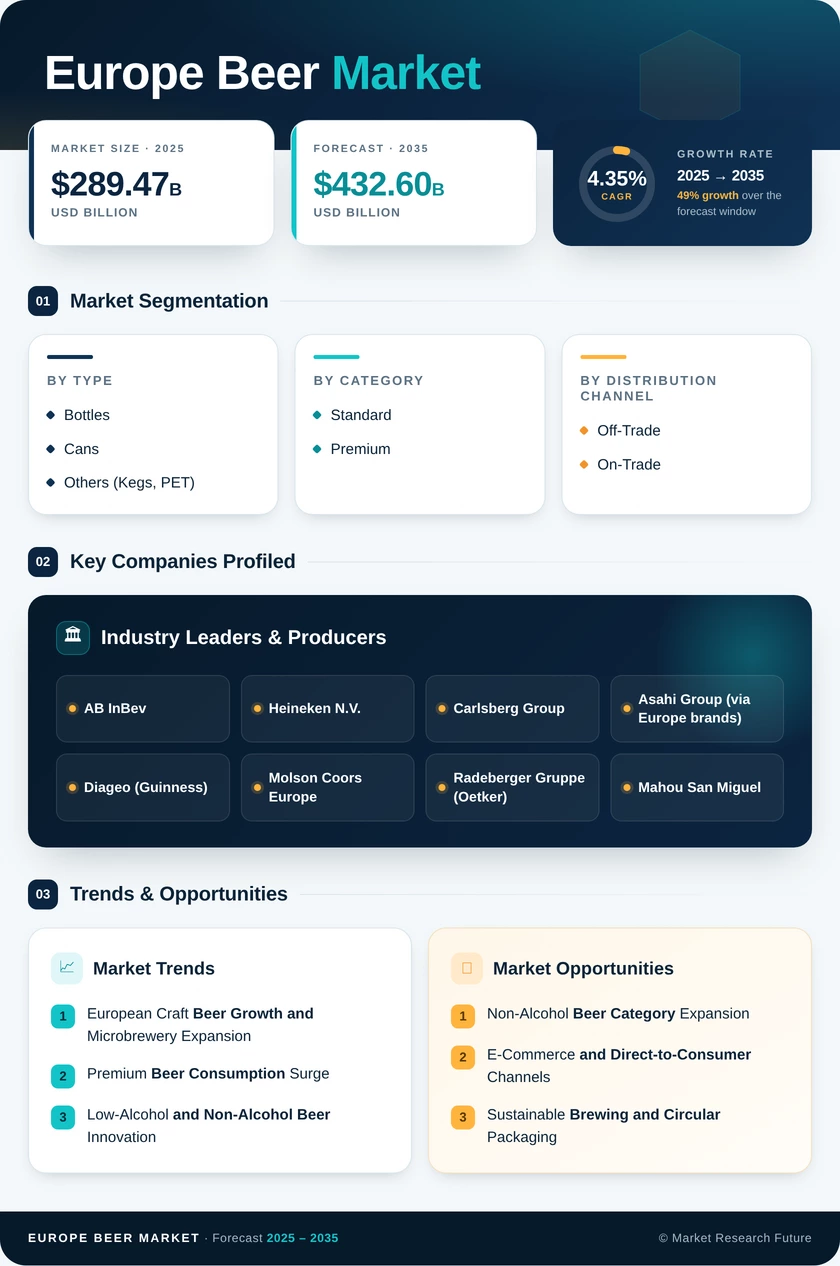
Europe Beer Market

ID: MRFR/FnB/20020-HCR
200 Pages
Varsha More
Last Updated: May 28, 2026
Europe Beer Market Size, Share, Industry Trend & Analysis Research Report By Product Type (Lager, Ale, Non/Low-Alcohol Beer, Others), Category (Standard, Premium), By Packaging Type (Bottles, Cans, Others), By Distribution Channel (Off-Trade, On-Trade), By Geography (Western Europe, Central Europe, Northern Europe, Southern Europe, Eastern Europe) -Forecast to 2035
Download PDF ×

We do not share your information with anyone. However, we may send you emails based on your report interest from time to time. You may contact us at any time to opt-out.

  1. 1 Market Overview |
    1. 1.1 Study Assumptions & Market Definition |
    2. 1.2 Scope of the Study |
    3. 1.3 Research Methodology
  2. 2 Market Summary & Key Takeaways
  3. 3 Market Dynamics |
    1. 3.1 Market Drivers Analysis | |
      1. 3.1.1 European Craft Beer Growth and Microbrewery Expansion | |
      2. 3.1.2 European Premium Beer Consumption Surge | |
      3. 3.1.3 Low-Alcohol and Non-Alcohol Beer Innovation | |
      4. 3.1.4 EU Excise Duty Reform Favoring Small Brewers | |
      5. 3.1.5 On-Trade Channel Recovery and Experiential Drinking | |
      6. 3.1.6 Recyclable Packaging and Sustainability Branding | |
      7. 3.1.7 E-Commerce and Direct-to-Consumer Beer Delivery |
    2. 3.2 Market Restraints Analysis | |
      1. 3.2.1 Europe Beer Excise Tax Regulation Burden | |
      2. 3.2.2 Volume Decline in Traditional Lager Segments | |
      3. 3.2.3 Input Cost Inflation (Barley, Energy, Glass) | |
      4. 3.2.4 Tightening Alcohol Advertising Restrictions | |
      5. 3.2.5 Competition from Wine, Spirits, and RTDs |
    3. 3.3 Market Opportunity Analysis | |
      1. 3.3.1 Non-Alcohol Beer Category Expansion | |
      2. 3.3.2 E-Commerce and Direct-to-Consumer Channels | |
      3. 3.3.3 Sustainable Brewing and Circular Packaging | |
      4. 3.3.4 Eastern European Craft Beer Emergence | |
      5. 3.3.5 Beer Tourism and Experiential On-Trade |
    4. 3.4 Industry Value Chain Analysis |
    5. 3.5 Porter's Five Forces Analysis
  4. 4 Europe Beer Market Size & Forecast (2021–2035) |
    1. 4.1 Historical Market Size (2021–2025) |
    2. 4.2 Current & Forecast Market Size (2026–2035) |
    3. 4.3 Market Size by Revenue (USD Billion) |
    4. 4.4 Year-over-Year Growth Analysis
  5. 5 Segmentation Analysis |
    1. 5.1 By Product Type | |
      1. 5.1.1 Lager | |
      2. 5.1.2 Ale | |
      3. 5.1.3 Non/Low-Alcohol Beer | |
      4. 5.1.4 Others (Stout, Wheat, Specialty) |
    2. 5.2 By Category | |
      1. 5.2.1 Standard | |
      2. 5.2.2 Premium |
    3. 5.3 By Packaging Type | |
      1. 5.3.1 Bottles | |
      2. 5.3.2 Cans | |
      3. 5.3.3 Others (Kegs, PET) |
    4. 5.4 By Distribution Channel | |
      1. 5.4.1 Off-Trade (Specialty/Liquor Stores and More) | |
      2. 5.4.2 On-Trade
  6. 6 Regional Analysis |
    1. 6.1 Western Europe | |
      1. 6.1.1 United Kingdom | |
      2. 6.1.2 France | |
      3. 6.1.3 Belgium | |
      4. 6.1.4 Netherlands |
    2. 6.2 Central Europe | |
      1. 6.2.1 Germany | |
      2. 6.2.2 Czech Republic | |
      3. 6.2.3 Austria |
    3. 6.3 Northern Europe | |
      1. 6.3.1 Nordic Countries | |
      2. 6.3.2 Denmark |
    4. 6.4 Southern Europe | |
      1. 6.4.1 Spain | |
      2. 6.4.2 Italy |
    5. 6.5 Eastern Europe | |
      1. 6.5.1 Poland | |
      2. 6.5.2 Romania | |
      3. 6.5.3 Russia
  7. 7 Competitive Landscape |
    1. 7.1 Market Share Analysis (2025) |
    2. 7.2 Competitive Benchmarking Matrix |
    3. 7.3 Company Profiles | |
      1. 7.3.1 AB InBev | |
      2. 7.3.2 Heineken N.V. | |
      3. 7.3.3 Carlsberg Group | |
      4. 7.3.4 Asahi Group | |
      5. 7.3.5 Diageo | |
      6. 7.3.6 Molson Coors Europe | |
      7. 7.3.7 Radeberger Gruppe | |
      8. 7.3.8 Mahou San Miguel | |
      9. 7.3.9 Swinkels Family Brewers | |
      10. 7.3.10 BrewDog PLC
  8. 8 Future Outlook & Strategic Recommendations (2026–2035) |
    1. 8.1 AI-Driven Brewing and Smart Fermentation |
    2. 8.2 Platform Economics and Beer-as-a-Service |
    3. 8.3 Sustainability and ESG Reporting Mandates |
    4. 8.4 Demographic Shifts and the Moderation Megatrend
  9. 9 Recent Developments & News
  10. 10 Frequently Asked Questions (FAQs)
  11. 11 Report Scope & Methodology |
    1. 11.1 Study Period & Base Year |
    2. 11.2 Data Sources & Citations |
    3. 11.3 Abbreviations
  12. 12 LIST OF TABLES |
  13. TABLE 1 Europe Beer Market Size & Forecast, by Revenue (USD Billion), 2021–2035 |
  14. TABLE 2 Europe Beer Market – Year-over-Year Growth Analysis, 2021–2035 |
  15. TABLE 3 Europe Beer Market – Driver Impact Analysis, 2026–2035 |
  16. TABLE 4 Europe Beer Market – Restraint Impact Analysis, 2026–2035 |
  17. TABLE 5 Europe Beer Market Size, by Product Type, 2021–2035 (USD Billion) |
  18. TABLE 6 Europe Beer Market Size, by Category, 2021–2035 (USD Billion) |
  19. TABLE 7 Europe Beer Market Size, by Packaging Type, 2021–2035 (USD Billion) |
  20. TABLE 8 Europe Beer Market Size, by Distribution Channel, 2021–2035 (USD Billion) |
  21. TABLE 9 Europe Beer Market Size, by Region, 2021–2035 (USD Billion) |
  22. TABLE 10 Western Europe Beer Market Size, by Country, 2021–2035 (USD Billion) |
  23. TABLE 11 Central Europe Beer Market Size, by Country, 2021–2035 (USD Billion) |
  24. TABLE 12 Northern Europe Beer Market Size, by Country, 2021–2035 (USD Billion) |
  25. TABLE 13 Southern Europe Beer Market Size, by Country, 2021–2035 (USD Billion) |
  26. TABLE 14 Eastern Europe Beer Market Size, by Country, 2021–2035 (USD Billion) |
  27. TABLE 15 Competitive Benchmarking Matrix – Europe Beer Market, 2025 |
  28. TABLE 16 Company Profiles – Key Players, Europe Beer Market |
  29. TABLE 17 Recent Developments & Strategic Announcements, 2023–2025 |
  30. TABLE 18 Report Scope & Methodology Summary |
  31. TABLE 19 Detailed Sources and Citations |
  32. TABLE 20 United Kingdom Beer Market Size, by Product Type, 2021–2035 (USD Billion) |
  33. TABLE 21 United Kingdom Beer Market Size, by Category, 2021–2035 (USD Billion) |
  34. TABLE 22 United Kingdom Beer Market Size, by Packaging Type, 2021–2035 (USD Billion) |
  35. TABLE 23 United Kingdom Beer Market Size, by Distribution Channel, 2021–2035 (USD Billion) |
  36. TABLE 24 Germany Beer Market Size, by Product Type, 2021–2035 (USD Billion) |
  37. TABLE 25 Germany Beer Market Size, by Category, 2021–2035 (USD Billion) |
  38. TABLE 26 Germany Beer Market Size, by Packaging Type, 2021–2035 (USD Billion) |
  39. TABLE 27 Germany Beer Market Size, by Distribution Channel, 2021–2035 (USD Billion) |
  40. TABLE 28 France Beer Market Size, by Product Type, 2021–2035 (USD Billion) |
  41. TABLE 29 France Beer Market Size, by Category, 2021–2035 (USD Billion) |
  42. TABLE 30 France Beer Market Size, by Packaging Type, 2021–2035 (USD Billion) |
  43. TABLE 31 France Beer Market Size, by Distribution Channel, 2021–2035 (USD Billion) |
  44. TABLE 32 Spain Beer Market Size, by Product Type, 2021–2035 (USD Billion) |
  45. TABLE 33 Spain Beer Market Size, by Category, 2021–2035 (USD Billion) |
  46. TABLE 34 Spain Beer Market Size, by Packaging Type, 2021–2035 (USD Billion) |
  47. TABLE 35 Spain Beer Market Size, by Distribution Channel, 2021–2035 (USD Billion) |
  48. TABLE 36 Italy Beer Market Size, by Product Type, 2021–2035 (USD Billion) |
  49. TABLE 37 Italy Beer Market Size, by Category, 2021–2035 (USD Billion) |
  50. TABLE 38 Italy Beer Market Size, by Packaging Type, 2021–2035 (USD Billion) |
  51. TABLE 39 Italy Beer Market Size, by Distribution Channel, 2021–2035 (USD Billion) |
  52. TABLE 40 Poland Beer Market Size, by Product Type, 2021–2035 (USD Billion) |
  53. TABLE 41 Poland Beer Market Size, by Category, 2021–2035 (USD Billion) |
  54. TABLE 42 Poland Beer Market Size, by Packaging Type, 2021–2035 (USD Billion) |
  55. TABLE 43 Poland Beer Market Size, by Distribution Channel, 2021–2035 (USD Billion)
  56. 13 LIST OF FIGURES |
  57. FIGURE 1 Europe Beer Market Dynamics — Drivers, Restraints & Opportunities |
  58. FIGURE 2 Industry Value Chain Analysis — Europe Beer Market |
  59. FIGURE 3 Porter's Five Forces Analysis — Europe Beer Market |
  60. FIGURE 4 Europe Beer Market Size Trend & Forecast (USD Billion), 2021–2035 |
  61. FIGURE 5 Europe Beer Market Share, by Product Type, 2025 (%) |
  62. FIGURE 6 Europe Beer Market Share, by Category, 2025 (%) |
  63. FIGURE 7 Europe Beer Market Share, by Packaging Type, 2025 (%) |
  64. FIGURE 8 Europe Beer Market Share, by Distribution Channel, 2025 (%) |
  65. FIGURE 9 Europe Beer Market Share, by Region, 2025 (%) |
  66. FIGURE 10 Western Europe Beer Market Share, by Country, 2025 (%) |
  67. FIGURE 11 Central Europe Beer Market Share, by Country, 2025 (%) |
  68. FIGURE 12 Northern Europe Beer Market Share, by Country, 2025 (%) |
  69. FIGURE 13 Southern Europe Beer Market Share, by Country, 2025 (%) |
  70. FIGURE 14 Eastern Europe Beer Market Share, by Country, 2025 (%) |
  71. FIGURE 15 Competitive Landscape — Europe Beer Market Revenue Share, 2025 (%) |
  72. FIGURE 16 Key Player Positioning Matrix — Europe Beer Market, 2025

Segmentation Quick Reference

DimensionSub-SegmentsDominant SegmentFastest Growing Segment
Product TypeLager, Ale, Non/Low-Alcohol Beer, OthersLagerAle
CategoryStandard, PremiumStandardPremium
Packaging TypeBottles, Cans, OthersBottlesCans
Distribution ChannelOff-Trade, On-TradeOff-TradeOn-Trade
GeographyWestern Europe, Central Europe, Northern Europe, Southern Europe, Eastern EuropeWestern EuropeEastern Europe


Market Segmentation Overview

By Product Type

Sub-SegmentKey Trend
LagerPremiumization of mainstream pilsner styles; German and Czech heritage positioning
AleUK craft ale pub trend driving IPA, pale ale, and Belgian-style growth.
Non/Low-Alcohol BeerHealth-conscious consumers and the EU Beating Cancer Plan are fueling category expansion.
Others (Stout, Wheat, Specialty)Seasonal demand cycles; stout growth led by Guinness 0.0 and craft variants


Lager's commanding share reflects generations of Central and Southern European drinking culture, though growth has plateaued in mature markets. Ale and non-alcohol segments are capturing incremental share through innovation and demographic shifts toward moderation.

By Category

Sub-SegmentKey Trend
StandardPrice-driven volume play; dominant in Eastern and Southern Europe
PremiumCraft positioning, experiential packaging, and higher revenue per hectoliter


Standard beer retains its volume leadership, but premium is the growth engine. European premium beer consumption is rising across all age groups, with consumers willing to pay more for provenance, flavor complexity, and sustainable production credentials.

By Packaging Type

Sub-SegmentKey Trend
BottlesDeposit-return systems in Germany and the Nordics sustain glass dominance
CansCraft adoption, portability, and EU recycling mandates are driving share gains.
Others (Kegs, PET)On-trade draft systems and outdoor event channels


Bottles benefit from Europe's mature recycling infrastructure, but cans are the standout growth story — lighter, more recyclable, and increasingly preferred by craft brewers seeking shelf differentiation.

By Distribution Channel

Sub-SegmentKey Trend
Off-TradeSupermarket private-label growth; e-commerce acceleration post-pandemic
On-TradePub and restaurant recovery; experiential consumption and premium draft offerings


Off-trade maintains its majority share through convenience and pricing advantages. On-trade recovery trajectory reflects consumers' desire for social drinking experiences, particularly within the UK craft ale pub trend ecosystem and Spain's tapas bar culture.