×
Request Free Sample ×

Kindly complete the form below to receive a free sample of this Report

* Please use a valid business email

Leading companies partner with us for data-driven Insights

clients tt-cursor
Hero Background

Healthcare CRM Market

ID: MRFR/HC/5855-CR
123 Pages
Rahul Gotadki
March 2020

Healthcare CRM Market Research Report By Application (Patient Management, Sales Management, Marketing Automation, Reporting and Analytics, Customer Service), By Deployment Mode (On-Premises, Cloud-Based, Hybrid), By End User (Healthcare Providers, Pharmaceutical Companies, Insurance Companies, Research Organizations), By Product Type (Software Solutions, Consulting Services, Integration Services) and By Regional (North America, Europe, South America, Asia Pacific, Middle East and Africa)- Forecast to 2035

Share:
Download PDF ×

We do not share your information with anyone. However, we may send you emails based on your report interest from time to time. You may contact us at any time to opt-out.

Healthcare CRM Market Infographic
Purchase Options

Healthcare CRM Market Summary

As per MRFR analysis, the Healthcare CRM Market Size was estimated at 17.38 USD Billion in 2024. The Healthcare CRM industry is projected to grow from 19.22 USD Billion in 2025 to 52.64 USD Billion by 2035, exhibiting a compound annual growth rate (CAGR) of 10.6 during the forecast period 2025 - 2035.

Key Market Trends & Highlights

The Healthcare CRM Market is experiencing a transformative shift towards personalized and technology-driven solutions.

  • Personalized patient engagement is becoming increasingly vital in enhancing patient satisfaction and outcomes.
  • The integration of advanced technologies, such as AI and machine learning, is reshaping healthcare CRM functionalities.
  • The market is witnessing a shift towards value-based care, emphasizing quality over quantity in patient services.
  • Rising demand for patient-centric solutions and technological advancements in healthcare are driving growth, particularly in North America and the Asia-Pacific region.

Market Size & Forecast

2024 Market Size 17.38 (USD Billion)
2035 Market Size 52.64 (USD Billion)
CAGR (2025 - 2035) 10.6%

Major Players

Salesforce (US), Microsoft (US), Oracle (US), SAP (DE), Cerner (US), Epic Systems (US), Allscripts (US), McKesson (US), Athenahealth (US), NextGen Healthcare (US)

Healthcare CRM Market Trends

The Healthcare CRM Market is currently experiencing a transformative phase, driven by the increasing need for personalized patient engagement and improved operational efficiency. Healthcare organizations are recognizing the value of customer relationship management systems in enhancing patient experiences, streamlining communication, and fostering loyalty. As technology continues to evolve, the integration of advanced analytics and artificial intelligence into CRM solutions appears to be reshaping how healthcare providers interact with patients. This shift not only facilitates better data management but also enables more informed decision-making, ultimately leading to improved health outcomes. Moreover, the growing emphasis on value-based care is likely to propel the demand for Healthcare CRM solutions. Providers are seeking tools that can help them track patient journeys, manage care transitions, and measure outcomes effectively. The focus on patient-centric approaches suggests that organizations are prioritizing tools that enhance engagement and satisfaction. As the market evolves, it seems that the adoption of mobile and cloud-based CRM solutions will further enhance accessibility and flexibility, allowing healthcare professionals to connect with patients in real-time, regardless of location. This trend indicates a promising future for the Healthcare CRM Market, as it adapts to the changing landscape of healthcare delivery.

Personalized Patient Engagement

The trend towards personalized patient engagement is becoming increasingly prominent within the Healthcare CRM Market. Organizations are leveraging CRM systems to tailor communication and services to individual patient needs, thereby enhancing satisfaction and loyalty. This approach not only improves patient experiences but also fosters stronger relationships between providers and patients.

Integration of Advanced Technologies

The integration of advanced technologies, such as artificial intelligence and data analytics, is reshaping the Healthcare CRM Market. These technologies enable healthcare providers to analyze patient data more effectively, leading to improved decision-making and operational efficiency. As a result, organizations are better equipped to meet the evolving demands of patient care.

Shift Towards Value-Based Care

The shift towards value-based care is influencing the Healthcare CRM Market significantly. Providers are increasingly adopting CRM solutions that facilitate tracking of patient outcomes and care transitions. This trend reflects a broader commitment to enhancing patient care quality and ensuring that healthcare services are aligned with patient needs.

Healthcare CRM Market Drivers

Market Growth Projections

The Global Healthcare CRM Market Industry is poised for substantial growth, with projections indicating a rise from 18.4 USD Billion in 2024 to 50.4 USD Billion by 2035. This growth trajectory suggests a compound annual growth rate of 9.57% from 2025 to 2035. Factors contributing to this expansion include the increasing demand for patient-centric care, advancements in technology, and the growing focus on healthcare analytics. As organizations continue to invest in CRM solutions that enhance patient engagement and streamline operations, the market is likely to witness significant developments in the coming years.

Expansion of Telehealth Services

The expansion of telehealth services is reshaping the Global Healthcare CRM Market Industry. As healthcare providers increasingly adopt telehealth solutions, the need for effective CRM systems to manage remote patient interactions becomes critical. These systems facilitate seamless communication, appointment scheduling, and follow-up care, ensuring that patients receive consistent support regardless of their location. The rise of telehealth is expected to contribute to the market's growth, with projections indicating a compound annual growth rate of 9.57% from 2025 to 2035. This trend highlights the necessity for CRM solutions that can adapt to the evolving landscape of healthcare delivery.

Growing Focus on Healthcare Analytics

The increasing emphasis on healthcare analytics is a significant driver of the Global Healthcare CRM Market Industry. Organizations are recognizing the value of data-driven insights to improve operational efficiency and patient care. CRM systems equipped with analytics capabilities enable healthcare providers to track patient interactions, identify trends, and make informed decisions. This analytical approach can lead to enhanced patient outcomes and optimized resource allocation. As the market evolves, the integration of advanced analytics into CRM solutions is likely to become a standard practice, further propelling market growth and innovation.

Rising Demand for Patient-Centric Care

The Global Healthcare CRM Market Industry is experiencing a notable shift towards patient-centric care, driven by the increasing expectation of personalized services from healthcare providers. Patients now seek tailored experiences that enhance their engagement and satisfaction. This trend is reflected in the growing adoption of CRM systems that facilitate better communication and relationship management between patients and providers. As healthcare organizations prioritize patient needs, the market is projected to reach 18.4 USD Billion in 2024, indicating a robust growth trajectory. The emphasis on patient-centricity is likely to continue shaping the landscape of healthcare CRM solutions.

Regulatory Compliance and Data Security

The Global Healthcare CRM Market Industry is heavily influenced by the need for regulatory compliance and data security. As healthcare organizations handle sensitive patient information, adherence to regulations such as HIPAA in the United States becomes paramount. CRM systems that incorporate robust security measures and compliance features are increasingly sought after. This focus on data protection not only mitigates risks but also builds trust with patients. Consequently, the demand for compliant CRM solutions is expected to drive market growth, as organizations prioritize secure systems to safeguard patient data while enhancing their service delivery.

Technological Advancements in CRM Solutions

Technological innovations play a pivotal role in the expansion of the Global Healthcare CRM Market Industry. The integration of artificial intelligence, machine learning, and data analytics into CRM systems enhances their functionality, enabling healthcare providers to deliver more efficient services. These advancements allow for improved patient data management, predictive analytics, and automated communication, which can lead to better patient outcomes. As organizations increasingly leverage these technologies, the market is expected to grow significantly, with projections indicating a rise to 50.4 USD Billion by 2035. This technological evolution is likely to redefine how healthcare providers interact with their patients.

Market Segment Insights

By Application: Patient Management (Largest) vs. Marketing Automation (Fastest-Growing)

In the Healthcare CRM Market, the application segment is dominated by Patient Management, which holds the largest market share. This is due to the increasing need for healthcare providers to effectively manage patient interactions and streamline processes to enhance care delivery. Other applications like Sales Management and Customer Service contribute significantly but are not as prevalent as Patient Management. On the other hand, Marketing Automation is rapidly gaining traction as healthcare organizations recognize the importance of targeting and engaging patients through personalized marketing efforts. The shift towards digital marketing strategies and the need to promote services in an increasingly competitive environment are driving the growth of Marketing Automation. Analytics also plays a supportive role by enabling data-driven decision-making in marketing efforts.

Patient Management (Dominant) vs. Analytics (Emerging)

Patient Management is the cornerstone of the Healthcare CRM Market, providing essential tools for scheduling, communication, and patient engagement which enhance overall patient experience. Its dominance is attributed to healthcare systems seeking to maintain robust relationships with their patients, ensuring follow-ups and improving care outcomes. On the other hand, Analytics is emerging as a critical component for healthcare organizations aiming to leverage data to optimize operations and identify trends. The growing emphasis on data-driven strategies in healthcare not only facilitates better patient insights but also supports predictive modeling and performance benchmarking. This rise in Analytics reflects the shift towards a more informed, data-centric approach within the healthcare sector.

By End Use: Hospitals (Largest) vs. Clinics (Fastest-Growing)

In the Healthcare CRM market, the distribution of end-use segments reveals that hospitals hold the largest share, significantly impacting the overall landscape. Clinics, while not as large as hospitals, are rapidly increasing their market presence, indicating a shift towards outpatient services and personalized patient management. Pharmaceutical companies and insurance providers also play crucial roles, but their shares are relatively smaller compared to hospitals and clinics.

Hospitals (Dominant) vs. Clinics (Emerging)

Hospitals represent the dominant end-use segment in the Healthcare CRM Market, characterized by substantial investments in technology to enhance patient engagement and streamline operations. Their comprehensive client management solutions cater to various healthcare services, making them integral to the ecosystem. On the other hand, clinics have emerged as a significant force due to the rising trend of outpatient care and the demand for efficient patient relationship management tools. This emergence is fueled by the need for enhanced communication and data handling capabilities, which drive clinics to adopt advanced CRM solutions and improve patient experiences.

By Deployment Type: Cloud-Based (Largest) vs. On-Premise (Fastest-Growing)

In the Healthcare CRM Market, deployment type segmentation reveals a compelling distribution of market shares among On-Premise, Cloud-Based, and Hybrid solutions. Currently, Cloud-Based deployment dominates the market, preferred for its scalability, cost-effectiveness, and accessibility. On-Premise systems, while traditionally favored for their control and security protocols, have seen a significant share that reflects the ongoing competition in the space. Hybrid models are also present but account for a smaller portion of the market. Growth trends in the Healthcare CRM segment indicate that Cloud-Based deployments continue to attract healthcare organizations seeking flexible solutions. The shift towards remote patient management and telehealth services has accelerated the adoption of Cloud-Based platforms. Conversely, On-Premise systems are experiencing rapid growth as organizations seek to maintain data security and compliance, while Hybrid solutions are emerging as a valuable compromise for businesses looking for both flexibility and control.

Cloud-Based (Dominant) vs. On-Premise (Emerging)

Cloud-Based CRM solutions have established themselves as the dominant force in the Healthcare CRM Market due to their ability to provide real-time data access and integration across various platforms. This deployment type caters to the growing demand for telehealth and remote assistance, offering healthcare providers a streamlined approach that enhances patient engagement and response times. On the other hand, On-Premise solutions, while seen as emerging in this dynamic landscape, still hold relevance for organizations focused on maintaining stringent data governance. They offer customizable configurations and compliance adherence but require significant investment in IT infrastructure. Each deployment type meets distinct needs within the healthcare ecosystem, highlighting the diverse approaches organizations are adopting to optimize patient care.

By Size of Organization: Large (Largest) vs. Small (Fastest-Growing)

In the Healthcare CRM Market, the distribution of market share among organizations based on size reveals that large organizations hold the majority share. They capitalize on their extensive resources to implement sophisticated CRM solutions, fostering better patient engagement and operational efficiency. In contrast, small organizations are gaining traction, driven by their agility and ability to adopt innovative CRM services tailored for specific needs. This dynamic shift highlights the increasing importance of personalized healthcare solutions, particularly for smaller entities looking to enhance patient relations.

Large Organizations: Dominant vs. Small Organizations: Emerging

Large organizations dominate the Healthcare CRM Market due to their substantial resources, established infrastructure, and established client base, enabling them to invest significantly in technology and client relationship management. Their sophisticated CRM platforms support extensive data analytics, improving patient engagement and operational efficiencies. In contrast, small organizations, though emerging, are quickly adapting to market demands by leveraging cloud-based CRM solutions that offer scalability and cost-effectiveness. With a focus on personalized care, these small entities are effectively meeting local market needs, gaining momentum as they adopt technologies that enhance patient relationship management.

By Functionality: Lead Management (Largest) vs. Reporting and Analytics (Fastest-Growing)

In the Healthcare CRM Market, Lead Management stands out as the largest segment, commanding a significant portion of the market share. This functionality received substantial investment due to its critical role in nurturing patient relationships and converting leads into loyal customers. Following closely, Reporting and Analytics is rapidly gaining traction as organizations increasingly recognize the value of data-driven decisions in enhancing patient care and operational efficiency. Growth trends indicate that Lead Management will maintain its lead in market presence, driven by the need for streamlined patient outreach and engagement. However, Reporting and Analytics is emerging as a powerful tool, with healthcare providers focusing on its capabilities to generate actionable insights. This shift is further supported by advancements in technology and the growing emphasis on personalized care, making these functionalities essential in the competitive landscape of healthcare.

Lead Management (Dominant) vs. Workflow Automation (Emerging)

Lead Management is classified as the dominant functionality within the Healthcare CRM Market due to its essential role in cultivating potential patient relationships and enhancing engagement strategies. Organizations leverage this segment to optimize lead recognition and improve conversion rates, ensuring sustainable growth. On the other hand, Workflow Automation is identified as an emerging segment that is significantly transforming operational efficiencies. This functionality streamlines administrative tasks and facilitates better resource allocation, which is crucial for healthcare providers facing increased pressure to enhance productivity. The integration of these two functionalities allows organizations to create a more cohesive approach to patient management, solidifying their competitive edge in a rapidly evolving market.

Get more detailed insights about Healthcare CRM Market

Regional Insights

North America : Market Leader in Healthcare CRM

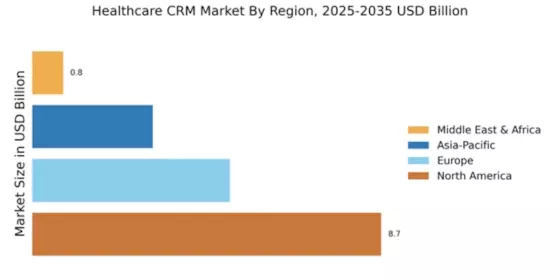
North America continues to lead the Healthcare CRM market, holding a significant share of 8.69 in 2024. The region's growth is driven by increasing demand for patient engagement solutions, regulatory support for digital health initiatives, and the rising adoption of cloud-based technologies. The focus on improving patient outcomes and operational efficiency further fuels market expansion. The competitive landscape is robust, with key players like Salesforce, Microsoft, and Oracle dominating the market. The U.S. remains the largest contributor, supported by a strong healthcare infrastructure and significant investments in technology. The presence of established firms and innovative startups enhances the region's market dynamics, ensuring continued growth and development.

Europe : Emerging Market with Growth Potential

Europe's Healthcare CRM market is poised for growth, with a market size of 4.92 in 2024. The region is witnessing an increase in demand for integrated healthcare solutions, driven by regulatory frameworks promoting digital transformation in healthcare. Initiatives aimed at enhancing patient care and data management are key growth catalysts. Leading countries such as Germany, the UK, and France are at the forefront of this transformation, with significant investments in healthcare technology. Major players like SAP and Oracle are expanding their presence, while local firms are innovating to meet specific regional needs. The competitive landscape is evolving, with a focus on interoperability and patient-centric solutions. The European Commission emphasizes the importance of digital health in its strategic plans.

Asia-Pacific : Rapidly Growing Healthcare Sector

The Asia-Pacific region is experiencing rapid growth in the Healthcare CRM market, with a size of 3.2 in 2024. Factors such as increasing healthcare expenditure, a growing aging population, and rising awareness of patient engagement are driving demand. Governments are also implementing policies to support digital health initiatives, further catalyzing market growth. Countries like China, India, and Japan are leading the charge, with significant investments in healthcare technology. The competitive landscape features both global players and local startups, fostering innovation and tailored solutions. As the region continues to embrace digital transformation, the Healthcare CRM market is expected to expand significantly, addressing unique regional challenges and opportunities.

Middle East and Africa : Emerging Market with Untapped Potential

The Middle East and Africa (MEA) region is gradually emerging in the Healthcare CRM market, with a size of 0.57 in 2024. The growth is driven by increasing healthcare investments, government initiatives to improve healthcare infrastructure, and a rising focus on patient engagement. Regulatory support for digital health solutions is also a significant catalyst for market development. Countries like the UAE and South Africa are leading the way, with investments in healthcare technology and digital solutions. The competitive landscape is characterized by a mix of international and local players, each aiming to capture the growing demand for CRM solutions. As healthcare systems evolve, the MEA region presents significant opportunities for growth and innovation in the Healthcare CRM market.

Key Players and Competitive Insights

The Healthcare CRM Market is currently characterized by a dynamic competitive landscape, driven by the increasing demand for patient-centric solutions and the integration of advanced technologies. Major players such as Salesforce (US), Microsoft (US), and Oracle (US) are strategically positioning themselves through innovation and partnerships, which collectively enhance their operational capabilities. Salesforce (US) focuses on leveraging its cloud-based solutions to improve patient engagement, while Microsoft (US) emphasizes its Azure platform to facilitate data interoperability across healthcare systems. Oracle (US) is enhancing its CRM offerings by integrating AI capabilities, thereby streamlining operations and improving decision-making processes.

The market structure appears moderately fragmented, with a mix of established players and emerging startups. Key business tactics include localizing services to meet regional healthcare needs and optimizing supply chains to ensure timely delivery of solutions. The collective influence of these major players shapes a competitive environment where agility and responsiveness to market demands are crucial for success.

In November 2025, Salesforce (US) announced a strategic partnership with a leading telehealth provider to enhance its CRM capabilities, enabling healthcare organizations to better manage patient interactions through integrated telehealth solutions. This move is significant as it aligns with the growing trend of remote patient management, positioning Salesforce (US) as a leader in providing comprehensive healthcare solutions that cater to evolving patient needs.

In October 2025, Microsoft (US) launched a new AI-driven analytics tool within its healthcare CRM suite, aimed at improving patient outcomes through predictive insights. This development underscores Microsoft's commitment to harnessing AI technology to enhance the effectiveness of healthcare delivery, potentially setting a new standard for data-driven decision-making in the industry.

In September 2025, Oracle (US) expanded its healthcare CRM offerings by acquiring a startup specializing in patient engagement technologies. This acquisition is likely to bolster Oracle's capabilities in delivering personalized patient experiences, reflecting a broader trend towards customization in healthcare services. Such strategic actions not only enhance Oracle's market position but also indicate a shift towards more integrated and user-friendly healthcare solutions.

As of December 2025, current competitive trends in the Healthcare CRM Market are heavily influenced by digitalization, sustainability, and the integration of AI technologies. Strategic alliances are increasingly shaping the landscape, as companies recognize the value of collaboration in driving innovation. The competitive differentiation is expected to evolve, moving away from traditional price-based competition towards a focus on technological advancements and supply chain reliability. This shift suggests that companies that prioritize innovation and adaptability will likely emerge as leaders in the market.

Key Companies in the Healthcare CRM Market market include

Industry Developments

The Global Healthcare CRM Market has seen significant developments recently, especially with major players like IBM, SAP, Salesforce, and Veeva Systems focusing on enhancing their customer engagement strategies. The increasing adoption of digital transformation in healthcare is driving the demand for CRM solutions that can streamline patient interactions and improve overall service delivery. Notably, Salesforce has been expanding its offerings tailored for healthcare providers, enhancing its market position. In terms of mergers and acquisitions, there were reports of acquisition activities among these companies, though specifics were not disclosed in recent months.

In the past couple of years, companies such as HubSpot and Oracle have reported substantial growth in their healthcare CRM segments, driven by the urgent need for efficient patient blood management systems amid the ongoing global health challenges. Furthermore, the pandemic has led to a heightened focus on integrating artificial intelligence and machine learning capabilities within CRM systems, enabling better data analytics for healthcare providers, thus directly impacting service efficiencies in the market. As of October 2023, these trends highlight a dynamic shift towards automation and enhanced patient relationship management in the healthcare industry globally.

Future Outlook

Healthcare CRM Market Future Outlook

The Healthcare CRM Market is projected to grow at a 10.6% CAGR from 2024 to 2035, driven by technological advancements, increasing patient engagement, and the need for streamlined operations.

New opportunities lie in:

  • Integration of AI-driven analytics for personalized patient engagement
  • Development of mobile CRM applications for real-time data access
  • Expansion of CRM solutions tailored for telehealth services

By 2035, the Healthcare CRM Market is expected to be robust, reflecting substantial growth and innovation.

Market Segmentation

Healthcare CRM Market End Use Outlook

  • Hospitals
  • Clinics
  • Pharmaceutical Companies
  • Insurance Providers

Healthcare CRM Market Application Outlook

  • Patient Management
  • Sales Management
  • Marketing Automation
  • Customer Service
  • Analytics

Healthcare CRM Market Functionality Outlook

  • Lead Management
  • Contact Management
  • Reporting and Analytics
  • Workflow Automation

Healthcare CRM Market Deployment Type Outlook

  • On-Premise
  • Cloud-Based
  • Hybrid

Healthcare CRM Market Size of Organization Outlook

  • Small
  • Medium
  • Large

Report Scope

MARKET SIZE 202417.38(USD Billion)
MARKET SIZE 202519.22(USD Billion)
MARKET SIZE 203552.64(USD Billion)
COMPOUND ANNUAL GROWTH RATE (CAGR)10.6% (2024 - 2035)
REPORT COVERAGERevenue Forecast, Competitive Landscape, Growth Factors, and Trends
BASE YEAR2024
Market Forecast Period2025 - 2035
Historical Data2019 - 2024
Market Forecast UnitsUSD Billion
Key Companies ProfiledSalesforce (US), Microsoft (US), Oracle (US), SAP (DE), Cerner (US), Epic Systems (US), Allscripts (US), McKesson (US), Athenahealth (US), NextGen Healthcare (US)
Segments CoveredApplication, End Use, Deployment Type, Size of Organization, Functionality
Key Market OpportunitiesIntegration of artificial intelligence enhances patient engagement in the Healthcare CRM Market.
Key Market DynamicsRising demand for personalized patient engagement drives innovation in Healthcare Customer Relationship Management solutions.
Countries CoveredNorth America, Europe, APAC, South America, MEA

Market Highlights

Author
Rahul Gotadki
Assistant Manager

He holds an experience of about 7+ years in Market Research and Business Consulting, working under the spectrum of Life Sciences and Healthcare domains. Rahul conceptualizes and implements a scalable business strategy and provides strategic leadership to the clients. His expertise lies in market estimation, competitive intelligence, pipeline analysis, customer assessment, etc. In addition to the above, his other responsibility includes strategic tracking of high growth markets & advising clients on the potential areas of focus they could direct their business initiatives

Leave a Comment

FAQs

What is the projected growth of the Healthcare CRM market?

The Healthcare CRM market is the expected increase in total market value of 52.64 USD billion over a defined forecast period 2025–2035. It is driven by factors such as demand trends, technological advances, regulatory changes, and geographic expansion.

What is the size of the Healthcare CRM market?

Healthcare CRM market size was valued at approximately 17.38 billion USD in 2024. This figure will reach 52.64 billion USD covering all regions (America, Europe, Asia, MEA and ROW), focusing its segments / services / distribution channels till 2035.

What is the CAGR of the Healthcare CRM market?

Healthcare CRM market is expected to grow at a CAGR of 10.6% between 2025 and 2035.

How much will the Healthcare CRM market be worth by 2035?

Healthcare CRM market is expected to be worth of 52.64 billion USD, reflecting growth driven by usage, technology and global demands by the end of 2035.

How will the Healthcare CRM market perform over the next 10 years?

Over the next 10 years the Healthcare CRM market is expected to shift from usd billion 17.38 to 52.64 billion USD, led by adoption of advanced tech, demographic trends, regulatory approvals, with potential headwinds from 2025 to 2035.

Which region is projected to hold the largest market share in the Global Healthcare CRM Market by 2035?

By 2035, North America is projected to hold the largest market share with a value of 20.2 USD Billion.

What is the projected market value of the Global Healthcare CRM Market in Europe by 2035?

The market value of the Global Healthcare CRM Market in Europe is expected to reach 13.5 USD Billion by 2035.

What are the values of key applications in the Global Healthcare CRM Market by 2035?

By 2035, Patient Management is valued at 15.15 USD Billion, Sales Management at 9.95 USD Billion, Marketing Automation at 7.85 USD Billion, Reporting and Analytics at 8.7 USD Billion, and Customer Service at 8.65 USD Billion.

What is the market value of the Global Healthcare CRM Market in the APAC region for the year 2024?

The market value of the Global Healthcare CRM Market in the APAC region is anticipated to be 4.0 USD Billion in 2024.

Which major players are dominating the Global Healthcare CRM Market?

Key players in the Global Healthcare CRM Market include IBM, SAP, Salesforce, Adobe, and Microsoft.

Download Free Sample

Kindly complete the form below to receive a free sample of this Report

Compare Licence

×
Features License Type
Single User Multiuser License Enterprise User
Price $4,950 $5,950 $7,250
Maximum User Access Limit 1 User Upto 10 Users Unrestricted Access Throughout the Organization
Free Customization
Direct Access to Analyst
Deliverable Format
Platform Access
Discount on Next Purchase 10% 15% 15%
Printable Versions