×
Request Free Sample ×

Kindly complete the form below to receive a free sample of this Report

* Please use a valid business email

Leading companies partner with us for data-driven Insights

clients tt-cursor
Hero Background

HVDC Converter Station Market

ID: MRFR/EnP/3045-HCR
110 Pages
Priya Nagrale
October 2025

HVDC Converter Station Market Research Report Information By Type (Monopolar, Bi-Polar, Back to Back, Multi-Terminal), By Converter Type (Line Commutated Current Sourced Converters (LCC), Voltage Source Converters), By Application (Power Industry, Powering Island and Remote Loads, Interconnecting Networks, Oil & Gas) And By Region (North America, Europe, Asia-Pacific, And Rest Of The World) –Market Forecast Till 2035

Share:
Download PDF ×

We do not share your information with anyone. However, we may send you emails based on your report interest from time to time. You may contact us at any time to opt-out.

HVDC Converter Station Market Infographic
Purchase Options

HVDC Converter Station Market Summary

As per MRFR analysis, the HVDC Converter Station Market Size was estimated at 6.1 USD Billion in 2024. The HVDC Converter Station industry is projected to grow from 6.34 in 2025 to 9.35 by 2035, exhibiting a compound annual growth rate (CAGR) of 3.96 during the forecast period 2025 - 2035.

Key Market Trends & Highlights

The HVDC Converter Station Market is poised for substantial growth driven by technological advancements and increasing integration of renewable energy sources.

  • North America remains the largest market for HVDC converter stations, driven by its extensive grid infrastructure.
  • Asia-Pacific is emerging as the fastest-growing region, fueled by rapid industrialization and energy demands.
  • The grid interconnection segment dominates the market, while the renewable energy integration segment is witnessing the fastest growth.
  • Key market drivers include the growing demand for efficient power transmission and increased investment in renewable energy projects.

Market Size & Forecast

2024 Market Size 6.1 (USD Billion)
2035 Market Size 9.35 (USD Billion)
CAGR (2025 - 2035) 3.96%

Major Players

Siemens (DE), ABB (CH), General Electric (US), Hitachi Energy (JP), Schneider Electric (FR), Mitsubishi Electric (JP), Toshiba (JP), Nexans (FR), Prysmian Group (IT)

HVDC Converter Station Market Trends

The HVDC Converter Station Market is currently experiencing a transformative phase, driven by the increasing demand for efficient power transmission and the integration of renewable energy sources. This market appears to be evolving in response to the global shift towards sustainable energy solutions, as HVDC technology offers advantages such as reduced transmission losses and enhanced grid stability. The growing emphasis on decarbonization and the need for reliable electricity supply are likely to propel investments in HVDC infrastructure, particularly in regions with high renewable energy potential. Furthermore, advancements in technology and the development of innovative converter designs may contribute to the market's expansion, as stakeholders seek to optimize performance and reduce costs. In addition, the HVDC Converter Station Market seems to be influenced by regulatory frameworks and government initiatives aimed at promoting clean energy. Policies that encourage the deployment of HVDC systems could foster collaboration among industry players, leading to strategic partnerships and joint ventures. As the market matures, it may witness increased competition, with various companies striving to differentiate their offerings through technological advancements and enhanced service capabilities. Overall, the HVDC Converter Station Market is poised for growth, driven by a confluence of factors that underscore the importance of efficient and sustainable power transmission.

Integration of Renewable Energy Sources

The HVDC Converter Station Market is increasingly aligning with the integration of renewable energy sources. As countries strive to meet ambitious climate goals, the demand for efficient transmission solutions that can accommodate variable energy generation is rising. HVDC technology facilitates the connection of remote renewable energy projects to urban centers, thereby enhancing grid reliability and supporting energy transition efforts.

Technological Advancements

Ongoing technological advancements in HVDC systems are shaping the market landscape. Innovations in converter technology, control systems, and materials are likely to improve efficiency and reduce operational costs. These developments may enable more flexible and reliable power transmission, making HVDC solutions more attractive to utilities and energy developers.

Regulatory Support and Policy Frameworks

The HVDC Converter Station Market appears to be significantly influenced by regulatory support and policy frameworks. Governments are increasingly recognizing the role of HVDC technology in achieving energy security and sustainability. Incentives and favorable regulations may encourage investments in HVDC infrastructure, fostering a conducive environment for market growth.

HVDC Converter Station Market Drivers

Market Growth Projections

The Global HVDC Converter Station Market Industry is projected to experience substantial growth over the coming years. With a market value of 6.1 USD Billion in 2024, it is anticipated to reach 9.36 USD Billion by 2035. This growth reflects a compound annual growth rate (CAGR) of 3.97% from 2025 to 2035, indicating a steady increase in demand for HVDC technology. Factors contributing to this growth include the rising need for efficient power transmission, the expansion of renewable energy sources, and supportive government policies. These projections highlight the market's potential and the critical role of HVDC systems in future energy infrastructure.

Government Initiatives and Policies

Government initiatives play a pivotal role in shaping the Global HVDC Converter Station Market Industry. Various nations are implementing policies that promote the adoption of HVDC technology as part of their energy transition strategies. For instance, incentives for renewable energy projects and funding for grid modernization are becoming increasingly common. These policies not only enhance the feasibility of HVDC projects but also stimulate investments in the sector. As a result, the market is expected to grow at a CAGR of 3.97% from 2025 to 2035, reflecting the positive impact of supportive regulatory frameworks on the industry.

Increasing Demand for Renewable Energy

The Global HVDC Converter Station Market Industry is experiencing a notable surge in demand driven by the transition towards renewable energy sources. As countries strive to meet their carbon reduction targets, the integration of wind and solar power into the grid becomes imperative. HVDC technology facilitates the efficient transmission of electricity over long distances, making it essential for connecting remote renewable energy sites to urban centers. This trend is reflected in the projected market value, which is anticipated to reach 6.1 USD Billion in 2024, indicating a robust growth trajectory as investments in renewable infrastructure continue to escalate.

Integration of Smart Grid Technologies

The integration of smart grid technologies is emerging as a key driver for the Global HVDC Converter Station Market Industry. Smart grids enable better management of electricity supply and demand, enhancing the efficiency of power systems. HVDC technology complements smart grid initiatives by facilitating the integration of distributed energy resources and improving grid resilience. The synergy between HVDC systems and smart grid technologies is likely to attract significant investments, as utilities seek to modernize their infrastructure. This trend is expected to support the market's growth trajectory, aligning with the broader shift towards more intelligent and responsive energy systems.

Technological Advancements in HVDC Systems

Technological advancements are significantly influencing the Global HVDC Converter Station Market Industry. Innovations in converter technology, control systems, and materials are enhancing the efficiency and reliability of HVDC systems. For example, developments in voltage source converter technology allow for more flexible and controllable power flow, which is crucial for modern power grids. These advancements not only improve operational performance but also reduce costs associated with HVDC installations. As a result, the market is poised for growth, with projections indicating a value of 9.36 USD Billion by 2035, underscoring the importance of continuous innovation in the sector.

Rising Urbanization and Electrification Needs

The Global HVDC Converter Station Market Industry is also driven by rising urbanization and the corresponding electrification needs. As urban populations expand, the demand for reliable and efficient power supply increases. HVDC technology offers a solution by enabling the transmission of large amounts of electricity over long distances with minimal losses. This capability is particularly vital for urban areas that require stable and uninterrupted power supply. The ongoing urbanization trends are expected to further fuel investments in HVDC infrastructure, thereby contributing to the overall market growth and enhancing energy security in densely populated regions.
Market Segment Insights

By Application: Grid Interconnection (Largest) vs. Renewable Energy Integration (Fastest-Growing)

In the HVDC Converter Station Market, Grid Interconnection currently holds the largest market share due to its critical role in enhancing the reliability and efficiency of power transmission. Following closely is Renewable Energy Integration, which is rapidly gaining traction as the world shifts towards sustainable energy sources. Other notable segments include Power Supply for Remote Areas, Voltage Source Converter, and Flexible AC Transmission Systems, each contributing to the diversified applications of HVDC technology in modern power grids.

Grid Interconnection (Dominant) vs. Renewable Energy Integration (Emerging)

Grid Interconnection serves as the backbone of HVDC technology, enabling different power systems to connect and operate seamlessly. Its dominance is rooted in the increasing need for resilient and efficient energy networks, especially in densely populated regions. Conversely, Renewable Energy Integration is on the rise as renewable sources like wind and solar become more prevalent. This segment emphasizes the need for adaptable systems that can manage intermittent energy supplies, providing market players with opportunities to innovate and develop advanced solutions tailored to changing energy demands.

By End Use: Utilities (Largest) vs. Industrial (Fastest-Growing)

The HVDC converter station market exhibits a diverse distribution across end-use segments, with Utilities leading the way. This segment accounts for a significant share of the market as HVDC technology plays a crucial role in modernizing power grids and enhancing transmission efficiency. The Industrial segment, while smaller in comparison, is rapidly growing as industries seek reliable and efficient power transmission solutions to meet their operational demands.

Utilities (Dominant) vs. Industrial (Emerging)

Utilities have established themselves as the dominant segment in the HVDC converter station market due to their need for efficient energy transmission over long distances. The adoption of HVDC technology in this sector enables better grid management and integration of renewable energy sources. On the other hand, the Industrial segment is emerging as a key player, driven by rising energy demands and a shift towards more sustainable practices. Industries are increasingly investing in HVDC systems to reduce transmission loss and optimize energy consumption, making them a fast-growing segment with promising potential.

By Technology: Voltage Source Converter (Largest) vs. Line Commutated Converter (Fastest-Growing)

In the HVDC Converter Station Market, the distribution of market share among various technologies reveals Voltage Source Converters (VSC) as the largest segment, primarily due to its flexibility and efficiency in modern power systems. Conversely, Line Commutated Converters (LCC), while traditionally dominant, are showing rapid growth as investments in high-capacity transmission projects rise. Both types of converters play integral roles, but VSC is capturing a larger portion of the market thanks to its adaptability in renewable energy applications. The growth trends in this market segment are driven by the increasing demand for efficient power transmission systems and the integration of renewable energy sources. The shift towards sustainable energy solutions has propelled VSCs, known for their compact size and advanced control capabilities. On the other hand, LCCs are witnessing renewed interest due to their cost-effectiveness over long-distance transmission. Multi-Terminal DC Systems and Hybrid DC Systems are emerging technologies, further promoting innovation and addressing diverse grid needs.

Technology: Voltage Source Converter (Dominant) vs. Line Commutated Converter (Emerging)

Voltage Source Converters (VSC) are currently the dominant technology in the HVDC Converter Station Market due to their versatility and efficiency. VSCs enable advanced grid functionalities and are particularly beneficial in integrating renewable sources like wind and solar power into the grid. Their capability to provide reactive power support enhances grid stability. In contrast, Line Commutated Converters (LCC), while historically significant, are emerging as a viable option for new projects, especially when considering long-distance power transmission. LCCs are generally preferred in bulk power transfer scenarios due to their robustness and lower operational costs. As technology evolves, both segment values may coexist, addressing a wider array of energy transmission requirements.

By Component: Transformers (Largest) vs. Control Systems (Fastest-Growing)

In the HVDC Converter Station Market, the component segment is primarily driven by the significant demand for transformers, which occupies the largest market share. Transformers facilitate efficient voltage conversion and ensure stable power transmission over long distances, making them essential in HVDC systems. Following closely are control systems, which have shown promising growth as operators seek enhanced reliability and flexibility in managing power flows. This dual focus on transformers and control systems illustrates the evolving dynamics of the market.

Control Systems (Dominant) vs. Cooling Systems (Emerging)

Control systems have emerged as a dominant force in the HVDC Converter Station Market due to their essential role in monitoring and managing system operations. With advancements in technology, these systems provide critical real-time data analysis and decision-making capabilities, contributing to the overall efficiency and reliability of HVDC installations. Conversely, cooling systems are positioned as an emerging segment, driven by the increasing need to maintain optimal operating temperatures under high load conditions. As HVDC technology continues to evolve, the integration of advanced cooling solutions will become crucial in enhancing performance and extending the lifespan of components.

By Installation Type: Onshore (Largest) vs. Offshore (Fastest-Growing)

The HVDC Converter Station Market showcases a diverse distribution among its installation types. Onshore installations currently dominate the market, primarily due to their cost-effectiveness and ease of access. They continue to retain the largest share over several years, driven by ongoing investments in land-based renewable energy projects. Conversely, offshore installations are experiencing rapid growth, fueled by advancements in technology and an increasing focus on minimizing land usage while harnessing wind and solar resources available in marine environments.

Onshore (Dominant) vs. Offshore (Emerging)

Onshore HVDC converter stations are recognized as the dominant installation type in the market, leveraging established infrastructure and streamlined project execution timelines. Their appeal lies in lower overall costs, accessibility, and the ability to easily integrate into existing electricity grids. Offshore installations, while currently in the emerging phase, are gaining momentum due to technological innovations and the global shift towards sustainable energy solutions. These installations, characterized by their challenging environments and higher initial investments, present a unique opportunity for growth, especially in regions with high offshore renewable potential.

Get more detailed insights about HVDC Converter Station Market

Regional Insights

North America : Established Energy Market

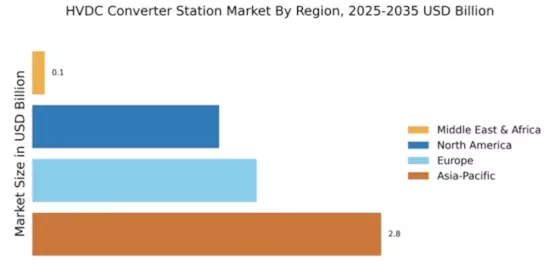
North America is witnessing steady growth in the HVDC converter station market, driven by increasing demand for efficient energy transmission and integration of renewable energy sources. The market size is projected at $1.5 billion by December 2025, reflecting a robust interest in modernizing the grid infrastructure. Regulatory support for clean energy initiatives is further catalyzing investments in HVDC technology, enhancing grid reliability and reducing transmission losses. The United States leads the North American market, with significant contributions from Canada. Key players such as General Electric and Siemens are actively involved in developing innovative HVDC solutions. The competitive landscape is characterized by strategic partnerships and technological advancements aimed at improving system efficiency. As the region focuses on sustainability, the demand for HVDC systems is expected to rise, positioning North America as a key player in the global market.

Europe : Innovative Energy Solutions

Europe is at the forefront of the HVDC converter station market, with a projected market size of $1.8 billion by December 2025. The region's commitment to renewable energy and stringent regulations on carbon emissions are driving the adoption of HVDC technology. Countries are increasingly investing in interconnectors to enhance energy security and facilitate cross-border electricity trade, contributing to the region's market growth. Germany, France, and the UK are leading the charge in HVDC deployment, supported by major players like ABB and Schneider Electric. The competitive landscape is marked by innovation and collaboration among industry stakeholders. As Europe aims for carbon neutrality, the demand for efficient energy transmission solutions will continue to rise, solidifying its position as a global leader in HVDC technology.

Asia-Pacific : Rapid Market Growth

Asia-Pacific is the largest market for HVDC converter stations, with a projected size of $2.8 billion by December 2025. The region's rapid urbanization and industrialization are driving the demand for efficient power transmission systems. Governments are increasingly investing in HVDC technology to support renewable energy integration and enhance grid stability, making it a key growth driver in the market. China and India are the leading countries in HVDC deployment, with significant contributions from companies like Hitachi Energy and Mitsubishi Electric. The competitive landscape is characterized by aggressive investments and technological advancements aimed at improving system performance. As the region continues to expand its energy infrastructure, the demand for HVDC solutions is expected to grow significantly, reinforcing Asia-Pacific's dominance in the global market.

Middle East and Africa : Emerging Energy Landscape

The HVDC converter station market in the Middle East and Africa is still in its nascent stages, with a market size of $0.1 billion projected by December 2025. The region is beginning to recognize the potential of HVDC technology for improving energy transmission efficiency and integrating renewable energy sources. Government initiatives aimed at enhancing energy infrastructure are expected to drive future growth in this sector. Countries like South Africa and the UAE are exploring HVDC solutions to address their energy challenges. The competitive landscape is evolving, with both local and international players looking to establish a foothold in this emerging market. As investments in renewable energy projects increase, the demand for HVDC technology is anticipated to rise, paving the way for future developments in the region.

Key Players and Competitive Insights

The HVDC Converter Station Market is currently characterized by a dynamic competitive landscape, driven by the increasing demand for efficient power transmission and the integration of renewable energy sources. Key players such as Siemens (DE), ABB (CH), and General Electric (US) are strategically positioned to leverage their technological expertise and extensive portfolios. Siemens (DE) focuses on innovation and digital transformation, aiming to enhance operational efficiency and reduce costs. ABB (CH) emphasizes partnerships and collaborations to expand its market reach, while General Electric (US) is investing in sustainable technologies to align with global energy transition goals. Collectively, these strategies contribute to a competitive environment that prioritizes technological advancement and sustainability.

In terms of business tactics, companies are increasingly localizing manufacturing to reduce lead times and optimize supply chains. The market structure appears moderately fragmented, with several key players holding substantial market shares. This fragmentation allows for a diverse range of offerings, yet the influence of major companies remains significant, shaping market trends and customer preferences.

In November 2025, ABB (CH) announced a strategic partnership with a leading renewable energy firm to develop integrated HVDC solutions aimed at enhancing grid stability. This collaboration is likely to bolster ABB's position in the market by combining its technological capabilities with renewable energy expertise, thereby addressing the growing need for reliable power transmission in renewable-heavy grids.

In October 2025, Siemens (DE) launched a new HVDC converter technology that promises to increase efficiency by 15% compared to previous models. This innovation not only reinforces Siemens' commitment to sustainability but also positions the company as a leader in the technological advancement of HVDC systems, potentially attracting new clients seeking cutting-edge solutions.

In September 2025, General Electric (US) completed the acquisition of a smaller firm specializing in HVDC technology, which is expected to enhance its product offerings and market presence. This acquisition reflects a broader trend of consolidation within the industry, as companies seek to strengthen their competitive edge through expanded capabilities and resources.

As of December 2025, the HVDC Converter Station Market is witnessing trends such as digitalization, sustainability, and the integration of AI technologies. Strategic alliances are increasingly shaping the competitive landscape, enabling companies to pool resources and expertise. Looking ahead, competitive differentiation is likely to evolve from traditional price-based competition to a focus on innovation, advanced technology, and supply chain reliability. This shift underscores the importance of adaptability and forward-thinking strategies in navigating the complexities of the energy market.

Key Companies in the HVDC Converter Station Market market include

Industry Developments

In January 2022, Acradis NV signed a USD 5.39 million contract with TenneT BV to design three converter stations in the Netherlands. The converter stations will mostly be used to convert direct current generated by the planned IJmuiden Ver offshore wind farm, which will be located roughly 62 kilometres off the west coast of the Netherlands.​

In December 2021, Samsung C&T Corporation awarded Hitachi Energy a contract to develop an HVDC converter station in the United Arab Emirates. The agreement is for the supply of four high-voltage direct current converter stations to connect Abu Dhabi National Oil Company's offshore operations to the onshore power system.

In December 2021, Taiwan Electricity Company has made an order with Mitsubishi Electric Corporation for an HVDC converter system for the Changuang offshore wind farm project. The effort aided in the integration of renewable energy sources into Taiwan's electrical grid.

Future Outlook

HVDC Converter Station Market Future Outlook

The HVDC Converter Station Market is projected to grow at a 3.96% CAGR from 2024 to 2035, driven by increasing demand for renewable energy integration and grid stability.

New opportunities lie in:

  • Development of modular HVDC systems for rapid deployment
  • Investment in advanced control technologies for enhanced efficiency
  • Expansion into emerging markets with aging grid infrastructure

By 2035, the HVDC Converter Station Market is expected to be robust, driven by technological advancements and increased global energy demands.

Market Segmentation

HVDC Converter Station Market End Use Outlook

  • Utilities
  • Industrial
  • Commercial
  • Residential

HVDC Converter Station Market Component Outlook

  • Transformers
  • Switchgear
  • Control Systems
  • Cooling Systems

HVDC Converter Station Market Technology Outlook

  • Line Commutated Converter
  • Voltage Source Converter
  • Multi-Terminal DC Systems
  • Hybrid DC Systems

HVDC Converter Station Market Application Outlook

  • Grid Interconnection
  • Renewable Energy Integration
  • Power Supply for Remote Areas
  • Voltage Source Converter
  • Flexible AC Transmission System

HVDC Converter Station Market Installation Type Outlook

  • Onshore
  • Offshore
  • Underground
  • Above Ground

Report Scope

MARKET SIZE 20246.1(USD Billion)
MARKET SIZE 20256.34(USD Billion)
MARKET SIZE 20359.35(USD Billion)
COMPOUND ANNUAL GROWTH RATE (CAGR)3.96% (2024 - 2035)
REPORT COVERAGERevenue Forecast, Competitive Landscape, Growth Factors, and Trends
BASE YEAR2024
Market Forecast Period2025 - 2035
Historical Data2019 - 2024
Market Forecast UnitsUSD Billion
Key Companies ProfiledSiemens (DE), ABB (CH), General Electric (US), Hitachi Energy (JP), Schneider Electric (FR), Mitsubishi Electric (JP), Toshiba (JP), Nexans (FR), Prysmian Group (IT)
Segments CoveredApplication, End Use, Technology, Component, Installation Type
Key Market OpportunitiesIntegration of renewable energy sources drives demand for advanced HVDC Converter Station technology.
Key Market DynamicsRising demand for renewable energy sources drives innovation and investment in HVDC converter station technologies.
Countries CoveredNorth America, Europe, APAC, South America, MEA

Market Highlights

Author
Priya Nagrale
Senior Research Analyst

With an experience of over five years in market research industry (Chemicals & Materials domain), I gather and analyze market data from diverse sources to produce results, which are then presented back to a client. Also, provide recommendations based on the findings. As a Senior Research Analyst, I perform quality checks (QC) for market estimations, QC for reports, and handle queries and work extensively on client customizations. Also, handle the responsibilities of client proposals, report planning, report finalization, and execution

Leave a Comment

FAQs

How much is the HVDC Converter Station Market?

The HVDC Converter Station Market size was valued at USD 6.10 Billion in 2024.

What is the growth rate of the HVDC Converter Station Market?

The market is projected to grow at a CAGR of 3.96% during the forecast period, 2025-2034.

Which region held the largest market share in the HVDC Converter Station Market?

Europe had the largest share in the market

Who are the key players in the HVDC Converter Station Market?

The key players in the market are Siemens AG (Germany), Crompton Greaves Ltd. (India), General Electric (U.S.), Nissin Electric Co Ltd (Japan), Toshiba Corporation (Japan and Hitachi Ltd. (Japan).

Which type led the HVDC Converter Station Market?

The bipolar category dominated the market in 2022.

Which converter type had the largest market share in the HVDC Converter Station Market?

The voltage source converters had the largest share in the market.

Download Free Sample

Kindly complete the form below to receive a free sample of this Report

Compare Licence

×
Features License Type
Single User Multiuser License Enterprise User
Price $4,950 $5,950 $7,250
Maximum User Access Limit 1 User Upto 10 Users Unrestricted Access Throughout the Organization
Free Customization
Direct Access to Analyst
Deliverable Format
Platform Access
Discount on Next Purchase 10% 15% 15%
Printable Versions