Download Free Sample
Kindly complete the form below to receive a free sample of this Report
Italy Artificial Tears Market Research Report: Size, Share, Trend Analysis By Types (Polyethylene Glycol, Propylene Glycol, Cellulose, Glycerin, Others), By Delivery Mode (Eye Drops, Ointments, Sprays), By Applications (Dry Eye Syndrome, Allergies, Infections, Others), and By Distribution Channel (Hospital Pharmacies, Drug Stores, Retail Pharmacies, Online Pharmacies) - Growth Outlook & Industry Forecast 2025 To 2035
As per Market Research Future analysis, the Italy Artificial Tears Market size was estimated at 105.1 USD Million in 2024. The Artificial Tears market is projected to grow from 112.47 USD Million in 2025 to 221.44 USD Million by 2035, exhibiting a compound annual growth rate (CAGR) of 7.0% during the forecast period 2025 - 2035
The Italy artificial tears market is experiencing a notable shift towards advanced formulations and increased accessibility.
| 2024 Market Size | 105.1 (USD Million) |
| 2035 Market Size | 221.44 (USD Million) |
| CAGR (2025 - 2035) | 7.01% |
Allergan (US), Santen Pharmaceutical (JP), Bausch Health (CA), Novartis (CH), Johnson & Johnson (US), Alcon (CH), Ocular Therapeutix (US), Eyevance Pharmaceuticals (US)
Our Impact
Enabled $4.3B Revenue Impact for Fortune 500 and Leading Multinationals
Partnering with 2000+ Global Organizations Each Year
30K+ Citations by Top-Tier Firms in the Industry
The Italy Artificial Tears Market is experiencing notable growth. This growth is driven by an increasing prevalence of dry eye conditions among the population. Factors such as environmental changes, prolonged screen time, and an aging demographic contribute to the rising demand for these products. As consumers become more aware of eye health, the market is witnessing a shift towards more advanced formulations that offer longer-lasting relief and enhanced comfort. This trend is further supported by the growing availability of over-the-counter options, making artificial tears more accessible to a wider audience. In addition, the regulatory landscape in Italy appears to be evolving, with authorities focusing on ensuring product safety and efficacy. This regulatory scrutiny may lead to the introduction of innovative products that meet higher standards. Furthermore, the increasing emphasis on natural ingredients in formulations suggests a potential shift in consumer preferences towards products perceived as safer and more effective. Overall, the artificial tears market is poised for continued expansion, reflecting broader trends in health and wellness, as well as advancements in product development.
There is a noticeable trend towards the development of advanced artificial tears that provide longer-lasting relief. These formulations often incorporate innovative ingredients aimed at enhancing comfort and effectiveness, catering to the needs of consumers seeking improved eye care solutions.
The availability of artificial tears in pharmacies and retail outlets has expanded significantly. This trend indicates a shift towards greater consumer accessibility, allowing individuals to easily obtain products without the need for prescriptions, thereby promoting proactive eye health management.
A growing preference for products containing natural ingredients is emerging within the artificial tears market. Consumers are increasingly inclined to choose formulations perceived as safer and more aligned with their health-conscious lifestyles, prompting manufacturers to adapt their offerings accordingly.
The aging population in Italy is a crucial driver for the artificial tears market. As individuals age, they often experience dry eye syndrome and other ocular conditions, leading to an increased demand for artificial tears. According to recent statistics, approximately 25% of the Italian population is over 65 years old, a demographic that is particularly susceptible to eye-related issues. This trend suggests that the artificial tears market will likely see a significant uptick in sales as more elderly individuals seek relief from dry eyes. Furthermore, the healthcare system in Italy is increasingly recognizing the importance of eye care, which may lead to more prescriptions and recommendations for artificial tears. Consequently, the growing aging population is expected to play a pivotal role in shaping the future of the artificial tears market in Italy.
The growing emphasis on preventive eye care in Italy is emerging as a vital driver for the artificial tears market. Healthcare professionals are increasingly advocating for proactive measures to maintain eye health, particularly among individuals at risk of developing dry eye syndrome. This focus on prevention is encouraging consumers to incorporate artificial tears into their daily routines as a means of safeguarding their ocular health. Recent surveys indicate that nearly 40% of Italians are now using artificial tears as a preventive measure, reflecting a shift in consumer attitudes towards eye care. As awareness of the benefits of preventive eye care continues to rise, the artificial tears market is expected to expand, driven by a more health-conscious population.
There is a notable increase in awareness regarding eye health among the Italian population, which serves as a significant driver for the artificial tears market. Educational campaigns and healthcare initiatives have been implemented to inform citizens about the importance of maintaining eye health, particularly in relation to dry eye conditions. This heightened awareness appears to correlate with a growing willingness to invest in eye care products, including artificial tears. Market data indicates that sales of artificial tears have risen by approximately 15% in the past year, reflecting this trend. As consumers become more informed about the symptoms and treatments for dry eyes, the demand for artificial tears is likely to continue its upward trajectory. This shift in consumer behavior is expected to have a lasting impact on the artificial tears market in Italy.
Technological advancements in the formulation of artificial tears are driving innovation within the artificial tears market. Manufacturers are increasingly focusing on developing products that offer longer-lasting relief and improved comfort for users. For instance, the introduction of preservative-free formulations and enhanced viscosity agents has made artificial tears more effective and appealing to consumers. In Italy, the market for advanced formulations is projected to grow by 20% over the next five years, as consumers seek out products that provide superior hydration and comfort. This trend indicates that ongoing research and development in the field of ophthalmic solutions will likely continue to shape the artificial tears market, leading to a wider variety of options for consumers.
The availability of over-the-counter (OTC) artificial tears is another significant driver for the market in Italy. With the easing of regulations surrounding the sale of eye care products, consumers now have greater access to a variety of artificial tears without the need for a prescription. This shift has made it easier for individuals experiencing dry eye symptoms to find suitable relief quickly. Market analysis suggests that the OTC segment of the artificial tears market has expanded by approximately 30% in the last year, indicating a strong consumer preference for accessible solutions. As pharmacies and retail outlets continue to stock a diverse range of artificial tears, the market is likely to experience sustained growth, catering to the needs of a broader audience.
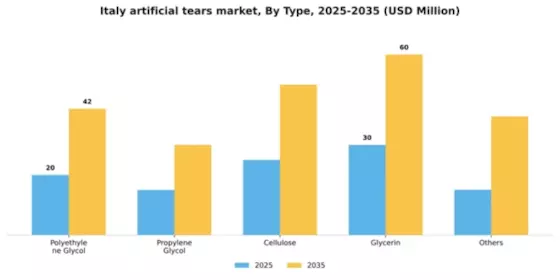
In the Italy artificial tears market, the segment distribution shows that Polyethylene Glycol remains the largest contributor to market share, driven by its widespread acceptance for its lubricating properties and effectiveness in treating dry eye symptoms. Other components like Propylene Glycol and Cellulose also hold significant shares, yet they lag behind Polyethylene Glycol in terms of consumer preference and recognition within the market. The growth trends indicate that Glycerin is emerging as the fastest-growing segment, primarily due to its superior moisturizing capabilities and efficacy in providing relief from dry eye discomfort. Increased awareness about eye health and advancements in product formulations contribute to this growth. Additionally, the rise in contact lens usage is further accelerating demand for artificial tears containing Glycerin, making it a segment to watch in the coming years.
Polyethylene Glycol (Dominant) vs. Glycerin (Emerging)
Polyethylene Glycol is a dominant player in the Italy artificial tears market, known for its high efficiency in providing lubrication and comfort for dry eyes. Its composition allows for prolonged retention in the ocular surface, making it a preferred choice among consumers and healthcare professionals. In contrast, Glycerin, while currently labeled as an emerging segment, showcases rapid growth due to its exceptional hydrating properties. It efficiently alleviates dryness while promoting eye health, resulting in increased adoption. The product formulations incorporating Glycerin are now being hailed for their effectiveness, and this trend is expected to continue as consumers seek more effective solutions in the artificial tears market.
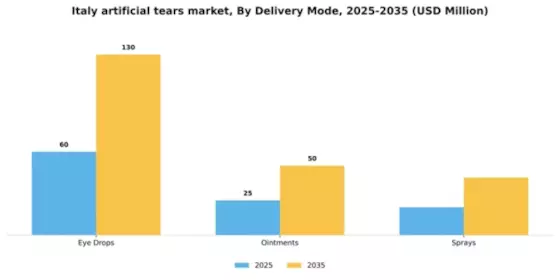
In the Italy artificial tears market, the delivery mode segment is primarily dominated by eye drops, which command a significant share owing to their convenience and widespread acceptance among consumers. Ointments, while beneficial for their longer-lasting effects, hold a smaller market presence compared to the more popular eye drops. Sprays have emerged recently, attracting attention as they offer an innovative and user-friendly alternative, contributing to a growing niche within the segment. The growth trends within the delivery mode segment are heavily driven by increasing awareness of eye health and the rising incidence of dry eye conditions. The convenience of eye drops ensures their dominance, while sprays are experiencing rapid growth due to their ease of application and effectiveness. As consumers seek more user-friendly products, sprays are expected to capture a larger market share in the coming years, supported by evolving preferences and innovative product launches.
Ointments (Dominant) vs. Sprays (Emerging)
Ointments, although facing stiff competition, remain a dominant player in the Italy artificial tears market due to their unique advantages in providing sustained relief for dry eye symptoms, particularly during nighttime use. Their thicker consistency offers prolonged moisture retention, making them a preferred choice for patients with chronic dry eye conditions. On the other hand, sprays are emerging as an innovative delivery method, catering to the needs of consumers looking for quick and hassle-free solutions. These products appeal to a younger demographic that values convenience and speed in their healthcare routines. As consumer preferences continue to evolve, both ointments and sprays will play crucial roles in addressing distinct patient needs.
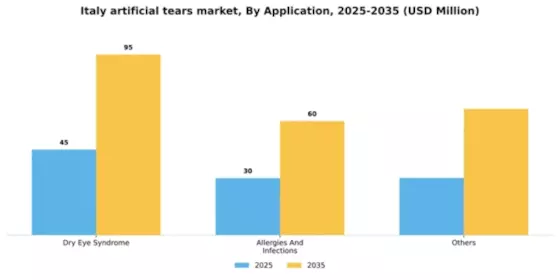
In the Italy artificial tears market, the distribution of market share reveals that Dry Eye Syndrome is currently the largest segment, reflecting a growing awareness and prevalence of this condition among the population. Meanwhile, Allergies and Infections are gaining traction, attracting attention due to their increased incidence, especially during seasonal changes, contributing to a shift in consumer preferences and demand for targeted artificial tears products. Growth trends are notably propelled by a rising aging population, which often experiences dry eye symptoms, alongside a surge in allergenic conditions exacerbated by environmental factors. The market is also benefiting from advancements in formulation technologies that enhance product efficacy and usability, thereby expanding the consumer base and driving sales, especially within the Allergies and Infections segment, which is emerging as a key player in the market.
Dry Eye Syndrome (Dominant) vs. Allergies And Infections (Emerging)
The Dry Eye Syndrome segment is characterized by its significant consumer base, driven by factors such as prolonged digital device usage and increased screen time, leading to higher instances of eye discomfort. This segment benefits from established brand loyalty and extensive product offerings tailored for various severity levels. Conversely, the Allergies and Infections segment is positioned as an emerging focus area, capturing the interest of healthcare providers and consumers alike. This growth is supported by a greater awareness of environmental allergens and their impact on eye health, leading to innovation in formulations aimed at providing quick relief and enhancing comfort. As consumers increasingly seek targeted solutions, the market dynamics favor both segments, highlighting Dry Eye Syndrome as the dominant market force while Allergies and Infections rapidly gain consumer attention.
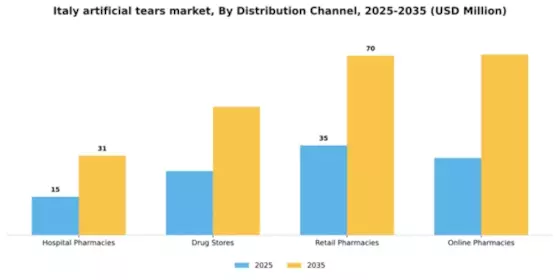
In the Italy artificial tears market, the distribution among various channels reveals that Retail Pharmacies hold the largest market share, catering to a broad segment of consumers seeking immediate access to artificial tear products. Hospital Pharmacies and Drug Stores follow in market presence, providing specialized options based on patient needs. Meanwhile, Online Pharmacies, while currently smaller in share, are rapidly gaining traction due to changing consumer purchasing habits, making them a significant channel to watch. The growth trends within these distribution channels are influenced by various factors. Retail Pharmacies continue to thrive as they offer convenience and valuable face-to-face interaction with pharmacists. Online Pharmacies, however, demonstrate the fastest growth due to their accessibility and the increasing acceptance of e-commerce in healthcare. This shift is driven by a growing preference among consumers for easy ordering, home delivery, and discreet purchasing options, suggesting a promising future for online sales of artificial tears.
Retail Pharmacies (Dominant) vs. Online Pharmacies (Emerging)
Retail Pharmacies serve as the dominant distribution channel in the Italy artificial tears market, characterized by their extensive reach and ability to provide immediate solutions to consumers. These pharmacies are well-equipped with knowledgeable staff, facilitating customer inquiries and promoting trusted brands. They create a strong community presence and are often the first point of contact for consumers seeking remedies for dry eyes. On the other hand, Online Pharmacies are emerging as a compelling alternative, attracting tech-savvy consumers who appreciate the convenience of online shopping. These platforms are rapidly enhancing their offerings, focusing on user-friendly interfaces and efficient delivery systems, appealing particularly to younger demographics who prefer online purchases, thereby reshaping the competitive landscape.
Get more detailed insights about Italy Artificial Tears Market Request Free Sample
The artificial tears market in Italy is characterized by a competitive landscape that is increasingly shaped by innovation, strategic partnerships, and a focus on patient-centric solutions. Key players such as Allergan (US), Santen Pharmaceutical (JP), and Bausch Health (CA) are actively engaged in enhancing their product offerings and expanding their market presence. Allergan (US) has positioned itself as a leader through continuous innovation in its product line, particularly with its flagship product, Restasis, which has seen recent enhancements aimed at improving patient compliance. Meanwhile, Santen Pharmaceutical (JP) emphasizes its commitment to research and development, focusing on novel formulations that cater to specific ocular conditions, thereby differentiating itself in a crowded market. Bausch Health (CA) has adopted a strategy of regional expansion, particularly in southern Europe, to capitalize on the growing demand for artificial tears, which is driven by an aging population and increasing screen time among younger demographics.The business tactics employed by these companies reflect a nuanced understanding of the market's structure, which is moderately fragmented yet dominated by a few key players. Localizing manufacturing and optimizing supply chains have become essential strategies to enhance operational efficiency and reduce costs. This competitive structure allows for a diverse range of products, catering to various consumer needs while fostering a dynamic environment where innovation can thrive.
In October Allergan (US) announced a strategic partnership with a leading telehealth provider to enhance patient access to its artificial tears products. This move is significant as it aligns with the growing trend of digital health solutions, enabling patients to receive prescriptions and consultations remotely, thus potentially increasing market penetration. The partnership not only broadens Allergan's distribution channels but also reinforces its commitment to patient-centric care.
In September Santen Pharmaceutical (JP) launched a new line of preservative-free artificial tears, targeting patients with sensitive eyes. This product introduction is particularly noteworthy as it addresses a critical gap in the market, catering to the increasing demand for preservative-free options among consumers. The strategic importance of this launch lies in Santen's ability to leverage its research capabilities to meet evolving consumer preferences, thereby enhancing its competitive edge.
In August Bausch Health (CA) completed the acquisition of a smaller competitor specializing in innovative ocular therapies. This acquisition is indicative of Bausch's strategy to bolster its product portfolio and expand its market share in the artificial tears segment. By integrating new technologies and formulations, Bausch Health aims to enhance its competitive positioning and respond more effectively to market demands.
As of November the competitive trends in the artificial tears market are increasingly influenced by digitalization, sustainability, and the integration of artificial intelligence in product development. Strategic alliances are becoming more prevalent, allowing companies to pool resources and expertise to drive innovation. The competitive differentiation is likely to evolve from traditional price-based competition towards a focus on technological advancements, product efficacy, and supply chain reliability. This shift suggests that companies that prioritize innovation and patient engagement will be better positioned to thrive in the future.

Recent developments in the Italy Artificial Tears Market have been marked by the increasing demand for innovative eye care solutions. Notably, Allergan continues to expand its product offerings, while Santen Pharmaceutical has emphasized R&D in unique formulations targeting dry-eye syndromes.
In October 2023, Eton Pharmaceuticals announced a collaboration aimed at enhancing access to its proprietary artificial tear products across Italy. Furthermore, in September 2023, Bausch Health initiated a strategic review of its eye health division, potentially influencing investment trends in the Italian market.
Mergers and acquisitions are also a significant trend, with Recipharm and Alcon discussing synergies to enhance manufacturing capabilities, officially confirmed in August 2023. AbbVie’s acquisition of Allergan in 2020 has continued to reverberate through the market, impacting product availability and pricing strategies.
The market valuation for companies like Eyevance Pharmaceuticals has shown substantial growth, driven by rising consumer awareness of eye health, further fueled by digital engagement strategies. Over the past two years, the Italian Regulatory Authority has emphasized stricter guidelines for artificial tear formulations, impacting the regulatory landscape and future product launches.
The Artificial Tears Market is projected to grow at 7.01% CAGR from 2025 to 2035, driven by increasing prevalence of dry eye conditions and advancements in formulation technologies.
New opportunities lie in:
By 2035, the market is expected to achieve substantial growth, reflecting evolving consumer needs and innovative solutions.
| MARKET SIZE 2024 | 105.1(USD Million) |
| MARKET SIZE 2025 | 112.47(USD Million) |
| MARKET SIZE 2035 | 221.44(USD Million) |
| COMPOUND ANNUAL GROWTH RATE (CAGR) | 7.01% (2025 - 2035) |
| REPORT COVERAGE | Revenue Forecast, Competitive Landscape, Growth Factors, and Trends |
| BASE YEAR | 2024 |
| Market Forecast Period | 2025 - 2035 |
| Historical Data | 2019 - 2024 |
| Market Forecast Units | USD Million |
| Key Companies Profiled | Allergan (US), Santen Pharmaceutical (JP), Bausch Health (CA), Novartis (CH), Johnson & Johnson (US), Alcon (CH), Ocular Therapeutix (US), Eyevance Pharmaceuticals (US) |
| Segments Covered | Type, Delivery Mode, Application, Distribution Channel |
| Key Market Opportunities | Growing demand for preservative-free formulations in the artificial tears market presents significant opportunities. |
| Key Market Dynamics | Rising demand for preservative-free artificial tears drives innovation and competition among local manufacturers in Italy. |
| Countries Covered | Italy |
The market valuation of artificial tears in Italy was $105.1 Million in 2024.
The projected market valuation for artificial tears in Italy is $221.44 Million by 2035.
The expected CAGR for the artificial tears market in Italy during the forecast period 2025 - 2035 is 7.01%.
Key players in the Italian artificial tears market include Allergan, Santen Pharmaceutical, Bausch Health, Novartis, Johnson & Johnson, Alcon, Ocular Therapeutix, and Eyevance Pharmaceuticals.
The main types of artificial tears in Italy include Polyethylene Glycol, Propylene Glycol, Cellulose, Glycerin, and others.
Sales of eye drops in Italy range from $60.0 Million to $130.0 Million, whereas ointments and sprays range from $25.0 Million to $50.0 Million and $20.1 Million to $41.44 Million, respectively.
The primary applications driving demand for artificial tears in Italy are Dry Eye Syndrome, Allergies and Infections, and others.
Distribution channels for artificial tears in Italy include Hospital Pharmacies, Drug Stores, Retail Pharmacies, and Online Pharmacies.
The market value of glycerin-based artificial tears in Italy was $30.0 Million in 2024, with projections reaching $60.0 Million by 2035.
The market for artificial tears in Italy appears to be evolving positively, with a projected increase in valuation and a steady CAGR of 7.01% from 2025 to 2035.


Kindly complete the form below to receive a free sample of this Report

“This is really good guys. Excellent work on a tight deadline. I will continue to use you going forward and recommend you to others. Nice job”


“Thanks. It’s been a pleasure working with you, please use me as reference with any other Intel employees.”


“Thanks for sending the report it gives us a good global view of the Betaïne market.”


“Thank you, this will be very helpful for OQS.”


“We found the report very insightful! we found your research firm very helpful. I'm sending this email to secure our future business.”


“I am very pleased with how market segments have been defined in a relevant way for my purposes (such as "Portable Freezers & refrigerators" and "last-mile"). In general the report is well structured. Thanks very much for your efforts.”


“I have been reading the first document or the study, ,the Global HVAC and FP market report 2021 till 2026. Must say, good info! I have not gone in depth at all parts, but got a good indication of the data inside!”


“We got the report in time, we really thank you for your support in this process. I also thank to all of your team as they did a great job.”


“The Automotive 48V ECU Components Procurement Intelligence Study” was a complex project, but the Market Research Future (MRFR) team handled it with quality, agility, and customer-centricity. They delivered all requested data on time and within the agreed scope. The team, including Shubhendra Anand and Rahul Gotadki, was always readily available to clarify questions and swiftly implement necessary adjustments, driving the project to a successful conclusion within a very demanding timeframe.
I would also like to specifically commend Akshay Agarwal for his responsiveness and support at every stage—from our initial inquiry on May 6th through to final delivery on June 18th. His dedication made the entire process seamless.”



