Download Free Sample
Kindly complete the form below to receive a free sample of this Report
South America Artificial Tears Market Research Report By Type (Polyethylene Glycol, Propylene Glycol, Cellulose, Glycerin, Others), By Delivery Mode (Eye Drops, Ointments, Sprays), By Application (Dry Eye Syndrome, Allergies, Infections, Others), By Distribution Channel (Hospital Pharmacies, Drug Stores, Retail Pharmacies, Online Pharmacies), and By Regional (Brazil, Mexico, Argentina, Rest of South America) - Growth & Industry Forecast 2025 To 2035
As per Market Research Future analysis, the South America artificial tears market Size was estimated at 280.26 USD Million in 2024. The South America artificial tears market is projected to grow from 292.59 USD Million in 2025 to 450.0 USD Million by 2035, exhibiting a compound annual growth rate (CAGR) of 4% during the forecast period 2025 - 2035
The South America artificial tears market is experiencing robust growth driven by increasing awareness and innovative product developments.
| 2024 Market Size | 280.26 (USD Million) |
| 2035 Market Size | 450.0 (USD Million) |
| CAGR (2025 - 2035) | 4.4% |
Allergan (US), Santen Pharmaceutical (JP), Bausch Health (CA), Novartis (CH), Johnson & Johnson (US), Alcon (CH), Ocular Therapeutix (US), Eyevance Pharmaceuticals (US)
Our Impact
Enabled $4.3B Revenue Impact for Fortune 500 and Leading Multinationals
Partnering with 2000+ Global Organizations Each Year
30K+ Citations by Top-Tier Firms in the Industry
The artificial tears market in South America is currently experiencing notable growth, driven by an increasing prevalence of dry eye conditions among the population. Factors such as urbanization, prolonged screen time, and environmental changes contribute to the rising incidence of this ailment. As awareness of eye health improves, consumers are seeking effective solutions, leading to a surge in demand for artificial tears. This trend is further supported by advancements in formulation technologies, which enhance the efficacy and comfort of these products. Manufacturers are focusing on developing innovative formulations that cater to diverse consumer needs, thereby expanding their market presence. In addition, the regulatory landscape in South America is evolving, with governments implementing policies that promote eye care and the availability of over-the-counter products. This regulatory support is likely to facilitate market entry for new players and encourage existing companies to expand their product lines. Furthermore, the growing trend of self-medication among consumers is influencing purchasing behaviors, as individuals increasingly opt for accessible solutions to manage their eye health. Overall, the artificial tears market is poised for continued expansion, reflecting a broader commitment to improving ocular health across the region.
The prevalence of dry eye conditions in South America appears to be increasing, driven by lifestyle changes and environmental factors. This trend is likely to boost demand for artificial tears, as more individuals seek relief from discomfort.
Manufacturers are focusing on developing advanced formulations that enhance the effectiveness and comfort of artificial tears. This innovation may attract consumers looking for tailored solutions to their eye care needs.
Government initiatives aimed at promoting eye health and accessibility to over-the-counter products are likely to create a favorable environment for the artificial tears market. This support may encourage new entrants and product diversification.
The demographic shift towards an aging population in South America is significantly influencing the artificial tears market. Older adults are more susceptible to dry eye conditions due to age-related changes in tear production and quality. By 2025, it is projected that individuals aged 65 and older will constitute around 15% of the total population in several South American countries. This demographic trend suggests a growing need for artificial tears, as older adults often require regular use of these products to maintain eye comfort. Consequently, the artificial tears market is likely to expand in response to the increasing demand from this age group.
The expansion of distribution channels for artificial tears in South America is facilitating greater accessibility for consumers. Pharmacies, online platforms, and healthcare facilities are increasingly stocking a variety of artificial tear products, making them more readily available to the public. This trend is particularly relevant in urban areas, where consumers prefer the convenience of purchasing eye care products online. The artificial tears market is likely to benefit from this increased accessibility, as it encourages more individuals to seek out and purchase artificial tears for their eye care needs.
The growing awareness of eye health among the South American population is a crucial driver for the artificial tears market. As individuals become more informed about the implications of dry eye syndrome and its impact on quality of life, the demand for artificial tears is likely to rise. Educational campaigns by healthcare professionals and organizations are contributing to this trend. In 2025, it is estimated that the prevalence of dry eye conditions in South America could reach approximately 20%, leading to a corresponding increase in the consumption of artificial tears. This heightened awareness is expected to drive the artificial tears market, as consumers actively seek solutions to alleviate their symptoms.
Urbanization in South America is leading to lifestyle changes that contribute to dry eye conditions, thereby driving the artificial tears market. Increased screen time due to work and leisure activities, coupled with exposure to environmental pollutants, is exacerbating eye dryness among urban dwellers. Reports indicate that urban populations are experiencing a 30% higher incidence of dry eye symptoms compared to rural counterparts. As a result, the demand for artificial tears is expected to surge, prompting manufacturers to innovate and diversify their product offerings. This trend is likely to shape the artificial tears market in the coming years.
Technological advancements in the formulation and delivery of artificial tears are driving innovation within the market. Manufacturers are investing in research and development to create products that offer longer-lasting relief and improved comfort. For instance, the introduction of preservative-free formulations and advanced delivery systems is appealing to consumers who are concerned about the side effects of traditional products. As these innovations gain traction, the artificial tears market is expected to experience growth, with consumers increasingly opting for advanced solutions that cater to their specific eye care requirements.
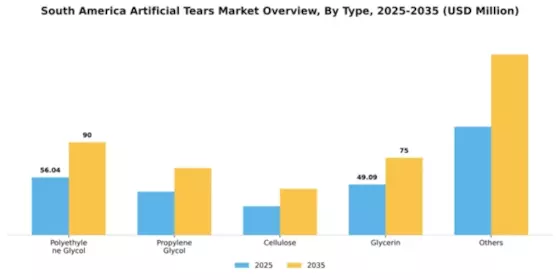
The market share distribution among the segment values reveals that Polyethylene Glycol holds a significant position due to its widespread use in over-the-counter artificial tears formulations. Its adoption is largely driven by its effective moisture retention capabilities, which enhances user experience. In contrast, Glycerin has gained traction recently, appealing to users seeking effective relief from dry eyes and becoming a preferred choice in innovative formulations.
Growth trends indicate that while Polyethylene Glycol remains the dominant player, Glycerin is emerging rapidly, driven by increasing consumer awareness and demand for eye care products. The rise in digital device usage has led to a surge in dry eye conditions, further propelling the demand for effective solutions like Glycerin. Furthermore, ongoing research into optimal formulations is likely to bolster the competitive landscape.
Polyethylene Glycol (Dominant) vs. Glycerin (Emerging)
Polyethylene Glycol is widely recognized as the dominant component in artificial tear formulations, known for its superior moisture retention and long-lasting effects. It caters to a broad audience, including those with chronic dry eye conditions. In contrast, Glycerin is rapidly establishing itself as an emerging player, appealing to a growing segment of consumers who prefer products that offer immediate relief. Glycerin-based formulations are increasingly popular due to their ability to enhance lubrication and provide quick comfort to users. As consumer preferences evolve, these two segment values highlight the shifting dynamics of the market, with Polyethylene Glycol maintaining its stronghold while Glycerin paves the way for innovative solutions.
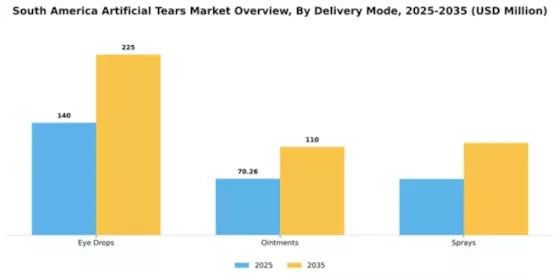
In the artificial tears market, Eye Drops hold the largest share, significantly outperforming Ointments and Sprays. This preference is primarily due to the convenience and ease of use associated with Eye Drops, which are the go-to choice for customers seeking immediate relief from dry eyes. Ointments, while smaller in market share, are gaining traction due to their longer-lasting effects, appealing particularly to those with chronic issues.
The growth trends within this segment reveal a robust increase in demand for Ointments as they are recognized for their effectiveness in providing prolonged moisture relief. The rising awareness about dry eye conditions among the population and the expanding product offerings are driving this growth. Additionally, increasing lifestyle changes leading to eye strain have encouraged consumers to explore varied delivery modes, further enhancing the overall market dynamics.
Eye Drops (Dominant) vs. Ointments (Emerging)
Eye Drops are established as the dominant form of delivery mode in the artificial tears market, characterized by their user-friendly application and rapid effectiveness in alleviating symptoms. Their convenience makes them popular among a diverse consumer base, including those with intermittent dry eye issues. On the other hand, Ointments are considered an emerging category, now gaining popularity for their ability to provide long-term relief but requiring a more careful application process. This segment appeals to those seeking extensive hydration, especially during night-time or when experiencing severe dryness. The ongoing innovation in formulation and awareness campaigns are enhancing the positioning of Ointments, setting them up for a stronger competitive presence in the market.
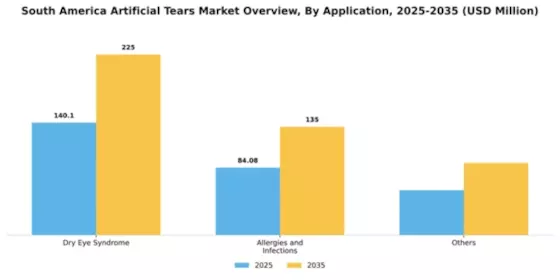
In the South America artificial tears market, the distribution of market share among the application segments reveals that Dry Eye Syndrome holds the largest share, driven by the increasing prevalence of this condition among the aging population. Allergies and Infections are also significant contributors, showcasing a healthy share as awareness regarding eye health improves, alongside a growing population prone to allergic reactions. The 'Others' category includes less prevalent applications but still plays a role in overall market dynamics.
Growth trends in this segment are primarily influenced by a rise in lifestyle-related eye problems, increasing digital screen exposure, and environmental factors contributing to dry eyes. Additionally, the surge in demand for over-the-counter remedies for Allergies and Infections points to consumer trends favoring easy access to eye care solutions. Manufacturers are responding with innovative products tailored to specific applications, further stimulating market growth.
Dry Eye Syndrome (Dominant) vs. Allergies and Infections (Emerging)
Dry Eye Syndrome is recognized as the dominant application segment due to its widespread occurrence among various demographics, particularly older adults and those with sedentary lifestyles. The condition is often exacerbated by environmental factors, leading to a steady demand for artificial tears designed to alleviate symptoms. On the other hand, Allergies and Infections represent an emerging segment that is rapidly gaining attention. With increasing pollution levels and seasonal allergies affecting a broad demographic, there is a growing need for effective treatment options. This has prompted manufacturers to innovate and develop specialized products, thereby capitalizing on the increasing awareness and demand for effective allergy relief solutions.
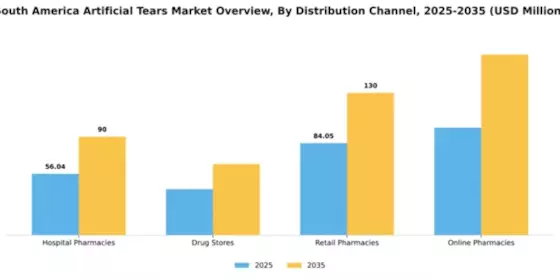
In the South America artificial tears market, the distribution channel segment showcases a diverse landscape. Retail pharmacies dominate this segment, capturing a significant share due to their widespread accessibility and established customer relationships. Following closely are hospital pharmacies and drug stores, which contribute to the market but do not match the breadth of retail pharmacy coverage. Online pharmacies, while currently a smaller player in market share, are emerging quickly as consumer preferences shift towards digital purchasing options.
Growth trends indicate a strong push towards convenience and accessibility as driving forces behind the success of online pharmacies, particularly among younger, tech-savvy consumers. With growing internet penetration and mobile health apps, the demand for purchasing artificial tears online is set to surge. This trend is further supported by the increasing awareness and need for easy access to ocular health products, placing online pharmacies in a competitive position moving forward.
Retail Pharmacies (Dominant) vs. Online Pharmacies (Emerging)
Retail pharmacies play a dominant role in the distribution of artificial tears, leveraging their extensive network to provide consumers with immediate access to these products. They benefit from established trust and familiarity among consumers, offering a range of eye care solutions alongside personalized customer service. Conversely, online pharmacies represent an emerging force in the market, capitalizing on the growing trend of e-commerce. They offer convenience and potentially lower prices, appealing to a tech-oriented demographic. As consumers become more comfortable with online transactions for health products, online pharmacies are expected to increase their market share significantly, challenging the traditional retail pharmacy model.
Get more detailed insights about South America Artificial Tears Market Request Free Sample
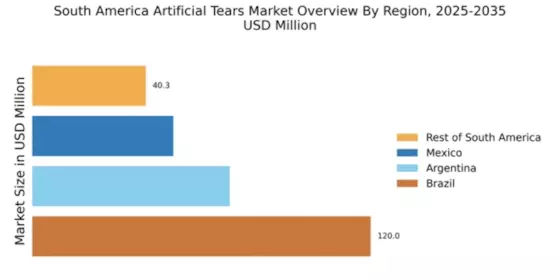
Brazil holds a commanding market share of 120.0, representing a significant portion of the South American artificial tears market. Key growth drivers include an increasing prevalence of dry eye syndrome, heightened awareness of eye health, and government initiatives promoting ocular health. Regulatory policies are becoming more supportive, facilitating the entry of innovative products. Additionally, Brazil's robust healthcare infrastructure and industrial development are enhancing distribution channels and accessibility for consumers.
Mexico's artificial tears market is valued at 50.0, reflecting a growing demand driven by lifestyle changes and increased screen time. The government is actively promoting eye care awareness, which is fostering consumption patterns favoring preventive healthcare. Regulatory frameworks are evolving to support new product approvals, enhancing market dynamics. Infrastructure improvements in healthcare facilities are also contributing to better access to these products across the country.
Argentina's market for artificial tears is valued at 70.0, with a steady growth trajectory fueled by rising awareness of eye health and the impact of environmental factors on ocular conditions. Government initiatives aimed at improving healthcare access are also playing a crucial role. The regulatory environment is becoming more favorable for new entrants, which is expected to diversify the product offerings in the market. Industrial development in urban areas is enhancing distribution networks.
The Rest of South America accounts for a market value of 40.26, characterized by diverse demand patterns influenced by local economic conditions and healthcare access. Growth drivers include increasing urbanization and awareness of eye health issues. Regulatory policies vary significantly across countries, impacting market entry for new products. Infrastructure development is uneven, affecting distribution and availability of artificial tears in remote areas.
The artificial tears market in South America is characterized by a competitive landscape that is increasingly shaped by innovation, strategic partnerships, and regional expansion. Key players such as Allergan (US), Santen Pharmaceutical (JP), and Bausch Health (CA) are actively pursuing strategies that enhance their market presence. For instance, Allergan (US) has focused on expanding its product portfolio through innovative formulations, while Santen Pharmaceutical (JP) emphasizes its commitment to research and development, particularly in the area of preservative-free solutions. Bausch Health (CA) appears to be leveraging its established distribution networks to penetrate emerging markets, thereby enhancing its competitive positioning.The business tactics employed by these companies reflect a concerted effort to optimize supply chains and localize manufacturing processes. The market structure is moderately fragmented, with several players vying for market share. This fragmentation allows for a diverse range of products, catering to varying consumer needs. However, the collective influence of major players like Johnson & Johnson (US) and Alcon (CH) is significant, as they continue to set industry standards through their extensive research capabilities and marketing strategies.
In October Johnson & Johnson (US) announced a strategic partnership with a local South American distributor to enhance its market reach. This move is likely to facilitate better access to consumers and improve the supply chain efficiency, thereby positioning the company favorably against its competitors. Such partnerships are indicative of a broader trend where companies seek to leverage local expertise to navigate the complexities of regional markets.
In September Alcon (CH) launched a new line of artificial tears that incorporates advanced technology aimed at improving user experience. This product introduction not only reflects Alcon's commitment to innovation but also highlights the growing consumer demand for high-quality, effective solutions. The strategic importance of this launch lies in its potential to capture market share from competitors who may not have similar technological advancements.Furthermore, in August 2025, Santen Pharmaceutical (JP) expanded its operations in Brazil by establishing a new manufacturing facility. This strategic investment underscores the company's long-term commitment to the South American market and its intent to enhance production capabilities. By localizing manufacturing, Santen can potentially reduce costs and improve product availability, which is crucial in a competitive landscape.
As of November the competitive trends in the artificial tears market are increasingly defined by digitalization, sustainability, and the integration of artificial intelligence (AI) in product development. Strategic alliances are becoming more prevalent, as companies recognize the value of collaboration in driving innovation. Looking ahead, it is anticipated that competitive differentiation will evolve, with a shift from price-based competition to a focus on technological advancements, product quality, and supply chain reliability. This evolution suggests that companies that prioritize innovation and strategic partnerships will likely emerge as leaders in the market.

The South America Artificial Tears Market has seen significant developments recently, particularly with the growing prevalence of dry eye disease due to environmental factors and an aging population. Companies such as Allergan and Bausch Health Companies are expanding their product lines to cater to the increasing demand for effective treatment options.
In terms of mergers and acquisitions, in July 2023, Johnson and Johnson announced plans to acquire a smaller eye care company, enhancing its portfolio in the artificial tears segment. Additionally, in December 2022, AbbVie completed its acquisition of Allergan, resulting in enhanced resources for research in artificial tear solutions.
The market witnessed a notable growth, with valued estimates reaching approximately 10% growth over the past three years, driven by both product innovation and increasing awareness about eye health issues. Alcon has also introduced new formulations of artificial tears tailored for specific demographics, aiming to capture a larger market share.
Moreover, governmental support for vision health initiatives in Brazil has positively impacted the market landscape, confirming the importance of artificial tears in managing dry eye symptoms across South America. Such dynamic shifts highlight the ongoing transformation in the artificial tears market within this region.
The Artificial Tears Market is projected to grow at a 4.4% CAGR from 2025 to 2035, driven by increasing prevalence of dry eye conditions and rising awareness of eye health.
New opportunities lie in:
By 2035, the market is expected to achieve robust growth, positioning itself as a leader in eye care solutions.
| MARKET SIZE 2024 | 280.26(USD Million) |
| MARKET SIZE 2025 | 292.59(USD Million) |
| MARKET SIZE 2035 | 450.0(USD Million) |
| COMPOUND ANNUAL GROWTH RATE (CAGR) | 4.4% (2025 - 2035) |
| REPORT COVERAGE | Revenue Forecast, Competitive Landscape, Growth Factors, and Trends |
| BASE YEAR | 2024 |
| Market Forecast Period | 2025 - 2035 |
| Historical Data | 2019 - 2024 |
| Market Forecast Units | USD Million |
| Key Companies Profiled | Allergan (US), Santen Pharmaceutical (JP), Bausch Health (CA), Novartis (CH), Johnson & Johnson (US), Alcon (CH), Ocular Therapeutix (US), Eyevance Pharmaceuticals (US) |
| Segments Covered | Type, Delivery Mode, Application, Distribution Channel |
| Key Market Opportunities | Emerging technologies in formulation enhance efficacy and patient compliance in the artificial tears market. |
| Key Market Dynamics | Rising demand for preservative-free formulations drives innovation in the artificial tears market across South America. |
| Countries Covered | Brazil, Mexico, Argentina, Rest of South America |
The market valuation of artificial tears in South America was $280.26 Million in 2024.
The projected market valuation for artificial tears in South America is $450.0 Million by 2035.
The expected CAGR for the South America artificial tears market during the forecast period 2025 - 2035 is 4.4%.
Key players in the South America artificial tears market include Allergan, Santen Pharmaceutical, Bausch Health, Novartis, Johnson & Johnson, Alcon, Ocular Therapeutix, and Eyevance Pharmaceuticals.
The main types of artificial tears available in the market include Polyethylene Glycol, Propylene Glycol, Cellulose, Glycerin, and others.
The Polyethylene Glycol segment generated $56.04 Million in 2024.
The delivery modes utilized for artificial tears in South America include Eye Drops, Ointments, and Sprays.
The revenue generated by Eye Drops in 2024 was $140.0 Million.
Prominent distribution channels for artificial tears in South America include Hospital Pharmacies, Drug Stores, Retail Pharmacies, and Online Pharmacies.
The revenue from Online Pharmacies in 2024 was $98.15 Million.


Kindly complete the form below to receive a free sample of this Report

“This is really good guys. Excellent work on a tight deadline. I will continue to use you going forward and recommend you to others. Nice job”


“Thanks. It’s been a pleasure working with you, please use me as reference with any other Intel employees.”


“Thanks for sending the report it gives us a good global view of the Betaïne market.”


“Thank you, this will be very helpful for OQS.”


“We found the report very insightful! we found your research firm very helpful. I'm sending this email to secure our future business.”


“I am very pleased with how market segments have been defined in a relevant way for my purposes (such as "Portable Freezers & refrigerators" and "last-mile"). In general the report is well structured. Thanks very much for your efforts.”


“I have been reading the first document or the study, ,the Global HVAC and FP market report 2021 till 2026. Must say, good info! I have not gone in depth at all parts, but got a good indication of the data inside!”


“We got the report in time, we really thank you for your support in this process. I also thank to all of your team as they did a great job.”


“The Automotive 48V ECU Components Procurement Intelligence Study” was a complex project, but the Market Research Future (MRFR) team handled it with quality, agility, and customer-centricity. They delivered all requested data on time and within the agreed scope. The team, including Shubhendra Anand and Rahul Gotadki, was always readily available to clarify questions and swiftly implement necessary adjustments, driving the project to a successful conclusion within a very demanding timeframe.
I would also like to specifically commend Akshay Agarwal for his responsiveness and support at every stage—from our initial inquiry on May 6th through to final delivery on June 18th. His dedication made the entire process seamless.”



