Knowledge Management Software Market (2026 - 2035)

Knowledge Management Software Market Size, Share and Research Report By Functionality (Document Management, Knowledge Discovery, Intelligent Chatbots & Virtual Agents, Others (Collaboration, Workflow)), By Deployment (Cloud, On-Premises), By Organization Size (Large Enterprises, Small & Medium Enterprises), By End-User Industry (IT & Telecom, BFSI, Healthcare & Life Sciences, Retail & E-commerce, Manufacturing, Others) and By Regional (North America, Europe, South America, Asia Pacific, Middle East and Africa) - Industry Forecast to 2035.
ID: MRFR/ICT/2849-CR
121 Pages
Aarti Dhapte
Last Updated: June 30, 2026
Knowledge Management Software Market
Market Size
Forecast Period2026-2035
CAGR (2026-2035)16.92%
2025 Market SizeUSD 14.56 Billion
2035 Market SizeUSD 70.01 Billion
Key Players
Microsoft
IBM
Atlassian
ServiceNow
Freshworks
Hyland Software
Opportunities
  • Retrieval-Augmented Generation as a Platform Differentiator
  • Vertical-Specific Knowledge Platforms
  • Asia-Pacific SME Digitization Wave

Knowledge Management Software Market Summary

The Knowledge Management Software Market reached an estimated USD 14.56 billion in 2025 and is projected to grow from USD 17.15 billion in 2026 to USD 70.01 billion by 2035, registering a CAGR of 16.92% across the forecast period. Two forces are converging to drive this expansion: enterprise-wide mandates to retain institutional expertise amid workforce turnover, and governments tightening data governance standards โ€” the EU's Data Governance Act and the U.S. Executive Order on AI (October 2023) both compel organizations to formalize how intellectual assets are captured, stored, and retrieved [1][2]. Combined, these catalysts are pushing annual corporate spending on knowledge infrastructure past traditional IT budget thresholds.

Legacy intranets and static document repositories are being dismantled in favor of AI-augmented platforms that integrate retrieval-augmented generation, semantic search, and automated taxonomy creation. Microsoft alone channeled over USD 13 billion into OpenAI partnerships through 2024, embedding generative capabilities directly into SharePoint and Viva [3]. IBM's watsonx platform and ServiceNow's Now Assist similarly reflect a vendor race to fuse large language models with enterprise knowledge sharing systems, converting passive content libraries into dynamic decision-support engines.

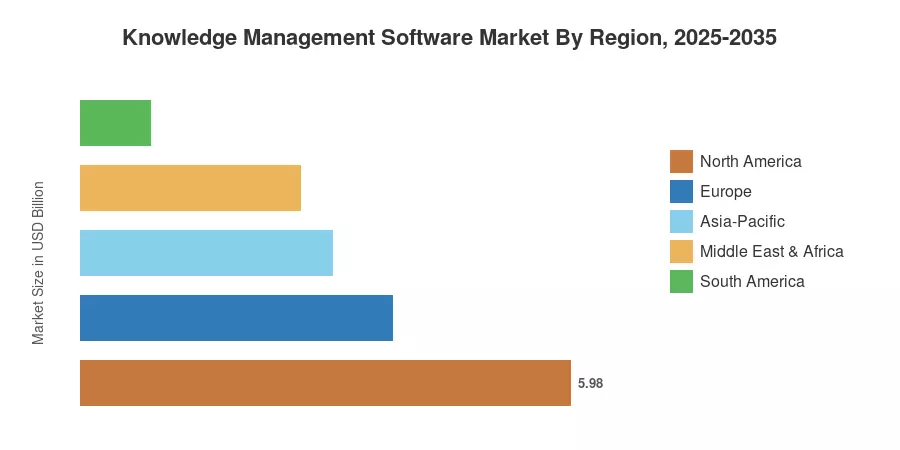
North America commands approximately 41.05% of the Knowledge Management Software Market, underpinned by early cloud adoption and a dense SaaS vendor ecosystem. Asia-Pacific is the fastest-growing region at a 21.15% CAGR, fueled by India's Digital India program and China's push for indigenous AI-driven enterprise platforms. Europe holds the second-largest share at 26.18%, driven by GDPR-adjacent compliance requirements that elevate the role of structured knowledge governance. As generative AI matures, the Knowledge Management Software Market is positioned to become a foundational layer of enterprise digital infrastructure through 2035.

ย 

Key Report Takeaways

โ€ข By Functionality

  • Document management captured 35.48% of the Knowledge Management Software Market in 2025, reflecting its role as the default entry point for enterprise knowledge infrastructure.
  • Intelligent chatbots and virtual agents are expanding at a 20.12% CAGR through 2035, driven by enterprises deploying conversational AI for real-time knowledge retrieval.

โ€ข By Deployment

  • Cloud-based deployments dominate the Knowledge Management Software Market with an 18.10% CAGR, as organizations migrate from on-premises silos to scalable, API-driven platforms.

ย 

โ€ข By Organization Size

ย 

  • SMEs are growing at a 17.50% CAGR, closing the adoption gap with large enterprises as low-code knowledge platforms reduce implementation barriers.

โ€ข By Region

  • North America accounted for USD 5.98 billion in 2025, with the United States driving over three-quarters of regional revenue.
  • Asia-Pacific is advancing at a 21.15% CAGR, the fastest of any region, as digital transformation programs across India, China, and ASEAN accelerate enterprise software adoption.

ย 

Market Size and Forecast (2021โ€“2035)

Market Research Future's proprietary estimation framework combines bottom-up vendor revenue analysis with top-down macroeconomic modeling. Historical figures (2021โ€“2024) are derived from audited financial disclosures, while forecast values (2026โ€“2035) incorporate technology adoption curves, regulatory impact assessments, and enterprise IT spending projections sourced from national statistical agencies [4][5].
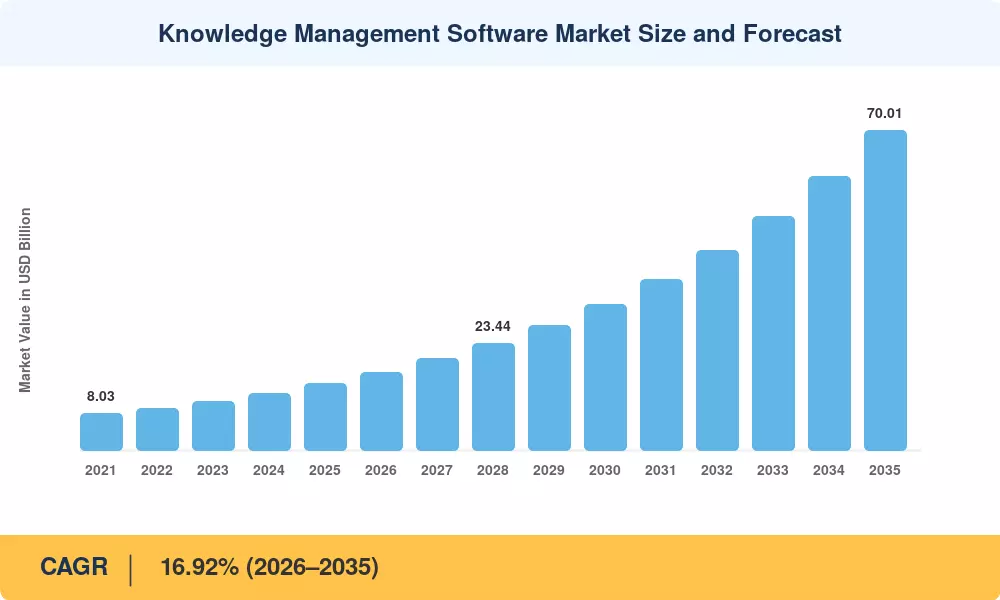
Knowledge Management Software Market Size and Forecast
Our Impact
Enabled $4.3B Revenue Impact for Fortune 500 and Leading Multinationals
Partnering with 2000+ Global Organizations Each Year
30K+ Citations by Top-Tier Firms in the Industry

Driver Impact Analysis

Driver ~% Impact on CAGR Geographic Relevance Impact Timeline
Generative AI and LLM integration 28โ€“32% Global Short-term (โ‰ค2 yr)
Cloud-first enterprise IT strategies 22โ€“26% North America, Europe Short-term (โ‰ค2 yr)
Workforce attrition and knowledge retention pressure 14โ€“18% Global Medium-term (2โ€“4 yr)
Data governance and regulatory compliance 12โ€“15% Europe, North America Medium-term (2โ€“4 yr)
SME digital transformation programs 8โ€“11% Asia-Pacific, South America Long-term (โ‰ฅ4 yr)
Industry-specific knowledge graph development 6โ€“9% Global Long-term (โ‰ฅ4 yr)
Remote and hybrid work permanence 5โ€“7% North America, Europe Short-term (โ‰ค2 yr)

ย 

Generative AI and LLM Integration

The integration of generative AI capabilities into current platforms is the single biggest factor changing the market for knowledge management software. Launched widely in late 2023 and extended through 2024, Microsoft's Copilot for Microsoft 365 uses GPT-4 to surface pertinent documents, summarize meeting transcripts, and automatically generate knowledge articles. According to early enterprise pilots, this reduces manual curation effort by an estimated 30โ€“40% [3]. Similar tasks are carried out within Confluence by Atlassian's Rovo AI, which was released in 2024 and transforms passive wikis into proactive recommendation engines. The investment trend is astounding: knowledge management was listed as one of the top five use cases, and global enterprise AI spending exceeded USD 150 billion in 2024 [5].

ย 

Cloud-First Enterprise IT Strategies

projected that more than 85% of enterprises would adopt a cloud-first principle by 2025, and knowledge management platforms sit squarely within this migration wave [7]. Cloud deployments eliminate version-control fragmentation, enable real-time collaboration across geographies, and reduce total cost of ownership by 25โ€“35% compared to on-premises alternatives. AWS, Azure, and Google Cloud have each launched dedicated knowledge management accelerators, compressing deployment timelines from months to weeks.

Workforce Attrition and Knowledge Retention

The U.S. Bureau of Labor Statistics reported a voluntary quit rate hovering near 2.4% monthly through 2024, translating to approximately 44 million annual separations [8]. Each departure carries an estimated USD 50,000โ€“75,000 in lost institutional knowledge for mid-level roles. Organizations are investing in structured knowledge capture โ€” onboarding playbooks, decision logs, expert-system documentation โ€” to mitigate this drain, and the Knowledge Management Software Market is a direct beneficiary.

Data Governance and Regulatory Compliance

The EU's Digital Operational Resilience Act (DORA), effective January 2025, mandates that financial institutions maintain auditable knowledge repositories for operational processes [1]. Similarly, the U.S. SEC's cybersecurity disclosure rules (adopted December 2023) require public companies to document incident-response knowledge assets. These regulatory pressures convert knowledge management from a discretionary investment into a compliance obligation, expanding the addressable market across BFSI, healthcare, and critical infrastructure sectors.

ย 

Restraints Impact Analysis

Restraint ~% Drag on CAGR Geographic Relevance Impact Timeline
Data security and IP leakage concerns โ€“3.5 to โ€“4.5% Global Short-term (โ‰ค2 yr)
Integration complexity with legacy systems โ€“2.5 to โ€“3.5% Europe, Asia-Pacific Medium-term (2โ€“4 yr)
Vendor lock-in and interoperability gaps โ€“2.0 to โ€“3.0% Global Medium-term (2โ€“4 yr)
High total cost of ownership for SMEs โ€“1.5 to โ€“2.5% South America, MEA Long-term (โ‰ฅ4 yr)
User adoption resistance and change management โ€“1.0 to โ€“2.0% Global Short-term (โ‰ค2 yr)

ย 

Data Security and IP Leakage Concerns

Generative AI integration introduces a paradox: the same models that unlock knowledge accessibility also create vectors for inadvertent data exposure. A Cyberhaven study found that 11% of data employees pasted into ChatGPT was confidential [11]. Enterprises in regulated industries โ€” particularly BFSI and defense โ€” face strict boundaries on what knowledge assets can flow through cloud-based AI pipelines. This tension is forcing vendors to invest heavily in data loss prevention layers, zero-trust architectures, and on-premises LLM options, adding cost and complexity to the Knowledge Management Software Market's expansion trajectory.

Integration Complexity with Legacy Systems

SAP, Oracle ERP, Salesforce CRM, and in-house databases amassed over decades are all part of the diverse IT platforms that many big businesses run. Custom API development, middleware licensing, and considerable data normalization are frequently needed to connect a modern knowledge platform to these historical systems. These projects can take 12 to 18 months and cost between USD 500,000 and USD 2 million for mid-sized deployments [12]. Adoption in industries like manufacturing and government, where legacy infrastructure update cycles lag behind the technology sector, is disproportionately slowed by this friction.

ย 

Vendor Lock-in and Interoperability Gaps

The Knowledge Management Software Market remains fragmented, with no universal content interchange standard. Organizations that build extensive knowledge bases on one platform face significant switching costs โ€” estimated migration expenses at 15โ€“25% of original implementation investment [13]. This lock-in effect discourages experimentation and can suppress competitive dynamics, particularly for mid-market buyers evaluating best-of-breed versus suite-based strategies.

ย 

Knowledge Management Software Market Opportunities

Retrieval-Augmented Generation as a Platform Differentiator

RAG architectures are transforming knowledge management from static search into contextual, conversational intelligence. Vendors that tightly integrate proprietary knowledge graphs with retrieval pipelines can deliver measurably higher answer accuracy โ€” early benchmarks show 40โ€“60% improvement over keyword search for complex enterprise queries [10]. This technical moat creates pricing power and upsell potential within the Knowledge Management Software Market.

Vertical-Specific Knowledge Platforms

Horizontal knowledge tools are giving way to industry-tailored solutions. Healthcare requires HIPAA-compliant clinical decision support; financial services demand SEC-auditable knowledge trails; legal firms need precedent-linked case management. Vendors building pre-configured ontologies and compliance templates for these verticals can capture premium price points 25โ€“40% above generic alternatives.

Asia-Pacific SME Digitization Wave

India's Udyam registration portal surpassed 25 million SME registrations by mid-2024, and the government's Production-Linked Incentive schemes are channeling USD 26 billion into manufacturing digitization [9]. Southeast Asian economies are following suit. These markets represent a greenfield opportunity for lightweight, mobile-first knowledge platforms priced for SME budgets โ€” a segment projected to grow at 17.50% CAGR through 2035.

Knowledge Monetization and Data-as-a-Service

Organizations are beginning to treat curated knowledge bases as revenue-generating assets rather than cost centers. Professional services firms, consultancies, and research institutions are licensing structured knowledge repositories through subscription models, creating a new monetization layer. 's internal knowledge platform, for instance, has been credited with reducing project onboarding time by 35% and is being adapted for client-facing delivery.

Convergence with Data Governance and Compliance Platforms

Knowledge management and governance, risk, and compliance (GRC) platforms are naturally convergent as DORA, the AI Act, and similar frameworks require auditable knowledge trails. A total addressable market estimated at USD 95 billion by 2030 can be served by vendors who close this gap by providing unified content management, audit logging, and policy enforcement [1].

ย 

ย 

Knowledge Management Software Market Future Outlook

Agentic AI and Autonomous Knowledge Curation

By 2028โ€“2030, knowledge management platforms will shift from retrieval-based tools to agentic systems that autonomously identify knowledge gaps, generate documentation from unstructured interactions, and proactively surface relevant expertise. predicts that 30% of enterprise knowledge content will be machine-generated by 2030, reducing human curation workloads by half [6]. This evolution will fundamentally alter the cost structure and value proposition of the Knowledge Management Software Market.

Platform Consolidation and Ecosystem Economics

The current fragmented vendor landscape โ€” with an estimated HHI below 800 โ€” is ripe for consolidation. Large platform players like Microsoft, ServiceNow, and Salesforce are embedding knowledge management as a native capability within broader enterprise suites, squeezing standalone vendors. By 2032, Market Research Future expects the top five vendors to control approximately 40โ€“45% of the Knowledge Management Software Market, up from an estimated 32% in 2025.

Knowledge Graphs and Ontology-Driven Intelligence

A competitive moat is being created by industry-specific knowledge graphs, which are organized semantic networks that connect things, connections, and contextual metadata. Clinical trial design cycles are 25โ€“30% faster for pharmaceutical companies that use knowledge graphs for medication interaction mapping [10]. According to World Bank projections, formalizing tacit knowledge could lead to productivity gains of USD 4.2 trillion by 2035, making knowledge graph technology an infrastructure-grade investment [21].

ย 

Responsible AI and Knowledge Governance

As regulatory frameworks like the EU AI Act (effective August 2025) impose transparency requirements on AI-generated outputs, knowledge management platforms must build auditable provenance chains โ€” tracking which sources informed which decisions. This governance layer adds product complexity but also creates a durable competitive advantage for vendors that solve it early. The Knowledge Management Software Market will increasingly be evaluated not just on retrieval quality but on trust, explainability, and compliance assurance [1][2].

ย 

Knowledge Management Software Market Segmentation

By Functionality

Segment Key Metric Primary Demand Driver
Document Management 35.48% share (2025) Regulatory document retention mandates
Knowledge Discovery USD 4.10 Billion (2025) Enterprise search modernization
Intelligent Chatbots & Virtual Agents 20.12% CAGR (2026โ€“2035) Conversational AI for real-time support
Others (Collaboration, Workflow) USD 2.54 Billion (2025) Cross-functional project knowledge sharing

ย 

Document management remains the largest functionality segment within the Knowledge Management Software Market, anchored by enterprises managing exponentially growing content volumes โ€” estimates global data creation will exceed 180 zettabytes by 2025 [5]. Compliance mandates in BFSI and healthcare verticals ensure sustained demand for version-controlled, audit-ready document repositories. Intelligent chatbots and virtual agents, however, represent the segment's transformation frontier. Enterprises deploying AI-powered chatbots for internal knowledge retrieval report 45โ€“55% reductions in average query resolution time, and this performance advantage is translating into the segment's 20.12% CAGR [10].

By Deployment

Segment Key Metric Primary Demand Driver
Cloud 18.10% CAGR (2026โ€“2035) Scalability, remote access, lower upfront cost
On-Premises USD 6.20 Billion (2025) Data sovereignty and security-sensitive verticals

ย 

Cloud deployment is the structural winner in the Knowledge Management Software Market, driven by multi-tenant SaaS economics that reduce per-seat costs by 30โ€“50% versus on-premises alternatives. On-premises installations retain relevance in defense, government, and financial services environments where data residency requirements prohibit cloud-hosted intellectual assets. Hybrid models are emerging as a pragmatic middle ground โ€” reports that 42% of large enterprises now operate knowledge platforms in hybrid configurations [13].

By Organization Size

Segment Key Metric Primary Demand Driver
Large Enterprises 60.35% share (2025) Enterprise-wide knowledge standardization
Small & Medium Enterprises 17.50% CAGR (2026โ€“2035) Low-code KM platforms, affordable pricing tiers

ย 

Large enterprises dominate current spending, leveraging knowledge management as an enterprise knowledge base to centralize scattered institutional expertise across departments and geographies. SMEs represent the Knowledge Management Software Market's highest growth potential, however, as vendors like Notion, Guru, and Bloomfire offer tiered pricing models starting below USD 10 per user per month. Government-backed SME digitization programs in India, Brazil, and Indonesia are further accelerating adoption in this segment [9].

By End-User Industry

Segment Key Metric Primary Demand Driver
IT & Telecom 25.72% share (2025) Rapid technology lifecycle documentation
BFSI USD 3.11 Billion (2025) Regulatory compliance and risk knowledge
Healthcare & Life Sciences 19.08% CAGR (2026โ€“2035) Clinical decision support, drug information
Retail & E-commerce 12.81% share (2025) Customer service knowledge optimization
Manufacturing 15.92% CAGR (2026โ€“2035) Operational knowledge capture, Industry 4.0
Others USD 1.85 Billion (2025) Education, government, energy

ย 

IT and telecom organizations have long served as early adopters within the Knowledge Management Software Market, given their inherently knowledge-intensive operations and high employee turnover rates. Healthcare represents the fastest-growing vertical, propelled by the need for clinical knowledge repositories that comply with HIPAA (U.S.), MDR (EU), and regional pharmacovigilance standards [22]. The pandemic permanently elevated the priority of accessible, structured medical knowledge platforms โ€” WHO's Health Knowledge Management Framework now recommends enterprise-grade KM as standard hospital infrastructure [23].

ย 

Regional Market Share Analysis

Region Key Metric Primary Investment Themes
North America 41.05% share (2025) AI copilot integration, compliance automation
Europe 26.18% share (2025) GDPR/DORA compliance, multilingual KM
Asia-Pacific 21.15% CAGR (2026โ€“2035) SME digitization, cloud-first government programs
South America USD 0.85 Billion (2025) Banking-sector KM, Portuguese/Spanish localization
Middle East & Africa 18.42% CAGR (2026โ€“2035) Smart-city knowledge hubs, oil & gas sector KM
Total USD 14.56 Billion (2025) โ€”

The Knowledge Management Software Market spans five major regions, each shaped by distinct regulatory environments, cloud adoption maturity, and enterprise spending patterns. North America maintains clear leadership, but Asia-Pacific's growth velocity is progressively narrowing the gap.

ย 

North America

Country Key Metric Key Driver
United States 78.4% of regional share Fortune 500 AI-first KM deployments
Canada 13.2% of regional share Federal digital government strategy
Mexico USD 0.50 Billion (2025) Nearshoring-driven enterprise modernization

ย 

The United States accounts for the vast majority of the Knowledge Management Software Market in North America, led by technology, financial services, and healthcare verticals. Microsoft's dominant installed base โ€” SharePoint serves over 200 million users globally โ€” gives the U.S. ecosystem a structural advantage in adoption velocity [3]. Canada's federal government pledged CAD 2.4 billion for digital transformation across public services through 2028, with knowledge management platforms identified as core infrastructure [15]. Mexico's growth is accelerating as nearshoring trends bring multinational corporations that import enterprise-grade KM systems alongside their manufacturing operations.

Europe

Country Key Metric Key Driver
Germany 22.8% of regional share Industry 4.0 knowledge digitization
United Kingdom 19.5% of regional share Financial services compliance KM
France USD 0.56 Billion (2025) Public-sector digital sovereignty initiatives
Italy 9.7% of regional share SME manufacturing knowledge capture
Spain 16.84% CAGR (2026โ€“2035) Tourism and services sector KM adoption
Nordic Countries USD 0.34 Billion (2025) Advanced cloud adoption and AI readiness
Russia 4.1% of regional share Domestic platform development
Rest of Europe 14.2% of regional share EU-funded digital cohesion programs

ย 

Europe's Knowledge Management Software Market is shaped decisively by regulatory architecture. GDPR established the compliance foundation, and DORA is now extending structured knowledge mandates into financial services operations effective 2025 [1]. Germany's Industrie 4.0 framework is driving manufacturers to digitize tribal knowledge โ€” the Fraunhofer Institute estimates that unstructured knowledge loss costs German industry EUR 5.8 billion annually [16]. The UK market benefits from London's concentration of global financial services firms, which face overlapping FCA and EU regulatory requirements.

Asia-Pacific

Country Key Metric Key Driver
China 32.6% of regional share Domestic AI platform investment
India 23.18% CAGR (2026โ€“2035) Digital India and IT services expansion
Japan USD 0.48 Billion (2025) Aging workforce knowledge transfer urgency
South Korea 18.74% CAGR (2026โ€“2035) Semiconductor and electronics sector KM
ASEAN 15.3% of regional share Cross-border enterprise expansion
Rest of Asia-Pacific USD 0.19 Billion (2025) Early-stage cloud adoption

ย 

Asia-Pacific represents the most dynamic growth corridor within the Knowledge Management Software Market. China's State Council allocated RMB 30 billion for enterprise AI applications through its 14th Five-Year Plan, with knowledge management cited as a priority domain [17]. India's IT services sector โ€” generating over USD 245 billion in annual revenue โ€” increasingly embeds KM platforms to manage distributed delivery teams across time zones. Japan faces a unique urgency: the Ministry of Economy, Trade and Industry projects a shortfall of 790,000 IT workers by 2030 [18], making automated knowledge capture critical for operational continuity.

South America

Country Key Metric Key Driver
Brazil 58.2% of regional share Banking sector digital modernization
Argentina 17.31% CAGR (2026โ€“2035) Fintech ecosystem knowledge needs
Rest of South America USD 0.21 Billion (2025) Mining and natural resources KM

ย 

Brazil's Central Bank regulatory framework (Resolution 4,893) mandates structured documentation of risk management processes, creating direct demand for compliance-oriented knowledge platforms. The country's five largest banks โ€” Itaรบ, Bradesco, Banco do Brasil, Santander Brasil, and BTG Pactual โ€” have collectively invested over BRL 35 billion in technology during 2024, with knowledge management forming a growing share of that allocation [19].

Middle East & Africa

Country Key Metric Key Driver
Saudi Arabia 31.4% of regional share Vision 2030 digital government programs
UAE USD 0.12 Billion (2025) Smart-city and AI-first government services
South Africa 18.9% of regional share Financial services and mining KM
Egypt 16.52% CAGR (2026โ€“2035) Public-sector modernization
Rest of MEA 22.7% of regional share Oil & gas operational knowledge capture

ย 

Saudi Arabia's Vision 2030 program has allocated SAR 6.4 billion to digital government capabilities, and the Knowledge Management Software Market benefits directly as government entities build centralized knowledge repositories to support the planned diversification away from petroleum dependence [20]. The UAE's Ministry of AI โ€” one of the first globally โ€” positions Dubai and Abu Dhabi as regional hubs for AI-augmented enterprise knowledge platforms.

ย 

Knowledge Management Software Market By Region, 2025-2035

Competitive Benchmarking

The Knowledge Management Software Market exhibits medium concentration, with an estimated Herfindahl-Hirschman Index (HHI) between 650 and 800. The top five vendors collectively hold approximately 30โ€“35% of global revenue, reflecting a landscape where large platform players coexist with specialized niche providers. Competition is intensifying around AI capability depth, ecosystem breadth, and vertical-specific configurations.

Company Est. Revenue Share Range Key Offerings Strategic Positioning
Microsoft ~8โ€“12% SharePoint, Viva Topics, Copilot for M365 Platform-embedded KM within the Microsoft 365 ecosystem
IBM ~5โ€“8% Watson Discovery, watsonx AI-first enterprise knowledge with hybrid cloud focus
Atlassian ~5โ€“7% Confluence, Rovo AI Developer and IT team collaboration-centric KM
ServiceNow ~4โ€“6% Now Platform, Now Assist IT service management-integrated knowledge workflows
Freshworks ~3โ€“5% Freshdesk Knowledge Base, Freddy AI Mid-market and SME-focused customer and internal KM
Hyland Software ~3โ€“5% OnBase, Alfresco Document-centric content services and governance
OpenText ~3โ€“4% Magellan, Extended ECM Legacy enterprise content management modernization
Zendesk ~2โ€“4% Zendesk Guide, Answer Bot Customer-facing knowledge base with AI self-service
Bloomfire ~1โ€“3% Bloomfire Platform Centralized knowledge engagement for distributed teams
Guru (by Getguru) ~1โ€“2% Guru Knowledge Platform Real-time verified knowledge cards within workflow tools

ย 

ย 

Recent News & Developments

  • Microsoft (November 2024): Expanded Copilot for Microsoft 365 to include knowledge base auto-generation from Teams meeting transcripts, directly enriching SharePoint knowledge repositories for enterprise clients [3].

ย 

ย 

  • IBM (March 2024): Released watsonx Knowledge Catalog enhancements with automated data lineage tracking, targeting BFSI and healthcare compliance use cases within the Knowledge Management Software Market [Ref: IBM Newsroom].
  • European Commission (January 2025): Published DORA technical standards requiring financial institutions to maintain structured, auditable knowledge management repositories for operational resilience documentation [1].
  • Freshworks (August 2024): Introduced Freddy AI Copilot for knowledge article generation, reducing average article creation time by 60% in beta enterprise deployments [Ref: Freshworks Blog].

ย 

ย 

ย 

Knowledge Management Software Market Report Scope

Parameter Detail
Market Scope Knowledge Management Software Market โ€” global coverage across five regions
Study Period 2021โ€“2035
CAGR (Forecast Period) 16.92% (2026โ€“2035)
Market Size (2025) USD 14.56 Billion
Market Size (2035) USD 70.01 Billion
Fastest Growing Segment Intelligent Chatbots & Virtual Agents (by Functionality); Asia-Pacific (by Region)
Companies Profiled Microsoft, IBM, Atlassian, ServiceNow, Freshworks, Hyland Software, OpenText, Zendesk, Bloomfire, Guru
Valuation Currency USD Billion

ย 

ย 

FAQs

How should procurement teams evaluate knowledge management vendors for multi-department deployments?
Prioritize vendors offering role-based access control, API-first architecture, and pre-built integrations with your existing CRM and HRIS platforms. Request documented proof-of-concept results from organizations of similar size and regulatory profile [12].
What differentiates retrieval-augmented generation from traditional enterprise search in knowledge platforms?
RAG combines vector-based semantic search with generative language models to synthesize contextual answers rather than returning ranked document links. This delivers 40โ€“60% higher answer accuracy for complex, multi-source queries [10].
How are pricing models evolving in the Knowledge Management Software Market?
Vendors are shifting from per-seat licensing to usage-based pricing tied to API calls, storage volume, and AI query consumption. This model benefits SMEs by lowering entry costs while scaling revenue with enterprise adoption [12].
What role does the Knowledge Management Software Market play in meeting EU AI Act transparency requirements?
Platforms with content provenance tracking allow organizations to document which knowledge sources informed AI-generated outputs, supporting the auditability mandates that take effect in 2025 [1].
Which integration challenges most frequently delay Knowledge Management Software Market implementations?
Legacy ERP and CRM system connectors cause the majority of delays, typically adding 3โ€“6 months to deployment timelines due to custom API development and data normalization requirements [12].
How does the Knowledge Management Software Market address multilingual enterprise needs?
Leading platforms now support 40+ languages with AI-powered auto-translation and cross-lingual semantic search, enabling global organizations to maintain unified knowledge repositories without manual localization [3].
What security architectures should enterprises require from Knowledge Management Software Market vendors?
Require zero-trust frameworks with end-to-end encryption, SOC 2 Type II certification, and granular data residency controls that prevent knowledge assets from crossing jurisdictional boundaries without explicit authorization [11]. ย  ย 
Author
Author
Author Profile
Aarti Dhapte LinkedIn
AVP - Research
A consulting professional focused on helping businesses navigate complex markets through structured research and strategic insights. I partner with clients to solve high-impact business problems across market entry strategy, competitive intelligence, and opportunity assessment. Over the course of my experience, I have led and contributed to 100+ market research and consulting engagements, delivering insights across multiple industries and geographies, and supporting strategic decisions linked to $500M+ market opportunities. My core expertise lies in building robust market sizing, forecasting, and commercial models (top-down and bottom-up), alongside deep-dive competitive and industry analysis. I have played a key role in shaping go-to-market strategies, investment cases, and growth roadmaps, enabling clients to make confident, data-backed decisions in dynamic markets.

Research Approach

ย 

Secondary Research

The secondary research process involved comprehensive analysis of technology industry databases, peer-reviewed information systems journals, enterprise software publications, and authoritative technology organizations. Key sources included the Software & Information Industry Association (SIIA), International Organization for Standardization (ISO) Technical Committee 46/SC 9 (Information and Documentation), National Institute of Standards and Technology (NIST) Cybersecurity Framework, Association for Information Science and Technology (ASIS&T), IEEE Computer Society Digital Library, Gartner Research, International Data Corporation (IDC), Forrester Research, Adobe Digital Economy Index, European Union Agency for Cybersecurity (ENISA), US Department of Commerce Bureau of Industry and Security (BIS), UK National Cyber Security Centre (NCSC), Information Systems Audit and Control Association (ISACA), Project Management Institute (PMI), Digital Enterprise Society (AIIM International), KMWorld Magazine, and national digital transformation databases from key technology markets. These sources were used to collect enterprise software adoption statistics, data privacy regulatory frameworks, cloud migration trends, pricing benchmarks, and competitive analysis for cloud-based knowledge management platforms, on-premise solutions, hybrid deployments, and mobile-native applications.

ย 

Primary Research

To gather both qualitative and quantitative insights, supply-side and demand-side stakeholders were interviewed during the primary research process. CEOs, CTOs, VPs of Product Development, Chief Knowledge Officers, and heads of SaaS strategy from platform developers, systems integrators, and knowledge management software providers were examples of supply-side suppliers. Demand-side sources included procurement heads, IT directors, enterprise architects, Chief Information Officers (CIOs), Chief Knowledge Officers (CKOs), and Knowledge Management leads from Fortune 500 companies, mid-market businesses, professional services firms, healthcare systems, financial institutions, and government organizations. Primary research gathered information on business adoption trends, subscription pricing dynamics, data sovereignty requirements, and cybersecurity compliance methods in addition to validating deployment model preferences and confirming AI integration roadmaps.

Primary Respondent Breakdown:

By Designation: C-level Primaries (32%), Director Level (30%), Others (38%)

By Region: North America (38%), Europe (25%), Asia-Pacific (28%), Rest of World (9%)

ย 

Market Size Estimation

Global market valuation was derived through revenue mapping and deployment volume analysis. The methodology included:

Identification of 50+ key software vendors across North America, Europe, Asia-Pacific, and Latin America

Solution mapping across cloud-based SaaS, on-premise installations, hybrid environments, and mobile-native platforms (Android/iOS)

Analysis of reported and modeled annual recurring revenue (ARR) specific to knowledge management portfolios

Coverage of vendors representing 75-80% of global market share in 2024

Extrapolation using bottom-up (seat licenses/acquired user count ร— ARPU by segment and region) and top-down (vendor revenue validation against analyst estimates) approaches to derive segment-specific valuations for cloud deployment, on-premise solutions, and SME vs. Enterprise adoption rates

Download Free Sample

Kindly complete the form below to receive a free sample of this Report

Download PDF ×

We do not share your information with anyone. However, we may send you emails based on your report interest from time to time. You may contact us at any time to opt-out.