Knowledge Management Software Market (2026 - 2035)

ID: MRFR/ICT/2849-CR
121 Pages
Aarti Dhapte
Last Updated: June 30, 2026
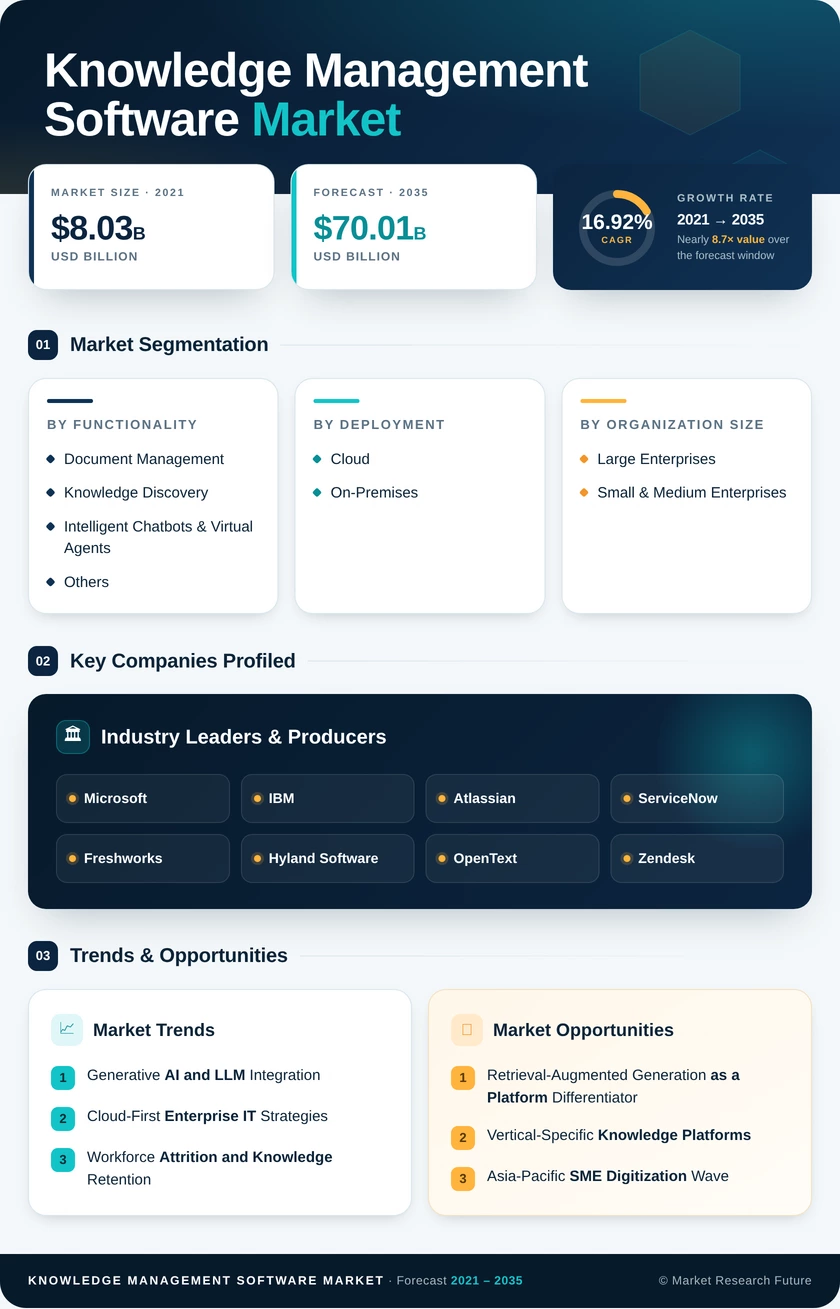
Knowledge Management Software Market Size, Share and Research Report By Functionality (Document Management, Knowledge Discovery, Intelligent Chatbots & Virtual Agents, Others (Collaboration, Workflow)), By Deployment (Cloud, On-Premises), By Organization Size (Large Enterprises, Small & Medium Enterprises), By End-User Industry (IT & Telecom, BFSI, Healthcare & Life Sciences, Retail & E-commerce, Manufacturing, Others) and By Regional (North America, Europe, South America, Asia Pacific, Middle East and Africa) - Industry Forecast to 2035.
Knowledge Management Software Market
Market Size
Forecast Period2026-2035
CAGR (2026-2035)16.92%
2025 Market SizeUSD 14.56 Billion
2035 Market SizeUSD 70.01 Billion
Key Players
Microsoft
IBM
Atlassian
ServiceNow
Freshworks
Hyland Software
Opportunities
  • Retrieval-Augmented Generation as a Platform Differentiator
  • Vertical-Specific Knowledge Platforms
  • Asia-Pacific SME Digitization Wave
  1. 1 Market Overview |
    1. 1.1 Study Assumptions & Market Definition |
    2. 1.2 Scope of the Study |
    3. 1.3 Research Methodology
  2. 2 Market Summary & Key Takeaways
  3. 3 Market Dynamics |
    1. 3.1 Market Drivers Analysis | |
      1. 3.1.1 Generative AI and LLM Integration | |
      2. 3.1.2 Cloud-First Enterprise IT Strategies | |
      3. 3.1.3 Workforce Attrition and Knowledge Retention Pressure | |
      4. 3.1.4 Data Governance and Regulatory Compliance | |
      5. 3.1.5 SME Digital Transformation Programs | |
      6. 3.1.6 Industry-Specific Knowledge Graph Development | |
      7. 3.1.7 Remote and Hybrid Work Permanence |
    2. 3.2 Market Restraints Analysis | |
      1. 3.2.1 Data Security and IP Leakage Concerns | |
      2. 3.2.2 Integration Complexity with Legacy Systems | |
      3. 3.2.3 Vendor Lock-in and Interoperability Gaps | |
      4. 3.2.4 High Total Cost of Ownership for SMEs | |
      5. 3.2.5 User Adoption Resistance and Change Management |
    3. 3.3 Market Opportunity Analysis | |
      1. 3.3.1 Retrieval-Augmented Generation as a Platform Differentiator | |
      2. 3.3.2 Vertical-Specific Knowledge Platforms | |
      3. 3.3.3 Asia-Pacific SME Digitization Wave | |
      4. 3.3.4 Knowledge Monetization and Data-as-a-Service | |
      5. 3.3.5 Convergence with Data Governance and Compliance Platforms |
    4. 3.4 Industry Value Chain Analysis |
    5. 3.5 Porter's Five Forces Analysis
  4. 4 Global Knowledge Management Software Market Size & Forecast (2021–2035) |
    1. 4.1 Historical Market Size (2021–2025) |
    2. 4.2 Current & Forecast Market Size (2026–2035) |
    3. 4.3 Market Size by Revenue (USD Billion) |
    4. 4.4 Year-over-Year Growth Analysis
  5. 5 Segmentation Analysis |
    1. 5.1 By Functionality | |
      1. 5.1.1 Document Management | |
      2. 5.1.2 Knowledge Discovery | |
      3. 5.1.3 Intelligent Chatbots & Virtual Agents | |
      4. 5.1.4 Others (Collaboration, Workflow) |
    2. 5.2 By Deployment | |
      1. 5.2.1 Cloud | |
      2. 5.2.2 On-Premises |
    3. 5.3 By Organization Size | |
      1. 5.3.1 Large Enterprises | |
      2. 5.3.2 Small & Medium Enterprises |
    4. 5.4 By End-User Industry | |
      1. 5.4.1 IT & Telecom | |
      2. 5.4.2 BFSI | |
      3. 5.4.3 Healthcare & Life Sciences | |
      4. 5.4.4 Retail & E-commerce | |
      5. 5.4.5 Manufacturing | |
      6. 5.4.6 Others
  6. 6 Regional Analysis |
    1. 6.1 North America | |
      1. 6.1.1 United States | |
      2. 6.1.2 Canada | |
      3. 6.1.3 Mexico |
    2. 6.2 Europe | |
      1. 6.2.1 Germany | |
      2. 6.2.2 United Kingdom | |
      3. 6.2.3 France | |
      4. 6.2.4 Italy | |
      5. 6.2.5 Spain | |
      6. 6.2.6 Nordic Countries | |
      7. 6.2.7 Russia | |
      8. 6.2.8 Rest of Europe |
    3. 6.3 Asia-Pacific | |
      1. 6.3.1 China | |
      2. 6.3.2 India | |
      3. 6.3.3 Japan | |
      4. 6.3.4 South Korea | |
      5. 6.3.5 ASEAN | |
      6. 6.3.6 Rest of Asia-Pacific |
    4. 6.4 South America | |
      1. 6.4.1 Brazil | |
      2. 6.4.2 Argentina | |
      3. 6.4.3 Rest of South America |
    5. 6.5 Middle East & Africa | |
      1. 6.5.1 Saudi Arabia | |
      2. 6.5.2 UAE | |
      3. 6.5.3 South Africa | |
      4. 6.5.4 Egypt | |
      5. 6.5.5 Rest of MEA
  7. 7 Competitive Landscape |
    1. 7.1 Market Share Analysis (2025) |
    2. 7.2 Competitive Benchmarking Matrix |
    3. 7.3 Company Profiles | |
      1. 7.3.1 Microsoft | |
      2. 7.3.2 IBM | |
      3. 7.3.3 Atlassian | |
      4. 7.3.4 ServiceNow | |
      5. 7.3.5 Freshworks | |
      6. 7.3.6 Hyland Software | |
      7. 7.3.7 OpenText | |
      8. 7.3.8 Zendesk | |
      9. 7.3.9 Bloomfire | |
      10. 7.3.10 Guru (by Getguru)
  8. 8 Future Outlook & Strategic Recommendations (2026–2035) |
    1. 8.1 Agentic AI and Autonomous Knowledge Curation |
    2. 8.2 Platform Consolidation and Ecosystem Economics |
    3. 8.3 Knowledge Graphs and Ontology-Driven Intelligence |
    4. 8.4 Responsible AI and Knowledge Governance
  9. 9 Recent Developments & News
  10. 10 Frequently Asked Questions (FAQs)
  11. 11 Report Scope & Methodology |
    1. 11.1 Study Period & Base Year |
    2. 11.2 Data Sources & Citations |
    3. 11.3 Abbreviations
  12. 12 LIST OF TABLES |
  13. TABLE 1 Global Knowledge Management Software Market Size & Forecast, by Revenue (USD Billion), 2021–2035 |
  14. TABLE 2 Global Knowledge Management Software Market — Year-over-Year Growth Analysis, 2021–2035 |
  15. TABLE 3 Market Driver Impact Analysis, 2026–2035 |
  16. TABLE 4 Market Restraint Impact Analysis, 2026–2035 |
  17. TABLE 5 Global Knowledge Management Software Market Size, by Functionality, 2021–2035 (USD Billion) |
  18. TABLE 6 Global Knowledge Management Software Market Size, by Deployment, 2021–2035 (USD Billion) |
  19. TABLE 7 Global Knowledge Management Software Market Size, by Organization Size, 2021–2035 (USD Billion) |
  20. TABLE 8 Global Knowledge Management Software Market Size, by End-User Industry, 2021–2035 (USD Billion) |
  21. TABLE 9 Global Knowledge Management Software Market Size, by Region, 2021–2035 (USD Billion) |
  22. TABLE 10 North America Knowledge Management Software Market Size, by Country, 2021–2035 (USD Billion) |
  23. TABLE 11 Europe Knowledge Management Software Market Size, by Country, 2021–2035 (USD Billion) |
  24. TABLE 12 Asia-Pacific Knowledge Management Software Market Size, by Country, 2021–2035 (USD Billion) |
  25. TABLE 13 South America Knowledge Management Software Market Size, by Country, 2021–2035 (USD Billion) |
  26. TABLE 14 Middle East & Africa Knowledge Management Software Market Size, by Country, 2021–2035 (USD Billion) |
  27. TABLE 15 Competitive Benchmarking Matrix — Global Knowledge Management Software Market, 2025 |
  28. TABLE 16 Company Profiles — Key Players, Global Knowledge Management Software Market |
  29. TABLE 17 Recent Developments & Strategic Announcements, 2023–2025 |
  30. TABLE 18 Report Scope & Methodology Summary |
  31. TABLE 19 Detailed Sources and Citations
  32. 13 LIST OF FIGURES |
  33. FIGURE 1 Knowledge Management Software Market Dynamics — Drivers, Restraints, Opportunities |
  34. FIGURE 2 Industry Value Chain Analysis — Knowledge Management Software Market |
  35. FIGURE 3 Porter's Five Forces Analysis — Knowledge Management Software Market |
  36. FIGURE 4 Global Knowledge Management Software Market Size Trend (USD Billion), 2021–2035 |
  37. FIGURE 5 Knowledge Management Software Market Share, by Functionality, 2025 |
  38. FIGURE 6 Knowledge Management Software Market Share, by Deployment, 2025 |
  39. FIGURE 7 Knowledge Management Software Market Share, by Organization Size, 2025 |
  40. FIGURE 8 Knowledge Management Software Market Share, by End-User Industry, 2025 |
  41. FIGURE 9 Knowledge Management Software Market Share, by Region, 2025 |
  42. FIGURE 10 North America Knowledge Management Software Market — Country Share, 2025 |
  43. FIGURE 11 Europe Knowledge Management Software Market — Country Share, 2025 |
  44. FIGURE 12 Asia-Pacific Knowledge Management Software Market — Country Share, 2025 |
  45. FIGURE 13 South America Knowledge Management Software Market — Country Share, 2025 |
  46. FIGURE 14 Middle East & Africa Knowledge Management Software Market — Country Share, 2025 |
  47. FIGURE 15 Competitive Landscape — Market Share Analysis, 2025

Segmentation Quick Reference

DimensionSub-SegmentsDominant SegmentFastest Growing Segment
By FunctionalityDocument Management; Knowledge Discovery; Intelligent Chatbots & Virtual Agents; OthersDocument ManagementIntelligent Chatbots & Virtual Agents
By DeploymentCloud; On-PremisesCloudCloud
By Organization SizeLarge Enterprises; Small & Medium EnterprisesLarge EnterprisesSmall & Medium Enterprises
By End-User IndustryIT & Telecom; BFSI; Healthcare & Knowledge Management Software Market; Retail & E-commerce; Manufacturing; OthersIT & TelecomHealthcare & Knowledge Management Software Market
By GeographyNorth America; Europe; Asia-Pacific; South America; Middle East & AfricaNorth AmericaAsia-Pacific


Market Segmentation Overview

By Functionality

Sub-SegmentKey Trend
Document ManagementAI-powered auto-tagging and version control replacing manual filing workflows
Knowledge DiscoverySemantic search and vector databases enabling cross-repository discovery
Intelligent Chatbots & Virtual AgentsConversational AI reducing Level-1 support queries by 45–55%
Others (Collaboration, Workflow)Low-code workflow builders embedding knowledge capture into daily operations


Document management continues to anchor the functionality dimension as enterprises manage accelerating content volumes driven by regulatory archiving requirements and digital-first business processes. Intelligent chatbots represent the transformative growth vector, with enterprises deploying conversational interfaces that turn static knowledge repositories into interactive, on-demand advisory systems.

By Deployment

Sub-SegmentKey Trend
CloudMulti-tenant SaaS models enabling rapid deployment and per-seat scalability
On-PremisesHybrid architectures satisfying data sovereignty in defense and government sectors


Cloud deployment dominates adoption trajectories, with enterprises favoring the operational flexibility and reduced infrastructure burden of SaaS-based knowledge platforms. On-premises solutions retain a structural role in sectors where regulatory constraints or classification requirements prohibit cloud-hosted data storage.

By Organization Size

Sub-SegmentKey Trend
Large EnterprisesEnterprise-wide KM standardization across global operations
Small & Medium EnterprisesLow-cost, template-driven platforms lowering adoption barriers


Large enterprises account for the majority of current spending, driven by the complexity of managing knowledge across thousands of employees and multiple geographies. SMEs represent the fastest-growing segment as vendors introduce freemium tiers and industry-specific templates that compress time-to-value.

By End-User Industry

Sub-SegmentKey Trend
IT & TelecomRapid technology lifecycle documentation and developer knowledge sharing
BFSICompliance-driven knowledge repositories for regulatory audit readiness
Healthcare & Knowledge Management Software MarketClinical decision support and pharmacovigilance knowledge systems
Retail & E-commerceCustomer service knowledge optimization and self-service portals
ManufacturingOperational knowledge capture aligned with Industry 4.0 initiatives
OthersEducation, government, and energy sector knowledge digitization


IT and telecom leads by revenue share, reflecting the sector's inherent knowledge intensity and early technology adoption patterns. Healthcare is advancing at the fastest rate as regulatory mandates and patient safety imperatives accelerate investment in structured clinical knowledge systems.

By Geography

Sub-SegmentKey Trend
North AmericaAI copilot integration and compliance automation driving sustained leadership
EuropeGDPR and DORA compliance requirements elevating knowledge governance spending
Asia-PacificGovernment-backed SME digitization programs and domestic AI platform investment
South AmericaBanking-sector modernization creating demand for compliance-oriented KM
Middle East & AfricaVision 2030 and smart-city initiatives driving government KM adoption


North America maintains its dominant position through a combination of mature enterprise IT ecosystems and aggressive AI integration by leading vendors. Asia-Pacific's growth velocity is the highest globally, driven by national digital transformation programs and a rapidly expanding SME base adopting cloud-first knowledge management solutions.


 

Download PDF ×

We do not share your information with anyone. However, we may send you emails based on your report interest from time to time. You may contact us at any time to opt-out.