Meat Substitutes Market Summary
The Meat Substitutes Market closed 2025 at USD 10.42 Billion, opens the forecast window at USD 11.13 Billion in 2026, and reaches USD 20.12 Billion by 2035 at a 6.8% CAGR. That trajectory is materially slower than the sector believed it would be three years ago, and the correction is the story. Global retail sales across plant-based meat, seafood, milk, yogurt, ice cream and cheese totalled an estimated USD 28.9 Billion in 2025, up just three percent year over year [1]. Narrowed to plant-based meat and seafood alone, the global figure sat near USD 6.6 billion [1]. The wider Meat Substitutes Market carries a larger base because it includes tofu, tempeh, textured vegetable protein and seitan — categories with deep, non-Western volume that never participated in the analog boom and never suffered its bust.
The technology shift is being driven by reformulation, not category expansion. Shorter-deck formulations, higher-protein blends, and fermentation-derived proteins are replacing first-generation extruded analogs that are constructed on lengthy ingredient decks. This is the result of consumer resistance to ultra-processed food: producers are removing additives rather than adding claims. In 2025, the retail sales of plant-based meat and seafood in the United States decreased by 10% to approximately USD 1 billion, with an 11% decrease in units. Conversely, tofu, seitan, and tempeh experienced a 1% increase, making them the sole protein sub-segment to experience growth [2]. Capital has followed the signal, transitioning from analog scale-up to mycoprotein capacity and blended formats.
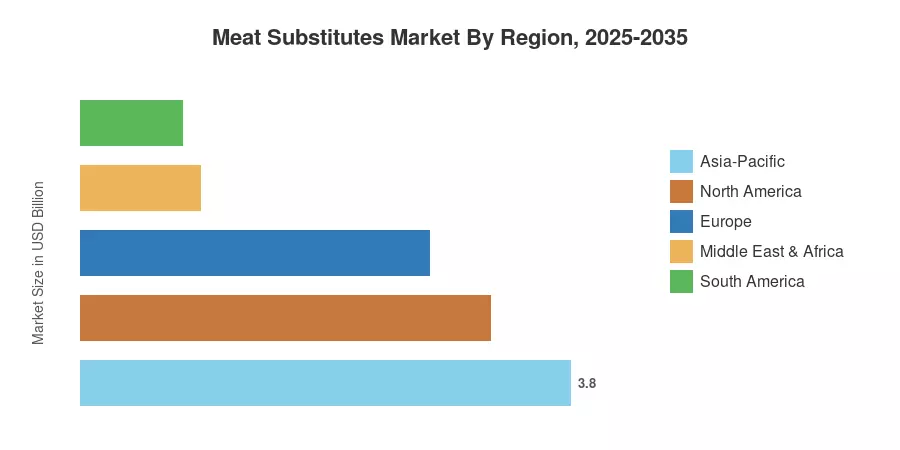
On the basis of its traditional base in China, Indonesia, Japan, and India, Asia-Pacific currently controls 36.5% of the Meat Substitutes Market. The Middle East and Africa region experiences the most rapid growth, with a compound annual growth rate (CAGR) of 8.9%, despite its relatively tiny denominator. North America continues to be the second-largest region, with a share of 30.5%. However, its share is declining throughout the forecast as volume recovery is delayed in comparison to Asia. The reacceleration of the Meat Substitutes Market beyond 7% is contingent upon the success of reformulated products in recapturing lapsed buyers, rather than the introduction of new products.
Key Report Takeaways
• By Type
- Tofu commands 34.5% of the Meat Substitutes Market by value in 2025, anchored by East and Southeast Asian household consumption.
- Textured Vegetable Protein generated USD 2.81 billion in 2025, the largest industrial-input segment
- Seitan expands at a 7.4% CAGR through 2035, the fastest-growing traditional format
• By Source
- Soy accounts for 52.0% of the Meat Substitutes Market by source
- Mycoprotein posts an 8.6% CAGR, the fastest-growing source class
- Wheat-derived substrates contributed USD 2.19 Billion in 2025
• By Region
- Asia-Pacific leads the Meat Substitutes Market with a 36.5% share
- Middle East & Africa records an 8.9% CAGR, the fastest regional rate
- Europe reached USD 2.71 Billion in 2025 despite labelling headwinds
Market Size and Forecast (2021–2035)
Historical values are triangulated from Euromonitor retail tracking published through the Good Food Institute, SPINS United States scanner data, and disclosed company revenues [1][2][8]. Traditional-format volume outside scanner coverage is estimated from national consumption surveys and applied at regional average pricing. Forecast years apply a demand-recovery curve weighted toward reformulated product acceptance.