Polyurethane Coatings Market

Key Players: AkzoNobel N.V., BASF SE, PPG Industries, Inc., RPM International Inc., Axalta Coating Systems Ltd., Covestro AG, Huntsman Corporation, Nippon Paint Holdings Co., Ltd.

Polyurethane Coatings Market

Polyurethane Coatings Market Research Report Information By Technology (Solvent-Borne, Water-Borne, Spray), By End-user (Automotive, Aerospace, Household, Construction, Electronics), And By Region (North America, Europe, Asia-Pacific, And Rest Of The World) – Market Forecast Till 2035
ID: MRFR/CnM/2190-HCR
140 Pages
Chitranshi Jaiswal
Last Updated: June 22, 2026

Polyurethane Coatings Market Summary

The Polyurethane Coatings Market stood at USD 25.77 Million in 2025 and is projected to reach USD 41.62 Million by 2035, expanding at a 4.95% CAGR over the 2026–2035 forecast window. From a 2026 starting value of USD 26.95 million, steady demand growth reflects tightening VOC emission regulations across the EU and North America, alongside accelerating construction activity in Asia-Pacific economies. The Polyurethane Coatings Market benefits directly from policy catalysts such as the European Green Deal's push toward low-emission building materials and the U.S. EPA's 2024 National Emission Standards update, both of which channel specifiers toward compliant polyurethane systems [1][2].

A technology transition is underway within the Polyurethane Coatings Market as traditional solvent-borne formulations face substitution pressure from waterborne dispersions and radiation-cured chemistries. Global investment in bio-based polyol feedstocks exceeded USD 1.2 billion between 2022 and 2024, driven by BASF, Covestro, and mid-tier formulators seeking isocyanate-free curing pathways [3]. Governments in China and India now mandate maximum solvent content thresholds for architectural and industrial applications, accelerating reformulation timelines.

Asia-Pacific commands roughly 39.8% of the Polyurethane Coatings Market, underpinned by China's infrastructure pipeline and India's Smart Cities Mission. The region also registers the fastest CAGR at 5.79% through 2035. North America holds the second-largest position at 24.5% share, supported by automotive OEM refinish cycles and aerospace MRO spending. Europe follows closely, leveraging sustainability mandates to drive waterborne adoption. As circular-economy raw materials gain commercial scale, the Polyurethane Coatings Market is positioned for sustained medium-term expansion across all end-use verticals.


Key Report Takeaways

• By Technology

  • Solvent-borne coatings held a 43.9% revenue share in 2025, retaining the largest technology segment position within the Polyurethane Coatings Market despite regulatory headwinds.
  • Water-borne technology is the fastest-growing segment, projected to advance at a 7.20% CAGR through 2035 as OEMs and architectural specifiers shift toward low-VOC formulations.

• By End-User Industry

  • Automotive applications captured 31.6% of the Polyurethane Coatings Market in 2025, driven by OEM primer and clearcoat demand cycles.
  • Construction end-use is expanding at a 5.28% CAGR through 2035, propelled by green building certifications and waterproofing specifications.

• By Region

  • Asia-Pacific contributed 39.8% of global revenue in 2025, the dominant regional market.
  • South America is projected to register a 5.45% CAGR, the second-fastest regional growth rate, led by Brazilian infrastructure investment.


Market Size and Forecast (2021–2035)

Market Research Future derives market sizing through a triangulated methodology combining bottom-up supply audits of resin producers, top-down end-user demand modeling, and cross-validation against publicly reported revenues of the top 10 coatings companies. All figures are expressed in constant 2025 USD.
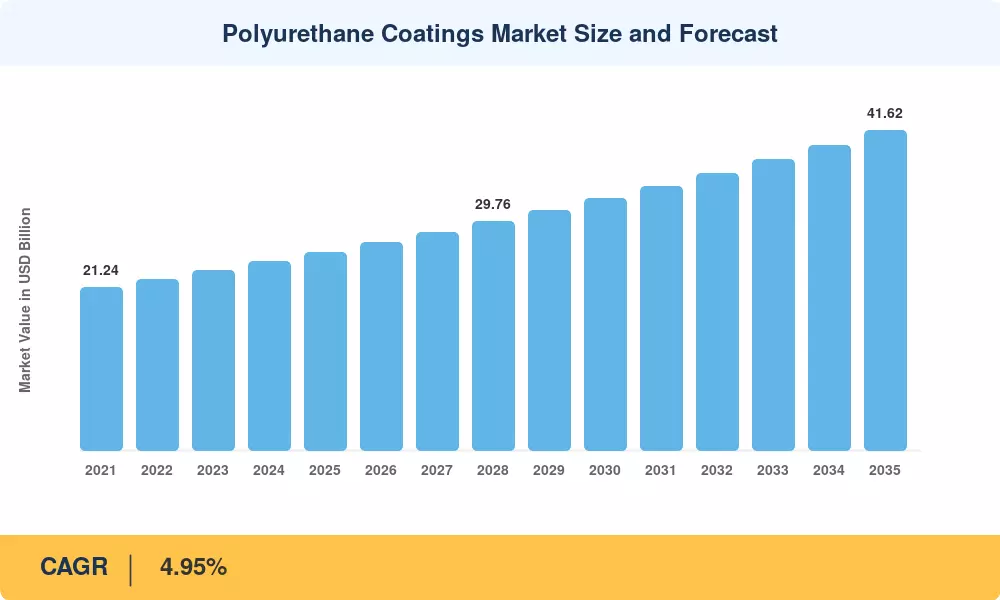
Polyurethane Coatings Market Size and Forecast
Our Impact
Enabled $4.3B Revenue Impact for Fortune 500 and Leading Multinationals
Partnering with 2000+ Global Organizations Each Year
30K+ Citations by Top-Tier Firms in the Industry

Driver Impact Analysis

Driver ~% Impact on CAGR Geographic Relevance Impact Timeline
Low-VOC regulatory mandates +0.90 Global Short-term (≤2 yr)
Automotive OEM coating cycles +0.75 North America, Europe Medium-term (2–4 yr)
Infrastructure and green building programs +0.70 Asia-Pacific, South America Long-term (≥4 yr)
Bio-based polyol commercialization +0.55 Europe, North America Medium-term (2–4 yr)
Waterborne dispersion innovation +0.50 Global Short-term (≤2 yr)
EV battery enclosure coating demand +0.40 China, Europe Medium-term (2–4 yr)
Industrial flooring refurbishment cycles +0.35 North America, Europe Long-term (≥4 yr)


Low-VOC Regulatory Mandates

The US EPA's NESHAP frameworks govern hazardous air pollutants (HAPs) at industrial facilities. Similarly, under the permanent EU Decopaint Directive (2004/42/EC Phase II), strict VOC thresholds are fixed by product subclass. These thresholds effectively force formulators to reformulate legacy solvent-borne lines or lose specification eligibility. The Polyurethane Coatings Market benefits because polyurethane chemistries adapt well to waterborne and high-solids platforms, giving PU-based formulators a compliance advantage over alkyd and epoxy alternatives that face steeper reformulation costs.

Automotive OEM Coating Cycles

OICA forecasts that worldwide light-vehicle production would top 93 million units by 2027, spurring primer, basecoat, and clearcoat use across assembly plants [5]. Polyurethane Coatings Market is likely to grow on the back of rising demand from Electric vehicle platforms requiring specialist dielectric and corrosion-protection coatings for battery enclosures. Germany and Japan’s premium vehicle OEMs have officially committed to 100% waterborne primer lines by 2028, and this is where legislative ambition becomes measurable volume shifts.


Infrastructure and Green Building Programs

The USD 7.5 billion Smart Cities Mission of India has committed funds for the renovation of infrastructure for 100 cities by 2025, including coating-intensive sectors such as bridge decks, parking structures, and institutional floors [7]. China’s 14th Five-Year Plan infrastructure spending to reach USD 1.1 trillion, driving substantial demand for high-durability floor and wall coating solutions. Green building certification standards, such as LEED v4.1 and BREEAM, explicitly favor waterborne polyurethane topcoats by awarding credits for low-emission interior finishes.


Bio-Based Polyol Commercialization

Covestro's Cardyon platform and BASF's Sovermol line demonstrate that bio-based polyols can now replace 30–40% of petroleum-derived feedstocks without sacrificing film hardness or chemical resistance [3]. The European Commission's Circular Economy Action Plan offers grant funding to pilot bio-feedstock integration in coatings manufacturing. These investments compress the cost premium for bio-PU systems, making them commercially viable for mid-volume applications.


Restraints Impact Analysis

The restraint estimates below are directional and reflect each factor's drag on overall growth momentum. They do not subtract directly from the headline CAGR.

Restraint ~% Impact on CAGR Geographic Relevance Impact Timeline
Volatile isocyanate and polyol prices –0.60 Global Short-term (≤2 yr)
Regulatory complexity across jurisdictions –0.40 Global Medium-term (2–4 yr)
Curing limitations in cold climates –0.25 Northern Europe, Canada Short-term (≤2 yr)
Substitution threat from silicone and epoxy hybrids –0.20 North America, Europe Long-term (≥4 yr)
Skilled applicator shortages –0.15 Global Medium-term (2–4 yr)


Volatile Isocyanate and Polyol Prices

MDI and TDI prices swung by 18–25% between 2022 and 2024 as upstream toluene and propylene oxide markets experienced supply disruptions from plant turnarounds in China and the Gulf Coast [12]. This volatility compresses formulator margins and delays product-launch timelines, since price protection clauses in OEM supply contracts typically lag spot markets by 60–90 days. Smaller formulators operating on thin working capital face disproportionate pressure, a dynamic that accelerates M&A consolidation within the Polyurethane Coatings Market.

Regulatory Complexity Across Jurisdictions

While VOC limits drive demand for reformulated products, the lack of harmonized standards across the EU, U.S., China, and ASEAN creates duplicative testing and registration costs [13]. This fragmentation particularly disadvantages mid-size players in the Polyurethane Coatings Market that lack centralized regulatory affairs teams.


Polyurethane Coatings Market Opportunities

Waterborne Polyurethane Dispersion Growth

The rapid 6.2% CAGR projected for waterborne technology signals a large reformulation opportunity for resin producers and coatings formulators. Early movers that lock in specification positions with OEM purchasing groups will benefit from multi-year supply contracts, particularly in automotive primer and wood-furniture topcoat applications.

EV Battery Enclosure and Electronics Coatings

Electric vehicle production is expected to reach 40 million units annually by 2030, each requiring dielectric conformal coatings and thermal-management finishes for battery packs [9]. This creates an entirely new application category within the Polyurethane Coatings Market that did not exist at scale five years ago.

Emerging-Market Construction Boom

PAC infrastructure initiative in Brazil, Indonesia’s new capital city project at Nusantara, and Saudi Arabia’s Vision 2030 megaprojects together account for more than USD 350 billion in construction spending until 2030 [7][17]. High volume entry points for global PU suppliers in these projects are protective floor coatings, bridge-deck membranes, and architectural finishes in the Polyurethane Coatings Market.


Digital Color-Matching and Specification Platforms

Cloud-based platforms that integrate spectrophotometer data with coatings specification databases are enabling formulators to monetize color-matching services on a per-project subscription basis. This digital-services layer transforms a commodity chemical sale into a recurring-revenue business model, with early adopters reporting 12–15% margin improvement on specification-linked volumes [18].

Self-Healing and Nano-Enabled Chemistries

Nano-silica and graphene-oxide additives are advancing from laboratory-scale trials to commercial pilot runs, offering scratch-recovery and corrosion-resistant coatings that extend maintenance intervals by 2–3× compared with conventional PU topcoats [19]. Licensing these additive packages represents a platform opportunity for specialty chemical suppliers.


Polyurethane Coatings Market Future Outlook

Sustainability Reporting and ESG-Driven Specification

The EU Corporate Sustainability Reporting Directive (CSRD) will require over 50,000 companies to disclose Scope 3 emissions, including embodied carbon in purchased materials [20]. Coatings formulators that publish verified Environmental Product Declarations (EPDs) will secure specification advantages in public procurement and ESG-screened supply chains, reshaping competitive positioning within the Polyurethane Coatings Market.

Electrification Supercycle and New Coating Substrates

The global EV transition will create demand for coatings on lightweight composite body panels, aluminum battery trays, and thermoplastic interior components that cannot be addressed by standard steel-optimized primers [9]. Polyurethane systems that can be tuned for flexibility and adhesion profiles are ideally positioned to address this diversification of substrates, especially in the 2028-2032 time frame when the proliferation of EV platforms peaks.


AI-Enabled Formulation and Quality Control

Machine-learning models trained on decades of formulation data are reducing new-product development processes from 18 months to less than 6 months for large coatings businesses [21]. Automated spectral analysis during manufacturing allows for real-time correction of viscosity and color-match, leading to a 30–40% reduction in batch rejection rates. These digital tools are giving an increasing efficiency edge to scale players in the Polyurethane Coatings Market.


Circular Economy and Coating Recyclability

The Ellen MacArthur Foundation's Plastics Pact targets 100% reusable, recyclable, or compostable plastic packaging by 2030, and coatings applied to recyclable substrates must not contaminate recycling streams [22]. Decoatable and de-laminatable PU coating technologies are emerging to satisfy this requirement, opening a new R&D frontier for the Polyurethane Coatings Market by 2030.


Polyurethane Coatings Market Segmentation

By Technology

Segment Key Metric (2025) Primary Demand Driver
Solvent-Borne 43.9% share Legacy OEM and industrial specifications
Water-Borne 7.20% CAGR (2026–2035) VOC regulation compliance
Powder USD 4.33 Million Appliance and furniture finishing
Radiation-Cured/UV 6.85% CAGR (2026–2035) Electronics and packaging


Solvent-borne coatings retain the largest share of the Polyurethane Coatings Market because decades of application data and established cure schedules make them the default choice for heavy-industrial maintenance and marine applications. Reformulation to waterborne alternatives requires capital investment in new spray equipment and oven modifications, slowing the transition for smaller applicators.

Water-borne technology is the fastest-growing segment in the Polyurethane Coatings Market, propelled by regulatory mandates in the EU, U.S., and China that cap solvent emissions. Advances in polyurethane dispersion (PUD) chemistry now deliver film performance — including scratch resistance, gloss retention, and chemical resistance — that closely rivals solvent-borne benchmarks, removing historical performance objections [8].

By End-User Industry

Segment Key Metric (2025) Primary Demand Driver
Automotive 31.6% share OEM primer and clearcoat cycles
Construction 5.28% CAGR (2026–2035) Green building certifications
Wood and Furniture USD 4.25 Million Interior design and export demand
Transportation 5.02% CAGR (2026–2035) Rail and aerospace MRO
Electrical and Electronics USD 2.45 Million Conformal and dielectric coatings
Other End-User Industries 4.60% CAGR (2026–2035) Miscellaneous industrial applications


Automotive remains the top end-user within the Polyurethane Coatings Market due to multi-layer coating stacks required across each vehicle — electrocoat, primer, basecoat, and clearcoat — with PU chemistry dominant in primer-surfacer and clearcoat layers. EV platform proliferation is adding incremental demand for battery-tray coatings.

Construction is the fastest-growing end-user segment, as green building standards increasingly specify waterborne PU floor coatings, deck membranes, and facade finishes. LEED v4.1 and BREEAM credit structures penalize high-VOC products, giving the Polyurethane Coatings Market a regulatory tailwind in commercial and institutional construction.


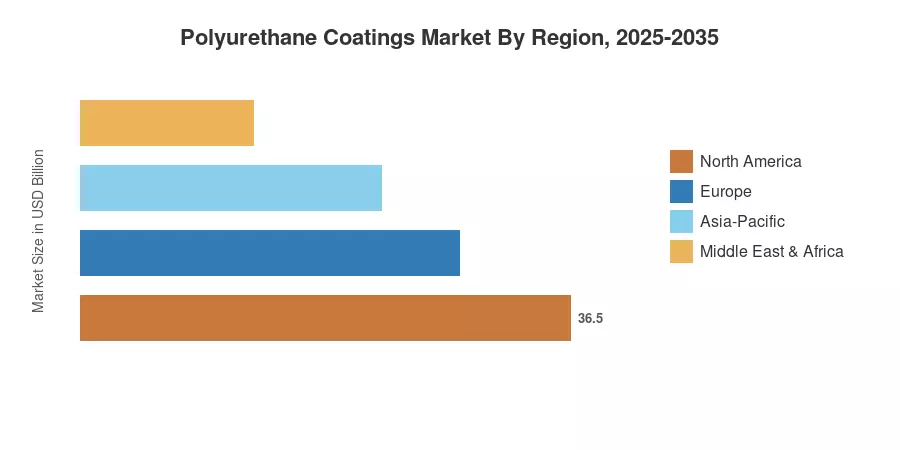
Regional Market Share Analysis

Region Key Metric (2025) Primary Investment Themes
Asia-Pacific 39.8% share Infrastructure buildout, automotive assembly expansion
North America 24.5% share OEM refinish, aerospace MRO, VOC compliance
Europe 22.2% share Waterborne transition, sustainability mandates
South America USD 2.01 Million PAC infrastructure, residential construction
Middle East & Africa 5.45% CAGR (2026–2035) Megaproject coatings, oil & gas asset protection
Total USD 25.77 Million

The Polyurethane Coatings Market exhibits distinct regional dynamics shaped by regulatory environments, construction cycles, and automotive manufacturing footprints.


North America

Country Key Metric Key Driver
US 68.2% of regional share Automotive OEM and aerospace refinish
Canada 4.85% CAGR Oil sands infrastructure coatings
Mexico USD 1.02 Million Nearshoring automotive assembly plants


The United States dominates the North American Polyurethane Coatings Market through a combination of automotive assembly volume, aerospace MRO spending, and strict EPA emission standards that push specifiers toward compliant PU systems. Canada's oil sands maintenance cycle and Mexico's expanding automotive export base provide secondary growth vectors.

Europe

Country Key Metric Key Driver
Germany 26.4% of regional share Automotive OEM demand
UK 5.12% CAGR Green building retrofits
France USD 0.82 Million Aerospace and rail applications
Italy 12.6% of regional share Furniture and wood finishing
Spain 4.78% CAGR Construction recovery cycle
Nordic Countries USD 0.38 Million Offshore wind infrastructure
Russia 3.8% of regional share Heavy industrial maintenance
Rest of Europe 4.65% CAGR Regulatory harmonization benefits


European demand for the Polyurethane Coatings Market is anchored by Germany's automotive sector and Italy's wood-furniture industry, while the Decopaint Directive continues to drive waterborne reformulation across the continent. The UK's Energy Efficiency Retrofit Programme, worth GBP 6 billion, creates substantial demand for interior low-VOC floor and wall coatings through 2028 [6].

Asia-Pacific

Country Key Metric Key Driver
China 48.5% of regional share Infrastructure and EV manufacturing
India 6.10% CAGR Smart Cities Mission, housing
Japan USD 1.38 Million Automotive and electronics
South Korea 5.85% CAGR Semiconductor fab coatings
ASEAN USD 0.94 Million Construction and industrial growth
Rest of Asia-Pacific 4.92% CAGR Developing market penetration


Asia-Pacific's dominance in the Polyurethane Coatings Market reflects China's dual role as the world's largest construction market and its fastest-growing EV production base. India's residential housing shortage — estimated at 30 million urban units — sustains long-duration demand for waterproof and decorative PU finishes [7]. Japan and South Korea contribute high-value demand from automotive refinish and semiconductor cleanroom coatings.

South America

Country Key Metric Key Driver
Brazil 62.5% of regional share PAC infrastructure program
Argentina 4.90% CAGR Agricultural storage coatings
Rest of South America USD 0.42 Million Mining and industrial maintenance


Brazil's PAC growth acceleration program channels over USD 65 billion into transport, energy, and social infrastructure, creating demand for bridge-deck, pipeline, and institutional floor coating systems. Argentina's agricultural sector requires grain-storage facility coatings, a niche but steady volume contributor to the regional Polyurethane Coatings Market [17].

Middle East & Africa

Country Key Metric Key Driver
Saudi Arabia 34.2% of regional share Vision 2030 megaprojects
UAE 5.60% CAGR NEOM, Expo legacy developments
South Africa USD 0.24 Million Mining and heavy-industry coatings
Egypt 5.15% CAGR New Administrative Capital construction
Rest of MEA 4.70% CAGR Oil & gas asset protection


Saudi Arabia's NEOM, Red Sea Global, and Diriyah Gate projects require industrial surface coatings for structural steel, concrete substrates, and decorative interiors on an unprecedented scale. The UAE's post-Expo construction pipeline and Egypt's New Administrative Capital program sustain demand growth across the MEA Polyurethane Coatings Market through the forecast period [17].


Polyurethane Coatings Market By Region, 2025-2035

Competitive Benchmarking

The Polyurethane Coatings Market exhibits medium concentration, with the top five players accounting for an estimated 38–44% of global revenue and a Herfindahl-Hirschman Index in the 600–800 range. The remaining market is fragmented across regional formulators, toll manufacturers, and specialty additive suppliers. M&A activity has intensified since 2023 as global suppliers acquire mid-size formulators to gain regional distribution and niche technology platforms.

Company Est. Revenue Share Range Key Offerings Strategic Positioning
AkzoNobel N.V. ~8–11% Architectural and protective PU coatings Global scale, sustainability leadership
BASF SE ~7–10% Automotive OEM coatings, polyol systems Vertically integrated feedstock supply
PPG Industries, Inc. ~7–10% Aerospace, automotive, industrial PU lines Multi-sector diversification
The Sherwin-Williams Company ~6–9% Architectural, protective, wood finishes Extensive distributor network
RPM International Inc. ~4–6% Specialty protective and marine coatings Niche brand portfolio strategy
Axalta Coating Systems Ltd. ~4–6% Automotive refinish, industrial coatings Refinish channel dominance
Covestro AG ~3–5% Raw material supply (MDI, polyols, PUDs) Upstream integration
Huntsman Corporation ~3–5% MDI-based coating systems Isocyanate feedstock position
Nippon Paint Holdings Co., Ltd. ~3–5% Architectural, automotive coatings in APAC Asia-Pacific market leadership
Asian Paints Limited ~2–4% Decorative and industrial coatings in India Emerging-market distribution


Recent News & Developments


  • BASF (January 2025): Optimized its global manufacturing footprint by accelerating downstream chemical investments across its South China clusters, expanding polymer dispersion and specialized acrylic capacity at its Huizhou facility to serve regional architectural and industrial coating formulators.


  • The Sherwin-Williams Company (April 2024): Invested USD 45 million in a new R&D center in the Cleveland suburb of Brecksville, Ohio, focused on next-generation waterborne and UV-cure PU technologies [8].
  • European Commission (January 2024): Maintained strict category-level enforcement under Phase II of the Decopaint Directive (2004/42/EC), compelling architectural coating manufacturers to adhere to rigid volatile organic compound limitations, including the 300 g/L maximum boundary for interior/exterior trim glosses.
  • Nippon Paint Holdings (September 2023): Signed a joint venture with BASF Greater China to debut eco-friendly industrial packaging for its dry-mixed mortar product lines, substituting traditional plastic containers with sustainable paper boards coated with water-based Joncryl® acrylic barrier resins.


Polyurethane Coatings Market Report Scope

Parameter Detail
Market Scope Global Polyurethane Coatings Market by Technology, End-User Industry, and Region
Study Period 2021–2035
CAGR (2026–2035) 4.95%
Base Year Market Size USD 25.77 Million (2025)
Forecast Endpoint USD 41.62 Million (2035)
Fastest Growing Technology Water-Borne (7.20% CAGR)
Fastest Growing Region Asia-Pacific (5.79% CAGR)
Companies Profiled 10
Valuation Currency USD Million


FAQs

How do isocyanate-free curing technologies affect formulation costs for polyurethane coatings?

Isocyanate-free systems currently carry a 15–25% raw-material premium over conventional MDI-based formulations [15]. Costs are expected to narrow as production scales and bio-based crosslinker supply matures.

What testing certifications should specifiers require when evaluating the Polyurethane Coatings Market for aerospace applications?

Specifiers should require AMS 3095 and MIL-PRF-85285 compliance, covering chemical resistance and UV stability [10]. Third-party Nadcap accreditation of the applicator facility adds another quality assurance layer.

How does the Polyurethane Coatings Market address substrate adhesion challenges on lightweight composites?

Formulators use plasma or corona surface pretreatment paired with flexible PU primers designed for low-surface-energy substrates [19]. This approach achieves cross-hatch adhesion ratings exceeding ASTM D3359 Class 5B on carbon-fiber panels.

What procurement strategies help buyers manage MDI price volatility in polyurethane coatings?

Buyers negotiate index-linked pricing clauses tied to published ICIS MDI benchmarks and maintain 60–90-day safety stock [12]. Dual-sourcing from at least two isocyanate suppliers reduces single-vendor exposure.

Which emerging application in the Polyurethane Coatings Market offers the highest near-term volume potential?

EV battery enclosure coatings present the strongest near-term upside, with BloombergNEF projecting 40 million annual EV units by 2030 [9]. Each vehicle requires 1.5–2.5 square meters of dielectric PU film on battery housings.

How do digital color-matching platforms change competitive dynamics among coating formulators?

Cloud-based spectrophotometry platforms enable formulators to offer color-match-as-a-service subscriptions, generating recurring revenue [18]. This shifts competitive advantage from production scale toward data and specification integration.

What risks should investors evaluate before entering the Polyurethane Coatings Market through M&A?

Key risks include unresolved REACH or TSCA registration gaps, customer concentration above 30%, and pending VOC-compliance capital expenditures [13]. Thorough regulatory due diligence is essential before closing any acquisition.    
Author
Author
Author Profile
Chitranshi Jaiswal LinkedIn
Team Lead - Research
Chitranshi is a Team Leader in the Chemicals & Materials (CnM) and Energy & Power (EnP) domains, with 6+ years of experience in market research. She leads and mentors teams to deliver cross-domain projects that equip clients with actionable insights and growth strategies. She is skilled in market estimation, forecasting, competitive benchmarking, and both primary & secondary research, enabling her to turn complex data into decision-ready insights. An engineer and MBA professional, she combines technical expertise with strategic acumen to solve dynamic market challenges. Chitranshi has successfully managed projects that support market entry, investment planning, and competitive positioning, while building strong client relationships. Certified in Advanced Excel & Power BI she leverages data-driven approaches to ensure accuracy, clarity, and impactful outcomes.

Research Approach


Secondary Research

The secondary research process involved comprehensive analysis of regulatory databases, peer-reviewed chemical engineering journals, industry publications, and authoritative chemical/coating organizations. Key sources included the US Environmental Protection Agency (EPA), European Chemicals Agency (ECHA) REACH database, Occupational Safety and Health Administration (OSHA), American Coatings Association (ACA), European Coatings Association (ECA), Society for Protective Coatings (SSPC), NACE International (AMPP), American Chemical Society (ACS) Chemical Abstracts Service, Journal of Coatings Technology and Research, Paint & Coatings Industry (PCI) Magazine, European Paint and Resin News, ChemQuest Powder Coating Research, Freedonia Group Chemical Reports, US Census Bureau Construction Spending Data, International Energy Agency (IEA) industrial coatings data, China National Chemical Information Center, and Japan Paint Manufacturers Association (JPMA). These sources were utilized to collect production capacity data, regulatory compliance standards (VOC emissions, hazardous substance directives), raw material pricing trends (MDI/TDI/polyols), application technology studies, and end-user industry forecasts for automotive, construction, and marine sectors.

Specific Sources Consulted:

Regulatory Bodies: EPA 40 CFR Part 59 (National Volatile Organic Compound Emission Standards), EU Directive 2004/42/CE (Paints Directive), REACH Registration Database, California Air Resources Board (CARB) Suggested Control Measures

Industry Associations: American Coatings Association (ACA), European Council of Paint, Printing Ink and Artists' Colours Manufacturers (CEPE), The Society for Protective Coatings (SSPC), Association for Materials Protection and Performance (AMPP), China National Coatings Industry Association (CNCIA)

Technical Standards: ISO 12944 (Corrosion protection of steel structures), ASTM D1640 (Drying/Curing of Organic Coatings), NACE SP0108 (Protection of Coatings and Linings)

Raw Material Intelligence: ICIS Chemical Pricing (Polyols, Isocyanates), Platts Petrochemical Analytics, Cefic European Chemical Industry Council production statistics

End-User Industry Data: OICA Automotive Production Statistics, European Automobile Manufacturers' Association (ACEA), US Bureau of Transportation Statistics, Eurostat Construction Production Index, Clarkson's World Shipyard Monitor (Marine coatings)


Primary Research

Qualitative and quantitative insights were obtained by interviewing supply-side and demand-side stakeholders during the primary research process. The supply-side sources comprised CEOs, VPs of Manufacturing, Heads of R&D and Product Development, Chief Sustainability Officers, and regulatory affairs managers from polyurethane coating manufacturers, raw material suppliers (polyisocyanate and polyol producers), and OEM partners. Demand-side sources included procurement directors from automotive OEMs and tier-1 suppliers, construction project managers, marine fleet maintenance superintendents, industrial coating applicators, wood furniture manufacturing executives, and aerospace coating specification engineers. The primary research validated technology adoption rates (water-borne vs. solvent-borne), confirmed sustainability pipeline timelines, and garnered insights on VOC regulation compliance costs, pricing strategies for two-component PU systems, and raw material volatility management.

Primary Respondent Breakdown:

By Designation: C-level Primaries (32%), Director Level (30%), Others (38%)

By Region: North America (32%), Europe (30%), Asia-Pacific (28%), Rest of World (10%)


Market Size Estimation

Global market valuation was derived through revenue mapping and consumption volume analysis across architectural, industrial, and automotive OEM markets. The methodology included:

Identification of over 60 main manufacturers in North America, Europe, Asia-Pacific, and Latin America, including diversified chemical conglomerates and dedicated coating manufacturers

Product mapping across solvent-borne (conventional high-solids), water-borne (emulsion and dispersion), and spray application technologies (powder and liquid)

End-use segmentation analysis across automotive OEM/refinish, general industrial, wood/furniture, marine, aerospace, and construction protective coatings

Analysis of reported and modeled annual revenues specific to polyurethane coating portfolios and regional subsidiaries

Coverage of manufacturers representing 65-70% of global market share in 2024, with statistical imputation for private coating companies

Raw material consumption cross-validation (MDI, TDI, aliphatic isocyanates, polyether/acrylic polyols) against coating production volumes

Extrapolation using bottom-up (application area × coating consumption rates × ASP by country/sector) and top-down (manufacturer revenue validation and chemical industry aggregates) approaches to derive segment-specific valuations

Capacity utilization analysis at major production facilities in Germany, China, US, and Japan to estimate effective market supply

Adjustment for grey market imports and unorganized sector activity in emerging Asian markets

Download Free Sample

Kindly complete the form below to receive a free sample of this Report

Download PDF ×

We do not share your information with anyone. However, we may send you emails based on your report interest from time to time. You may contact us at any time to opt-out.