Polyurethane Coatings Market

ID: MRFR/CnM/2190-HCR
140 Pages
Chitranshi Jaiswal
Last Updated: June 22, 2026
Polyurethane Coatings Market Research Report Information By Technology (Solvent-Borne, Water-Borne, Spray), By End-user (Automotive, Aerospace, Household, Construction, Electronics), And By Region (North America, Europe, Asia-Pacific, And Rest Of The World) – Market Forecast Till 2035
Download PDF ×

We do not share your information with anyone. However, we may send you emails based on your report interest from time to time. You may contact us at any time to opt-out.

  1. 1 Market Overview |
    1. 1.1 Study Assumptions & Market Definition |
    2. 1.2 Scope of the Study |
    3. 1.3 Research Methodology
  2. 2 Market Summary & Key Takeaways
  3. 3 Market Dynamics |
    1. 3.1 Market Drivers Analysis | |
      1. 3.1.1 Low-VOC Regulatory Mandates | |
      2. 3.1.2 Automotive OEM Coating Cycles | |
      3. 3.1.3 Infrastructure and Green Building Programs | |
      4. 3.1.4 Bio-Based Polyol Commercialization | |
      5. 3.1.5 Waterborne Dispersion Innovation | |
      6. 3.1.6 EV Battery Enclosure Coating Demand | |
      7. 3.1.7 Industrial Flooring Refurbishment Cycles |
    2. 3.2 Market Restraints Analysis | |
      1. 3.2.1 Volatile Isocyanate and Polyol Prices | |
      2. 3.2.2 Regulatory Complexity Across Jurisdictions | |
      3. 3.2.3 Curing Limitations in Cold Climates | |
      4. 3.2.4 Substitution Threat from Silicone and Epoxy Hybrids | |
      5. 3.2.5 Skilled Applicator Shortages |
    3. 3.3 Market Opportunity Analysis | |
      1. 3.3.1 Waterborne Polyurethane Dispersion Growth | |
      2. 3.3.2 EV Battery Enclosure and Electronics Coatings | |
      3. 3.3.3 Emerging-Market Construction Boom | |
      4. 3.3.4 Digital Color-Matching and Specification Platforms | |
      5. 3.3.5 Self-Healing and Nano-Enabled Chemistries |
    4. 3.4 Industry Value Chain Analysis |
    5. 3.5 Porter's Five Forces Analysis
  4. 4 Global Polyurethane Coatings Market Size & Forecast (2021–2035) |
    1. 4.1 Historical Market Size (2021–2025) |
    2. 4.2 Current & Forecast Market Size (2026–2035) |
    3. 4.3 Market Size by Revenue (USD Million) |
    4. 4.4 Year-over-Year Growth Analysis
  5. 5 Segmentation Analysis |
    1. 5.1 By Technology | |
      1. 5.1.1 Solvent-Borne | |
      2. 5.1.2 Water-Borne | |
      3. 5.1.3 Powder | |
      4. 5.1.4 Radiation-Cured/UV |
    2. 5.2 By End-User Industry | |
      1. 5.2.1 Automotive | |
      2. 5.2.2 Construction | |
      3. 5.2.3 Wood and Furniture | |
      4. 5.2.4 Transportation | |
      5. 5.2.5 Electrical and Electronics | |
      6. 5.2.6 Other End-User Industries
  6. 6 Regional Analysis |
    1. 6.1 North America | |
      1. 6.1.1 United States | |
      2. 6.1.2 Canada | |
      3. 6.1.3 Mexico |
    2. 6.2 Europe | |
      1. 6.2.1 Germany | |
      2. 6.2.2 United Kingdom | |
      3. 6.2.3 France | |
      4. 6.2.4 Italy | |
      5. 6.2.5 Spain | |
      6. 6.2.6 Nordic Countries | |
      7. 6.2.7 Russia | |
      8. 6.2.8 Rest of Europe |
    3. 6.3 Asia-Pacific | |
      1. 6.3.1 China | |
      2. 6.3.2 India | |
      3. 6.3.3 Japan | |
      4. 6.3.4 South Korea | |
      5. 6.3.5 ASEAN | |
      6. 6.3.6 Rest of Asia-Pacific |
    4. 6.4 South America | |
      1. 6.4.1 Brazil | |
      2. 6.4.2 Argentina | |
      3. 6.4.3 Rest of South America |
    5. 6.5 Middle East & Africa | |
      1. 6.5.1 Saudi Arabia | |
      2. 6.5.2 UAE | |
      3. 6.5.3 South Africa | |
      4. 6.5.4 Egypt | |
      5. 6.5.5 Rest of MEA
  7. 7 Competitive Landscape |
    1. 7.1 Market Share Analysis (2025) |
    2. 7.2 Competitive Benchmarking Matrix |
    3. 7.3 Company Profiles | |
      1. 7.3.1 AkzoNobel N.V. | |
      2. 7.3.2 BASF SE | |
      3. 7.3.3 PPG Industries, Inc. | |
      4. 7.3.4 The Sherwin-Williams Company | |
      5. 7.3.5 RPM International Inc. | |
      6. 7.3.6 Axalta Coating Systems Ltd. | |
      7. 7.3.7 Covestro AG | |
      8. 7.3.8 Huntsman Corporation | |
      9. 7.3.9 Nippon Paint Holdings Co., Ltd. | |
      10. 7.3.10 Asian Paints Limited
  8. 8 Future Outlook & Strategic Recommendations (2026–2035) |
    1. 8.1 Sustainability Reporting and ESG-Driven Specification |
    2. 8.2 Electrification Supercycle and New Coating Substrates |
    3. 8.3 AI-Enabled Formulation and Quality Control |
    4. 8.4 Circular Economy and Coating Recyclability
  9. 9 Recent Developments & News
  10. 10 Frequently Asked Questions (FAQs)
  11. 11 Report Scope & Methodology |
    1. 11.1 Study Period & Base Year |
    2. 11.2 Data Sources & Citations |
    3. 11.3 Abbreviations
  12. 12 LIST OF TABLES |
  13. TABLE 1 Global Polyurethane Coatings Market Size & Forecast, by Revenue (USD Million), 2021–2035 |
  14. TABLE 2 Global Polyurethane Coatings Market — Year-over-Year Growth Analysis, 2021–2035 |
  15. TABLE 3 Market Driver Impact Analysis, 2026–2035 |
  16. TABLE 4 Market Restraint Impact Analysis, 2026–2035 |
  17. TABLE 5 Regional Market Summary, Polyurethane Coatings Market, 2025 |
  18. TABLE 6 North America Polyurethane Coatings Market, by Country, 2021–2035 (USD Million) |
  19. TABLE 7 Europe Polyurethane Coatings Market, by Country, 2021–2035 (USD Million) |
  20. TABLE 8 Asia-Pacific Polyurethane Coatings Market, by Country, 2021–2035 (USD Million) |
  21. TABLE 9 South America Polyurethane Coatings Market, by Country, 2021–2035 (USD Million) |
  22. TABLE 10 Middle East & Africa Polyurethane Coatings Market, by Country, 2021–2035 (USD Million) |
  23. TABLE 11 Global Polyurethane Coatings Market Size, by Technology, 2021–2035 (USD Million) |
  24. TABLE 12 Global Polyurethane Coatings Market Size, by End-User Industry, 2021–2035 (USD Million) |
  25. TABLE 13 Competitive Benchmarking Matrix — Global Polyurethane Coatings Market, 2025 |
  26. TABLE 14 Company Profiles — Key Players, Global Polyurethane Coatings Market |
  27. TABLE 15 Recent Developments & Strategic Announcements, 2023–2025 |
  28. TABLE 16 Report Scope & Methodology Summary |
  29. TABLE 17 Detailed Sources and Citations |
  30. TABLE 18 North America Polyurethane Coatings Market Size, by Technology, 2021–2035 (USD Million) |
  31. TABLE 19 North America Polyurethane Coatings Market Size, by End-User Industry, 2021–2035 (USD Million) |
  32. TABLE 20 Europe Polyurethane Coatings Market Size, by Technology, 2021–2035 (USD Million) |
  33. TABLE 21 Europe Polyurethane Coatings Market Size, by End-User Industry, 2021–2035 (USD Million) |
  34. TABLE 22 Asia-Pacific Polyurethane Coatings Market Size, by Technology, 2021–2035 (USD Million) |
  35. TABLE 23 Asia-Pacific Polyurethane Coatings Market Size, by End-User Industry, 2021–2035 (USD Million) |
  36. TABLE 24 South America Polyurethane Coatings Market Size, by Technology, 2021–2035 (USD Million) |
  37. TABLE 25 South America Polyurethane Coatings Market Size, by End-User Industry, 2021–2035 (USD Million) |
  38. TABLE 26 Middle East & Africa Polyurethane Coatings Market Size, by Technology, 2021–2035 (USD Million) |
  39. TABLE 27 Middle East & Africa Polyurethane Coatings Market Size, by End-User Industry, 2021–2035 (USD Million)
  40. 13 LIST OF FIGURES |
  41. FIGURE 1 Market Dynamics — Drivers, Restraints, and Opportunities |
  42. FIGURE 2 Industry Value Chain Analysis — Polyurethane Coatings Market |
  43. FIGURE 3 Porter's Five Forces Analysis — Polyurethane Coatings Market |
  44. FIGURE 4 Global Polyurethane Coatings Market Size Trend (USD Million), 2021–2035 |
  45. FIGURE 5 Polyurethane Coatings Market Share, by Technology, 2025 |
  46. FIGURE 6 Polyurethane Coatings Market Share, by End-User Industry, 2025 |
  47. FIGURE 7 Polyurethane Coatings Market Share, by Region, 2025 |
  48. FIGURE 8 North America Polyurethane Coatings Market Size Trend, 2021–2035 |
  49. FIGURE 9 Europe Polyurethane Coatings Market Size Trend, 2021–2035 |
  50. FIGURE 10 Asia-Pacific Polyurethane Coatings Market Size Trend, 2021–2035 |
  51. FIGURE 11 South America Polyurethane Coatings Market Size Trend, 2021–2035 |
  52. FIGURE 12 Middle East & Africa Polyurethane Coatings Market Size Trend, 2021–2035 |
  53. FIGURE 13 Competitive Landscape — Market Share of Top 10 Players, 2025

Segmentation Quick Reference

DimensionSub-SegmentsDominant SegmentFastest Growing Segment
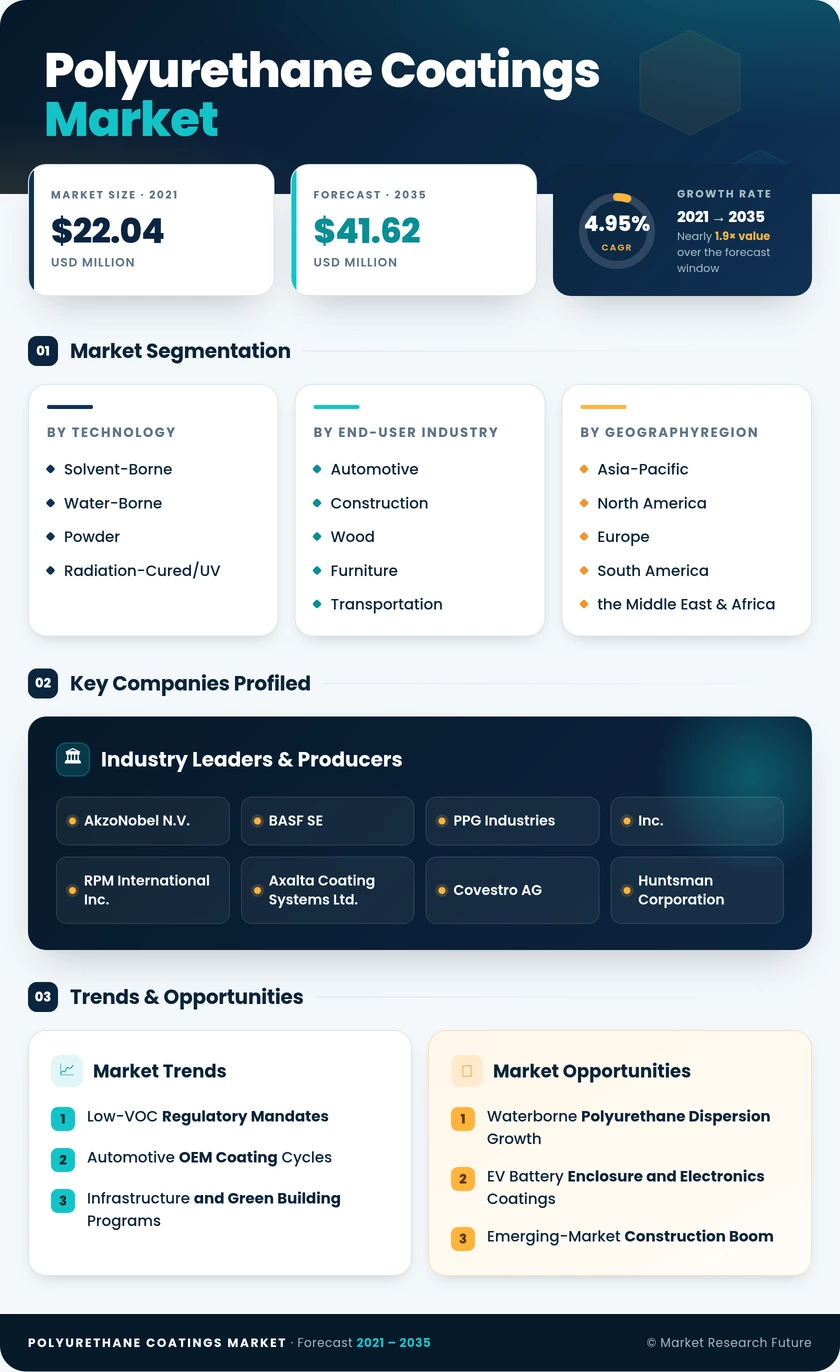
TechnologySolvent-Borne, Water-Borne, Powder, Radiation-Cured/UVSolvent-Borne (43.9% share, 2025)Water-Borne (7.20% CAGR)
End-User IndustryAutomotive, Construction, Wood and Furniture, Transportation, Electrical and Electronics, Other End-User IndustriesAutomotive (31.6% share, 2025)Construction (5.28% CAGR)
RegionAsia-Pacific, North America, Europe, South America, the Middle East & AfricaAsia-Pacific (39.8% share, 2025)Asia-Pacific (5.79% CAGR)


Market Segmentation Overview

By Technology

Sub-SegmentKey Trend
Solvent-BorneDeclining share under VOC regulation pressure, but retains dominance in heavy-industrial and marine specifications
Water-BorneFastest adoption driven by OEM sustainability mandates and architectural low-VOC requirements
PowderStable growth in appliance and furniture finishing, where zero-VOC is a competitive requirement
Radiation-Cured/UVRapid cure speeds attracting electronics and packaging converters seeking throughput gains


Solvent-borne systems continue to anchor the technology landscape due to entrenched specification histories in industrial maintenance and marine coatings. Waterborne polyurethane dispersions are closing the performance gap and winning new specifications in automotive primer and wood topcoat applications, making this the most dynamic technology transition in the forecast period.

By End-User Industry

Sub-SegmentKey Trend
AutomotiveMulti-layer OEM coating stacks and expanding EV platform demand sustain the leading position
ConstructionGreen building certifications and infrastructure megaprojects drive the fastest growth
Wood and FurnitureExport-oriented furniture manufacturing in Asia and Europe sustains steady demand for high-gloss and matte PU finishes
TransportationRail, aerospace, and commercial vehicle MRO cycles create predictable recoating demand
Electrical and ElectronicsConformal coatings for PCBs and dielectric films for EV power electronics represent emerging high-value niches
Other End-User IndustriesIncludes packaging, textiles, and general-purpose industrial maintenance coatings


Automotive end-use benefits from the multi-coat specification standard on every vehicle produced globally, while construction demand is expanding as urbanization and sustainability mandates channel investment into coated infrastructure assets across both developed and emerging markets.