×
Request Free Sample ×

Kindly complete the form below to receive a free sample of this Report

* Please use a valid business email

Leading companies partner with us for data-driven Insights

clients tt-cursor
Hero Background

Propylene Glycol Alginate Market

ID: MRFR/CnM/4278-HCR
111 Pages
Chitranshi Jaiswal
October 2025

Propylene Glycol Alginate Market Research Report Information By Application (stabilizers, emulsifiers, thickeners and Others), By End Use (food & beverage, Personal Care & Cosmetics and pharmaceuticals) And By Region (North America, Europe, Asia-Pacific, And Rest Of The World) –Market Forecast Till 2035

Share:
Download PDF ×

We do not share your information with anyone. However, we may send you emails based on your report interest from time to time. You may contact us at any time to opt-out.

Propylene Glycol Alginate Market Infographic
Purchase Options

Propylene Glycol Alginate Market Summary

As per MRFR analysis, the Propylene Glycol Alginate Market Size was estimated at 3767.27 USD Million in 2024. The Propylene Glycol Alginate industry is projected to grow from 4007.32 in 2025 to 7432.39 by 2035, exhibiting a compound annual growth rate (CAGR) of 6.37 during the forecast period 2025 - 2035.

Key Market Trends & Highlights

The Propylene Glycol Alginate Market is poised for growth driven by increasing demand for natural ingredients and technological advancements.

  • North America remains the largest market for propylene glycol alginate, driven by its extensive application in the food and beverage sector.
  • Asia-Pacific is emerging as the fastest-growing region, reflecting a rising interest in natural additives across various industries.
  • The food and beverage segment continues to dominate the market, while the pharmaceutical segment is experiencing rapid growth due to innovative applications.
  • Key market drivers include the increasing application in the food industry and regulatory support for natural additives, which are shaping market dynamics.

Market Size & Forecast

2024 Market Size 3767.27 (USD Million)
2035 Market Size 7432.39 (USD Million)
CAGR (2025 - 2035) 6.37%

Major Players

DuPont (US), Kraton Corporation (US), Ashland Global Holdings Inc. (US), FMC Corporation (US), Kao Corporation (JP), Nippon Synthetic Chemical Industry Co., Ltd. (JP), Sichuan Huasheng Tianlong Technology Co., Ltd. (CN), Zhejiang Jianfeng Technology Co., Ltd. (CN)

Propylene Glycol Alginate Market Trends

The Propylene Glycol Alginate Market is currently experiencing a notable evolution, driven by various factors that influence its demand across multiple sectors. This natural polysaccharide, derived from brown algae, is increasingly recognized for its versatile applications in food, pharmaceuticals, and cosmetics. The growing consumer preference for clean-label products and natural ingredients appears to be a significant driver, as manufacturers seek to replace synthetic additives with more sustainable alternatives. Furthermore, the rising awareness regarding health and wellness is likely to bolster the market, as propylene glycol alginate is often utilized as a thickening and stabilizing agent in various formulations. In addition to the health-conscious trends, the Propylene Glycol Alginate Market is also witnessing advancements in production technologies, which may enhance the efficiency and quality of the product. Innovations in extraction and processing methods could lead to improved yield and purity, thereby attracting more industries to adopt this ingredient. Moreover, the increasing regulatory support for natural additives is expected to create a favorable environment for market growth. As the demand for eco-friendly and safe ingredients continues to rise, the Propylene Glycol Alginate Market is poised for further expansion, potentially leading to new applications and market segments in the near future.

Rising Demand for Natural Ingredients

The Propylene Glycol Alginate Market is witnessing a surge in demand for natural ingredients, driven by consumer preferences for clean-label products. This trend reflects a broader shift towards healthier and more sustainable food options, prompting manufacturers to seek alternatives to synthetic additives.

Technological Advancements in Production

Innovations in extraction and processing technologies are likely to enhance the efficiency and quality of propylene glycol alginate. These advancements may lead to improved yield and purity, making the ingredient more appealing to various industries.

Regulatory Support for Natural Additives

Increasing regulatory support for natural additives is expected to foster a favorable environment for the Propylene Glycol Alginate Market. As regulations evolve to promote the use of safe and eco-friendly ingredients, market growth may accelerate.

Propylene Glycol Alginate Market Drivers

Market Growth Projections

The Global Propylene Glycol Alginate Market Industry is projected to experience substantial growth over the coming years. The market is expected to reach a valuation of 3.77 USD Billion in 2024, with a significant increase anticipated by 2035, potentially reaching 7.44 USD Billion. This growth trajectory suggests a robust compound annual growth rate (CAGR) of 6.37% from 2025 to 2035. Such projections indicate a strong demand across various sectors, including food, pharmaceuticals, and personal care, driven by the ingredient's versatility and increasing consumer preference for natural products.

Rising Demand in Food Industry

The Global Propylene Glycol Alginate Market Industry experiences a notable surge in demand from the food sector, where it serves as a thickening and stabilizing agent. This trend is driven by the increasing consumer preference for natural and clean-label products. For instance, propylene glycol alginate is utilized in various food applications, including sauces, dressings, and dairy products. As the market evolves, the industry is projected to reach a valuation of 3.77 USD Billion in 2024, reflecting the growing incorporation of this ingredient in food formulations. This demand is likely to continue, contributing to the overall growth of the market.

Growth in Personal Care Products

The Global Propylene Glycol Alginate Market Industry is also benefitting from the rising incorporation of propylene glycol alginate in personal care products. This ingredient is valued for its emulsifying and thickening properties, making it a popular choice in cosmetics and skincare formulations. With consumers increasingly seeking products that are both effective and safe, the demand for natural ingredients is on the rise. This trend is likely to drive the market forward, as propylene glycol alginate aligns with the clean beauty movement. The anticipated growth in this segment may further enhance the overall market dynamics, contributing to a robust CAGR of 6.37% from 2025 to 2035.

Expansion in Pharmaceutical Applications

The Global Propylene Glycol Alginate Market Industry is witnessing significant growth due to its expanding applications in the pharmaceutical sector. Propylene glycol alginate is utilized as a stabilizer and emulsifier in various drug formulations, enhancing the bioavailability of active ingredients. The increasing focus on developing novel drug delivery systems is likely to propel the demand for this ingredient. As the pharmaceutical industry continues to innovate, the market for propylene glycol alginate is expected to flourish, potentially contributing to the projected market size of 7.44 USD Billion by 2035. This growth underscores the ingredient's versatility and importance in modern pharmaceuticals.

Technological Advancements in Production

The Global Propylene Glycol Alginate Market Industry is influenced by ongoing technological advancements in the production processes of propylene glycol alginate. Innovations in extraction and purification techniques are enhancing the efficiency and quality of this ingredient, making it more accessible for various applications. As manufacturers adopt these advanced technologies, the production costs may decrease, potentially leading to increased market penetration. This shift could stimulate demand across multiple sectors, including food, pharmaceuticals, and personal care. The positive impact of these advancements is expected to be reflected in the market's growth trajectory, aligning with the projected increase in market size.

Regulatory Support for Natural Ingredients

The Global Propylene Glycol Alginate Market Industry benefits from favorable regulatory frameworks that support the use of natural ingredients in various applications. Regulatory bodies are increasingly endorsing the use of propylene glycol alginate as a safe and effective additive in food, pharmaceuticals, and cosmetics. This regulatory backing is likely to enhance consumer confidence and drive demand for products containing this ingredient. As the market continues to evolve, the alignment of propylene glycol alginate with regulatory standards may facilitate its adoption across diverse sectors, further contributing to the anticipated growth of the market.
Market Segment Insights

By Application: Food and Beverage (Largest) vs. Pharmaceuticals (Fastest-Growing)

In the Propylene Glycol Alginate Market, the application segment reveals that Food and Beverage holds a commanding position, dominating the market share. This sector utilizes propylene glycol alginate extensively due to its stabilizing, thickening, and emulsifying properties in various products, from sauces to baked goods. On the other hand, Pharmaceuticals is emerging as a significant player, relying on this ingredient for its effective performance in drug formulations and delivery systems. As we discuss growth trends within the application segment, Pharmaceuticals is poised to experience remarkable expansion, driven by the increasing demand for innovative drug delivery solutions and the rising prevalence of chronic diseases. Meanwhile, the Food and Beverage sector will also sustain its dominance but may face challenges from regulatory changes and consumer preferences, emphasizing the need for clean label ingredients.

Food and Beverage (Dominant) vs. Pharmaceuticals (Emerging)

The Food and Beverage application of propylene glycol alginate is characterized by its robust use in various food products, leveraging its ability to enhance texture and extend shelf life. This segment has established a dominant presence owing to its essential role in creating innovative food solutions that meet consumer demands for quality and convenience. In contrast, the Pharmaceuticals sector is emerging rapidly, characterized by increasing investment in research and development. Here, propylene glycol alginate plays a crucial role in drug formulation, particularly in improving the solubility and bioavailability of active pharmaceutical ingredients. As healthcare continues to evolve, this segment is likely to attract significant attention for its potential in developing next-generation therapeutics.

By End Use: Food Additive (Largest) vs. Thickening Agent (Fastest-Growing)

In the Propylene Glycol Alginate Market, the 'End Use' segment is primarily dominated by food additives, which hold the largest share due to their essential role in enhancing food quality and shelf life. This segment is critical in various food applications, including baked goods, dairy products, and sauces, where the unique properties of propylene glycol alginate improve taste, texture, and overall product appeal. Other significant end uses include thickening agents, stabilizers, emulsifiers, and gelling agents, contributing to a diverse application landscape within the market.

Food Additive: Dominant vs. Thickening Agent: Emerging

Food additives, particularly propylene glycol alginate, represent a dominant force in the market due to their multifunctional capabilities, enhancing not only the sensory attributes of food products but also their stability and longevity. As consumer preferences shift toward clean labels and natural ingredients, these additives are finding increased use in organic and health-oriented products. Conversely, the thickening agent segment is emerging rapidly, driven by growing demand in convenience foods and an increasing trend towards plant-based eating. Thickening agents are crucial for achieving desired textures in products like soups, sauces, and dairy alternatives, positioning them as a vital player in the evolving food industry.

By Formulation Type: Liquid (Largest) vs. Powder (Fastest-Growing)

In the Propylene Glycol Alginate Market, the segment distribution is primarily led by Liquid formulations, capturing the largest market share due to their versatile application across food, pharmaceuticals, and cosmetics. Following closely are Powder and Granular formulations, which cater to specific industries requiring more concentrated forms of the compound. Gel formulations, while essential, represent a smaller portion of the market, focusing on niche applications that leverage their unique properties.

Liquid (Dominant) vs. Powder (Emerging)

Liquid propylene glycol alginate is renowned for its flexibility, making it the dominant choice in various applications such as food stabilization and emulsification. Its ability to quickly dissolve and interact with other ingredients allows for seamless integration into products. On the other hand, Powder formulations of propylene glycol alginate are emerging rapidly due to growing demand in dry formulations and the convenience of storage and transport. As industries shift towards powdered ingredients that enhance shelf-life and product stability, the Powder segment is witnessing significant growth, offering unique advantages such as ease of handling and measurement.

By Source: Natural (Largest) vs. Synthetic (Fastest-Growing)

In the Propylene Glycol Alginate Market, the market share distribution is significantly skewed towards natural sources, which hold a dominant position owing to their increasing preference among consumers for clean-label and organic products. This inclination towards natural ingredients has been fueled by a rising awareness of health and wellness, making natural propylene glycol alginate a preferred choice among manufacturers across various food and pharmaceutical applications. On the other hand, the synthetic segment, while smaller in market share, is witnessing a rapid increase in demand driven by advancements in chemical synthesis technologies that allow for enhanced properties and functionalities, making synthetic sources attractive for specific applications.

Source: Natural (Dominant) vs. Synthetic (Emerging)

Natural propylene glycol alginate is recognized for its superior safety profile and compatibility with health-oriented trends, positioning it as a dominant force in the market. With its origins in natural seaweed, this source appeals to consumers who seek transparency and sustainability in their food and product choices. Conversely, the synthetic variant is emerging rapidly, gaining traction due to its cost-effectiveness and the ability to customize properties according to specific industrial requirements. Although it lacks the organic status of its natural counterpart, innovations are continuously being made in this segment, positioning it as a viable alternative for manufacturers seeking performance and reliability.

By Functionality: Thickening (Largest) vs. Stabilizing (Fastest-Growing)

In the Propylene Glycol Alginate Market, the functionality segment exhibits diverse applications, with thickening functions holding the largest share. This functionality is crucial in food processing, pharmaceuticals, and personal care products, where it enhances texture and consistency. Stabilizing functionalities are increasingly capturing market attention due to their essential role in maintaining product integrity, especially in emulsified systems and formulations, marking them as the fastest-growing segment in recent years.

Thickening (Dominant) vs. Stabilizing (Emerging)

Thickening is a dominant functionality in the Propylene Glycol Alginate Market, widely used across various industries due to its ability to improve viscosity and mouthfeel in food products. This segment is favored for its effectiveness in stabilizing mixtures and preventing separation in formulations. Conversely, the stabilizing segment is emerging rapidly, driven by increased demand in dairy and beverage applications. Both functionalities are integral, yet thickening leads in market share, while stabilizing is anticipated to experience significant growth, driven by innovation and advancements in formulations.

Get more detailed insights about Propylene Glycol Alginate Market

Regional Insights

North America : Market Leader in Innovation

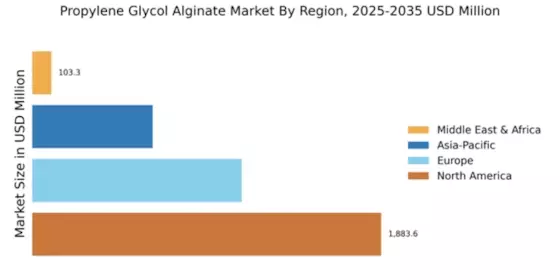
North America is poised to maintain its leadership in the Propylene Glycol Alginate market, holding a significant share of 1880.0. The region's growth is driven by increasing demand in food and beverage applications, coupled with stringent regulatory standards that favor high-quality ingredients. The presence of major players like DuPont and Kraton Corporation further fuels market expansion, supported by ongoing innovations in product formulations. The United States stands out as the leading country in this sector, with a robust competitive landscape characterized by key players such as Ashland Global Holdings and FMC Corporation. These companies are investing heavily in R&D to enhance product offerings and meet evolving consumer preferences. The market is also witnessing strategic partnerships and collaborations aimed at expanding distribution channels and improving market penetration.

Europe : Emerging Market with Growth Potential

Europe is experiencing a notable increase in the Propylene Glycol Alginate market, with a size of 950.0. The growth is primarily driven by rising health consciousness among consumers and the demand for natural food additives. Regulatory frameworks in the EU are becoming more favorable, promoting the use of safe and sustainable ingredients in food products, which is a significant catalyst for market growth. Leading countries in this region include Germany, France, and the UK, where the presence of established companies like Kao Corporation and Ashland Global Holdings enhances competitive dynamics. The market is characterized by a mix of local and international players, all vying for a share of the growing demand. The focus on innovation and compliance with EU regulations is shaping the competitive landscape, ensuring that companies remain at the forefront of market trends.

Asia-Pacific : Rapid Growth in Emerging Markets

The Asia-Pacific region is witnessing rapid growth in the Propylene Glycol Alginate market, currently valued at 800.0. This growth is fueled by increasing urbanization, rising disposable incomes, and a growing preference for processed foods. Regulatory bodies are also beginning to implement standards that encourage the use of safe food additives, which is expected to further boost market demand in the coming years. China and Japan are the leading countries in this market, with significant contributions from local manufacturers like Nippon Synthetic Chemical Industry and Sichuan Huasheng Tianlong Technology. The competitive landscape is evolving, with both domestic and international players striving to capture market share. Investments in technology and product development are key strategies employed by these companies to meet the diverse needs of consumers in the region.

Middle East and Africa : Emerging Market with Untapped Potential

The Middle East and Africa region is gradually emerging in the Propylene Glycol Alginate market, currently valued at 137.27. The growth is driven by increasing demand for food additives in the food and beverage sector, alongside a growing awareness of health and nutrition. Regulatory frameworks are evolving, which is expected to create a more conducive environment for market expansion in the near future. Countries like South Africa and the UAE are leading the way in market development, with a mix of local and international players entering the space. The competitive landscape is characterized by a focus on quality and compliance with emerging regulations. Companies are increasingly investing in marketing and distribution strategies to tap into the growing consumer base in this region.

Key Players and Competitive Insights

The Propylene Glycol Alginate Market is currently characterized by a dynamic competitive landscape, driven by increasing demand across various sectors, including food and beverage, pharmaceuticals, and cosmetics. Key players such as DuPont (US), Kraton Corporation (US), and Ashland Global Holdings Inc. (US) are strategically positioned to leverage their extensive research and development capabilities. DuPont (US) focuses on innovation in product formulations, while Kraton Corporation (US) emphasizes sustainability in its production processes. Ashland Global Holdings Inc. (US) is enhancing its market presence through strategic partnerships, which collectively shape a competitive environment that is increasingly focused on technological advancements and sustainability initiatives.

In terms of business tactics, companies are localizing manufacturing to reduce lead times and optimize supply chains. The market structure appears moderately fragmented, with several players vying for market share. However, the collective influence of major companies is significant, as they drive trends in product development and sustainability practices, thereby shaping the overall market dynamics.

In November 2025, DuPont (US) announced the launch of a new line of propylene glycol alginate products designed specifically for the food industry, which is expected to enhance texture and stability in various applications. This strategic move underscores DuPont's commitment to innovation and its focus on meeting the evolving needs of food manufacturers, potentially positioning the company as a leader in this niche segment.

In October 2025, Kraton Corporation (US) expanded its production capacity for propylene glycol alginate at its facility in Texas. This expansion is likely to enhance supply chain efficiency and meet the growing demand from the pharmaceutical sector, indicating Kraton's proactive approach to scaling operations in response to market needs.

In September 2025, Ashland Global Holdings Inc. (US) entered into a strategic partnership with a leading food technology firm to co-develop new applications for propylene glycol alginate in plant-based products. This collaboration not only reflects Ashland's focus on innovation but also highlights the increasing trend towards plant-based alternatives in the food industry, suggesting a shift in consumer preferences that companies must address.

As of December 2025, current competitive trends indicate a strong emphasis on digitalization, sustainability, and the integration of AI technologies within production processes. Strategic alliances are increasingly shaping the landscape, allowing companies to pool resources and expertise. Looking ahead, competitive differentiation is likely to evolve from traditional price-based competition to a focus on innovation, technological advancements, and supply chain reliability, as companies strive to meet the demands of a rapidly changing market.

Key Companies in the Propylene Glycol Alginate Market market include

Industry Developments

  • Q1 2024: CP Kelco Announces Expansion of Propylene Glycol Alginate Market Production Capacity in China CP Kelco announced the opening of a new production line at its Wulian, China facility to increase output of propylene glycol alginate, aiming to meet rising demand from the food and beverage sector in Asia.
  • Q2 2024: Kerry Group Launches Clean-Label Propylene Glycol Alginate Market for Beverage Applications Kerry Group introduced a new clean-label propylene glycol alginate ingredient designed for use in low-pH beverage formulations, targeting the growing market for natural and vegan-friendly stabilizers.
  • Q2 2024: Cargill Signs Supply Agreement with Major US Beverage Producer for Propylene Glycol Alginate Market Cargill secured a multi-year contract to supply propylene glycol alginate to a leading US beverage manufacturer, expanding its footprint in the North American food additives market.
  • Q3 2024: Fuji Kasei Opens New R&D Center Focused on Alginates in Japan Fuji Kasei inaugurated a research and development center in Shizuoka, Japan, dedicated to innovation in alginate-based products, including propylene glycol alginate for food and pharmaceutical applications.
  • Q3 2024: DuPont Nutrition & Biosciences Appoints New Head of Food Ingredients Division DuPont Nutrition & Biosciences named Dr. Emily Chen as the new head of its Food Ingredients Division, overseeing the global propylene glycol alginate business among other product lines.
  • Q4 2024: Qingdao Allforlong Biotech Receives Regulatory Approval for Propylene Glycol Alginate Market Plant Expansion Qingdao Allforlong Biotech announced it received local government approval to expand its propylene glycol alginate manufacturing facility in Shandong Province, China, to boost production capacity by 30%.
  • Q4 2024: CP Kelco Partners with European Dairy Producer for New Yogurt Stabilizer CP Kelco entered a partnership with a major European dairy company to supply a custom propylene glycol alginate stabilizer for use in a new line of high-protein yogurts.
  • Q1 2025: Kimica Corporation Launches Pharmaceutical-Grade Propylene Glycol Alginate Market Kimica Corporation introduced a new pharmaceutical-grade propylene glycol alginate product, targeting drug formulation and controlled-release applications in the Japanese and international markets.
  • Q1 2025: FMC Corporation Announces Strategic Investment in Alginates Production Facility FMC Corporation revealed a $50 million investment to upgrade its alginates production facility in the US, with a focus on increasing output and quality of propylene glycol alginate for food and pharmaceutical customers.
  • Q2 2025: Cargill Expands Propylene Glycol Alginate Market Distribution in Latin America Cargill announced the expansion of its propylene glycol alginate distribution network in Brazil and Argentina, aiming to serve the growing demand from the regional food processing industry.
  • Q2 2025: CP Kelco Receives EU Novel Food Approval for New Propylene Glycol Alginate Market Variant CP Kelco obtained European Union Novel Food approval for a new variant of propylene glycol alginate, enabling its use in a wider range of food and beverage applications across the EU.
  • Q3 2025: DuPont Nutrition & Biosciences Launches Sustainable Propylene Glycol Alginate Market Sourcing Program DuPont Nutrition & Biosciences introduced a new sustainability initiative for sourcing seaweed used in propylene glycol alginate production, aiming to ensure traceability and environmental responsibility.

Future Outlook

Propylene Glycol Alginate Market Future Outlook

The Propylene Glycol Alginate Market is projected to grow at a 6.37% CAGR from 2024 to 2035, driven by increasing demand in food and pharmaceutical applications.

New opportunities lie in:

  • Expansion into emerging markets with tailored product offerings.
  • Development of eco-friendly formulations to meet sustainability demands.
  • Strategic partnerships with food manufacturers for innovative applications.

By 2035, the market is expected to solidify its position as a key ingredient in diverse industries.

Market Segmentation

Propylene Glycol Alginate Market Source Outlook

  • Natural
  • Synthetic

Propylene Glycol Alginate Market End Use Outlook

  • Food Additive
  • Thickening Agent
  • Stabilizer
  • Emulsifier
  • Gelling Agent

Propylene Glycol Alginate Market Application Outlook

  • Food and Beverage
  • Pharmaceuticals
  • Cosmetics
  • Personal Care
  • Industrial

Propylene Glycol Alginate Market Functionality Outlook

  • Thickening
  • Stabilizing
  • Emulsifying
  • Gelling

Propylene Glycol Alginate Market Formulation Type Outlook

  • Liquid
  • Powder
  • Granular
  • Gel

Report Scope

MARKET SIZE 20243767.27(USD Million)
MARKET SIZE 20254007.32(USD Million)
MARKET SIZE 20357432.39(USD Million)
COMPOUND ANNUAL GROWTH RATE (CAGR)6.37% (2024 - 2035)
REPORT COVERAGERevenue Forecast, Competitive Landscape, Growth Factors, and Trends
BASE YEAR2024
Market Forecast Period2025 - 2035
Historical Data2019 - 2024
Market Forecast UnitsUSD Million
Key Companies ProfiledDuPont (US), Kraton Corporation (US), Ashland Global Holdings Inc. (US), FMC Corporation (US), Kao Corporation (JP), Nippon Synthetic Chemical Industry Co., Ltd. (JP), Sichuan Huasheng Tianlong Technology Co., Ltd. (CN), Zhejiang Jianfeng Technology Co., Ltd. (CN)
Segments CoveredApplication, End Use, Formulation Type, Source, Functionality
Key Market OpportunitiesGrowing demand for clean label products drives innovation in the Propylene Glycol Alginate Market.
Key Market DynamicsRising demand for clean-label products drives innovation and competition in the Propylene Glycol Alginate Market.
Countries CoveredNorth America, Europe, APAC, South America, MEA

Market Highlights

Author
Chitranshi Jaiswal
Research Analyst Level I

In her 3 years of experience in the market research field, she has handled critical cross-domain projects. She has an in-depth knowledge of market estimation & analysis, problem-solving, primary as well as secondary research, and team management.She holds an engineering degree and is an MBA professional from a well-known university, capable of evaluating the market and competitive conditions. An exceptional strategist with excellent communication skills and a passion for delivering cutting-edge & practical insights for the market. Proficient in multi-tasking, and can successfully deal with competing demands, while maintaining complete confidentiality. Generated business through active client and project development, networking, and high-quality responses. Her knowledge and skills have helped in making solid business decisions, securing funding from investors, and avoiding business failures.

Leave a Comment

FAQs

What is propylene glycol alginate?

Propylene glycol alginate is an ester of alginic acid and is abundantly found in the cell walls of brown algae in the form of a viscous gum.

What are the leading applications of propylene glycol alginate?

Leading application segments of the market include food and beverage, cosmetics and personal care products, pharmaceuticals, and others.

What is the major driver for the market?

The growing demand for stabilizers, thickening agents, and emulsifiers from the food and beverage industry is the major driver for the global market.

Which is the leading regional market?

North America held the dominant share in the propylene glycol alginate market in 2016.

What are the key players in the market?

Leading players in the market include Kikkoman Corporation, Fuji Kasei, and KIMICA Corporation, among others.

Download Free Sample

Kindly complete the form below to receive a free sample of this Report

Compare Licence

×
Features License Type
Single User Multiuser License Enterprise User
Price $4,950 $5,950 $7,250
Maximum User Access Limit 1 User Upto 10 Users Unrestricted Access Throughout the Organization
Free Customization
Direct Access to Analyst
Deliverable Format
Platform Access
Discount on Next Purchase 10% 15% 15%
Printable Versions