Software Defined Networking (SDN) Market

ID: MRFR/ICT/1076-CR
124 Pages
Aarti Dhapte
Last Updated: June 17, 2026
Software Defined Networking (SDN) Market Size, Share and Research Report By Component (SDN Infrastructure, SDN Software / Controllers, Services and Support), By Deployment Mode (On-Premises, Cloud), By Organization Size (Large Enterprises, SMEs), By Application (Data Center and Cloud, Enterprise Campus, SD-WAN), By End User (Telecom and Cloud Service Providers, BFSI, Manufacturing, Government, Healthcare) and By Regional (North America, Europe, South America, Asia Pacific, Middle East and Africa) - Industry Forecast to 2035
Download PDF ×

We do not share your information with anyone. However, we may send you emails based on your report interest from time to time. You may contact us at any time to opt-out.

  1. 1 Market Overview |
    1. 1.1 Study Assumptions & Market Definition |
    2. 1.2 Scope of the Study |
    3. 1.3 Research Methodology
  2. 2 Market Summary & Key Takeaways
  3. 3 Market Dynamics |
    1. 3.1 Market Drivers Analysis | |
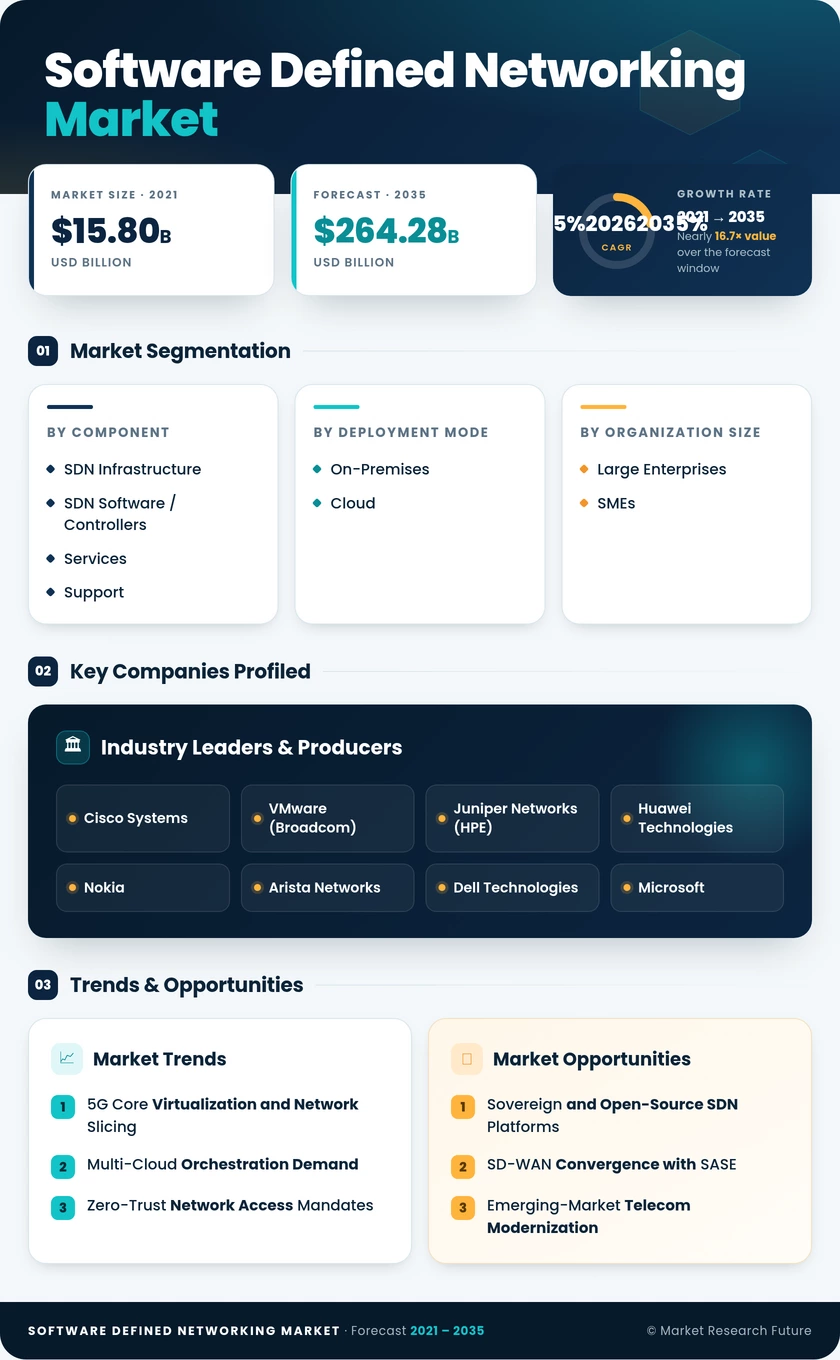
      1. 3.1.1 5G Core Virtualization & Network Slicing | |
      2. 3.1.2 Multi-Cloud & Hybrid-Cloud Migration | |
      3. 3.1.3 Zero-Trust & Microsegmentation Mandates | |
      4. 3.1.4 AI/ML-Driven Network Telemetry | |
      5. 3.1.5 Energy-Efficiency Regulations for Data Centers | |
      6. 3.1.6 Digital-Sovereignty & Open-Source Policies | |
      7. 3.1.7 Edge Computing & IoT Traffic Explosion |
    2. 3.2 Market Restraints Analysis | |
      1. 3.2.1 Legacy Network Equipment Lock-In | |
      2. 3.2.2 Skilled SDN Talent Shortage | |
      3. 3.2.3 Interoperability & Standards Fragmentation | |
      4. 3.2.4 Security Concerns Around Centralized Controllers | |
      5. 3.2.5 High Initial Migration Costs for SMEs |
    3. 3.3 Market Opportunity Analysis | |
      1. 3.3.1 Sovereign and Open-Source SDN Platforms | |
      2. 3.3.2 SD-WAN Convergence with SASE | |
      3. 3.3.3 Emerging-Market Telecom Modernization | |
      4. 3.3.4 Network-as-a-Service Revenue Models | |
      5. 3.3.5 AI-Native Closed-Loop Automation |
    4. 3.4 Industry Value Chain Analysis |
    5. 3.5 Porter's Five Forces Analysis
  4. 4 Global Software Defined Networking Market Size & Forecast (2021–2035) |
    1. 4.1 Historical Market Size (2021–2025) |
    2. 4.2 Current & Forecast Market Size (2026–2035) |
    3. 4.3 Market Size by Revenue (USD billion) |
    4. 4.4 Year-over-Year Growth Analysis
  5. 5 Segmentation Analysis |
    1. 5.1 By Component | |
      1. 5.1.1 SDN Infrastructure | |
      2. 5.1.2 SDN Software / Controllers | |
      3. 5.1.3 Services and Support |
    2. 5.2 By Deployment Mode | |
      1. 5.2.1 On-Premises | |
      2. 5.2.2 Cloud |
    3. 5.3 By Organization Size | |
      1. 5.3.1 Large Enterprises | |
      2. 5.3.2 SMEs |
    4. 5.4 By Application | |
      1. 5.4.1 Data Center and Cloud | |
      2. 5.4.2 Enterprise Campus | |
      3. 5.4.3 SD-WAN |
    5. 5.5 By End User | |
      1. 5.5.1 Telecom and Cloud Service Providers | |
      2. 5.5.2 BFSI | |
      3. 5.5.3 Manufacturing | |
      4. 5.5.4 Government | |
      5. 5.5.5 Healthcare
  6. 6 Regional Analysis |
    1. 6.1 North America | |
      1. 6.1.1 United States | |
      2. 6.1.2 Canada | |
      3. 6.1.3 Mexico |
    2. 6.2 Europe | |
      1. 6.2.1 Germany | |
      2. 6.2.2 United Kingdom | |
      3. 6.2.3 France | |
      4. 6.2.4 Italy | |
      5. 6.2.5 Spain | |
      6. 6.2.6 Nordic Countries | |
      7. 6.2.7 Russia | |
      8. 6.2.8 Rest of Europe |
    3. 6.3 Asia-Pacific | |
      1. 6.3.1 China | |
      2. 6.3.2 India | |
      3. 6.3.3 Japan | |
      4. 6.3.4 South Korea | |
      5. 6.3.5 ASEAN | |
      6. 6.3.6 Rest of Asia-Pacific |
    4. 6.4 South America | |
      1. 6.4.1 Brazil | |
      2. 6.4.2 Argentina | |
      3. 6.4.3 Rest of South America |
    5. 6.5 Middle East & Africa | |
      1. 6.5.1 Saudi Arabia | |
      2. 6.5.2 UAE | |
      3. 6.5.3 South Africa | |
      4. 6.5.4 Egypt | |
      5. 6.5.5 Rest of MEA
  7. 7 Competitive Landscape |
    1. 7.1 Market Share Analysis (2025) |
    2. 7.2 Competitive Benchmarking Matrix |
    3. 7.3 Company Profiles | |
      1. 7.3.1 Cisco Systems | |
      2. 7.3.2 VMware (Broadcom) | |
      3. 7.3.3 Juniper Networks (HPE) | |
      4. 7.3.4 Huawei Technologies | |
      5. 7.3.5 Nokia | |
      6. 7.3.6 Arista Networks | |
      7. 7.3.7 Dell Technologies | |
      8. 7.3.8 Microsoft | |
      9. 7.3.9 IBM | |
      10. 7.3.10 Extreme Networks
  8. 8 Future Outlook & Strategic Recommendations (2026–2035) |
    1. 8.1 AI-Autonomous Network Operations |
    2. 8.2 Platform Economics and Network-as-a-Service |
    3. 8.3 Sustainability and Network Energy Optimization |
    4. 8.4 6G-Ready Programmable Fabrics
  9. 9 Recent Developments & News
  10. 10 Frequently Asked Questions (FAQs)
  11. 11 Report Scope & Methodology |
    1. 11.1 Study Period & Base Year |
    2. 11.2 Data Sources & Citations |
    3. 11.3 Abbreviations
  12. 12 LIST OF TABLES |
  13. TABLE 1 Global Software Defined Networking Market Size & Forecast, by Revenue (USD billion), 2021–2035 |
  14. TABLE 2 Global Software Defined Networking Market — Year-over-Year Growth Analysis, 2021–2035 |
  15. TABLE 3 Driver Impact Analysis — Software Defined Networking Market, 2026–2035 |
  16. TABLE 4 Restraint Impact Analysis — Software Defined Networking Market, 2026–2035 |
  17. TABLE 5 Global Software Defined Networking Market Size, by Component, 2021–2035 (USD billion) |
  18. TABLE 6 Global Software Defined Networking Market Size, by Deployment Mode, 2021–2035 (USD billion) |
  19. TABLE 7 Global Software Defined Networking Market Size, by Organization Size, 2021–2035 (USD billion) |
  20. TABLE 8 Global Software Defined Networking Market Size, by Application, 2021–2035 (USD billion) |
  21. TABLE 9 Global Software Defined Networking Market Size, by End User, 2021–2035 (USD billion) |
  22. TABLE 10 Global Software Defined Networking Market Size, by Region, 2021–2035 (USD billion) |
  23. TABLE 11 North America Software Defined Networking Market Size, by Country, 2021–2035 (USD billion) |
  24. TABLE 12 Europe Software Defined Networking Market Size, by Country, 2021–2035 (USD billion) |
  25. TABLE 13 Asia-Pacific Software Defined Networking Market Size, by Country, 2021–2035 (USD billion) |
  26. TABLE 14 South America Software Defined Networking Market Size, by Country, 2021–2035 (USD billion) |
  27. TABLE 15 Middle East & Africa Software Defined Networking Market Size, by Country, 2021–2035 (USD billion) |
  28. TABLE 16 Competitive Benchmarking Matrix — Global Software Defined Networking Market, 2025 |
  29. TABLE 17 Company Profiles — Key Players, Global Software Defined Networking Market |
  30. TABLE 18 Recent Developments & Strategic Announcements, 2024–2025 |
  31. TABLE 19 North America Software Defined Networking Market Size, by Component, 2021–2035 (USD billion) |
  32. TABLE 20 North America Software Defined Networking Market Size, by Deployment Mode, 2021–2035 (USD billion) |
  33. TABLE 21 North America Software Defined Networking Market Size, by Organization Size, 2021–2035 (USD billion) |
  34. TABLE 22 North America Software Defined Networking Market Size, by Application, 2021–2035 (USD billion) |
  35. TABLE 23 North America Software Defined Networking Market Size, by End User, 2021–2035 (USD billion) |
  36. TABLE 24 Europe Software Defined Networking Market Size, by Component, 2021–2035 (USD billion) |
  37. TABLE 25 Europe Software Defined Networking Market Size, by Deployment Mode, 2021–2035 (USD billion) |
  38. TABLE 26 Europe Software Defined Networking Market Size, by Organization Size, 2021–2035 (USD billion) |
  39. TABLE 27 Europe Software Defined Networking Market Size, by Application, 2021–2035 (USD billion) |
  40. TABLE 28 Europe Software Defined Networking Market Size, by End User, 2021–2035 (USD billion) |
  41. TABLE 29 Asia-Pacific Software Defined Networking Market Size, by Component, 2021–2035 (USD billion) |
  42. TABLE 30 Asia-Pacific Software Defined Networking Market Size, by Deployment Mode, 2021–2035 (USD billion) |
  43. TABLE 31 Asia-Pacific Software Defined Networking Market Size, by Organization Size, 2021–2035 (USD billion) |
  44. TABLE 32 Asia-Pacific Software Defined Networking Market Size, by Application, 2021–2035 (USD billion) |
  45. TABLE 33 Asia-Pacific Software Defined Networking Market Size, by End User, 2021–2035 (USD billion) |
  46. TABLE 34 South America Software Defined Networking Market Size, by Component, 2021–2035 (USD billion) |
  47. TABLE 35 South America Software Defined Networking Market Size, by Deployment Mode, 2021–2035 (USD billion) |
  48. TABLE 36 South America Software Defined Networking Market Size, by Organization Size, 2021–2035 (USD billion) |
  49. TABLE 37 South America Software Defined Networking Market Size, by Application, 2021–2035 (USD billion) |
  50. TABLE 38 South America Software Defined Networking Market Size, by End User, 2021–2035 (USD billion) |
  51. TABLE 39 Middle East & Africa Software Defined Networking Market Size, by Component, 2021–2035 (USD billion) |
  52. TABLE 40 Middle East & Africa Software Defined Networking Market Size, by Deployment Mode, 2021–2035 (USD billion) |
  53. TABLE 41 Middle East & Africa Software Defined Networking Market Size, by Organization Size, 2021–2035 (USD billion) |
  54. TABLE 42 Middle East & Africa Software Defined Networking Market Size, by Application, 2021–2035 (USD billion) |
  55. TABLE 43 Middle East & Africa Software Defined Networking Market Size, by End User, 2021–2035 (USD billion)
  56. 13 LIST OF FIGURES |
  57. FIGURE 1 Global Software Defined Networking Market Dynamics (Drivers, Restraints, Opportunities) |
  58. FIGURE 2 Industry Value Chain Analysis — Software Defined Networking Market |
  59. FIGURE 3 Porter's Five Forces Analysis — Software Defined Networking Market |
  60. FIGURE 4 Global Software Defined Networking Market Size Trend, 2021–2035 (USD billion) |
  61. FIGURE 5 Global Software Defined Networking Market Share, by Component, 2025 (%) |
  62. FIGURE 6 Global Software Defined Networking Market Share, by Deployment Mode, 2025 (%) |
  63. FIGURE 7 Global Software Defined Networking Market Share, by Organization Size, 2025 (%) |
  64. FIGURE 8 Global Software Defined Networking Market Share, by Application, 2025 (%) |
  65. FIGURE 9 Global Software Defined Networking Market Share, by End User, 2025 (%) |
  66. FIGURE 10 Global Software Defined Networking Market Share, by Region, 2025 (%) |
  67. FIGURE 11 North America Software Defined Networking Market Share, by Country, 2025 (%) |
  68. FIGURE 12 Europe Software Defined Networking Market Share, by Country, 2025 (%) |
  69. FIGURE 13 Asia-Pacific Software Defined Networking Market Share, by Country, 2025 (%) |
  70. FIGURE 14 South America Software Defined Networking Market Share, by Country, 2025 (%) |
  71. FIGURE 15 Middle East & Africa Software Defined Networking Market Share, by Country, 2025 (%) |
  72. FIGURE 16 Competitive Landscape — Software Defined Networking Market, 2025

Segmentation Quick Reference

DimensionSub-SegmentsDominant Segment (2025)Fastest Growing Segment (2026–2035)
ComponentSDN Infrastructure; SDN Software / Controllers; Services and SupportSDN InfrastructureServices and Support
Deployment ModeOn-Premises; CloudOn-PremisesCloud
Organization SizeLarge Enterprises; SMEsLarge EnterprisesSMEs
ApplicationData Center and Cloud; Enterprise Campus; SD-WANData Center and CloudSD-WAN
End UserTelecom & Cloud SPs; BFSI; Manufacturing; Government; HealthcareTelecom & Cloud SPsManufacturing


Market Segmentation Overview

By Component

Sub-SegmentKey Trend
SDN InfrastructureWhite-box merchant silicon switches are displacing proprietary chassis
SDN Software / ControllersIntent-based orchestration platforms integrating AI-driven analytics
Services and SupportManaged SDN services are gaining traction among mid-market enterprises.


SDN Infrastructure remains the revenue anchor due to the capital-intensive nature of physical network build-outs. At the same time, SDN Software and Controllers capture higher margins as enterprises invest in automation-layer licensing. Services and support are scaling as organizations seek expert-managed deployment and 24/7 monitoring.

By Deployment Mode

Sub-SegmentKey Trend
On-PremisesPreferred by regulated industries for data-sovereignty compliance
CloudMulti-cloud SDN-as-a-Service adoption is accelerating among distributed enterprises.


On-premises installations continue to dominate in verticals where latency sensitivity and regulatory restrictions prevent off-site control-plane hosting. In contrast, cloud-managed SDN is the default choice for born-in-the-cloud enterprises expanding across multiple public-cloud providers.

By Organization Size

Sub-SegmentKey Trend
Large EnterprisesComplex multi-site deployments requiring bespoke SDN fabric engineering
SMEsSubscription-based NaaS models are removing capex barriers to adoption.


Large enterprises drive the majority of current revenue through complex data-center and campus-fabric initiatives. At the same time, SMEs represent the high-growth frontier as vendor pricing evolves toward usage-based billing.

By Application

Sub-SegmentKey Trend
Data Center and CloudAI/ML workload clustering requiring lossless, programmable Ethernet fabrics
Enterprise CampusWi-Fi 6E/7 integration with campus-fabric SDN controllers
SD-WANSASE convergence merging WAN optimization with cloud-delivered security


Data-center and cloud applications remain the largest segment, propelled by hyperscaler traffic growth. SD-WAN leads growth momentum as the SASE architecture becomes the preferred enterprise WAN model.

By End User

Sub-SegmentKey Trend
Telecom and Cloud Service Providers5G SA core network slicing demanding programmable control planes
BFSIMicrosegmentation for PCI-DSS and regulatory compliance
ManufacturingOT/IT convergence via campus-fabric SDN in smart factories
GovernmentZero-trust architecture mandates driving SDN procurement.
HealthcareHIPAA-compliant network segmentation and IoMT device management


Telecom operators remain the largest buyer category, while manufacturing is the fastest-growing vertical as Industry 4.0 adoption spreads SDN into factory-floor environments that previously relied on proprietary industrial Ethernet.