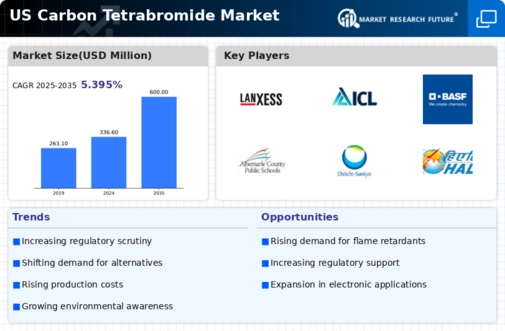
The carbon tetrabromide market exhibits a competitive landscape characterized by a blend of established players and emerging entities, driven by increasing demand for flame retardants and specialty chemicals. Key players such as Albemarle Corporation (US), ICL Group Ltd (US), and Lanxess Corporation (Germany) are strategically positioned to leverage their extensive product portfolios and technological capabilities. Albemarle Corporation (US) focuses on innovation and sustainability, aiming to enhance its product offerings while reducing environmental impact. Meanwhile, ICL Group Ltd (US) emphasizes regional expansion and strategic partnerships to bolster its market presence, particularly in North America. Lanxess Corporation (Germany) is actively pursuing digital transformation initiatives to optimize its operations and improve customer engagement, thereby shaping a competitive environment that prioritizes innovation and responsiveness.
The business tactics employed by these companies reflect a concerted effort to localize manufacturing and optimize supply chains, which is crucial in a moderately fragmented market. The collective influence of these key players fosters a competitive structure that encourages collaboration and innovation, as companies seek to differentiate themselves through advanced technologies and sustainable practices. This dynamic is further enhanced by the growing emphasis on regulatory compliance and environmental stewardship, which compels companies to adapt their strategies accordingly.
In November 2025, Albemarle Corporation (US) announced a significant investment in a new production facility aimed at increasing its carbon tetrabromide output. This strategic move is expected to enhance the company's capacity to meet rising demand while reinforcing its commitment to sustainability through the implementation of energy-efficient technologies. Such investments not only bolster Albemarle's market position but also signal a broader trend towards capacity expansion among leading players in the sector.
In October 2025, ICL Group Ltd (US) entered into a strategic partnership with a leading technology firm to develop advanced flame retardant solutions. This collaboration is poised to enhance ICL's product offerings and align with the growing market demand for innovative and environmentally friendly solutions. By leveraging technological advancements, ICL aims to strengthen its competitive edge and cater to evolving customer needs in the carbon tetrabromide market.
In September 2025, Lanxess Corporation (Germany) launched a new digital platform designed to streamline its supply chain operations and improve customer interactions. This initiative reflects the company's commitment to digitalization and operational efficiency, positioning it favorably in a market that increasingly values technological integration. The platform is expected to enhance responsiveness to market changes and customer demands, thereby solidifying Lanxess's competitive stance.
As of December 2025, the carbon tetrabromide market is witnessing trends that emphasize digitalization, sustainability, and the integration of artificial intelligence in operations. Strategic alliances are becoming increasingly pivotal, as companies recognize the value of collaboration in driving innovation and enhancing market reach. The competitive differentiation is likely to evolve from traditional price-based competition towards a focus on technological advancements, supply chain reliability, and sustainable practices. This shift underscores the importance of innovation as a key driver of success in the carbon tetrabromide market.




















Leave a Comment