Automotive Cockpit Electronics Market

Key Players: Bosch (DE), Denso (JP), Continental (DE), Harman (US), Panasonic (JP), Valeo (FR), NXP Semiconductors (NL), Aptiv (IE), Magna International (CA)

Automotive Cockpit Electronics Market

汽车驾驶舱电子市场研究报告信息按电子类型(平视显示器、信息娱乐系统、{驾驶舱集成平台、显示和集成系统}、驾驶员信息显示、{中央显示器、乘客显示器、控制和集成元件}、气候控制系统、远程信息处理、音频系统、行车记录仪等)、按车辆类型(乘用车{掀背车、轿车、SUV和MUV、运动和超级跑车等}、商用车{轻型商用车、卡车和公共汽车)、按乘用车类别(经济型(4.3 万美元以下)、中型(44,000-87,000 美元)、高级(88,000-163,000 美元)和豪华型(163,000 美元以上))、按车辆自动驾驶(传统和半自动)、按车辆驱动(内燃机和电动汽车)、按销售渠道(OEM 和售后市场)以及按地区(北美、欧洲、亚太地区、中东和非洲以及南美洲)——2034 年之前的市场预测
ID: MRFR/AT/3762-CR
128 Pages
Triveni Bhoyar, Swapnil Palwe
Last Updated: June 09, 2026

Automotive Cockpit Electronics Market 摘要

根据 MRFR 分析,2024 年汽车驾驶舱电子市场规模预计为 534.1 亿美元。汽车驾驶舱电子行业预计将从 2025 年的 57.72 亿美元增长到 2035 年的 1255.7 亿美元,在 2025 年至 2035 年的预测期内复合年增长率 (CAGR) 为 8.08%。

主要市场趋势和亮点

在技​​术进步和不断变化的消费者偏好的推动下,汽车驾驶舱电子市场有望实现大幅增长。

  • 高级驾驶辅助系统的集成变得越来越普遍,增强了车辆安全性和用户体验。
  • 连接和信息娱乐解决方案正在蓬勃发展,特别是在北美,消费者对高级功能的需求很高。
  • 可持续和节能技术正在受到关注,尤其是在亚太地区,这反映出人们向更环保的汽车解决方案的转变。
  • 电动汽车市场的扩张和消费者对用户体验的期望不断提高是推动驾驶舱电子产品增长的关键驱动力。

市场规模与预测

2024 年市场规模 53.41 (USD Billion)
2035年市场规模 125.57 (USD Billion)
CAGR (2025 - 2035) 8.08%
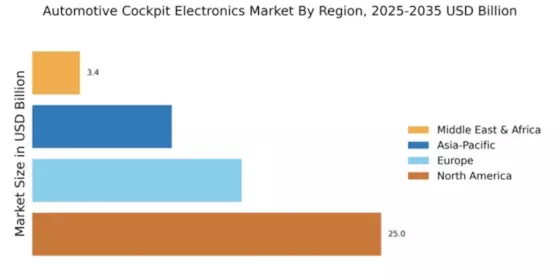
2024 年最大的区域市场份额 北美

主要参与者

博世 (DE)、电装 (JP)、大陆航空 (德国)、哈曼(美国)、松下(日本)、法雷奥(法国)、恩智浦半导体(荷兰)、安波福(爱尔兰)、麦格纳国际(加拿大)

Our Impact
Enabled $4.3B Revenue Impact for Fortune 500 and Leading Multinationals
Partnering with 2000+ Global Organizations Each Year
30K+ Citations by Top-Tier Firms in the Industry

市场细分洞察

按应用分类:信息娱乐系统(最大)与高级驾驶辅助系统(增长最快)

在汽车驾驶舱电子市场中,市场份额分布表明,信息娱乐系统是最大的细分市场,受到消费者对增强车内娱乐和连接选项的需求的强烈推动。紧随其后的是,高级驾驶辅助系统正在成为增长最快的领域,反映出人们对安全功能和自动驾驶技术的日益关注。仪表板和平视显示器等其他细分市场也有助于市场多元化,但在份额和增长速度方面落后。该领域的增长趋势主要是由快速的技术进步和不断变化的消费者偏好推动的。智能手机集成和连接功能的兴起极大地推动了信息娱乐系统领域的发展,而对更安全驾驶技术的推动则推动了先进驾驶辅助系统的增长。人工智能和物联网框架的集成将进一步增强这些应用程序的功能,从而在未来几年提高车辆的采用率。

信息娱乐系统(主导)与高级驾驶辅助系统(新兴)

信息娱乐系统领域是汽车驾驶舱电子市场的主导者,其特点是丰富的多媒体功能、交互式触摸屏和无缝智能手机连接选项。该细分市场满足了消费者对卓越娱乐和导航解决方案的需求,从而在各种车辆类别中实现了更高的采用率。相反,高级驾驶员辅助系统领域虽然正在兴起,但显示出强大的潜力,自适应巡航控制和车道保持辅助等功能已迅速集成到新车型中。该细分市场深受安全监管压力和向自动化技术转变的影响,因此随着制造商投资这些先进功能以吸引精通技术的消费者,该细分市场呈现出引人注目的市场地位。

按最终用途:乘用车(最大)与电动汽车(增长最快)

在汽车驾驶舱电子市场中,最终用途细分市场的分布明显多样化。乘用车占据最大份额,主要是由于消费者对先进信息娱乐和连接功能的需求不断增长。对乘用车的强烈偏好源于对增强驾驶体验的渴望,使乘用车成为市场的主导部分。与此同时,电动汽车正在蓬勃发展,由于其环保吸引力和驾驶舱电子技术的进步,吸引了消费者和制造商的极大关注。该细分市场的增长趋势凸显了汽车设计和消费者偏好的关键转变。在环境意识的高涨和推动可持续汽车解决方案的政府法规的推动下,电动汽车的增长尤其最快。这一趋势表明制造商将优先将先进的座舱技术集成到电动车型中,以满足消费者的期望并增强整体驾驶体验,从而重塑市场竞争格局。

乘用车(主导)与商用车(新兴)

汽车驾驶舱电子市场以乘用车为主导市场,因为乘用车占有很大份额并且广泛采用先进的驾驶舱技术。这些车辆配备了最先进的信息娱乐系统、先进的驾驶辅助技术和无缝连接解决方​​案,迎合了消费者对增强舒适性和安全性日益增长的偏好。相比之下,商用车虽然传统上处于落后地位,但随着制造商越来越认识到集成先进电子产品以提高运营效率和用户体验的重要性,商用车正在成为新兴细分市场。向智能车队解决方案(包括远程信息处理和车队管理系统)的过渡正在推动该领域的增长。因此,商用车开始采用更复杂的驾驶舱电子设备,缩小传统功能和现代技术优势之间的差距。

按技术:显示技术(最大)与音频技术(增长最快)

在汽车驾驶舱电子市场中,由于车辆对高分辨率显示器的需求不断增长,显示技术占据了最大的份额。该技术包括用于信息娱乐、仪表盘和先进驾驶辅助系统的各种类型的屏幕,满足消费者对增强用户体验的期望。相比之下,在消费者对优质音频系统日益增长的偏好的推动下,音频技术正在迅速发展。随着汽车制造商专注于增强车内娱乐,随着音质的进步、智能功能的集成和个性化音频体验的进步,这一细分市场正在吸引市场的广泛关注。

显示技术(主导)与音频技术(新兴)

显示技术是汽车驾驶舱电子市场的主导力量,主要是因为它融入了现代汽车内饰的各个方面。它不仅增强了审美吸引力,而且在用户交互和导航中发挥着至关重要的作用。从模拟显示到数字显示的转变彻底改变了驾驶体验,并有助于提高安全功能。另一方面,音频技术正在成为集成先进音响系统和智能技术的关键参与者。随着制造商在音响工程方面进行创新,融入环绕声和连接选项等元素,该细分市场正在经历显着增长,这吸引了年轻消费者并增强了整体驾驶体验。

按组件类型:显示器(最大)与微控制器(增长最快)

汽车驾驶舱电子市场的特点是元件类型多样,其中显示器占据最大的市场份额。显示器在这一领域占据主导地位,通过先进的图形界面提供重要信息,从而增强驾驶体验。除了显示器之外,微控制器占据了市场的很大一部分,在控制驾驶舱内的各种电子功能方面发挥着至关重要的作用。它们的日益普及凸显了向更加智能和集成的驾驶舱系统的转变,有效地提高了车辆的整体性能和用户参与度。

显示器(主导)与微控制器(新兴)

显示器在汽车驾驶舱电子市场中至关重要,是负责向驾驶员和乘客呈现实时数据和多媒体的主要组件。它们与触摸屏和增强现实等先进技术的集成增强了用户交互,使驾驶体验更加直观。与此同时,微控制器作为一个新兴领域,由于其能够管理车辆驾驶舱内的众多功能(包括信息娱乐系统和气候控制)而迅速获得关注。它们的增长是由半导体技术的进步和对更智能的车辆操作的需求推动的,将它们定位为未来汽车创新的重要组成部分。

按车辆类型:内燃机(最大)与电动汽车(增长最快)

汽车驾驶舱电子市场在车型领域呈现出显着的多样性,其中内燃机(ICE)保持着最大的市场份额。尽管面临新兴技术的挑战,内燃机汽车的持久存在反映了它们根深蒂固地融入了消费者的喜好。与此同时,电动汽车 (EV) 正在迅速获得关注,标志着汽车行业的变革。它们在驾驶舱电子领域的份额不断增加,突显了在有利的政府政策和基础设施发展的支持下,消费者对先进技术和可持续性的偏好日益增长。随着汽车格局的转变,电动汽车的增长轨迹尤其引人注目。在电池技术进步和对环境可持续性的高度重视的推动下,电动汽车预计将在未来几年超过传统的内燃机汽车。促进电动交通的激励措施和充电基础设施可用性的不断提高进一步推动了这种增长。因此,为电动汽车设计的驾驶舱电子设备可能会出现重大创新,集成尖端功能,以满足精通技术的消费者不断变化的需求。

内燃机(主导)与电动汽车(新兴)

由于其成熟的技术和广泛的采用,内燃机汽车仍然是汽车驾驶舱电子市场的主导力量。这些车辆通常配备先进的信息娱乐系统、驾驶员辅助技术和其他可增强驾驶员体验的驾驶舱功能。随着消费者对传统汽车的依赖持续,内燃机仍然是该细分市场的关键参与者。相反,电动汽车代表了新兴领域,其特点是技术突破和专为电动汽车量身定制的创新驾驶舱解决方案。电动汽车优先考虑用户交互,无缝集成智能技术、信息娱乐和连接功能,旨在吸引具有环保意识的消费者。电动汽车行业的快速增长正在重塑驾驶舱电子产品格局,营造鼓励创新和响应市场需求的竞争环境。

获取关于Automotive Cockpit Electronics Market的更多详细见解

Automotive Cockpit Electronics Market市场的主要公司包括

报告范围

FAQs

What is the projected market valuation of the Automotive Cockpit Electronics Market by 2035?

The Automotive Cockpit Electronics Market is projected to reach a valuation of 125.57 USD Billion by 2035.

What was the market valuation of the Automotive Cockpit Electronics Market in 2024?

In 2024, the market valuation of the Automotive Cockpit Electronics Market was 53.41 USD Billion.

What is the expected CAGR for the Automotive Cockpit Electronics Market during the forecast period 2025 - 2035?

The expected CAGR for the Automotive Cockpit Electronics Market during the forecast period 2025 - 2035 is 8.08%.

Which segment is anticipated to have the highest valuation in the Automotive Cockpit Electronics Market by 2035?

The Infotainment System segment is anticipated to have the highest valuation, projected to reach between 20.0 and 45.0 USD Billion by 2035.

How does the valuation of the Electric Vehicle segment compare to that of the Commercial Vehicle segment by 2035?

By 2035, the Electric Vehicle segment is projected to reach between 15.0 and 35.0 USD Billion, whereas the Commercial Vehicle segment is expected to reach between 10.0 and 25.0 USD Billion.

What are the key players in the Automotive Cockpit Electronics Market?

Key players in the Automotive Cockpit Electronics Market include Robert Bosch GmbH, Denso Corporation, Continental AG, and Harman International, among others.

What is the projected valuation range for the Advanced Driver Assistance System segment by 2035?

The Advanced Driver Assistance System segment is projected to reach a valuation range of 10.0 to 25.0 USD Billion by 2035.

Which technology segment is expected to show significant growth in the Automotive Cockpit Electronics Market?

The Telematics Technology segment is expected to show significant growth, with a projected valuation range of 16.41 to 35.57 USD Billion by 2035.

What is the anticipated valuation for the Audio Systems component type by 2035?

The Audio Systems component type is anticipated to reach a valuation of between 20.41 and 45.57 USD Billion by 2035.

How does the market for Instrument Clusters compare to that of Head-Up Displays by 2035?

By 2035, the Instrument Cluster segment is projected to reach between 10.0 and 25.0 USD Billion, while the Head-Up Display segment is expected to reach between 5.0 and 15.0 USD Billion.
作者
Author
Author Profile
Triveni Bhoyar LinkedIn
Senior Research Analyst
Triveni Bhoyar has over 5 years of experience in the market research industry, specializing in the Automotive and Aerospace & Defense sectors. She has contributed to 200+ reports, including numerous custom projects for leading global companies, delivering solutions to complex business challenges. Renowned for her ability to generate valuable insights, Triveni excels in addressing unique market dynamics with precision and depth. Her expertise spans market sizing, competitive intelligence, and trend analysis, enabling clients to craft data-driven growth strategies. With strong analytical rigor and a client-centric approach, she plays a pivotal role in driving impactful, strategic decision-making.
Co-Author
Co-Author Profile
Swapnil Palwe LinkedIn
Team Lead - Research
With a technical background as Bachelor's in Mechanical Engineering, with MBA in Operations Management , Swapnil has 6+ years of experience in market research, consulting and analytics with the tasks of data mining, analysis, and project execution. He is the POC for our clients, for their consulting projects running under the Automotive/A&D domain. Swapnil has worked on major projects in verticals such as Aerospace & Defense, Automotive and many other domain projects. He has worked on projects for fortune 500 companies' syndicate and consulting projects along with several government projects.
发表评论

Research Approach


Secondary Research

The secondary research process involved comprehensive analysis of regulatory databases, automotive industry publications, technical standards documentation, and authoritative transportation organizations. Key sources included the US National Highway Traffic Safety Administration (NHTSA), European Automobile Manufacturers' Association (ACEA), European Telecommunications Standards Institute (ETSI), International Organization for Standardization (ISO/TC 22) for automotive standards, Society of Automotive Engineers (SAE) International, International Electrotechnical Commission (IEC) for electronics standards, US Department of Transportation (DOT), European Commission Mobility and Transport Directorate-General, China Association of Automobile Manufacturers (CAAM), Japan Automobile Manufacturers Association (JAMA), National Highway Traffic Safety Administration (NHTSA) Fatality Analysis Reporting System, International Energy Agency (IEA) Global EV Outlook, World Economic Forum (WEF) Future of Mobility, International Telecommunication Union (ITU) for connectivity standards, German Association of the Automotive Industry (VDA), and national automotive ministry reports from key markets (US, Germany, Japan, China, South Korea, India). These sources were used to collect vehicle production statistics, regulatory compliance data, autonomous driving framework developments, consumer technology adoption trends, and market landscape analysis for Head-Up Display systems, Infotainment platforms, Driver Information Displays, Climate Control electronics, Telematics modules, Audio systems, and other cockpit technologies.


Primary Research

In order to gather both qualitative and quantitative insights, supply-side and demand-side stakeholders were interviewed during the primary research process. CEOs, vice presidents of product development, heads of cockpit electronics engineering, chief technology officers, heads of user experience (UX) design, directors of regulatory compliance, and commercial directors from Tier-1 automotive electronics suppliers, cockpit system integrators, display manufacturers, semiconductor companies, and OEMs were among the supply-side sources. Chief engineers from international automakers, heads of interior design, procurement directors for cockpit electronics, fleet managers from commercial vehicle operators, ride-sharing technology leaders, and quality assurance managers from automobile manufacturing facilities were examples of demand-side sources. Primary research verified product pipeline timelines for next-generation cockpit platforms, validated market segmentation across HUD, infotainment, and driver information systems, and obtained information on supply chain dynamics, software integration tactics, cybersecurity frameworks, and HMI adoption trends.

Primary Respondent Breakdown:

• By Designation: C-level Primaries (28%), Director Level (45%), Others (27%)

• By Region: North America (42%), Europe (23%), Asia-Pacific (30%), Rest of World (5%)


Market Size Estimation

Global market valuation was derived through revenue mapping and vehicle unit production analysis. The methodology included:

• Identification of 55+ key manufacturers across North America, Europe, Asia-Pacific, and Latin America specializing in cockpit electronics, display technologies, and HMI systems

• Product mapping across Head-Up Display, Infotainment System (Cockpit Integration Platform, Display and Integration System), Driver Information Display (Central Display, Passenger Display, Controls and Integration Elements), Climate Control System, Telematics, Audio System, Dash Cameras, and other emerging categories

• Analysis of reported and modeled annual revenues specific to cockpit electronics portfolios and subsystem categories

• Coverage of manufacturers representing 75-80% of global market share in 2024

• Extrapolation using bottom-up (vehicle unit production × average system content value by region) and top-down (manufacturer revenue validation against OEM procurement data) approaches to derive segment-specific valuations for passenger cars (hatchback, sedan, SUV/MUV, sports/hypercar) and commercial vehicles (LCVs, trucks, buses)
下载免费样本

请填写以下表格以获取本报告的免费样本

Download PDF ×

We do not share your information with anyone. However, we may send you emails based on your report interest from time to time. You may contact us at any time to opt-out.