Automotive Cockpit Electronics Market (2026 - 2035)

Automotive Cockpit Electronics Market Research Report By Product (Head-Up Display, Information Display, Infotainment and Navigation, Instrument Cluster, Telematics, Other Products), By Vehicle Type (Passenger Cars, Commercial Vehicles) and By Regional (North America, Europe, South America, Asia Pacific, Middle East and Africa) - Forecast to 2035
ID: MRFR/AT/3762-CR
128 Pages
Triveni Bhoyar, Swapnil Palwe
Last Updated: August 24, 2026
Automotive Cockpit Electronics Market
Market Size
Forecast Period2026-2035
CAGR (2026-2035)9.2%
2019 Market Size42.8 USD Billion
2021 Market Size46.7 USD Billion
Key Players
Continental AG
Robert Bosch GmbH
Visteon Corporation
Harman International
Denso Corporation
Panasonic Automotive
Opportunities
  • AR-HUD and Windshield-as-Display Technologies
  • Software-Defined Cockpit Monetization
  • Emerging-Market Cockpit Digitization

Automotive Cockpit Electronics Market Summary

The Automotive Cockpit Electronics Market reached an estimated USD 42.8 billion in 2025 and is projected to grow from USD 46.7 billion in 2026 to USD 103.2 billion by 2035, registering a CAGR of 9.2% during the forecast period. Two catalysts anchor this trajectory: the European Union's General Safety Regulation (EU 2019/2144), which mandated intelligent speed assistance and driver drowsiness detection across all new vehicles sold from July 2024, and a surge in OEM capital expenditure exceeding USD 18 billion annually on software-defined vehicle platforms [1][2]. Together, these forces are reshaping how automakers think about in-cabin technology.

A broad technology transformation is redefining the Automotive Cockpit Electronics Market. Analog gauge clusters and standalone head units are giving way to domain-consolidated architectures running on high-performance system-on-chip platforms. Qualcomm's Snapdragon Digital Chassis program alone has attracted design wins worth over USD 30 billion in lifetime value since 2022, illustrating the scale of investment flowing into next-generation cockpit computing [3]. This shift from hardware-centric to software-defined interiors is the single biggest structural change in the segment.

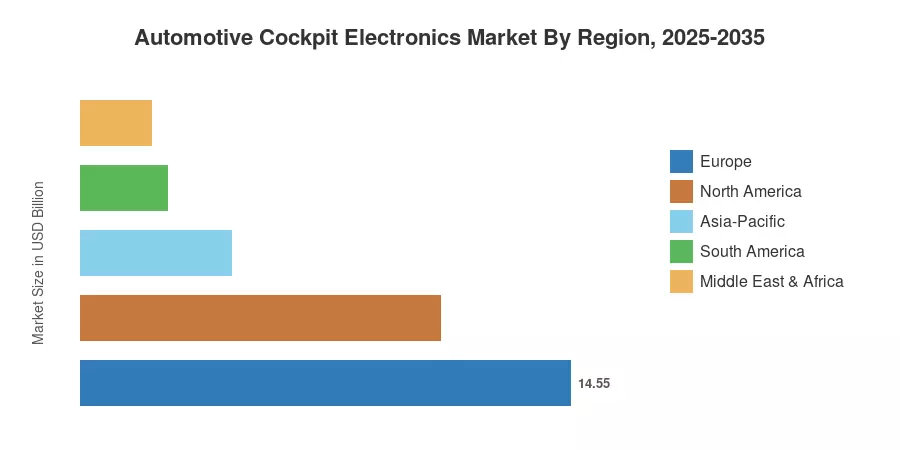
Europe commands approximately 34% of the global Automotive Cockpit Electronics Market, buoyed by premium OEM concentration in Germany and tightening Euro NCAP protocols. Asia-Pacific is the fastest-growing region at an estimated 10.5% CAGR, driven by expanding vehicle production in China and India's emerging component-manufacturing ecosystem. North America holds roughly 25% of the market, supported by strong consumer preference for connected and autonomous driving features. The convergence of electrification, autonomy, and digital user experience will keep cockpit electronics at the center of automotive investment through 2035.


Key Report Takeaways

• By Product

  • Infotainment and navigation systems account for approximately 31% of the Automotive Cockpit Electronics Market, reflecting OEM prioritization of connected media and real-time navigation stacks.
  • The head-up display segment is expanding at the fastest pace — roughly 12.4% CAGR — as augmented-reality windshield projection moves from luxury into mid-range vehicles.
  • Instrument clusters represent an estimated USD 9.8 billion in 2025, underpinned by the transition from analog dials to fully reconfigurable digital screens.

• By Vehicle Type

  • Passenger cars generate over 82% of total Automotive Cockpit Electronics Market revenue, given the volume and feature-intensity of the segment.
  • Commercial vehicles are growing at approximately 10.1% CAGR as fleet operators adopt telematics-integrated cockpit solutions for driver monitoring and route optimization.

• By Region

  • Europe leads the Automotive Cockpit Electronics Market with a 34% share, anchored by German premium OEMs and pan-European safety mandates.
  • Asia-Pacific is forecast to grow at 10.5% CAGR, the highest among all regions, as China and India scale domestic cockpit electronics production.
  • North America contributes approximately USD 10.7 billion to the 2025 market, reflecting high attach rates for advanced infotainment and ADAS-linked cockpit features.


Market Size and Forecast (2021–2035)

Market Research Future's estimates draw on OEM production schedules, Tier-1 supplier revenue disclosures, and proprietary demand models calibrated against regional vehicle registration databases and component bill-of-materials analysis.
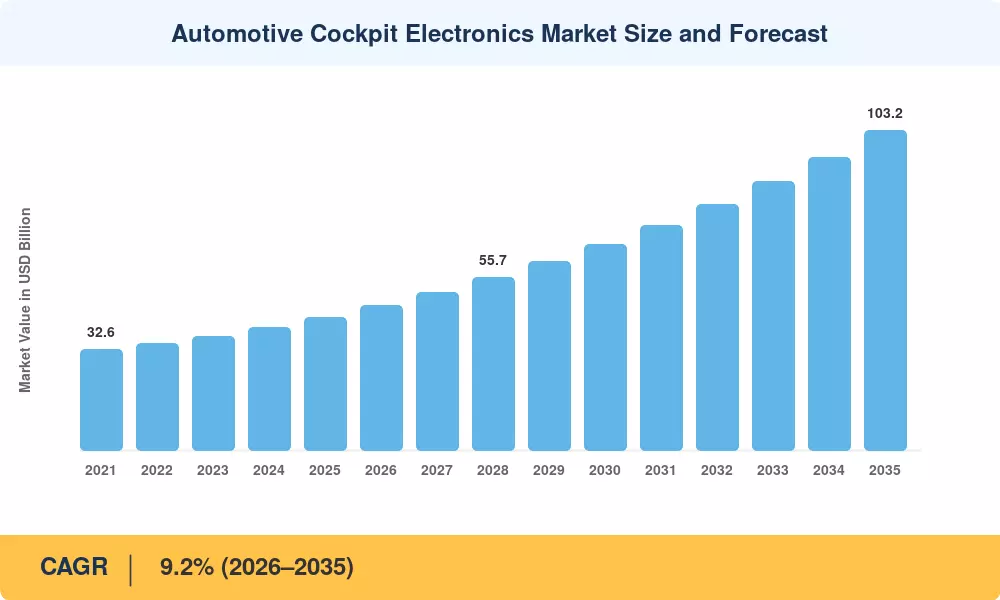
Automotive Cockpit Electronics Market Size and Forecast
Our Impact
Enabled $4.3B Revenue Impact for Fortune 500 and Leading Multinationals
Partnering with 2000+ Global Organizations Each Year
30K+ Citations by Top-Tier Firms in the Industry

Driver Impact Analysis

Driver ~% Impact on CAGR Geographic Relevance Impact Timeline
ADAS mandates and safety regulations 22% Global Short-term
Software-defined vehicle architecture shift 20% North America, Europe Medium-term
EV production growth and cockpit redesign 18% Asia-Pacific, Europe Medium-term
Consumer demand for connected experiences 15% Global Short-term
Autonomous driving L3+ cockpit requirements 12% Europe, North America Long-term
5G and V2X connectivity integration 8% Asia-Pacific, North America Long-term
Emerging-market vehicle digitization 5% South America, MEA Long-term


ADAS Mandates and Safety Regulations

The EU General Safety Regulation mandates driver drowsiness and attention warning systems, intelligent speed assistance, and event data recorders in every new vehicle sold across 27 member states from July 2024 [2]. NHTSA's proposed rulemaking (NPRM-2023-0064) in the United States would similarly require automatic emergency braking calibrated to pedestrian detection by 2028, forcing cockpit displays to integrate real-time ADAS status indicators [8]. These regulatory floors compress adoption timelines and guarantee baseline demand for the Automotive Cockpit Electronics Market regardless of consumer preference cycles.

Software-Defined Vehicle Architecture Shift

Three to five high-performance domain controllers are replacing outdated electrical/electronic architectures that used 80–120 separate ECUs per vehicle. With the cockpit domain acting as the key human-machine interaction layer, Volkswagen's CARIAD unit has dedicated more than EUR 2 billion to its unified software platform [3]. By consolidating infotainment, instrument cluster, and HUD rendering onto a single SoC, this structural modification increases addressable content per car and boosts cockpit electronics income per unit by an estimated 35–45% as compared to scattered architectures [10].


EV Production Growth and Cockpit Redesign

A recent source projects global electric vehicle sales will surpass 28 million units by 2027, representing 33% of new passenger car sales [14]. EVs typically carry a higher cockpit electronics bill-of-materials because the absence of a traditional engine allows broader dashboard surfaces, pillar-to-pillar displays, and more aggressive integration of climate, energy management, and infotainment functions into a unified screen ecosystem. OEMs like BYD and Hyundai have made ultra-wide curved OLED cockpit displays a standard differentiator in their EV lineups.

Consumer Demand for Connected Experiences

A 2024 survey found that 68% of new-car buyers rank in-cabin digital experience among their top three purchase criteria — up from 42% in 2019 [15]. This pull-demand reinforces OEM willingness to invest in higher-resolution displays, voice assistants, and seamless smartphone projection. The Automotive Cockpit Electronics Market benefits directly, as consumer willingness to pay for premium digital cockpits creates pricing headroom that supports R&D reinvestment.


Restraints Impact Analysis

Restraint ~% Drag on CAGR Geographic Relevance Impact Timeline
Semiconductor supply volatility –8% Global Short-term
High integration and validation costs –6% Global Medium-term
Cybersecurity and data-privacy regulations –5% Europe, North America Medium-term
Legacy platform compatibility constraints –4% Global Short-term
Skilled software talent shortage –3% Global Long-term


Semiconductor Supply Volatility

Although the acute chip shortage of 2021–2022 has eased, cockpit electronics rely on advanced-node SoCs (7 nm and below) that remain capacity-constrained. TSMC's 3 nm ramp is absorbing smartphone and AI-server demand first, leaving automotive clients with lead times still averaging 20–26 weeks for high-performance cockpit processors as of early 2025 [4]. Price premiums for automotive-grade wafers have risen approximately 15% since 2021, compressing Tier-1 margins and occasionally delaying vehicle launch schedules.

Cybersecurity and Data-Privacy Regulations

UNECE WP.29 regulations R155 and R156 require every vehicle type-approved in the EU, Japan, and South Korea to demonstrate a certified cybersecurity management system and secure over-the-air update capability [17]. Compliance costs add an estimated USD 150–250 per vehicle across software auditing, penetration testing, and incident-response infrastructure. While these regulations ultimately benefit the Automotive Cockpit Electronics Market by enforcing higher standards, the short-term burden slows feature deployment cycles and increases time-to-market.

High Integration and Validation Costs

Consolidating multiple cockpit functions onto a single domain controller demands extensive functional-safety validation under ISO 26262 ASIL-B or higher. Tier-1 suppliers report validation cycles of 18–24 months for integrated cockpit platforms, compared with 8–12 months for standalone head units [16]. These extended timelines elevate engineering costs and slow the migration from legacy architectures, particularly for volume-segment OEMs operating on thinner margins.


Automotive Cockpit Electronics Market Opportunities

AR-HUD and Windshield-as-Display Technologies

Augmented-reality head-up displays that overlay navigation cues, hazard warnings, and ADAS status onto the windshield represent a high-growth opportunity within the Automotive Cockpit Electronics Market. Continental and Panasonic have both demonstrated 15-meter virtual-image-distance AR-HUD modules targeting 2026 production vehicles, and the segment is forecast to grow at roughly 12.4% CAGR. As waveguide and holographic film costs decline, AR-HUD adoption will spread beyond luxury vehicles into the mainstream C- and D-segment.

Software-Defined Cockpit Monetization

Over-the-air feature activation and subscription-based cockpit services open recurring revenue streams for OEMs and Tier-1 suppliers. BMW's "Functions on Demand" program, Tesla's premium connectivity tier, and Mercedes-Benz's acceleration-boost unlock demonstrate that consumers will pay for post-purchase digital enhancements [12]. This shift from one-time hardware revenue to software-as-a-service economics fundamentally alters the value-capture model in the cockpit electronics space.

Emerging-Market Cockpit Digitization

India's Production-Linked Incentive (PLI) scheme for automotive components, with an outlay of INR 259 billion (approximately USD 3.1 billion), is catalyzing domestic manufacturing of electronic instrument clusters and infotainment modules [9]. Brazil and Southeast Asian markets are following a similar trajectory, as rising disposable incomes and urbanization push demand for digitally equipped vehicles. These regions represent white-space opportunities for Tier-1 suppliers willing to localize production.

Cockpit-as-a-Platform for Third-Party Ecosystems

Similar to the smartphone app store concept, automakers are increasingly making cockpit software platforms available to outside developers. During commutes, consumers may access content, commerce, and service providers thanks to Google Built-in and Apple CarPlay's tighter integration into native vehicle systems. By turning the cockpit from a cost center into a data-monetization asset, this ecosystem play generates additional revenue streams that are projected to reach USD 4–6 billion globally by 2030 [15].


Driver and Occupant Monitoring Systems

China's GB/T standards are heading toward requiring cabin monitoring in commercial vehicles, while the EU's updated GSR will mandate enhanced driver-distraction identification by 2026 [2][13]. These regulations establish a specific market for AI-based attention algorithms, infrared sensors, and interior-facing cameras, all of which are closely linked to the cockpit electronics stack.


Automotive Cockpit Electronics Market Future Outlook

AI-Native Cockpit Experiences

Generative AI and large-language-model integration will redefine the cockpit interaction paradigm by 2028–2030. Mercedes-Benz has already deployed a ChatGPT-powered voice assistant in select models, and Qualcomm's Snapdragon Ride Flex integrates on-device AI inference for personalized driver profiles and proactive route suggestions [3]. The Automotive Cockpit Electronics Market will increasingly be valued on software intelligence rather than display hardware alone.

Electrification and Cockpit Convergence

As EV platforms standardize zonal and central computing architectures, the cockpit module absorbs functions previously handled by separate body controllers — climate management, battery-state visualization, and energy-recovery coaching. A recent source projects EVs will constitute 54% of global new-car sales by 2033, ensuring that cockpit electronics designed for electric drivetrains become the default rather than the exception [14].

Autonomous Driving Cockpit Transitions

Level 3 and Level 4 automated driving introduce a "transition of control" design challenge where the cockpit must manage handoffs between machine and driver safely. Mercedes-Benz's Drive Pilot and BMW's L3 highway system both employ dedicated cockpit displays that confirm automation status and countdown takeover requests [8]. These requirements add new display, audio, and haptic modules to the cockpit bill-of-materials, expanding the Automotive Cockpit Electronics Market beyond traditional infotainment.

Sustainability and Circular Electronics

ESG pressure is pushing OEMs to adopt recycled and bio-based materials for display housings and PCB substrates. The EU's proposed End-of-Life Vehicles Regulation (2023/0284) sets recovery targets for electronic components, while OEMs like Volvo commit to using 25% recycled plastics in interior electronics by 2030 [21]. Sustainable design will become a competitive differentiator and a procurement criterion in the Automotive Cockpit Electronics Market through 2035.


Automotive Cockpit Electronics Market Segmentation

By Product

Segment Key Metric Primary Demand Driver
Infotainment and Navigation 31% share (2025) Connected services and OEM app ecosystems
Instrument Cluster USD 9.8 B (2025) Analog-to-digital transition and reconfigurable displays
Head-Up Display CAGR 12.4% AR-HUD adoption in mid-range vehicles
Information Display 14% share (2025) Center-stack and passenger-entertainment screens
Telematics CAGR 10.3% Fleet management and V2X connectivity requirements
Other Products USD 2.1 B (2025) Ambient lighting controllers, haptic feedback modules


Infotainment and navigation systems dominate the Automotive Cockpit Electronics Market by product, accounting for nearly a third of total revenue. The segment's value is driven by OEM strategies to position the cockpit as a connected platform — integrating streaming media, real-time traffic, EV charging-station routing, and voice-assistant services into a unified experience. Qualcomm and Samsung-Harman supply the majority of high-performance application processors powering these systems [3][15].

Instrument clusters represent the second-largest revenue pool, as the industry migrates from analog dials to fully digital, software-reconfigurable panels. A standard 12.3-inch TFT cluster now costs automakers approximately USD 120–180 at Tier-1 pricing, compared with USD 40–60 for a legacy analog unit, reflecting the value uplift that digitization delivers to the Automotive Cockpit Electronics Market [16]. Head-up displays are the fastest-growing product category, with AR-HUD technology enabling projection distances beyond 10 meters and field-of-view angles that overlay navigation prompts directly onto the road scene.

By Vehicle Type

Segment Key Metric Primary Demand Driver
Passenger Cars 82% share (2025) Volume production and high feature expectations
Commercial Vehicles CAGR 10.1% Fleet telematics, driver-monitoring mandates


Passenger cars generate the vast majority of Automotive Cockpit Electronics Market revenue because consumer expectations for digital cabin experiences translate directly into OEM feature competition. Premium brands average four or more active displays per vehicle, and even mass-market models now ship with 10-inch-plus central touchscreens as standard. Commercial vehicles, while smaller in absolute terms, are growing faster as fleet operators adopt integrated cockpit systems combining navigation, real-time diagnostics, and EU-mandated driver fatigue monitoring into purpose-built displays [2][13].


Regional Market Share Analysis

Region Key Metric Primary Investment Themes
Europe 34% market share (2025) Premium OEM cockpit integration; Euro NCAP and GSR compliance
Asia-Pacific 10.5% CAGR (2026–2035) Volume EV production; component localization in India and China
North America USD 10.7 B (2025) Connected-car ecosystems; NHTSA AEB rulemaking
South America 6% market share (2025) Entry-level digital clusters; Brazilian automotive policy
Middle East & Africa USD 2.1 B (2025) Smart mobility initiatives in Gulf states; fleet modernization
Total USD 42.8 B (2025)

The Automotive Cockpit Electronics Market exhibits a multi-polar geographic structure, with Europe leading on value, Asia-Pacific accelerating fastest, and North America sustaining high per-vehicle content.


North America

Country Key Metric Key Driver
US 78% of regional share NHTSA AEB mandate; high consumer attach rate for connected features
Canada CAGR 8.9% Cold-climate HUD demand; EV incentive programs
Mexico USD 0.6 B (2025) Nearshoring of Tier-1 cockpit assembly operations


The United States anchors the North American Automotive Cockpit Electronics Market with its combination of regulatory pull and consumer willingness to pay for advanced digital cockpits. NHTSA's finalized AEB rule (effective 2029) will require dashboard-level driver notification integration, while GM, Ford, and Stellantis are each investing over USD 2 billion in software-defined vehicle programs that treat the cockpit as the primary interaction layer [8][3].

Europe

Country Key Metric Key Driver
Germany 28% of regional share Premium OEM headquarters (VW, BMW, Mercedes-Benz)
UK CAGR 9.4% Post-Brexit ADAS regulation alignment; JLR cockpit programs
France USD 1.8 B (2025) Stellantis STLA Brain platform rollout
Italy 8% of regional share Ferrari/Maserati luxury cockpit electronics
Spain CAGR 8.6% SEAT/CUPRA MEB-based EV cockpit production
Nordic Countries USD 0.9 B (2025) Volvo/Polestar digital-first cockpit strategy
Russia 3% of regional share Domestic substitution efforts post-sanctions
Rest of Europe CAGR 8.3% Czech/Romanian Tier-1 assembly growth


Germany's dominance reflects the concentration of premium OEMs that serve as first adopters for high-content cockpit architectures. The Automotive Cockpit Electronics Market in Europe benefits from Euro NCAP's 2025 roadmap, which awards top ratings only to vehicles equipped with driver monitoring, adaptive HUD, and advanced emergency-call systems [5].

Asia-Pacific

Country Key Metric Key Driver
China 42% of regional share BYD, NIO, and Li Auto drive domestic EV cockpit innovation
India CAGR 12.1% PLI scheme; rising middle-class vehicle digitization
Japan USD 2.5 B (2025) Denso, Panasonic, and Alpine technology leadership
South Korea 14% of regional share Hyundai-Kia connected cockpit standardization
ASEAN CAGR 10.8% Thailand/Indonesia EV assembly incentives
Rest of Asia-Pacific USD 0.7 B (2025) Australia and Taiwan niche electronics roles


Asia-Pacific is the fastest-growing region in the Automotive Cockpit Electronics Market, propelled by China's massive EV production base — over 9 million units in 2024 — and India's ambition to become a global automotive-components hub. Chinese OEMs are vertically integrating cockpit silicon, with firms like Horizon Robotics and Black Sesame Technologies challenging incumbent Western chipmakers on cost and local-market responsiveness [9][14].

South America

Country Key Metric Key Driver
Brazil 68% of regional share Rota 2030 program incentivizing electronics content
Argentina CAGR 8.2% Light-vehicle production recovery
Rest of South America USD 0.4 B (2025) Colombia and Chile emerging digital cluster demand


Brazil's Rota 2030 automotive policy allocates tax credits for R&D in connected and electrified vehicle technologies, indirectly supporting the Automotive Cockpit Electronics Market by incentivizing local Tier-1 investment in digital instrument clusters and entry-level infotainment systems [19].

Middle East & Africa

Country Key Metric Key Driver
Saudi Arabia 32% of regional share Vision 2030 smart-mobility investments
UAE CAGR 9.7% Smart-city infrastructure and luxury vehicle imports
South Africa USD 0.3 B (2025) Regional assembly hub for African markets
Egypt 8% of regional share CKD assembly expansion
Rest of MEA CAGR 7.5% Gradual fleet digitization


Gulf Cooperation Council states are investing heavily in smart-city transport ecosystems, creating pull-through demand for connected cockpit technologies in both passenger and commercial fleets. Saudi Arabia's NEOM and UAE's autonomous-vehicle pilots generate showcase demand for the Automotive Cockpit Electronics Market in a region historically reliant on imports [20].


Automotive Cockpit Electronics Market By Region, 2025-2035

Competitive Benchmarking

The Automotive Cockpit Electronics Market exhibits medium concentration, with the top five suppliers capturing an estimated 38–44% of global revenue. The Herfindahl-Hirschman Index (HHI) sits in the moderately competitive range (~900–1,100), reflecting a market where large Tier-1 suppliers compete with specialized display and silicon providers across overlapping product categories.

Company Est. Revenue Share Range Key Offerings for Automotive Cockpit Electronics Market Strategic Positioning
Continental AG ~8–11% AR-HUD, digital clusters, integrated cockpit platforms Full-stack cockpit integrator; strong Euro NCAP alignment
Robert Bosch GmbH ~7–10% Instrument clusters, driver monitoring, display ECUs Broad automotive portfolio; safety-electronics heritage
Visteon Corporation ~6–9% SmartCore™ cockpit domain controllers, digital clusters Pure-play cockpit electronics; domain-controller pioneer
Harman International ~6–8% Connected infotainment, audio, OTA platforms Samsung synergy in display and semiconductor supply
Denso Corporation ~5–8% HUD systems, meter clusters, cabin sensing Toyota-ecosystem integration; strong Japan/Asia presence
Panasonic Automotive ~4–7% Infotainment systems, eCockpit platforms Legacy head-unit expertise; EV-platform partnerships
Alpine Electronics ~3–5% Navigation, audio, display modules Premium aftermarket and OEM dual-channel strategy
Magna International ~3–5% Mirror-replacement displays, cockpit modules Contract-manufacturing scale; diversified Tier-1
Aptiv PLC ~2–4% Cockpit controllers, signal distribution, user experience Electrical-architecture expertise; L4 autonomous synergy
Mitsubishi Electric ~2–4% Instrument clusters, display modules, sensing Reliability-focused; strong Japanese OEM relationships


Recent News & Developments

  • Qualcomm (January 2025): Announced the Snapdragon Cockpit Elite platform built on 3 nm process technology, offering 3× AI performance over the previous generation for in-cabin personalization and AR-HUD rendering [3].
  • Continental AG (November 2024): Unveiled a pillar-to-pillar curved OLED cockpit display developed with LG Display, targeting 2026 production vehicles from a European premium OEM [7].
  • Visteon Corporation (September 2024): Secured a USD 4.2 billion lifetime order book for SmartCore domain controllers, with contracts spanning seven global OEMs [10].
  • European Commission (July 2024): Enforced mandatory driver drowsiness and attention monitoring under the General Safety Regulation, directly expanding cockpit electronics content per vehicle across the EU [2].


  • BYD (March 2024): Began in-house production of 15.6-inch rotating touchscreens for its Dynasty and Ocean series, vertically integrating cockpit display manufacturing [14].
  • NHTSA (December 2023): Finalized the automatic emergency braking rule requiring all passenger vehicles to include dashboard-integrated AEB status indicators by September 2029 [8].


Automotive Cockpit Electronics Market Report Scope

Parameter Detail
Market Scope Global Automotive Cockpit Electronics Market covering head-up display, information display, infotainment and navigation, instrument cluster, telematics, and other products
Study Period 2021–2035
CAGR (Forecast Period) 9.2% (2026–2035)
Base Year 2025 — USD 42.8 Billion
Forecast Endpoint 2035 — USD 103.2 Billion
Fastest Growing Segment Head-Up Display (by product); Asia-Pacific (by region)
Companies Profiled Continental AG, Robert Bosch, Visteon, Harman, Denso, Panasonic, Alpine Electronics, Magna, Aptiv, Mitsubishi Electric
Valuation Currency USD (Billion)

FAQs

How do automakers decide between integrated and modular cockpit architectures?
OEMs weigh platform scalability against supplier flexibility. Integrated domain controllers reduce wiring weight by 15–20% but lock the OEM into a single Tier-1's software stack [10].
What role does display-panel technology play in cockpit differentiation?
OLED and micro-LED panels offer higher contrast and thinner form factors than TFT-LCD, enabling curved and pillar-to-pillar designs that premium OEMs use as brand differentiators [7].
How are cybersecurity regulations affecting cockpit electronics procurement timelines?
UNECE R155 compliance adds 4–6 months of security auditing to cockpit platform validation, increasing Tier-1 development budgets by an estimated 8–12% [17].
What is the cost premium for AR head-up displays over conventional HUDs?
AR-HUD modules currently cost USD 200–350 more than combiner-type HUDs at Tier-1 pricing, though costs are declining 10–15% annually as waveguide yields improve [7].
How does the Automotive Cockpit Electronics Market differ between EV and ICE platforms?
EV cockpits carry 25–40% higher electronics content per vehicle due to energy-management displays and the absence of mechanical gauge interfaces [14].
What standards govern functional safety in cockpit domain controllers?
ISO 26262 ASIL-B is the baseline for cockpit controllers, with ASIL-D required for any functions shared with ADAS or braking-system feedback loops [16].
How are subscription-based cockpit services influencing the Automotive Cockpit Electronics Market value chain?
OTA feature activation shifts revenue from one-time hardware sales to recurring software subscriptions, allowing OEMs to capture post-sale value estimated at USD 10–15 per vehicle per month [12].    
Author
Author
Author Profile
Triveni Bhoyar LinkedIn
Senior Research Analyst
Triveni Bhoyar has over 5 years of experience in the market research industry, specializing in the Automotive and Aerospace & Defense sectors. She has contributed to 200+ reports, including numerous custom projects for leading global companies, delivering solutions to complex business challenges. Renowned for her ability to generate valuable insights, Triveni excels in addressing unique market dynamics with precision and depth. Her expertise spans market sizing, competitive intelligence, and trend analysis, enabling clients to craft data-driven growth strategies. With strong analytical rigor and a client-centric approach, she plays a pivotal role in driving impactful, strategic decision-making.
Co-Author
Co-Author Profile
Swapnil Palwe LinkedIn
Team Lead - Research
With a technical background as Bachelor's in Mechanical Engineering, with MBA in Operations Management , Swapnil has 6+ years of experience in market research, consulting and analytics with the tasks of data mining, analysis, and project execution. He is the POC for our clients, for their consulting projects running under the Automotive/A&D domain. Swapnil has worked on major projects in verticals such as Aerospace & Defense, Automotive and many other domain projects. He has worked on projects for fortune 500 companies' syndicate and consulting projects along with several government projects.

Research Approach


Secondary Research

The secondary research process involved comprehensive analysis of regulatory databases, automotive industry publications, technical standards documentation, and authoritative transportation organizations. Key sources included the US National Highway Traffic Safety Administration (NHTSA), European Automobile Manufacturers' Association (ACEA), European Telecommunications Standards Institute (ETSI), International Organization for Standardization (ISO/TC 22) for automotive standards, Society of Automotive Engineers (SAE) International, International Electrotechnical Commission (IEC) for electronics standards, US Department of Transportation (DOT), European Commission Mobility and Transport Directorate-General, China Association of Automobile Manufacturers (CAAM), Japan Automobile Manufacturers Association (JAMA), National Highway Traffic Safety Administration (NHTSA) Fatality Analysis Reporting System, International Energy Agency (IEA) Global EV Outlook, World Economic Forum (WEF) Future of Mobility, International Telecommunication Union (ITU) for connectivity standards, German Association of the Automotive Industry (VDA), and national automotive ministry reports from key markets (US, Germany, Japan, China, South Korea, India). These sources were used to collect vehicle production statistics, regulatory compliance data, autonomous driving framework developments, consumer technology adoption trends, and market landscape analysis for Head-Up Display systems, Infotainment platforms, Driver Information Displays, Climate Control electronics, Telematics modules, Audio systems, and other cockpit technologies.


Primary Research

In order to gather both qualitative and quantitative insights, supply-side and demand-side stakeholders were interviewed during the primary research process. CEOs, vice presidents of product development, heads of cockpit electronics engineering, chief technology officers, heads of user experience (UX) design, directors of regulatory compliance, and commercial directors from Tier-1 automotive electronics suppliers, cockpit system integrators, display manufacturers, semiconductor companies, and OEMs were among the supply-side sources. Chief engineers from international automakers, heads of interior design, procurement directors for cockpit electronics, fleet managers from commercial vehicle operators, ride-sharing technology leaders, and quality assurance managers from automobile manufacturing facilities were examples of demand-side sources. Primary research verified product pipeline timelines for next-generation cockpit platforms, validated market segmentation across HUD, infotainment, and driver information systems, and obtained information on supply chain dynamics, software integration tactics, cybersecurity frameworks, and HMI adoption trends.

Primary Respondent Breakdown:

• By Designation: C-level Primaries (28%), Director Level (45%), Others (27%)

• By Region: North America (42%), Europe (23%), Asia-Pacific (30%), Rest of World (5%)


Market Size Estimation

Global market valuation was derived through revenue mapping and vehicle unit production analysis. The methodology included:

• Identification of 55+ key manufacturers across North America, Europe, Asia-Pacific, and Latin America specializing in cockpit electronics, display technologies, and HMI systems

• Product mapping across Head-Up Display, Infotainment System (Cockpit Integration Platform, Display and Integration System), Driver Information Display (Central Display, Passenger Display, Controls and Integration Elements), Climate Control System, Telematics, Audio System, Dash Cameras, and other emerging categories

• Analysis of reported and modeled annual revenues specific to cockpit electronics portfolios and subsystem categories

• Coverage of manufacturers representing 75-80% of global market share in 2024

• Extrapolation using bottom-up (vehicle unit production × average system content value by region) and top-down (manufacturer revenue validation against OEM procurement data) approaches to derive segment-specific valuations for passenger cars (hatchback, sedan, SUV/MUV, sports/hypercar) and commercial vehicles (LCVs, trucks, buses)

Download Free Sample

Kindly complete the form below to receive a free sample of this Report

* Please use a valid business email

Download PDF ×

We do not share your information with anyone. However, we may send you emails based on your report interest from time to time. You may contact us at any time to opt-out.
















