Baked Chips Market (2026 - 2035)

Baked Chips Market Size, Share, Industry Trend & Analysis Research Report Information By Source (Fruits, Vegetables, Grains, Other Sources), By Flavor (Salty, Classic, Barbecue, Other Flavors), By Distribution Channel (Supermarkets/Hypermarkets, Convenience/Grocery Stores, Online Stores, Other Distribution Channels), By Geography (North America, Europe, Asia-Pacific, South America, Middle East and Africa) – Forecast Till 2035

Forecast Period
2026-2035
CAGR
5.92%
2025 Market Size
USD 1.79 Billion
2035 Market Size
USD 3.18 Billion
Food, Beverages & Nutrition ● Updated August 25, 2026 Report ID: MRFR/FnB/2353-HCR | Pages: 110 | Author: Sakshi Gupta

Baked Chips Market 摘要

根据市场研究未来的分析,烘焙薯片市场规模在2024年估计为319.8亿美元。预计烘焙薯片行业将从2025年的337.9亿美元增长到2035年的586.7亿美元,在预测期2025 - 2035年内展现出5.67%的年复合增长率(CAGR)。北美占全球烘焙薯片市场的最大份额,约为38%,这得益于消费者对更健康零食替代品的偏好和对低脂肪、营养零食选择的需求增加。美国是北美烘焙薯片市场的主导国家,预计在2025年占全球市场份额的约32%,这得益于强大的零食文化、广泛的零售可用性以及如PepsiCo的Frito-Lay和凯洛格的品客等主要行业参与者的存在。以土豆为基础的烘焙薯片在全球烘焙薯片市场中占据最大成分细分,预计在2025年占全球市场份额的约55%,这得益于消费者的广泛熟悉度、既定的口味偏好以及土豆薯片品牌在全球零售店的强大市场存在。

主要市场趋势和亮点

烘焙薯片市场正经历向健康意识和创新零食选择的动态转变。

  • 北美仍然是烘焙薯片最大的市场,受到对更健康零食替代品需求增长的推动。
  • 亚太地区正在成为增长最快的市场,反映出消费者对零食化的趋势上升。
  • 以蔬菜为基础的烘焙薯片主导市场,而以水果为基础的选择正在迅速获得人气。
  • 健康意识选择和口味创新是推动烘焙薯片市场增长的关键驱动因素。

市场规模与预测

2024市场规模 319.8(十亿美元)
2035市场规模 586.7(十亿美元)
年均增长率(2025 - 2035) 5.67%

主要参与者

百事可乐(美国),卡夫亨氏(美国),通用磨坊(美国),布鲁克林烘焙(美国),特拉薯片(美国),开普科德(美国),Kettle品牌(美国),品客(美国),海恩天圣集团(美国)
Our Impact
Enabled $4.3B Revenue Impact for Fortune 500 and Leading Multinationals
Partnering with 2000+ Global Organizations Each Year
30K+ Citations by Top-Tier Firms in the Industry

Baked Chips Market Drivers

电子商务增长

电子商务平台的快速扩展正在改变烘焙薯片市场,为消费者提供前所未有的多样化产品访问。在线购物变得越来越受欢迎,尤其是在年轻人群体中,他们更喜欢在家中舒适地购买零食。最近的统计数据显示,烘焙薯片的在线销售激增,反映了消费者购买行为的变化。这一趋势因订阅服务和直接面向消费者的模式的兴起而进一步加剧,这使品牌能够直接与客户互动。随着电子商务的持续增长,烘焙薯片市场有望利用这一趋势,增强分销渠道并接触更广泛的受众。

口味创新

口味创新是推动烘焙薯片市场增长的重要催化剂。随着消费者口味的演变,对独特和多样化口味的需求日益增长,超越传统产品。制造商越来越多地尝试异国香料、草药,甚至国际口味,以吸引喜欢冒险的零食爱好者。市场数据显示,调味烘焙薯片的受欢迎程度显著上升,促进了整体市场的扩展。限量版口味的推出和与烹饪专家的合作进一步增强了消费者的兴趣。因此,烘焙薯片市场可能会因口味创新而持续增长,吸引更广泛的受众并鼓励重复购买。

零食化趋势

零食化趋势的特点是餐食与零食之间的界限模糊,正在显著影响烘焙薯片市场。随着消费者越来越寻求方便和便携的零食选择,烘焙薯片正好满足这一需求。这个趋势在忙碌的专业人士和千禧一代中尤为明显,他们更喜欢快速、便携的零食,而不妥协于味道或质量。市场研究未来表明,零食食品细分市场正在快速扩展,烘焙薯片因其被认为的健康益处而成为首选。随着零食化趋势的持续升温,烘焙薯片市场可能会经历持续增长,受到不断变化的消费者生活方式和偏好的推动。

健康意识选择

消费者对健康和保健意识的提高似乎是烘焙薯片市场的一个关键驱动因素。随着个人寻求更健康的零食替代品,烘焙薯片因其通常比传统油炸薯片含有更低的脂肪和更少的卡路里而受到欢迎。根据最近的数据,对更健康零食选择的需求激增,烘焙薯片的销售显著增加。这一趋势进一步得到肥胖率和相关健康问题上升的支持,促使消费者选择符合其饮食偏好的零食。因此,制造商正在创新,创造不仅满足味道而且符合健康标准的烘焙薯片,从而扩大市场覆盖。烘焙薯片市场因此有望从这一向健康饮食的转变中受益。

可持续发展倡议

可持续发展倡议正成为烘焙薯片市场的一个关键驱动因素,因为消费者越来越重视环保产品。品牌正在通过采用可持续采购实践、减少包装浪费和使用环保材料来响应这一需求。这一转变不仅吸引了环保意识强的消费者,也符合对可持续实践的监管压力。市场数据显示,被标记为可持续的产品正在经历更高的销售增长,表明消费者对展现社会责任的品牌有明显偏好。随着可持续性成为购买决策中的关键考虑因素,烘焙薯片市场可能会看到对遵循这些原则的烘焙薯片需求的上升,从而促进品牌忠诚度并增强市场竞争力。

市场细分洞察

按烘焙薯片来源:蔬菜(最大)与水果(增长最快)

在烘焙薯片市场中,来源的分布显示蔬菜是最大的贡献者,展示了健康意识消费者的显著需求。水果和谷物也发挥着重要作用,迎合不同的口味和饮食偏好。谷物和其他成分补充了这一细分市场,为寻求更健康零食替代品的广泛消费者群体提供了多样化的选择。

蔬菜:(主导)与水果(新兴)

以蔬菜为基础的烘焙薯片目前是市场上的主导力量,以其有利的营养特征和天然风味吸引消费者。该细分市场包括羽衣甘蓝、甜菜和红薯薯片等受欢迎的选择,以其酥脆的口感和丰富的味道而闻名。另一方面,以水果为基础的烘焙薯片正在迅速崛起,抓住了关注创新和独特风味体验的消费者趋势。它们通常包括苹果、香蕉和浆果薯片等品种,特别吸引寻求甜味替代品的健康意识群体。

按烘焙薯片功能性:有机(最大)与无麸质(增长最快)

烘焙薯片市场展示了多样的功能性细分,有机选项在市场份额中领先。它们对健康意识消费者的吸引力以及对天然成分日益增长的趋势使有机烘焙薯片成为主流。与此同时,无麸质烘焙薯片正在迅速获得关注,占据了新产品发布的显著部分,因为它们迎合了需要或偏好无麸质饮食的细分但不断扩大的群体。

有机(主导)与无麸质(新兴)

有机烘焙薯片在烘焙薯片市场的功能性细分中代表着一种主导力量。它们的特点是使用天然和未加工的成分,吸引寻求更健康零食选择的消费者。随着对食品来源和成分透明度的认识不断提高,有机薯片已经占据了相当大的市场份额。相反,无麸质烘焙薯片作为一个显著的细分市场正在崛起,受到麸质敏感性和乳糜泻疾病日益普遍的推动。该细分市场吸引寻求健康益处和多样化零食选择的客户,品牌正在创新以增强风味和口感,从而确保市场竞争力。

按烘焙薯片分销渠道:基于商店(最大)与非基于商店(增长最快)

在烘焙薯片市场中,销售的分布主要通过基于商店的渠道进行,这些渠道包括超市、大型超市和便利店,有效地引领市场。基于商店的零售仍然是关键参与者,利用实体存在和客户互动,从而巩固其在该领域作为最大细分市场的地位。另一方面,非基于商店的渠道,包括电子商务平台和直接面向消费者的销售,正在迅速获得关注,并占据了销售的显著部分。由于其便利性以及消费者购物习惯向在线购买的转变,这一细分市场正在吸引关注。烘焙薯片分销渠道内的增长趋势在很大程度上受到消费者偏好变化和对便利性关注增加的影响。电子商务的兴起推动了非基于商店的细分市场,使各种消费者群体能够更广泛地接触和获取。此外,包装食品的持续创新为两个细分市场创造了新的机会,因为品牌努力迎合健康意识消费者。旨在提升品牌可见性和认知度的促销活动和营销策略在推动基于商店和非基于商店的分销渠道的增长中也至关重要。

基于商店(主导)与非基于商店(新兴)

基于商店的分销渠道是烘焙薯片市场的主导力量,其特点是广泛的覆盖面和建立的客户关系。超市和大型超市显著提供烘焙薯片,允许方便的购买体验并增强产品可见性。这些商店通常实施各种促销策略以吸引客户,从而导致更高的销售量。相比之下,非基于商店的渠道正在迅速崛起,尤其是在在线购物普及的背景下。该细分市场迎合了一个日益增长的群体,偏好在家中购买烘焙薯片的便利性。非基于商店的渠道正在重新定义市场参与,利用数字营销策略和直接发货以创新的方式与消费者连接。随着零售数字化趋势的持续发展,该细分市场将在未来重塑消费者的购买习惯。

获取关于Baked Chips Market的更多详细见解 申请免费样本

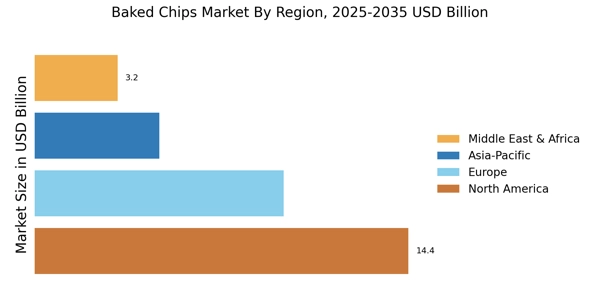
区域洞察

北美:健康意识零食市场

北美烘焙薯片市场受到消费者健康意识增强的推动,导致从传统油炸零食向更健康替代品的转变。该地区占据了约45%的最大市场份额,美国是主要贡献者。支持健康食品选择的监管支持进一步推动了这一增长,因为消费者寻求低脂肪和低卡路里的零食。主要参与者如百事可乐、卡夫亨氏和通用磨坊主导竞争格局,提供多种烘焙薯片产品。美国市场以创新的口味和包装为特征,迎合多样化的消费者偏好。成熟品牌的存在以及对有机和天然成分日益增长的趋势正在塑造市场动态,确保强劲的竞争和持续的产品开发。

欧洲:新兴健康趋势

在欧洲,烘焙薯片市场正在经历显著增长,受到健康意识增强和向更健康零食选择转变的推动。该地区占据了约30%的第二大市场份额。促进健康饮食习惯和食品标签透明度的监管举措是这一趋势的关键催化剂,鼓励消费者选择烘焙而非油炸零食。英国、德国和法国等主要国家在这一市场中处于前沿,竞争格局中既有本地品牌也有国际品牌。公司越来越关注产品创新,推出独特的口味和有机选择以满足消费者需求。像Walkers和Kettle Chips等主要参与者的存在增强了市场动态,促进了竞争环境,推动了增长和多样化。

亚太地区:快速增长的零食市场

亚太地区的烘焙薯片市场正在快速增长,受到城市化和消费者生活方式变化的推动。该地区的市场份额约为15%,中国和印度等国处于领先地位。可支配收入的增加和对便利零食选择的日益偏好是推动这一趋势的关键因素,同时也得到了支持健康食品产品的监管支持。中国和印度正在成为烘焙薯片市场的重要参与者,本地品牌与国际品牌一起获得了关注。竞争格局正在演变,公司专注于口味创新和更健康的成分,以吸引健康意识强的消费者。像Calbee和百事可乐等主要参与者的存在显著,他们调整产品以迎合区域口味和偏好,确保在这一动态市场中的持续增长。

中东和非洲:未开发的市场潜力

中东和非洲(MEA)地区为烘焙薯片市场提供了未开发的潜力,受到城市化和中产阶级增长的推动。该地区的市场份额约为10%,南非和阿联酋等国处于领先地位。对更健康零食选择的需求正在上升,得到了旨在改善公共健康和营养标准的监管举措的支持。南非正在成为烘焙薯片市场的关键参与者,本地品牌越来越受欢迎。竞争格局的特点是国际和区域参与者的混合,专注于产品创新和针对本地口味的营销策略。随着健康趋势继续影响消费者选择,像Simba和Lay's等主要参与者的存在预计将推动MEA地区的市场增长和多样化。

Baked Chips Market Regional Image

主要参与者和竞争洞察

领先的行业公司正在进行大量研发投资,以多样化其产品供应,这将推动烘焙薯片市场的扩展。重要的市场发展包括新产品发布、合同协议、并购、增加投资以及与其他组织的合作。市场参与者还参与多项战略行动,以增加其全球存在。为了在竞争激烈和严峻的市场环境中扩展和生存,烘焙薯片行业必须生产廉价产品。本地制造以降低运营成本是制造商在烘焙薯片行业中支持客户和增加市场份额的关键商业策略之一。近年来,烘焙薯片行业提供了一些最显著的优势。烘焙薯片市场的主要参与者,包括品客、凯洛格公司、通用磨坊等,正试图通过投资研发活动来增加市场需求。品客是由宝洁公司于1968年创建的可堆叠薯片品牌,品牌名为“品客的新奇薯片”。凯洛格于2012年收购了该品牌。品客是马鞍形的薯片。品客品牌有着引人入胜的历史,以其独特的罐子而闻名,品客薯片就是在这种罐子中出售的。薯片罐旨在防止破碎,并保持品客的完整性和均匀性,以便消费者使用。2019年5月,凯洛格的热门子公司“品客”宣布推出一款名为“腌黄瓜味”的新版本。这种口味灵感来自于流行的卡通《瑞克和莫蒂》,并为美国市场而创作。PeaTos正在努力使美国最受欢迎的零食更健康,并且不含人工成分。凭借如Cheetos、Doritos和Funyuns等品牌,PeaTos正在挑战Frito Lay在咸味薯片上的垄断地位。他们利用艺术和科学的结合,重新创造传统垃圾食品的美味和乐趣,但通过用营养丰富的豌豆和扁豆替代典型的玉米填充物,并去除所有化学物质,PeaTos发现了一种生产“没有垃圾的垃圾食品”的方法。2021年6月,基于豌豆的零食品牌Peatos推出了三种口味的玉米饼风格薯片:奶酪味、香辣牧场味和火辣素食奶酪味。这些产品被创造为Doritos的更健康替代品。

Baked Chips Market市场的主要公司包括

行业发展

2022年3月: 首先是长三明治,然后是长饼干,现在是烘焙Lay's长薯片。烘焙Lay's揭示了其与Subway的最新合作,展示了全球首款12英寸的脆片,正好赶上国家薯片日。这种新的脆脆发明将于2022年3月14日星期二在德克萨斯州弗里斯科的Subway独家发售。德克萨斯州的一切都更大,这使得Lay's和Subway推广烘焙Lay's长薯片成为理想之地。

2022年2月: BRB推出了爆米花味薯片。此外,该产品线在公司的D2C网站和亚马逊上可用。

未来展望

Baked Chips Market 未来展望

预计烘焙薯片市场在2025年至2035年期间将以5.67%的复合年增长率增长,受健康趋势、创新口味和对方便零食需求增加的推动。

到2035年,烘焙薯片市场预计将实现强劲增长和多样化。

市场细分

烘焙薯片市场烘焙薯片来源展望

  • 蔬菜
  • 水果
  • 谷物
  • 粮食
  • 其他

烘焙薯片市场烘焙薯片功能展望

  • 有机
  • 无麸质
  • 低热量
  • 低钠
  • 其他

烘焙薯片市场烘焙薯片分销渠道展望

  • 基于商店
  • 非商店

报告范围

Parameter Detail
Market Scope Global manufacture and sale of oven-baked, non-fried salty snack chips across retail and foodservice
Study Period 2021–2035 (Historical 2021–2024; Base Year 2025; Forecast 2026–2035)
CAGR 5.92% (2026–2035)
Market Size Checkpoints USD 1.79 Billion (2025); USD 1.90 Billion (2026); USD 3.18 Billion (2035)
Fastest Growing Segments Fruits (by Source); Barbecue (by Flavor); Online Stores (by Distribution Channel)
Companies Profiled 11 global and regional players across the Baked Chips Market
Valuation Currency USD Billion, at manufacturer selling price

市场亮点

FAQs

How should a private-label buyer qualify a co-manufacturer for the Baked Chips Market?
Audit oven throughput at target moisture spec, not nameplate capacity. Verify documented acrylamide mitigation under EU 2017/2158 and request 12 months of batch variance data before committing volume. [Ref 8]
Do baked chips have shorter shelf life than fried equivalents?
Typically no — lower residual oil reduces rancidity risk, often extending shelf life by four to eight weeks. Moisture pickup becomes the limiting factor instead, so barrier film specification matters more than antioxidant systems. [Ref 9]
Which certifications unlock export volume in the Baked Chips Market?
BRCGS or FSSC 22000 is table stakes for European and Gulf retail. Halal certification is mandatory across most Middle East and Southeast Asian accounts, and non-GMO Project verification meaningfully lifts US natural-channel placement. [Ref 22]
What does acrylamide mitigation actually cost per plant?
Asparaginase enzyme dosing, raw-material sugar specification and cold-chain discipline run roughly USD 0.9–1.6 million annually for a mid-sized facility. Most of that is recurring ingredient cost rather than capital expenditure. [Ref 8]
What is the most capital-efficient entry route into the Baked Chips Market?
Contract manufacturing beats owning a line below roughly 4,000 tonnes annual volume. Retrofit economics only work once you can fill 60% of a dedicated oven's available hours. [Ref 12]
Can existing extrusion pellet lines be converted to baked output?
Yes, and this is the cheapest conversion available. Pellet pre-gelatinisation followed by hot-air expansion produces better texture consistency than slice-and-bake, at retrofit costs near 40% of a full oven line. [Ref 9]
How does promotional depth affect category profitability?
Depth beyond 30% off list erodes reference price and rarely produces durable trial. UK HFSS promotion restrictions demonstrated that compliant products grew volume without multibuy support, arguing for everyday-value pricing instead. [Ref 7]      
作者
Author
Author Profile
Sakshi Gupta LinkedIn
Team Lead - Research
Currently a Team Lead in consumer goods, FMCG, and F&B, she translates rigorous research into decisive strategy. She develops GTM roadmaps, pricing architectures, and competitive benchmarks for companies across Europe, the US, and APAC. She synthesize insights, align cross-functional teams, and drive execution from brief to measurable outcomes. She leads end-to-end engagements with crisp analysis, compelling storytelling, and a strong command of Power BI, Tableau, SQL, and advanced research platforms.
分享:
申请免费样本

Research Approach


Secondary Research

The secondary research process involved comprehensive analysis of regulatory databases, industry trade publications, agricultural commodity reports, and authoritative food industry organizations. Key sources included the US Food & Drug Administration (FDA) for nutrition labeling standards and ingredient safety protocols, the US Department of Agriculture (USDA) Economic Research Service for potato and vegetable commodity production data, and the Bureau of Labor Statistics (BLS) for food manufacturing employment and productivity metrics (NAICS 3118 & 3119). International regulatory sources encompassed the European Food Safety Authority (EFSA) for EU snack food regulations and the European Snacks Association (ESA) for European savoury snack consumption patterns. Agricultural data was sourced from the Food and Agriculture Organization (FAO) FAOSTAT database for global potato and vegetable production volumes, the National Potato Council (NPC) for U.S. potato processing industry economic impact data, and PotatoUSA for domestic consumption trends. Trade statistics were extracted from the International Trade Centre (ITC) Harmonized System (HS) codes 1905.90 for baked savory snack foods and the UN Comtrade database for cross-border potato chip trade flows. Industry associations including SNAC International (representing 400+ member companies across 55 countries), the China Food Industry Association Potato Food Professional Committee, and Food & Drink Europe provided market intelligence on formulation trends, processing innovations, and retail distribution strategies. Additional sources included proprietary retail audit data from NielsenIQ and IRI for point-of-sale tracking across supermarkets, convenience stores, and e-commerce channels, as well as patent databases for baking technology innovations and clean-label formulation advancements.


Primary Research

To gather both qualitative and quantitative information, the primary research process involved interviewing players from both the supply and demand sides. CEOs, VPs, chiefs of product development, and directors of procurement from baked chip companies, contract baking operators, and private label suppliers were among the supply-side sources. Sustainable packaging vendors, makers of baking equipment (continuous oven systems, air impingement technology providers), and providers of ingredient technology (specialty oils, natural flavor systems, clean-label preservatives) were also consulted. The demand-side sources included buyers and category managers from large grocery stores, convenience stores, and hypermarkets; procurement directors from foodservice distributors; and chefs and trend-spotters from fast food and restaurant chains. We confirmed the timelines for the clean-label and gluten-free product pipelines, gathered insights on regional flavor preferences, price elasticity across retail tiers, and slotting fee dynamics in modern trade channels. Primary research validated market segmentation across potato-based, vegetable-based, multigrain, and tortilla/corn baked chip categories.

Primary Respondent Breakdown:

By Designation: C-level Primaries (28%), Director Level (32%), Others (40%)

By Region: North America (32%), Europe (30%), Asia-Pacific (28%), Rest of World (10%)


Market Size Estimation

Global market valuation was derived through revenue mapping, production volume analysis, and trade flow reconciliation. The methodology included:

Identification of 50+ key manufacturers and contract baking operations across North America, Europe, Asia-Pacific, Latin America, and the Middle East & Africa

Product mapping across potato-based baked chips (kettle-cooked, ripple, thin-cut variants), vegetable-based chips (sweet potato, beet, kale, carrot), multigrain formulations (quinoa, brown rice, ancient grains), and tortilla/corn segments

Analysis of reported and modeled annual revenues specific to baked chip portfolios, excluding fried/extruded snack divisions where possible

Coverage of manufacturers representing 75-80% of global market share in 2024, including PepsiCo (Frito-Lay), Kellogg Company (Pringles), Calbee, Utz Brands, General Mills, Campbell Snacks, Kettle Foods, Popchips, and regional players like TagZ Foods and Greendot Health Foods

Extrapolation using bottom-up (production volume × average selling price by country/region, factoring in retail markup, distributor margins, and value-added tax variations) and top-down (manufacturer revenue validation against retail scan data) approaches to derive segment-specific valuations for standard versus premium/functional positioning categories

Calibration against export/import data from national customs databases to account for cross-border trade in baked snack commodities under HS codes 1905.90.90 and related classifications

分享:
申请免费样本
下载免费样本

请填写以下表格以获取本报告的免费样本

* Please use a valid business email

分享:
申请免费样本
Download PDF ×

We do not share your information with anyone. However, we may send you emails based on your report interest from time to time. You may contact us at any time to opt-out.