AI in Drug Discovery Market (2026 - 2035)

ID: MRFR/Pharma/7918-CR
200 Pages
Kinjoll Dey
Last Updated: July 28, 2026
AI in Drug Discovery Market Research Report By Application (Target Identification, Lead Optimization, Drug Repurposing, Clinical Trials, Preclinical Testing), By Technology (Machine Learning, Natural Language Processing, Deep Learning, Knowledge Graphs, Robotic Process Automation), By Workflow (Data Mining, Predictive Modeling, Clinical Data Management, Assay Development), By End User (Pharmaceutical Companies, Biotechnology Firms, Research Institutions, Academic Institutions) and By Regional (North America, Europe, South America, Asia Pacific, Middle East and Africa) - Industry Forecast to 2035
AI in Drug Discovery Market
Market Size
Forecast Period2026-2035
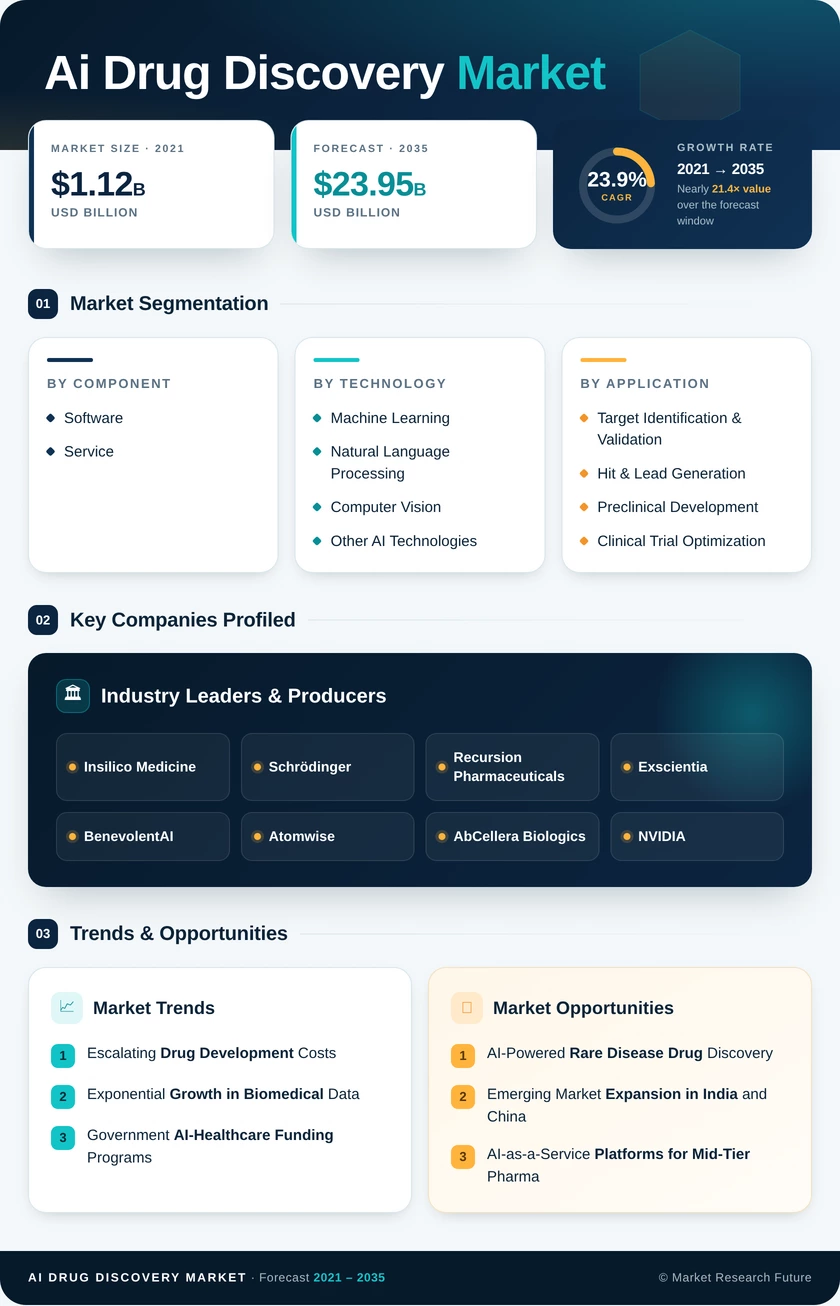
CAGR (2026-2035)23.9%
2025 Market SizeUSD 2.81 Billion
2035 Market SizeUSD 23.95 Billion
Key Players
Insilico Medicine
Schrödinger
Recursion Pharmaceuticals
Exscientia
BenevolentAI
Atomwise
Opportunities
  • AI-Powered Rare Disease Drug Discovery
  • Emerging Market Expansion in India and China
  • AI-as-a-Service Platforms for Mid-Tier Pharma
  1. 1 Market Overview |
    1. 1.1 Study Assumptions & Market Definition |
    2. 1.2 Scope of the Study |
    3. 1.3 Research Methodology
  2. 2 Market Summary & Key Takeaways
  3. 3 Market Dynamics |
    1. 3.1 Market Drivers Analysis | |
      1. 3.1.1 Escalating Drug Development Costs | |
      2. 3.1.2 Exponential Growth in Biomedical Data | |
      3. 3.1.3 Government AI-Healthcare Funding Programs | |
      4. 3.1.4 Pharma-AI Strategic Partnerships | |
      5. 3.1.5 Advances in Transformer Architectures for Molecular Generation | |
      6. 3.1.6 Regulatory Openness to AI-Assisted Submissions | |
      7. 3.1.7 Pandemic-Era Urgency for Rapid Drug Repurposing |
    2. 3.2 Market Restraints Analysis | |
      1. 3.2.1 Data Quality and Standardization Gaps | |
      2. 3.2.2 Regulatory Uncertainty for AI-Derived Therapeutics | |
      3. 3.2.3 High Platform Implementation and Integration Costs | |
      4. 3.2.4 Shortage of Interdisciplinary AI-Pharma Talent | |
      5. 3.2.5 Intellectual Property Ambiguity Around AI-Generated Molecules |
    3. 3.3 Market Opportunity Analysis | |
      1. 3.3.1 AI-Powered Rare Disease Drug Discovery | |
      2. 3.3.2 Emerging Market Expansion in India and China | |
      3. 3.3.3 AI-as-a-Service Platforms for Mid-Tier Pharma | |
      4. 3.3.4 Multi-Omics Data Integration | |
      5. 3.3.5 AI in Biologics and Cell-and-Gene Therapy Design |
    4. 3.4 Industry Value Chain Analysis |
    5. 3.5 Porter's Five Forces Analysis
  4. 4 Global AI in Drug Discovery Market Size & Forecast (2021–2035) |
    1. 4.1 Historical Market Size (2021–2025) |
    2. 4.2 Current & Forecast Market Size (2026–2035) |
    3. 4.3 Market Size by Revenue (USD Billion) |
    4. 4.4 Year-over-Year Growth Analysis
  5. 5 Segmentation Analysis |
    1. 5.1 By Component | |
      1. 5.1.1 Software | |
      2. 5.1.2 Service |
    2. 5.2 By Technology | |
      1. 5.2.1 Machine Learning | |
      2. 5.2.2 Natural Language Processing | |
      3. 5.2.3 Computer Vision | |
      4. 5.2.4 Other AI Technologies |
    3. 5.3 By Application | |
      1. 5.3.1 Target Identification & Validation | |
      2. 5.3.2 Hit & Lead Generation | |
      3. 5.3.3 Preclinical Development | |
      4. 5.3.4 Clinical Trial Optimization |
    4. 5.4 By Drug Type | |
      1. 5.4.1 Small Molecule | |
      2. 5.4.2 Biologic | |
      3. 5.4.3 Other (RNA, Peptide) |
    5. 5.5 By Deployment | |
      1. 5.5.1 Cloud-Based | |
      2. 5.5.2 On-Premise |
    6. 5.6 By End User | |
      1. 5.6.1 Pharmaceutical Companies | |
      2. 5.6.2 Biotechnology Companies | |
      3. 5.6.3 Contract Research Organizations (CROs) | |
      4. 5.6.4 Academic & Research Institutions
  6. 6 Regional Analysis |
    1. 6.1 North America | |
      1. 6.1.1 United States | |
      2. 6.1.2 Canada | |
      3. 6.1.3 Mexico |
    2. 6.2 Europe | |
      1. 6.2.1 Germany | |
      2. 6.2.2 United Kingdom | |
      3. 6.2.3 France | |
      4. 6.2.4 Italy | |
      5. 6.2.5 Spain | |
      6. 6.2.6 Nordic Countries | |
      7. 6.2.7 Russia | |
      8. 6.2.8 Rest of Europe |
    3. 6.3 Asia-Pacific | |
      1. 6.3.1 China | |
      2. 6.3.2 India | |
      3. 6.3.3 Japan | |
      4. 6.3.4 South Korea | |
      5. 6.3.5 ASEAN | |
      6. 6.3.6 Rest of Asia-Pacific |
    4. 6.4 South America | |
      1. 6.4.1 Brazil | |
      2. 6.4.2 Argentina | |
      3. 6.4.3 Rest of South America |
    5. 6.5 Middle East & Africa | |
      1. 6.5.1 Saudi Arabia | |
      2. 6.5.2 UAE | |
      3. 6.5.3 South Africa | |
      4. 6.5.4 Egypt | |
      5. 6.5.5 Rest of MEA
  7. 7 Competitive Landscape |
    1. 7.1 Market Share Analysis (2025) |
    2. 7.2 Competitive Benchmarking Matrix |
    3. 7.3 Company Profiles | |
      1. 7.3.1 Insilico Medicine | |
      2. 7.3.2 Schrödinger | |
      3. 7.3.3 Recursion Pharmaceuticals | |
      4. 7.3.4 Exscientia | |
      5. 7.3.5 BenevolentAI | |
      6. 7.3.6 Atomwise | |
      7. 7.3.7 AbCellera Biologics | |
      8. 7.3.8 NVIDIA | |
      9. 7.3.9 Google DeepMind | |
      10. 7.3.10 Absci Corporation
  8. 8 Future Outlook & Strategic Recommendations (2026–2035) |
    1. 8.1 Autonomous Discovery Loops |
    2. 8.2 Foundation Models for Biology |
    3. 8.3 Regulatory Co-Evolution |
    4. 8.4 Platform Consolidation and Vertical Integration
  9. 9 Recent Developments & News
  10. 10 Frequently Asked Questions (FAQs)
  11. 11 Report Scope & Methodology |
    1. 11.1 Study Period & Base Year |
    2. 11.2 Data Sources & Citations |
    3. 11.3 Abbreviations
  12. 12 LIST OF TABLES |
  13. TABLE 1 Global AI in Drug Discovery Market Size & Forecast, by Revenue (USD Billion), 2021–2035 |
  14. TABLE 2 Global AI in Drug Discovery Market — Year-over-Year Growth Analysis, 2021–2035 |
  15. TABLE 3 Global AI in Drug Discovery Market — Driver Impact Analysis |
  16. TABLE 4 Global AI in Drug Discovery Market — Restraints Impact Analysis |
  17. TABLE 5 Global AI in Drug Discovery Market Size, by Component, 2021–2035 (USD Billion) |
  18. TABLE 6 Global AI in Drug Discovery Market Size, by Technology, 2021–2035 (USD Billion) |
  19. TABLE 7 Global AI in Drug Discovery Market Size, by Application, 2021–2035 (USD Billion) |
  20. TABLE 8 Global AI in Drug Discovery Market Size, by Drug Type, 2021–2035 (USD Billion) |
  21. TABLE 9 Global AI in Drug Discovery Market Size, by Deployment, 2021–2035 (USD Billion) |
  22. TABLE 10 Global AI in Drug Discovery Market Size, by End User, 2021–2035 (USD Billion) |
  23. TABLE 11 Global AI in Drug Discovery Market Size, by Region, 2021–2035 (USD Billion) |
  24. TABLE 12 North America AI in Drug Discovery Market Size, by Country, 2021–2035 (USD Billion) |
  25. TABLE 13 Europe AI in Drug Discovery Market Size, by Country, 2021–2035 (USD Billion) |
  26. TABLE 14 Asia-Pacific AI in Drug Discovery Market Size, by Country, 2021–2035 (USD Billion) |
  27. TABLE 15 South America AI in Drug Discovery Market Size, by Country, 2021–2035 (USD Billion) |
  28. TABLE 16 Middle East & Africa AI in Drug Discovery Market Size, by Country, 2021–2035 (USD Billion) |
  29. TABLE 17 Competitive Benchmarking Matrix — Global AI in Drug Discovery Market, 2025 |
  30. TABLE 18 Company Profiles — Key Players, Global AI in Drug Discovery Market |
  31. TABLE 19 Recent Developments & Strategic Announcements, 2023–2025 |
  32. TABLE 20 Report Scope & Methodology Summary |
  33. TABLE 21 Detailed Sources and Citations
  34. 13 LIST OF FIGURES |
  35. FIGURE 1 AI in Drug Discovery Market Dynamics — Drivers, Restraints, and Opportunities |
  36. FIGURE 2 Industry Value Chain Analysis — AI in Drug Discovery Market |
  37. FIGURE 3 Porter's Five Forces Analysis — AI in Drug Discovery Market |
  38. FIGURE 4 Global AI in Drug Discovery Market Size Trend (USD Billion), 2021–2035 |
  39. FIGURE 5 AI in Drug Discovery Market Share, by Component (2025) |
  40. FIGURE 6 AI in Drug Discovery Market Share, by Technology (2025) |
  41. FIGURE 7 AI in Drug Discovery Market Share, by Application (2025) |
  42. FIGURE 8 AI in Drug Discovery Market Share, by Drug Type (2025) |
  43. FIGURE 9 AI in Drug Discovery Market Share, by Deployment (2025) |
  44. FIGURE 10 AI in Drug Discovery Market Share, by Region (2025) |
  45. FIGURE 11 North America AI in Drug Discovery Market — Country-Level Share (2025) |
  46. FIGURE 12 Europe AI in Drug Discovery Market — Country-Level Share (2025) |
  47. FIGURE 13 Asia-Pacific AI in Drug Discovery Market — Country-Level Share (2025) |
  48. FIGURE 14 South America AI in Drug Discovery Market — Country-Level Share (2025) |
  49. FIGURE 15 Middle East & Africa AI in Drug Discovery Market — Country-Level Share (2025) |
  50. FIGURE 16 Competitive Landscape — AI in Drug Discovery Market (2025)

Segmentation Quick Reference

DimensionSub-SegmentsDominant SegmentFastest Growing Segment
ComponentSoftware, ServiceSoftwareService
TechnologyMachine Learning, Natural Language Processing, Computer Vision, Other AI TechnologiesMachine LearningMachine Learning
ApplicationTarget Identification & Validation, Hit & Lead Generation, Preclinical Development, Clinical Trial OptimizationTarget Identification & ValidationClinical Trial Optimization
Drug TypeSmall Molecule, Biologic, Other (RNA, Peptide)Small MoleculeBiologic
DeploymentCloud-Based, On-PremiseCloud-BasedCloud-Based
End UserPharmaceutical Companies, Biotechnology Companies, CROs, Academic & Research InstitutionsPharmaceutical CompaniesBiotechnology Companies


Market Segmentation Overview

By Component

Sub-SegmentKey Trend
SoftwarePlatform consolidation; shift from point tools to integrated end-to-end discovery suites
ServiceGrowth of managed AI analytics and model-as-a-service offerings for mid-tier pharma


Software remains the revenue engine as pharma companies license integrated platforms combining virtual screening, molecular generation, and ADMET prediction. Service-based models are gaining traction among companies preferring to outsource AI capabilities rather than build in-house teams.

By Technology

Sub-SegmentKey Trend
Machine LearningDeep learning and graph neural networks for protein-ligand interaction prediction
Natural Language ProcessingBiomedical literature mining and pharmacovigilance signal detection
Computer VisionHigh-content screening image analysis and digital pathology
Other AI TechnologiesReinforcement learning for molecular optimization and retrosynthesis planning


Machine learning drives the majority of innovation, with transformer-based architectures and generative models reshaping how new molecular candidates are proposed and evaluated across the discovery pipeline.

By Application

Sub-SegmentKey Trend
Target Identification & ValidationMulti-omic integration for novel druggable target surface discovery
Hit & Lead GenerationGenerative chemistry replacing exhaustive library enumeration
Preclinical DevelopmentIn-silico ADMET and toxicity prediction reducing animal testing requirements
Clinical Trial OptimizationAI-driven patient stratification and adaptive trial design


Target identification and validation captures the largest share, reflecting industry emphasis on de-risking the earliest and highest-failure-rate stages of the drug discovery funnel.

By Drug Type

Sub-SegmentKey Trend
Small MoleculeEstablished compound libraries enabling rapid AI model training
BiologicAntibody and protein engineering leveraging structure-prediction breakthroughs
Other (RNA, Peptide)Emerging AI applications in mRNA design and peptide therapeutics


Small molecules remain the primary focus due to mature screening infrastructure and large historical datasets, while biologics represent the fastest-growing drug-type segment driven by advances in protein structure prediction.

By Deployment

Sub-SegmentKey Trend
Cloud-BasedElastic compute for large-scale molecular simulations; collaboration across sites
On-PremiseData sovereignty requirements for proprietary compound libraries


Cloud-based deployment leads adoption due to scalability advantages and lower upfront costs, though large pharmaceutical companies with sensitive IP portfolios continue to favor on-premise or hybrid installations.

By End User

Sub-SegmentKey Trend
Pharmaceutical CompaniesEnterprise-wide AI platform integration across R&D portfolios
Biotechnology CompaniesAI-native pipeline strategies from the founding stage
Contract Research Organizations (CROs)Embedding AI tools into outsourced discovery and preclinical workflows
Academic & Research InstitutionsOpen-source AI tools and government-funded research programs


Pharmaceutical companies represent the largest end-user segment by revenue, while biotechnology companies — many founded as AI-first discovery firms — are growing fastest and driving innovation at the platform level.


Download PDF ×

We do not share your information with anyone. However, we may send you emails based on your report interest from time to time. You may contact us at any time to opt-out.