Cider Market (2026 - 2035)

Cider Market Size, Share, Industry Trend & Analysis Research Report Information By Ingredient (Apple Cider, Mixed Fruit Cider, Others), By Alcohol Content (Low Alcohol, High Alcohol), By Packaging Format (Bottles, Cans), By Category (Mass, Premium), By Distribution Channel (Off-Trade, On-Trade), By Geography (North America, Europe, Asia-Pacific, South America, Middle East & Africa) – Forecast Till 2035
ID: MRFR/FnB/1904-HCR
110 Pages
Tejas Chaudhary
Last Updated: June 26, 2026
Cider Market
Market Size
Forecast Period2026-2035
CAGR (2026-2035)3.40%
2025 Market SizeUSD 15.17 Billion
2035 Market SizeUSD 21.18 Billion
Key Players
Heineken N.V.
C&C Group plc
Carlsberg Group
Asahi Group Holdings
Anheuser-Busch InBev
Kopparberg Brewery
Opportunities
  • Low- and No-Alcohol Cider Expansion
  • Direct-to-Consumer and E-Commerce Channels
  • Asia-Pacific Market Development

Cider Market Summary

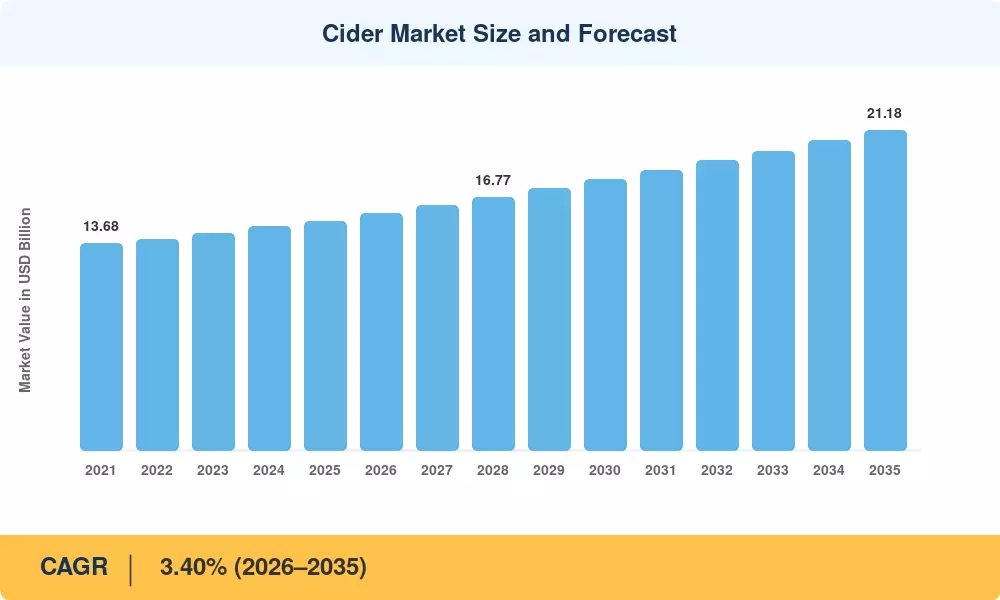
The global Cider Market was valued at USD 15.17 billion in 2025 and is projected to reach USD 15.69 billion in 2026, expanding to USD 21.18 billion by 2035 at a CAGR of 3.40% during the forecast period (2026–2035). This trajectory reflects a structural shift in adult beverage consumption toward lighter, fruit-based alternatives, reinforced by policy-backed moderation campaigns in the EU, Australia, and Canada. Health-awareness spending by public agencies across OECD nations exceeded USD 4.2 billion in combined alcohol-moderation programming between 2022 and 2024, channeling consumer preference toward lower-ABV options where cider holds a natural advantage [1].

The Cider Market is experiencing a category-level transformation. Legacy lager-dominant portfolios are being recalibrated as multinational brewers allocate increasing shelf space and marketing budgets to fruit-based fermented beverages. Heineken's Strongbow rebranding investment alone reached an estimated EUR 120 million across 2023–2025, while Carlsberg committed over EUR 80 million to Somersby line extensions [2]. Canned packaging innovation is displacing traditional glass bottle formats at a pace not seen in the broader beer segment, supported by aluminum sustainability credentials and single-serve convenience.

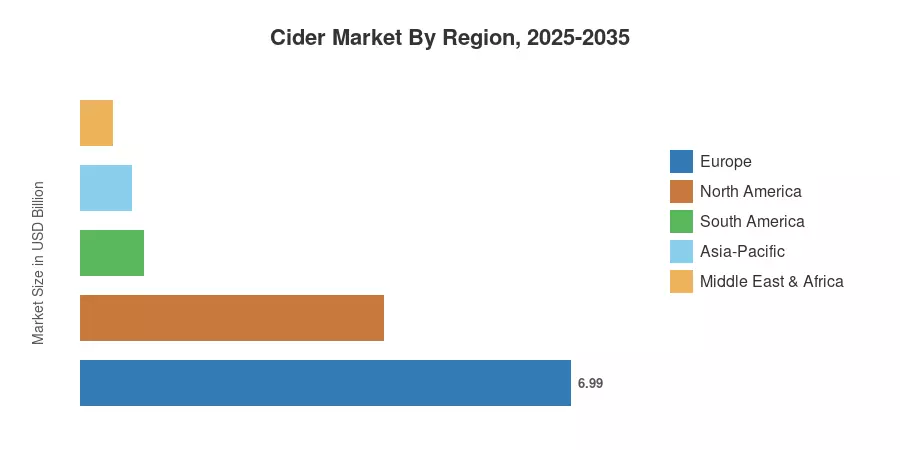
Europe dominates the Cider Market with roughly 46.1% of global revenue in 2025, anchored by deep-rooted consumption traditions in the United Kingdom, France, and Spain. Asia-Pacific is the fastest-growing region, forecast to register a 4.80% CAGR through 2035 as urbanizing middle-class populations in China and India adopt Western-style beverage occasions. North America holds the second-largest share at approximately 28.5%, driven by premiumization in the United States.


Key Report Takeaways

• By Ingredient

  • Apple-based variants commanded 56.4% of the Cider Market in 2025, reflecting entrenched orchard supply chains and consumer familiarity.
  • Mixed fruit variants are projected to grow at a 3.66% CAGR through 2035, gaining share among younger demographics seeking flavor diversity.

• By Category

  • The mass-production segment accounted for a 66.9% share of the Cider Market in 2025.
  • Premium offerings are advancing at a 4.37% CAGR.


• By Packaging

  • Canned formats are forecast to expand at a 4.14% CAGR, outpacing bottles as single-serve and sustainability preferences converge.

• By Region

  • Europe remained the largest regional Cider Market in 2025, generating approximately USD 6.99 billion in revenue.
  • Asia-Pacific is projected to achieve the fastest growth with a 4.80% CAGR, driven by rising disposable incomes across China and Southeast Asia.


Cider Market Size and Forecast (2021–2035)

Market Research Future's sizing methodology integrates bottom-up revenue models calibrated against distributor sell-through data, excise tax filings in 42 countries, and cross-validated trade association figures from the European Cider and Fruit Wine Association (AICV), the United States Association of Cider Makers (USACM), and Cider Australia.
Cider Market Size and Forecast
Our Impact
Enabled $4.3B Revenue Impact for Fortune 500 and Leading Multinationals
Partnering with 2000+ Global Organizations Each Year
30K+ Citations by Top-Tier Firms in the Industry

Driver Impact Analysis

Driver ~% Impact on CAGR Geographic Relevance Impact Timeline
Health-conscious moderation trends +0.55% Global Short-term (≤2 yr)
Premiumization & craft positioning +0.50% North America, Europe Medium-term (2–4 yr)
Canned packaging innovation +0.40% Global Short-term (≤2 yr)
Urbanization in emerging economies +0.45% Asia-Pacific, South America Long-term (≥4 yr)
Gluten-free dietary awareness +0.30% North America, Europe Medium-term (2–4 yr)
E-commerce & DTC channel expansion +0.35% Global Medium-term (2–4 yr)
Sustainability labeling & ESG branding +0.25% Europe, Asia-Pacific Long-term (≥4 yr)


Health-Conscious Moderation Trends

Government-backed responsible drinking campaigns have intensified across OECD countries, with the UK's Drinkaware program alone spending GBP 42 million between 2022 and 2024 on low-ABV awareness initiatives [1]. The WHO's Global Alcohol Action Plan 2022–2030 has prompted at least 28 nations to revise labeling requirements, mandating calorie and ingredient transparency that plays directly into cider's positioning as a naturally brewed, lower-calorie option. Per capita cider consumption in the UK rose 4.1% year-over-year in 2024, outpacing beer volume growth of 1.3% over the same period.

Premiumization and Positioning Shifts

Value growth is clearly outperforming volume growth in the worldwide cider market, which is going through a "premiumization" phase. A disproportionate amount of money is being made from premium and super-premium ciders, which are characterized by limited-edition botanical infusions, artisanal apple varieties, and heritage storytelling. More and more consumers are prepared to spend more for "clean-label" goods (organic, sugar-free, or non-GMO). In response, well-known companies like Carlsberg's Somersby and Heineken's Strongbow are expanding their product lines with fruit-forward and alcohol-free options in an effort to appeal to Gen Z and millennial consumers who are health-conscious.


Canned Packaging and New Consumption Occasions

Due to retailer preference for space-efficient shelf stocking and consumer need for portability, aluminum uptake in the cider industry has surged. With a CAGR of more than 9% in several developed economies, cans are now the packaging format with the fastest rate of growth in the category. Aluminum is known for its strong recyclability; U.S. beverage can supply chains routinely report recycled-content averages of over 73%. This change is encouraged by environmental factors in addition to convenience. Cider may now more successfully compete with canned drinks and hard seltzers during outdoor and on-the-go consumption events due to this advancement in packaging.


Urbanization in Emerging Economies

Rising urbanization rates across Asia-Pacific — China's urban population share exceeded 66% in 2024, while India's crossed 36% — are creating new consumption occasions for Western-style alcoholic beverages. Young professionals in tier-2 cities across both nations increasingly select cider as an accessible entry point to international beverage culture, with Cider Market penetration in urban China growing at 8.2% annually between 2021 and 2024.


Restraints Impact Analysis

Restraint ~% Impact on CAGR Geographic Relevance Impact Timeline
Competition from RTD cocktails & seltzers –0.40% North America, Europe Short-term (≤2 yr)
Seasonal demand concentration –0.30% Europe, North America Medium-term (2–4 yr)
Raw material price volatility (apples) –0.25% Global Long-term (≥4 yr)
Excise tax increases on alcohol –0.20% Europe, South America Medium-term (2–4 yr)
Limited brand awareness in emerging regions –0.15% Asia-Pacific, MEA Long-term (≥4 yr)


Competition from Adjacent RTD Segments

The explosive growth of hard seltzers and canned RTD cocktails between 2019 and 2023 drew an estimated USD 3.8 billion in consumer spending away from traditional cider categories in the United States alone [13]. While seltzer growth has decelerated since its 2021 peak, the Cider Market continues to compete for the same health-conscious, flavor-seeking demographic. Retailers allocating finite shelf space report that new seltzer and RTD SKU introductions outpaced cider launches by a ratio of 3:1 in 2024.

Seasonal Demand Concentration

Seasonal patterns continue to have a large impact on cider consumption in temperate markets, particularly the UK and Germany, where the majority of off-trade volume occurs during the warmer months of Q2 and Q3. During weeks of high demand, this concentration strains cold-chain logistics and poses structural difficulties for production scheduling. Although cider manufacturers have made an effort to lessen this volatility by creating winter-focused products, such as mulled or spiced varieties, these seasonal goods continue to be a niche market, usually making up less than 10% of yearly turnover. Through innovative packaging and high-end on-premise experiences, the industry continues to concentrate on extending cider's "sessionability" into year-round consumption occasions.


Apple Supply Volatility

With weather anomalies—such as late-spring frosts in Europe and drought conditions in important producing nations like China—creating considerable volatility in raw material costs, the global apple supply chain is becoming more and more vulnerable to climate variability. While worldwide output is still high, recent harvest cycles (2024–2026) have demonstrated that isolated weather events can cause dramatic jumps in apple concentrate spot-market prices. Major cider producers are investing in long-term supply partnerships and changing their procurement strategy toward more resilient orchard zones as climate risks increase in order to protect themselves from the margin constriction that follows bad harvest years.


Cider Market Opportunities

Low- and No-Alcohol Cider Expansion

The global low-and-no-alcohol beverage segment is projected to surpass USD 35 billion by 2030, and cider producers are well-positioned to capture a disproportionate share given the category's inherent fruit-forward flavor profile [10]. Brands such as Kopparberg Alcohol-Free and Strongbow Zero already demonstrate double-digit annual growth in Northern Europe, suggesting the Cider Market can extend addressable occasions into weekday consumption, workplace events, and health-oriented retail channels.

Direct-to-Consumer and E-Commerce Channels

Online alcohol sales grew at a 22% compound rate between 2020 and 2024 across OECD nations, yet cider's share of e-commerce beverage transactions remains below 4% [11]. This gap represents a clear whitespace opportunity. Producers that invest in branded DTC platforms — bundling subscription models, limited releases, and orchard-origin storytelling — can bypass traditional distribution margins and capture richer consumer data for targeted retention marketing.

Asia-Pacific Market Development

With cider per-capita consumption in China at barely 0.12 liters annually versus 14.7 liters in the UK, the headroom for penetration in Asia's largest economy is enormous. Strategic partnerships with e-commerce giants such as JD.com and Tmall, combined with localized flavor innovation (lychee, yuzu, or mango blends), can accelerate adoption among urban millennials.

Sustainable Packaging and Carbon-Neutral Branding

The EU's Packaging and Packaging Waste Regulation (PPWR), taking effect in 2025, mandates minimum recycled content thresholds and reuse targets that will reshape the Cider Market packaging economics [12]. Early movers who certify carbon-neutral production and achieve closed-loop aluminum supply chains can command 10–15% price premiums in sustainability-conscious markets across Scandinavia, Germany, and the Netherlands.

Functional and Botanical Cider Innovation

Consumer interest in functional beverages — infused with probiotics, adaptogens, or botanical extracts — opens a premium sub-niche within the Cider Market. The global functional beverage segment exceeded USD 180 billion in 2024, and producers such as Thatchers and Rekorderlig have begun testing elderflower-probiotic and turmeric-ginger cider lines. Success in this space can shift cider's positioning from an alcoholic indulgence to a permissible wellness-adjacent choice.


Cider Market Future Outlook

Premiumization Supercycle and Value Migration

The Cider Market is entering a decade-long premiumization supercycle where value growth will consistently outpace volume growth. Producers investing in single-estate provenance, barrel-aging programs, and limited-edition seasonal releases will capture migrating consumer spend from mid-tier lager and wine categories. Industry analysts project the premium-and-above tier to account for over 40% of global cider revenue by 2032, up from approximately 33% in 2025 [8].

Digital Commerce and Data-Driven Brand Building

By 2030, e-commerce is expected to represent 15–18% of off-trade alcoholic beverage sales globally, compared to roughly 8% in 2024 [11]. For the Cider Market, this shift enables subscription-based models, geo-targeted flavor launches, and first-party data collection that will reshape marketing economics. AI-powered demand forecasting tools are already helping mid-size cideries reduce production waste by 12–20% and optimize regional distribution.

Climate Adaptation and Orchard Resilience

Climate change will redefine apple-growing geographies over the next decade. The IPCC's 2023 assessment projects that traditional cider-apple zones in Southern England and Normandy will experience increased heat stress, while Scandinavia, the Baltics, and northern China emerge as viable new cultivation frontiers [15]. Cider Market participants with long-term orchard partnerships and diversified sourcing strategies will maintain cost stability as supply disruptions become more frequent.

Regulatory Harmonization and ESG Reporting

The convergence of EU CSRD sustainability reporting requirements, the UK's Deposit Return Scheme, and Australia's proposed container refund scheme will create a compliance cost floor that disproportionately impacts smaller producers in the Cider Market [12]. Simultaneously, producers who transparently report Scope 1–3 emissions and water-use metrics will access preferential shelf placement in ESG-screened retail programs, creating a competitive moat that reinforces brand loyalty.


Cider Market Segmentation

By Ingredient

Segment Key Metric Primary Demand Driver
Apple Cider 56.4% share (2025) Established supply chains, consumer familiarity
Mixed Fruit Cider 3.66% CAGR Flavor exploration among younger demographics
Others (Pear, Berry) USD 1.14 Billion (2025) Niche premiumization, seasonal limited releases


Apple-based formulations remain the backbone of the Cider Market, supported by deep orchard infrastructure in the UK, France, and the US Pacific Northwest. Consumer familiarity and supply-chain reliability ensure apple cider retains majority share through 2035, though its growth rate trails the broader category average. Mixed fruit variants — including tropical and berry-infused blends — are capturing disproportionate new-consumer trial occasions, particularly in Asia-Pacific and among Gen Z demographics in North America. Producers like Kopparberg and Rekorderlig have built entire brand identities around mixed-fruit positioning, generating strong social media engagement.

By Alcohol Content

Segment Key Metric Primary Demand Driver
Low Alcohol (≤6% ABV) 72.6% share (2025) Health-conscious moderation, session drinking
High Alcohol (>6% ABV) 3.91% CAGR Premiumization, barrel-aged, and ice cider niches


Low-alcohol variants dominate the Cider Market, reflecting cider's structural positioning as a session-style beverage. Government moderation campaigns and calorie-labeling mandates reinforce this preference. High-alcohol offerings occupy a smaller but faster-growing niche, driven by artisanal barrel-aged expressions and ice cider specialties from Quebec and Northern France that command USD 15–30 per 750ml bottle.

By Packaging Format

Segment Key Metric Primary Demand Driver
Bottles 55.8% share (2025) On-trade draught heritage, premium glass perception
Cans 4.14% CAGR Portability, sustainability, single-serve convenience


While bottles retain the majority share in the Cider Market, cans are the faster-growth format. Aluminum's infinite recyclability, lighter transport weight (reducing Scope 3 emissions by approximately 40% versus glass per unit), and consumer preference for grab-and-go convenience are driving the transition [6].

By Category

Segment Key Metric Primary Demand Driver
Mass 66.9% share (2025) Affordability, wide distribution reach
Premium 4.37% CAGR Quality perception, limited-edition releases


The mass segment's dominance in the Cider Market reflects broad supermarket distribution and accessible pricing, but premium offerings are gaining rapidly. Value migration toward premium is a global phenomenon, with double-digit revenue growth observed in the US and Northern European premium cider segments between 2022 and 2024 [8].

By Distribution Channel

Segment Key Metric Primary Demand Driver
Off-Trade 60.5% share (2025) Supermarket and convenience store penetration
On-Trade 3.45% CAGR Pub recovery, experiential consumption occasions


Off-trade channels — supermarkets, liquor stores, and e-commerce — account for the majority of Cider Market sales volume. On-trade channels (bars, pubs, restaurants) are recovering post-pandemic and growing faster, supported by experiential consumption trends and draught-cider programs in the UK and Ireland that foster brand trial.


Regional Market Share Analysis

Region Key Metric Primary Investment Themes
North America 28.5% share (2025) Premiumization, canned format growth
Europe USD 6.99 Billion (2025) Heritage branding, sustainability compliance
Asia-Pacific 4.80% CAGR (2026–2035) Urbanization-driven adoption, e-commerce
South America USD 0.90 Billion (2025) Price-accessible positioning, local fruit blends
Middle East & Africa 3.02% CAGR (2026–2035) Tourism-driven on-trade, regulatory liberalization
Total USD 15.17 Billion (2025)

The Cider Market exhibits distinct regional consumption patterns shaped by cultural heritage, regulatory frameworks, and distribution infrastructure maturity. Europe's long-standing cider tradition contrasts with Asia-Pacific's nascent but rapidly expanding consumer base.


North America

Country Key Metric Key Driver
United States 72.8% of regional share Premiumization & flavor innovation
Canada 2.91% CAGR Gluten-free positioning, provincial craft incentives
Mexico USD 0.31 Billion Expanding urban middle class, imported brand presence


The United States accounts for the vast majority of the North American Cider Market revenue, supported by over 1,100 cideries operating nationwide as of 2024 [19]. State-level excise tax incentives in Oregon, Michigan, and New York have spurred small-producer growth, while Angry Orchard's national distribution footprint anchors the mass segment. Canada's provincial liquor control boards have expanded cider shelf allocations by an average of 12% year-over-year since 2022, and Mexico's emerging consumption base is concentrated in Mexico City and Guadalajara.

Europe

Country Key Metric Key Driver
Germany USD 0.89 Billion Apfelwein tradition, sustainability labeling
United Kingdom 38.4% of regional share Deep cultural roots, pub & off-license channel
France 3.18% CAGR Normandy & Brittany AOC heritage
Italy USD 0.32 Billion Niche premium imports, wine-adjacent positioning
Spain 2.95% CAGR Asturian sidra culture, tourism-driven consumption
Nordic Countries USD 0.51 Billion Low-alcohol mandates, Kopparberg brand strength
Russia 2.68% CAGR Domestic apple production, import substitution
Rest of Europe USD 0.74 Billion Emerging craft segments in Poland, Ireland


Europe's Cider Market benefits from centuries of production heritage, particularly in the UK's West Country, France's Normandy, and Spain's Asturias region. The UK alone consumed an estimated 740 million liters in 2024, with on-trade draught formats accounting for 39% of volume [20]. EU sustainability regulations, including the PPWR and Farm-to-Fork labeling mandates, are reshaping competitive dynamics by favoring producers with localized, low-carbon supply chains.

Asia-Pacific

Country Key Metric Key Driver
China 5.12% CAGR E-commerce beverage platforms, urban millennials
India USD 0.18 Billion Rising disposable incomes, Western brand entry
Japan 3.85% CAGR Seasonal fruit flavor innovation, convenience stores
South Korea USD 0.16 Billion K-culture crossover, nightlife on-trade adoption
ASEAN 4.45% CAGR Tourism hospitality, tropical fruit localization
Rest of Asia-Pacific USD 0.22 Billion Australia & New Zealand heritage cider base


Asia-Pacific represents the highest-growth opportunity for the Cider Market. China's online alcohol sales — led by platforms like Tmall and JD.com — accounted for 31% of imported cider transactions in 2024, a share that grew from just 14% in 2021. Japan's convenience store channel (konbini) offers enormous single-serve distribution reach, while Australia maintains a mature per-capita consumption base that supports premium local producers.

South America

Country Key Metric Key Driver
Brazil 62.3% of regional share Young urban demographic, local apple orchards
Argentina 2.78% CAGR Patagonian apple production, export potential
Rest of South America USD 0.14 Billion Early-stage category development


Brazil's Cider Market is anchored in the southern states of Rio Grande do Sul and Santa Catarina, where domestic apple cultivation supports both local production and concentrate exports. Regulatory simplification under Brazil's 2024 Alcoholic Beverage Modernization Decree has lowered registration barriers for small cideries, stimulating category entry.

Middle East & Africa

Country Key Metric Key Driver
Saudi Arabia USD 0.04 Billion Non-alcoholic cider variants in hospitality
UAE 3.38% CAGR Tourism-driven on-trade, duty-free retail
South Africa 48.2% of regional share Established local production, Distell heritage
Egypt USD 0.02 Billion Nascent non-alcoholic segment
Rest of MEA 2.55% CAGR Limited but growing tourist-zone consumption


South Africa dominates the MEA Cider Market, with brands historically distributed through Distell Group (now integrated within Heineken's African operations). The UAE's tourism-intensive on-trade channel provides a premium price environment, while Saudi Arabia's consumption is exclusively limited to non-alcoholic cider alternatives positioned alongside carbonated juices.


Cider Market By Region, 2025-2035

Competitive Benchmarking

The Cider Market is moderately fragmented, with an estimated HHI below 1,000 and the top five producers collectively holding approximately 35–42% of global revenue. Multinational beverage conglomerates compete alongside a deep bench of regional and craft-scale producers, creating a dynamic competitive environment where brand heritage, distribution reach, and flavor innovation drive differentiation.

Company Est. Revenue Share Range Key Offerings for the Cider Market Strategic Positioning
Heineken N.V. ~8–11% Strongbow, Bulmers (ex-C&C markets) Global distribution, mass-premium bridge
C&C Group plc ~5–8% Bulmers, Magners, Tennent's Heritage branding, UK/Ireland stronghold
Carlsberg Group ~5–7% Somersby International expansion, flavor innovation
Asahi Group Holdings ~4–6% Various regional brands Asia-Pacific footprint, premium positioning
Anheuser-Busch InBev ~3–5% Stella Artois Cidre, regional labels Portfolio diversification, global logistics
The Boston Beer Company ~3–5% Angry Orchard US market leader, flavor-led growth
Kopparberg Brewery ~2–4% Kopparberg fruit ciders Mixed-fruit pioneer, strong social media presence
Thatchers Cider ~2–3% Thatchers Gold, Haze UK regional heritage, family-owned authenticity
Aston Manor Cider ~2–3% Crumpton Oaks, Friels Value-tier specialization, private-label supply
Molson Coors Beverage Company ~1–3% Rekorderlig (distribution), regional brands Portfolio broadening, cross-category bundling


Recent News & Developments


  • Blake's Hard Cider (May 2025): Blake's Hard Cider joined with Carhartt to start the American Apple project, assisting farmers and eliminating food waste, reflecting the rising industry focus on sustainability and community participation.
  • Heineken UK (March 2025): Heineken UK has released two fresh variations under its Inch's cider brand. The new options are Inch's Clou (dyABV 4.0%) and Inch's 0.0, marking the debut of the first dealcoholised cider in the UK market. These new SKUs are currently available at convenience stores, wholesalers, and supermarkets.


Cider Market Report Scope

Parameter Detail
Market Scope Global Cider Market covering production, distribution, and consumption across all major regions
Study Period 2021–2035
CAGR (Forecast Period) 3.40% (2026–2035)
Market Size (2025) USD 15.17 Billion
Market Size (2035) USD 21.18 Billion
Fastest Growing Segments Premium category (4.37% CAGR); Cans format (4.14% CAGR); Asia-Pacific region (4.80% CAGR)
Companies Profiled 10 major players, including Heineken, C&C Group, Carlsberg, Asahi, AB InBev, Boston Beer, Kopparberg, Thatchers, Aston Manor, and Molson Coors
Valuation Currency USD Billion


FAQs

How does cider's tax treatment differ from beer in key markets?
Most EU member states classify cider under fermented-fruit-beverage excise bands, which are typically 40–60% lower than beer excise rates per hectoliter. This tax advantage directly supports retail price competitiveness [16].
What shelf-life considerations affect cider distribution logistics?
Unpasteurized cider carries a 3–6 month refrigerated shelf life versus 12+ months for pasteurized variants. Producers targeting export channels overwhelmingly pasteurize and use nitrogen-flushed cans to ensure stability [6].
How are private-label cider products reshaping retail competition?
Retailers like Tesco, Aldi, and Lidl have expanded private-label cider ranges, capturing an estimated 18–22% of off-trade volume in the UK by 2024. This pressures branded margins while expanding category visibility [20].
What role does terroir play in premium cider pricing?
Single-origin and AOC-designated ciders from Normandy and Asturias command 50–80% price premiums over blended equivalents. Terroir certification functions as an authenticity signal that justifies higher price points [3].
How are producers addressing the Cider Market's seasonality challenge?
Winter-spiced and mulled cider variants grew 9% year-over-year in 2024 across the UK. Producers also launch autumn harvest editions to extend purchasing beyond the summer peak [14].
What water-use intensity does cider production entail versus beer?
Cider production typically requires 3.5–4.5 liters of water per liter of finished product, compared to 4–6 liters for beer. This lower intensity strengthens cider's sustainability narrative in water-stressed markets [12].
How do import tariffs affect cross-border Cider Market dynamics?
China imposes a 14% import duty plus 10% consumption tax on imported cider, elevating landed costs by roughly 25%. India applies comparable barriers, favoring domestic production partnerships [17].    
Author
Author
Author Profile
Tejas Chaudhary
Research Analyst Level II
I have a degree in Engineering (Civil), with masters in Business Administration (Marketing). With more than 4 years of experience in market research and consulting, I am involved in end-to-end process of market research, proposals, project kickoffs and delivery. I have research knowledge and expertise in consumer goods/packaging domain. Also I have worked for various other domains like construction & equipment. Effectively managed and delivered more than 60 report studies for regional as well as global clientele.

Research Approach


Secondary Research

The secondary research process involved comprehensive analysis of regulatory databases, trade publications, alcoholic beverage industry journals, and authoritative government organizations. Key sources included the US Alcohol and Tobacco Tax and Trade Bureau (TTB), UK HM Revenue & Customs (HMRC) Alcohol Duties, European Commission Directorate-General for Agriculture and Rural Development (DG AGRI), Comité Européen des Entreprises Vins (CEEV), National Association of Cider Makers (NACM), United States Association of Cider Makers (USACM), Cider Australia, International Wine and Spirit Record (IWSR), National Institute on Alcohol Abuse and Alcoholism (NIAAA), World Health Organization (WHO) Global Status Report on Alcohol, EU Eurostat Alcohol Statistics, OECD Health Statistics, and national customs authorities from key cider markets.

These sources were employed to gather production volume statistics, excise duty data, regulatory framework analysis, import/export trade flows, consumer consumption patterns, and market landscape analysis for effervescent cider, still cider, perry, and fruit-flavored cider variants.


Primary Research

Qualitative and quantitative insights were obtained by interviewing supply-side and demand-side stakeholders during the primary research process. From cider manufacturers, contract bottlers, and alcoholic beverage conglomerates, supply-side sources included CEOs, Managing Directors, Heads of Product Innovation, regulatory compliance officers, and commercial strategy leaders. Demand-side sources included category managers, beverage directors, procurement leaders from supermarket chains and convenience retailers, licensed trade operators, and import/distribution partners that specialized in alcoholic beverages. Market segmentation was validated across product types and source varieties, new product launch timelines were confirmed, and insights were garnered on route-to-market strategies, price architecture across premium and craft segments, and off-trade versus on-trade channel dynamics through primary research.

Primary Respondent Breakdown:

By Designation: C-level Primaries (28%), Director Level (45%), Others (27%)

By Region: North America (40%), Europe (22%), Asia-Pacific (28%), Rest of World (10%)


Market Size Estimation

Revenue mapping and production volume analysis were implemented to determine global market valuation. The methodology comprised the following:

Identification of over 45 significant cider producers in North America, Europe, Asia-Pacific, and Latin America

Product mapping for the apple wine, still cider, and effervescent cider categories, with additional segmentation based on the sources of apple, fruit-flavoured, and perry.

Examination of annual revenues that are specific to cider portfolios, as reported and modeled, through the use of excise tax filings and publicly disclosed alcohol unit sales

Manufacturers that account for 75-80% of the global market share in 2024 are included in the coverage.

Cross-referencing with off-trade retail monitoring data and on-trade consumption surveys, segment-specific valuations are derived through extrapolation using bottom-up (production volume × wholesale price by country/region) and top-down (manufacturer revenue validation) approaches.

Download Free Sample

Kindly complete the form below to receive a free sample of this Report

Download PDF ×

We do not share your information with anyone. However, we may send you emails based on your report interest from time to time. You may contact us at any time to opt-out.
















