×
Request Free Sample ×

Kindly complete the form below to receive a free sample of this Report

* Please use a valid business email

Leading companies partner with us for data-driven Insights

clients tt-cursor
Hero Background

Decorative Tile Market

ID: MRFR/PCM/2924-CR
111 Pages
Snehal Singh
December 2024

Decorative Tile Market Research Report By Material Type (Ceramic, Porcelain, Natural Stone, Glass, Vinyl), By Application (Flooring, Wall Tiles, Countertops, Backsplashes, Pools), By End Use (Residential, Commercial, Institutional, Industrial), By Design Style (Modern, Traditional, Contemporary, Rustic, Vintage) and By Regional (North America, Europe, South America, Asia Pacific, Middle East and Africa) - Forecast to 2035

Share:
Download PDF ×

We do not share your information with anyone. However, we may send you emails based on your report interest from time to time. You may contact us at any time to opt-out.

Decorative Tile Market Infographic
Purchase Options

Decorative Tile Market Summary

As per MRFR analysis, the Decorative Tile Market Size was estimated at 89016.8 USD Billion in 2024. The Decorative Tile industry is projected to grow from 93709.79 in 2025 to 156644.33 by 2035, exhibiting a compound annual growth rate (CAGR) of 5.27 during the forecast period 2025 - 2035.

Key Market Trends & Highlights

The Decorative Tile Market is experiencing a dynamic shift towards sustainability and technological integration.

  • The North American region remains the largest market for decorative tiles, driven by a strong demand for aesthetic appeal in residential spaces.
  • In contrast, the Asia-Pacific region is the fastest-growing market, fueled by rapid urbanization and increasing disposable incomes.
  • The residential segment continues to dominate the market, while the commercial segment is witnessing the fastest growth due to rising renovation activities.
  • Key market drivers include the increasing demand for eco-friendly products and advancements in tile production technology.

Market Size & Forecast

2024 Market Size 89016.8 (USD Billion)
2035 Market Size 156644.33 (USD Billion)
CAGR (2025 - 2035) 5.27%

Major Players

Mohawk Industries (US), Emser Tile (US), Daltile (US), Roca (ES), Porcelanosa (ES), Marazzi (IT), Ceramiche Ricchetti (IT), Crossville (US), Interceramic (MX)

Decorative Tile Market Trends

The Decorative Tile Market is currently experiencing a dynamic evolution, driven by a confluence of aesthetic preferences and functional requirements. As consumers increasingly seek to personalize their living spaces, the demand for unique and visually appealing tile designs has surged. This trend is further amplified by the growing inclination towards sustainable materials, as environmentally conscious choices become more prevalent among buyers. Manufacturers are responding by innovating with eco-friendly options, which not only cater to consumer preferences but also align with regulatory standards promoting sustainability. In addition to aesthetic considerations, the Decorative Tile Market is witnessing a shift towards technological advancements. Smart tiles, which integrate features such as temperature control and lighting, are gaining traction, appealing to tech-savvy consumers. Furthermore, the rise of online retail platforms has transformed the purchasing landscape, allowing for greater accessibility and variety. As the market continues to adapt to these evolving trends, it appears poised for sustained growth, reflecting broader changes in consumer behavior and preferences.

Sustainability Focus

There is a notable shift towards sustainable materials in the Decorative Tile Market. Consumers are increasingly prioritizing eco-friendly options, prompting manufacturers to innovate with recycled and natural materials. This trend not only meets consumer demand but also aligns with environmental regulations.

Technological Integration

The incorporation of technology into decorative tiles is becoming more prevalent. Smart tiles that offer features like temperature regulation and integrated lighting are appealing to modern consumers, indicating a blend of functionality and design.

E-commerce Expansion

The rise of online shopping platforms is reshaping the Decorative Tile Market. Consumers now have access to a wider variety of products, enhancing convenience and choice. This trend suggests a significant shift in how decorative tiles are marketed and sold.

Decorative Tile Market Drivers

Market Growth Projections

The Global Decorative Tile Market Industry is poised for considerable growth, with projections indicating a market size of 253.0 USD Billion in 2024 and an anticipated increase to 318.9 USD Billion by 2035. This growth trajectory suggests a robust demand for decorative tiles, driven by various factors including urbanization, technological advancements, and changing consumer preferences. The market is expected to maintain a steady CAGR of 2.13% from 2025 to 2035, reflecting a stable environment for manufacturers and stakeholders. These figures underscore the potential for investment and innovation within the decorative tile sector.

Growth of the Real Estate Sector

The expansion of the real estate sector significantly influences the Global Decorative Tile Market Industry, as new residential and commercial developments create a heightened demand for decorative tiles. Urbanization and population growth drive the construction of new buildings, which often incorporate decorative tiles for both functional and aesthetic purposes. This trend is particularly pronounced in emerging markets, where rapid urban development leads to increased investment in infrastructure. As the real estate sector continues to flourish, the demand for decorative tiles is expected to rise, contributing to the market's projected growth to 318.9 USD Billion by 2035.

Rising Demand for Aesthetic Appeal

The Global Decorative Tile Market Industry experiences a notable surge in demand driven by consumers' increasing preference for aesthetic appeal in residential and commercial spaces. Homeowners and businesses alike seek to enhance their interiors with visually striking designs, leading to a diversification of tile styles, colors, and patterns. This trend is particularly evident in urban areas, where modern architecture often incorporates decorative tiles as a key design element. As a result, the market is projected to reach 253.0 USD Billion in 2024, reflecting a growing inclination towards personalized and visually appealing environments.

Consumer Preference for Customization

Consumer preference for customization is a driving force in the Global Decorative Tile Market Industry, as individuals seek unique designs that reflect their personal style. This trend is evident in the growing popularity of bespoke tile solutions, where customers can select specific colors, patterns, and finishes. Manufacturers are responding by offering customizable options, allowing consumers to create personalized spaces that stand out. This shift towards tailored products not only enhances customer satisfaction but also fosters brand loyalty. As the market evolves, the ability to provide customized decorative tiles is likely to become a key differentiator among manufacturers.

Sustainability Trends in Construction

Sustainability emerges as a pivotal driver within the Global Decorative Tile Market Industry, as consumers and builders increasingly prioritize eco-friendly materials. The shift towards sustainable construction practices encourages the use of tiles made from recycled materials or those that minimize environmental impact during production. This trend aligns with global efforts to reduce carbon footprints and promote green building certifications. Consequently, manufacturers are innovating to produce tiles that not only meet aesthetic demands but also adhere to sustainability standards. This focus on eco-conscious products is likely to enhance market growth as awareness of environmental issues continues to rise.

Technological Advancements in Tile Production

Technological advancements play a crucial role in shaping the Global Decorative Tile Market Industry, as innovations in manufacturing processes lead to improved product quality and design capabilities. Enhanced printing technologies, such as digital printing, allow for intricate designs and textures that were previously unattainable. Additionally, advancements in materials science contribute to the development of tiles that are more durable and resistant to wear. These innovations not only meet consumer demands for high-quality products but also enable manufacturers to differentiate their offerings in a competitive market. As a result, the market is expected to grow steadily, with a projected CAGR of 2.13% from 2025 to 2035.
Market Segment Insights

By Application: Residential (Largest) vs. Commercial (Fastest-Growing)

The Decorative Tile Market is primarily driven by the application in the residential sector, which commands a significant market share, driven by relentless consumer demand for aesthetic and quality flooring solutions. This sector benefits from trends in interior design favoring decorative tiles for both aesthetic appeal and functionality. Meanwhile, the commercial application is witnessing rapid growth, fueled by an increase in construction activities and a surge in demand for innovative tile designs that meet the needs of business environments. Growth in the Decorative Tile Market is heavily influenced by ongoing urbanization, an increase in disposable incomes, and the growing trend towards home improvement projects. As consumers seek modern, stylish interiors, the demand for decorative tiles in both residential and commercial applications is expected to soar. The industrial and institutional sectors, while important, are relatively smaller in comparison. However, they do reflect specific growth opportunities as infrastructure development continues globally.

Residential (Dominant) vs. Commercial (Emerging)

The residential segment is the dominant force in the Decorative Tile Market, characterized by a strong consumer preference for personalized and unique tile designs that enhance the aesthetic appeal of homes. This segment offers a wide variety of styles, materials, and colors, catering to diverse consumer tastes and preferences. On the other hand, the commercial segment is emerging rapidly, with businesses increasingly opting for decorative tiles that combine functionality with style. This sector includes applications in retail spaces, offices, and hospitality, where aesthetic appeal and durability play crucial roles. As commercial spaces adopt more creative and modern designs, the demand for decorative tiles that provide both utility and visual impact is expected to rise significantly.

By Material Type: Ceramic (Largest) vs. Porcelain (Fastest-Growing)

The Decorative Tile Market exhibits a diverse material type distribution, predominantly led by ceramic tiles. Ceramic holds the largest market share, favored for its versatility and wide range of designs. Porcelain tiles, while still significant, are increasingly gaining traction due to their durability and aesthetic appeal. Glass and natural stone tiles follow, considerably smaller in portion but still cater to niche markets, with glass offering modern aesthetics and natural stone appealing to premium segments.

Ceramic (Dominant) vs. Glass (Emerging)

Ceramic tiles are positioned as the dominant player in the Decorative Tile Market, known for their affordability, ease of installation, and a plethora of designs that accommodate various consumer preferences. They are widely used in residential and commercial settings. On the other hand, glass tiles are categorized as an emerging segment, recognized for their unique visual impact and luminosity. While initially focused on upscale applications, glass tiles are gradually expanding into mainstream markets. They are sought after for their eco-friendly attributes and are being favored in contemporary designs, highlighting the shift towards sustainable practices in the decorative tile industry.

By Design Style: Modern (Largest) vs. Rustic (Fastest-Growing)

In the Decorative Tile Market, the segment values of Modern, Traditional, Rustic, and Contemporary exhibit distinct characteristics and preferences among consumers. Currently, the Modern style holds the largest market share, driven by contemporary aesthetics and functional designs. Traditional styles, while still popular, have seen a slowdown in growth due to changing consumer preferences. Conversely, Rustic tiles are emerging as a strong contender, appealing to those seeking more organic and textured finishes.

Modern (Dominant) vs. Rustic (Emerging)

The Modern design style is characterized by sleek lines, minimalistic patterns, and a focus on functionality, making it the dominant choice in the Decorative Tile Market. Its popularity can be attributed to the increasing trend towards open-concept living and the desire for spaces that are both stylish and practical. On the other hand, Rustic tiles, with their earthy tones and natural finishes, are rapidly gaining traction among consumers looking for unique textures that offer a tactile experience. This segment's growth is fueled by the rising interest in farmhouse and natural aesthetics, making Rustic an emerging favorite in home design.

By Installation Method: Thin-Set (Largest) vs. Self-Adhesive (Fastest-Growing)

In the Decorative Tile Market, the installation method segment showcases a dynamic distribution of market shares. Thin-Set, renowned for its flexibility and versatility, holds the largest share, dominating the preferences of contractors and DIY enthusiasts alike. Mud-Set follows as a traditional method valued for its durability, while self-adhesive tiles are rapidly gaining traction, particularly among those seeking convenience and ease of installation. Interlocking tiles, although smaller in market share, cater to specific niche segments seeking unique aesthetic appeals.

Thin-Set (Dominant) vs. Self-Adhesive (Emerging)

Thin-Set adhesive has become the dominant installation method in the Decorative Tile Market, favored for its strong bonding capabilities, adaptability to various substrates, and the professional finish it offers. Its use is widespread in both residential and commercial projects, reflecting its reliability among experienced installers. On the other hand, Self-Adhesive tiles represent the emerging wave, appealing particularly to DIY consumers due to their user-friendly application process, eliminating the need for additional adhesives. This segment is driven by a growing trend towards quick and hassle-free home renovations, making self-adhesive tiles an attractive choice for both individual homeowners and rental property makeovers.

Get more detailed insights about Decorative Tile Market

Regional Insights

North America : Market Growth and Innovation

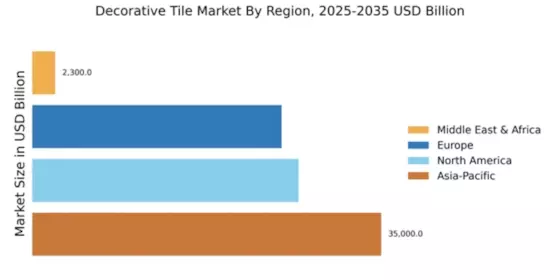
The North American decorative tile market is projected to reach $26,700M by December 2025, driven by increasing consumer demand for aesthetic home improvements and renovations. Regulatory support for sustainable building materials is also a significant catalyst, encouraging the use of eco-friendly tiles. The market is characterized by a growing trend towards customization and innovative designs, appealing to both residential and commercial sectors. Leading players in this region include Mohawk Industries, Emser Tile, and Daltile, which dominate the market with their extensive product ranges and strong distribution networks. The competitive landscape is marked by continuous innovation and strategic partnerships, enhancing product offerings. The U.S. remains the largest market, with significant contributions from Canada and Mexico, reflecting a robust demand for high-quality decorative tiles.

Europe : Sustainable Design Trends

Europe's decorative tile market is expected to reach €25,000M by December 2025, fueled by a strong emphasis on sustainability and eco-friendly materials. Regulatory frameworks across the EU promote energy-efficient building practices, driving demand for tiles that meet stringent environmental standards. The market is witnessing a shift towards natural materials and innovative designs, catering to the growing consumer preference for sustainable living. Key players such as Roca, Porcelanosa, and Marazzi are at the forefront of this transformation, offering a diverse range of products that align with eco-conscious trends. Italy and Spain are leading markets, supported by a rich tradition of tile craftsmanship. The competitive landscape is vibrant, with companies investing in R&D to develop new materials and designs that meet evolving consumer expectations. "The European market is increasingly focused on sustainability, with regulations driving innovation in decorative tiles," European Commission report.

Asia-Pacific : Rapid Market Expansion

The Asia-Pacific decorative tile market is projected to dominate with a market size of $35,000M by December 2025, reflecting its status as the largest regional market. The rapid urbanization and rising disposable incomes in countries like China and India are significant growth drivers. Additionally, government initiatives promoting infrastructure development and housing projects are catalyzing demand for decorative tiles across the region. China stands out as the leading country in this market, with major manufacturers like Crossville and Interceramic expanding their operations. The competitive landscape is characterized by a mix of local and international players, all vying for market share. The region's focus on innovation and design is evident, with companies investing heavily in technology to enhance product quality and aesthetics. The growing trend of home renovation further supports market growth, making Asia-Pacific a key player in the global decorative tile industry.

Middle East and Africa : Emerging Market Potential

The Middle East and Africa decorative tile market is projected to reach $2,300M by December 2025, driven by increasing urbanization and infrastructure development. The region is witnessing a surge in construction activities, particularly in the Gulf Cooperation Council (GCC) countries, where government investments in housing and commercial projects are significant. This growth is further supported by a rising middle class seeking aesthetic home improvements. Countries like the UAE and South Africa are leading the market, with a growing presence of international brands. The competitive landscape is evolving, with local manufacturers also gaining traction by offering cost-effective solutions. The demand for decorative tiles is expected to rise as consumers increasingly prioritize design and quality in their home and commercial spaces. "The Middle East is experiencing a construction boom, driving demand for decorative tiles," Gulf Cooperation Council report.

Key Players and Competitive Insights

The Decorative Tile Market is currently characterized by a dynamic competitive landscape, driven by factors such as increasing consumer demand for aesthetic home improvements and the growing trend towards sustainable building materials. Key players like Mohawk Industries (US), Emser Tile (US), and Roca (ES) are strategically positioning themselves through innovation and regional expansion. Mohawk Industries (US) has focused on enhancing its product portfolio with eco-friendly options, while Emser Tile (US) emphasizes digital transformation to streamline customer engagement. Roca (ES) is leveraging its strong brand heritage to penetrate emerging markets, collectively shaping a competitive environment that is increasingly focused on sustainability and technological advancement.

In terms of business tactics, companies are localizing manufacturing to reduce lead times and optimize supply chains, which is particularly crucial in a moderately fragmented market. The collective influence of these key players is significant, as they not only drive innovation but also set benchmarks for quality and sustainability that smaller competitors strive to meet. This competitive structure allows for a diverse range of products and services, catering to various consumer preferences and regional demands.

In November 2025, Mohawk Industries (US) announced the launch of a new line of tiles made from 100% recycled materials, reflecting a commitment to sustainability that resonates with contemporary consumer values. This strategic move not only enhances their product offering but also positions the company as a leader in eco-conscious manufacturing, potentially attracting a broader customer base concerned with environmental impact.

In October 2025, Emser Tile (US) unveiled an advanced digital platform aimed at improving customer experience through augmented reality (AR) tools that allow consumers to visualize tile designs in their own spaces. This initiative underscores the importance of digital transformation in the market, as it enhances customer engagement and streamlines the purchasing process, likely leading to increased sales and customer loyalty.

In September 2025, Roca (ES) expanded its operations into Southeast Asia, establishing a new manufacturing facility in Vietnam. This strategic expansion is indicative of the company's intent to tap into the rapidly growing construction market in the region, which may yield significant returns as urbanization continues to rise. Such moves not only enhance Roca's market presence but also contribute to a more resilient supply chain by diversifying production locations.

As of December 2025, current trends in the Decorative Tile Market are heavily influenced by digitalization, sustainability, and the integration of AI technologies. Strategic alliances among key players are increasingly shaping the competitive landscape, fostering innovation and collaboration. The shift from price-based competition to a focus on technological advancement and supply chain reliability is evident, suggesting that future differentiation will hinge on the ability to innovate and respond to evolving consumer preferences.

Key Companies in the Decorative Tile Market market include

Industry Developments

Recent developments in the Decorative Tile Market indicate a dynamic landscape marked by innovation and strategic business moves. Companies such as Marazzi Group, Porcelanosa, and Mohawk Industries have been enhancing their product lines with sustainable materials, which align with growing consumer demand for environmentally friendly options.

This push for sustainability is mirrored in the operations of Grupo Lamosa and Interface, both of which are adapting their manufacturing processes to reduce environmental impact.

Significant mergers and acquisitions are also shaping the market. For instance, Daltile's recent acquisition of a smaller ceramic production company has bolstered its manufacturing capabilities, while Emser Tile is reportedly expanding its market reach through strategic partnerships. Meanwhile, Royal Ceramics and Atlas Concorde are focusing on innovations in design to captivate the luxury segment of the market.

The overall valuation and growth of the Decorative Tile Market are being positively influenced by these strategic initiatives and a shift towards high-quality, aesthetically pleasing, and sustainable products. The competitive landscape among key players like Staffordshire Ceramics and Crossville continues to intensify, driving advancements that benefit the overall market growth.

Future Outlook

Decorative Tile Market Future Outlook

The Decorative Tile Market is projected to grow at a 5.27% CAGR from 2024 to 2035, driven by increasing demand for aesthetic home improvements and sustainable materials.

New opportunities lie in:

  • Expansion into eco-friendly tile production methods
  • Development of smart tiles with integrated technology
  • Partnerships with interior designers for exclusive collections

By 2035, the market is expected to achieve robust growth, driven by innovation and strategic partnerships.

Market Segmentation

Decorative Tile Market Application Outlook

  • Residential
  • Commercial
  • Industrial
  • Institutional

Decorative Tile Market Design Style Outlook

  • Modern
  • Traditional
  • Rustic
  • Contemporary

Decorative Tile Market Material Type Outlook

  • Ceramic
  • Porcelain
  • Glass
  • Natural Stone

Decorative Tile Market Installation Method Outlook

  • Thin-Set
  • Mud-Set
  • Self-Adhesive
  • Interlocking

Report Scope

MARKET SIZE 202489016.8(USD Billion)
MARKET SIZE 202593709.79(USD Billion)
MARKET SIZE 2035156644.33(USD Billion)
COMPOUND ANNUAL GROWTH RATE (CAGR)5.27% (2024 - 2035)
REPORT COVERAGERevenue Forecast, Competitive Landscape, Growth Factors, and Trends
BASE YEAR2024
Market Forecast Period2025 - 2035
Historical Data2019 - 2024
Market Forecast UnitsUSD Billion
Key Companies ProfiledMohawk Industries (US), Emser Tile (US), Daltile (US), Roca (ES), Porcelanosa (ES), Marazzi (IT), Ceramiche Ricchetti (IT), Crossville (US), Interceramic (MX)
Segments CoveredApplication, Material Type, Design Style, Installation Method
Key Market OpportunitiesIntegration of sustainable materials and smart technology in the Decorative Tile Market presents significant growth opportunities.
Key Market DynamicsRising consumer preference for sustainable materials drives innovation and competition in the decorative tile market.
Countries CoveredNorth America, Europe, APAC, South America, MEA

Market Highlights

Author
Snehal Singh
Assistant Manager - Research

High acumen in analyzing complex macro & micro markets with more than 6 years of work experience in the field of market research. By implementing her analytical skills in forecasting and estimation into market research reports, she has expertise in Packaging, Construction, and Equipment domains. She handles a team size of 20-25 resources and ensures smooth running of the projects, associated marketing activities, and client servicing.

Leave a Comment

FAQs

What is the projected CAGR for the Decorative Tile Market from 2024 to 2035?

Decorative Tile Market is projected to grow at a CAGR of 5.27% during the forecast period, 2025-2035

Which material type is leading in market value for the Decorative Tile Market in 2035?

Ceramic is projected to be the leading material type with a market value of 110.0 USD Billion in 2035.

What is the market size for the Porcelain segment in the Decorative Tile Market by 2035?

The Porcelain segment is expected to reach a market value of 95.0 USD Billion by 2035.

Which region is anticipated to hold the largest market value in 2035?

APAC is anticipated to hold the largest market value at 95.0 USD Billion in 2035.

What is the expected market size for North America in the Decorative Tile Market by 2035?

North America is expected to have a market size of 85.0 USD Billion by 2035.

What are some of the major players in the Decorative Tile Market?

Major players include Titus Tile, Marazzi Group, Porcelanosa, and Mohawk Industries.

What will be the market value for the Natural Stone segment by 2035?

The Natural Stone segment is projected to be valued at 60.0 USD Billion by 2035.

What is the anticipated market value for the Vinyl segment by 2024?

The Vinyl segment is anticipated to have a market value of 14.55 USD Billion by 2024.

How much is the market for Glass expected to grow by 2035?

The market for Glass is expected to grow to 25.0 USD Billion by 2035.

Download Free Sample

Kindly complete the form below to receive a free sample of this Report

Compare Licence

×
Features License Type
Single User Multiuser License Enterprise User
Price $4,950 $5,950 $7,250
Maximum User Access Limit 1 User Upto 10 Users Unrestricted Access Throughout the Organization
Free Customization
Direct Access to Analyst
Deliverable Format
Platform Access
Discount on Next Purchase 10% 15% 15%
Printable Versions