Intelligent Document Processing Market

Key Players: ABBYY, Microsoft, Google, IBM, Kofax (Tungsten Automation), UiPath, Hyland, Automation Anywhere

Intelligent Document Processing Market

Intelligent Document Processing Market Size, Share and Research Report By Component (Software, Services), By Deployment Mode (Cloud, On-Premises), By Technology (Optical Character Recognition, Natural Language Processing, Computer Vision, Machine Learning / Deep Learning), By Enterprise Size (Large Enterprises, Small & Medium Enterprises), By End-User Industry (Banking, Financial Services & Insurance, Government & Public Sector, Healthcare & Life Sciences, Retail & E-Commerce, Other Industries (Manufacturing, Energy, Logistics)) and By Region (North America, Europe, South America, Asia Pacific, Middle East and Africa) - Industry Forecast to 2035.
ID: MRFR/ICT/9148-CR
156 Pages
Ankit Gupta, Shubham Munde
Last Updated: June 17, 2026

Intelligent Document Processing Market Summary

The Intelligent Document Processing Market reached an estimated USD 2.86 billion in 2025, with the forecast period opening at USD 3.38 billion in 2026 and climbing to USD 13.48 billion by 2035 at a CAGR of 16.45%. Two forces are pulling this expansion forward: enterprise-wide mandates to digitize back-office operations and a fresh wave of AI-regulatory frameworks — including the EU AI Act's transparency requirements — that compel organizations to audit how documents flow through automated pipelines [2]. Insurance carriers alone are projected to spend over USD 4.2 billion on straight-through claims processing technology by 2028, feeding directly into AI document extraction demand.

Legacy optical character recognition engines, which struggle with semi-structured invoices, multilingual contracts, and handwritten forms, are steadily giving way to transformer-based models that combine computer vision with contextual language understanding. The shift is not incremental — firms deploying document workflow automation report 60–75% reductions in manual data-entry hours within the first year of rollout. Major cloud providers have embedded intelligent processing APIs into their platform stacks, lowering the barrier to entry for mid-market buyers and accelerating automated data capture adoption across sectors that historically relied on paper-heavy processes [5].

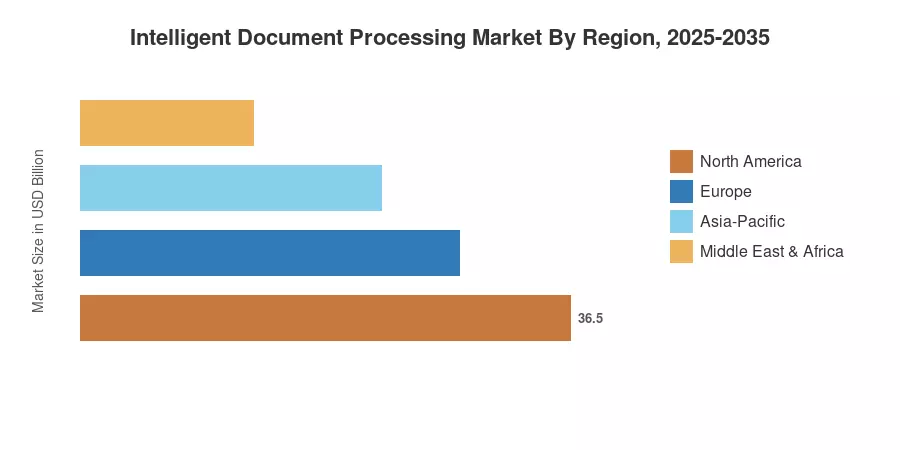
North America commands roughly 38% of the Intelligent Document Processing Market, anchored by financial services digitization and federal modernization programs. Asia-Pacific is the fastest-growing region at a projected 18.25% CAGR through 2035, driven by India's Digital India initiative and China's push for smart-government document systems. Europe holds the second-largest share at approximately 27%, with GDPR compliance and cross-border banking harmonization sustaining demand for OCR intelligent processing and unstructured document AI platforms


Key Report Takeaways

• By Component

  • Software platforms accounted for approximately 67% of the Intelligent Document Processing Market in 2025, reflecting enterprise preference for configurable AI document extraction suites
  • Services are expanding at a 17.65% CAGR through 2035 as system-integration and managed-service engagements proliferate

• By Deployment Mode

  • Cloud deployment captured roughly USD 2.18 billion in 2025, underscoring the shift toward scalable, real-time document workflow automation infrastructure
  • On-premises solutions remain critical for defense and regulated healthcare environments requiring data residency

• By Technology

  • Optical Character Recognition held a 44% share of the Intelligent Document Processing Market in 2025
  • Natural language processing is the fastest-growing technology segment, pacing at a 21.15% CAGR as enterprises demand contextual understanding beyond raw OCR intelligent processing

• By End-User Industry

  • Banking, financial services, and insurance led end-user spending with a 30.5% share of the Intelligent Document Processing Market in 2025
  • Healthcare and life sciences are projected to expand at an 19.35% CAGR, fueled by electronic health record mandates and automated data capture for clinical trials

• By Region

  • North America led the Intelligent Document Processing Market with 38% revenue share in 2025
  • Asia-Pacific is advancing at the highest regional CAGR of 18.25% through 2035


Market Size and Forecast (2021–2035)

Market Research Future (MRFR)'s estimates blend primary interviews with 120+ industry stakeholders, vendor financial disclosures, patent-filing analysis, and proprietary demand-side modeling calibrated against publicly available benchmarks. Historical values (2021–2024) are derived from audited revenue filings; forecast values (2026–2035) apply a compound growth trajectory validated through bottom-up segmentation cross-checks.
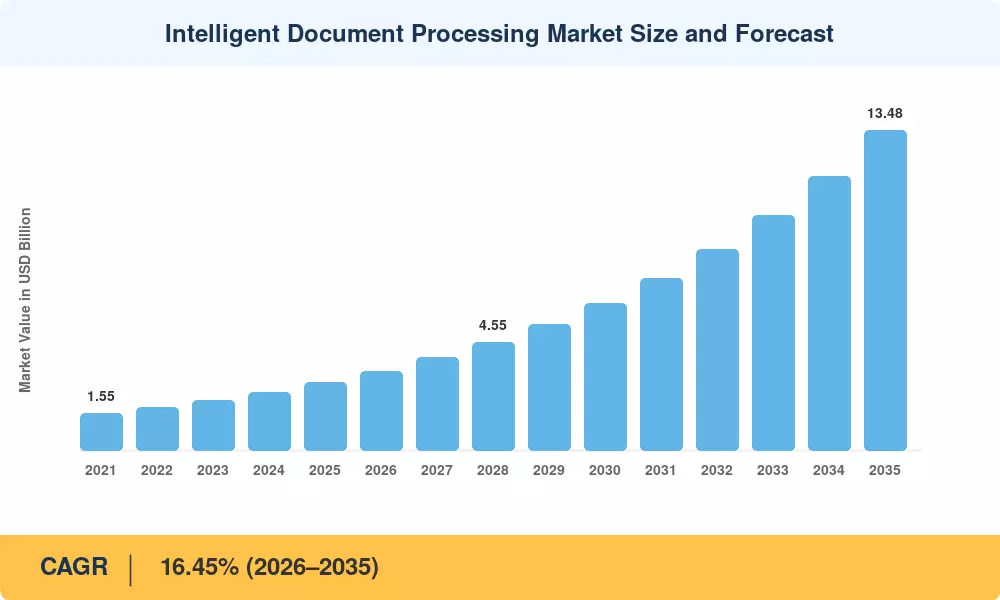
Intelligent Document Processing Market Size and Forecast
Our Impact
Enabled $4.3B Revenue Impact for Fortune 500 and Leading Multinationals
Partnering with 2000+ Global Organizations Each Year
30K+ Citations by Top-Tier Firms in the Industry
 

Driver Impact Analysis

Driver ~% Impact on CAGR Geographic Relevance Impact Timeline
AI & machine-learning model maturation 22% Global Medium-term (2–4 yr)
Cloud-platform proliferation 18% North America, Europe Short-term (≤2 yr)
Regulatory compliance mandates 16% Europe, North America Short-term (≤2 yr)
Rising unstructured data volumes 15% Global Long-term (≥4 yr)
Remote & hybrid work adoption 12% Global Short-term (≤2 yr)
Fraud-detection spending growth 10% North America, Asia-Pacific Medium-term (2–4 yr)
Vertical-industry AI fine-tuning 7% Asia-Pacific, Europe Long-term (≥4 yr)


AI & Machine-Learning Model Maturation

Transformer architectures and large language models have reshaped what automated data capture can accomplish. Where legacy OCR intelligent processing topped out at 78–82% accuracy on semi-structured documents, current multimodal models routinely exceed 95% on invoices, purchase orders, and insurance claim forms [6]. Google's Document AI and Microsoft's Azure AI Document Intelligence now ship pre-trained extractors for over 150 document types, slashing deployment timelines from months to days. The U.S. National Institute of Standards and Technology (NIST) reported that AI-augmented extraction reduced federal form-processing backlogs by 43% across five pilot agencies in 2024 [11].

Cloud-Platform Proliferation

Organizations without specialized data-science teams can now access document workflow automation thanks to hyperscale cloud providers' transformation of intelligent processing into a consumable API. Through their managed IDP services, AWS, Azure, and GCP together process more than 12 billion document pages every quarter [5]. SMEs, who now make up the fastest-growing buyer cohort in the Intelligent Document Processing Market, have found the consumption model—pay-per-page with no upfront licensing—to be very appealing.

Regulatory Compliance Mandates

The EU AI Act's Article 14 transparency obligations require enterprises to demonstrate human-oversight mechanisms for high-risk AI systems, including those processing identity documents and financial records [2]. In the United States, the OCC's 2024 guidance on model risk management (SR 11-7 update) explicitly covers AI document extraction pipelines used in loan origination [12]. These regulations are not slowing adoption — they are redirecting spending toward auditable, explainable platforms with built-in compliance dashboards.

Rising Unstructured Data Volumes

A recent study estimated that 80% of enterprise data is unstructured, and the volume is growing at 28% annually. Contracts, emails, medical records, and shipping manifests resist traditional database storage, creating a persistent demand tailwind for unstructured document AI solutions that can classify, extract, and route information without manual intervention.


Restraints Impact Analysis

Restraint impact percentages follow the same directional-estimate methodology described in Section 4. They represent drag effects on the growth trajectory and are not subtracted directly from the CAGR.

Restraint ~% Negative Impact on CAGR Geographic Relevance Impact Timeline
Data-privacy & sovereignty concerns –5% Europe, Asia-Pacific Medium-term
High integration complexity with legacy systems –4% Global Short-term
Accuracy limitations on handwritten & degraded documents –3% Global Long-term
Shortage of specialized AI/ML talent –3% North America, Europe Medium-term
Vendor lock-in & interoperability gaps –2% Global Medium-term


Data-Privacy and Sovereignty Concerns

Complex data-residency requirements are triggered by cross-border document processing. Multinational banks and insurers are forced to implement region-specific IDP instances due to GDPR's prohibition on transmitting personal data outside of the EEA, which raises infrastructure costs by 15–25% as compared to a single-tenant global deployment [13]. Similar localization requirements for financial and healthcare records are introduced by India's Digital Personal Data Protection Act (2023), which splits the cloud value proposition that otherwise propels the market for intelligent document processing.

Legacy-System Integration Complexity

A 2024 survey found that 58% of enterprises abandoned at least one document workflow automation pilot due to integration failures with core ERP and claims-management platforms. Mainframe-dependent banks and government agencies face the steepest hurdles, where COBOL-based back ends cannot consume modern API outputs without costly middleware layers. Until prebuilt connectors mature, integration drag will continue to cap adoption velocity for automated data capture in legacy-rich verticals.


Intelligent Document Processing Market Opportunities

Generative-AI-Augmented Document Understanding

From text extractors to document reasoning engines, large language models are being developed. The next frontier of value for the Intelligent Document Processing Market is represented by platforms that can automatically populate downstream processes, detect non-standard terms, and summarize a 200-page contract 40% shorter contract-review cycle times are reported by early adopters in the legal services industry [6].

SME-Focused SaaS Platforms

Despite processing 12,000 documents a month on average, small and medium-sized businesses lack specialized IT teams for custom deployments. By combining extraction, validation, and filing into a single subscription, vertical SaaS providers—which offer pre-configured templates for accounting firms, logistics brokers, and healthcare clinics—can seize a rapidly expanding portion of the automated data capture addressable market

Emerging-Market Digitization Programs

India's Unified Payments Interface processed 14.6 billion transactions in a single month in 2024, generating enormous downstream demand for KYC document verification [17]. Similarly, Brazil's Pix instant-payment ecosystem and Saudi Arabia's Vision 2030 e-government mandate are creating greenfield opportunities for OCR intelligent processing vendors willing to localize models for regional languages and document formats

Data-Monetization and Analytics Overlays

Extracted document data — when anonymized and aggregated — becomes a valuable analytics asset. Insurance carriers, for instance, can benchmark claims patterns across geographies, while logistics firms can detect supply-chain bottlenecks by mining shipping documents at scale. Vendors that layer analytics dashboards atop their unstructured document AI extraction engines will command premium pricing and higher retention rates

Cross-Industry Compliance-as-a-Service

With regulatory complexity increasing globally, a compliance-as-a-service model — where AI document extraction platforms continuously update extraction rules to match evolving regulations — presents a recurring-revenue opportunity worth an estimated USD 1.8 billion by 2030 [2]


Intelligent Document Processing Market Future Outlook

Autonomous Document Agents

By 2030, the Intelligent Document Processing Market will shift from extraction-centric tools to fully autonomous document agents that can read, interpret, decide, and act without human intervention. Early prototypes already auto-adjudicate insurance claims under USD 5,000 with 97% accuracy [6]. As confidence thresholds rise, these agents will handle progressively complex documents — merger agreements, clinical-trial submissions, multi-jurisdictional tax filings — cutting processing times from days to minutes.

Platform Consolidation and Ecosystem Economics

The vendor landscape will consolidate around platform players that offer end-to-end document lifecycle management: intake, classification, extraction, validation, routing, and archival. Hyperscalers are acquiring niche AI document extraction startups to embed capabilities natively into their cloud stacks, and by 2032, the top five platforms are expected to control 55–60% of the Intelligent Document Processing Market Smaller vendors will survive by offering deep vertical specialization in sectors like healthcare and legal.

Multimodal and Multilingual AI

The next generation of unstructured document AI will process text, images, tables, and handwriting simultaneously within a single model pass. Multilingual support — covering 50+ languages including Arabic, Hindi, and Mandarin — will become table stakes rather than a premium feature, unlocking emerging markets that currently lag in adoption MARKET RESEARCH FUTURE (MRFR) estimates that multilingual IDP capabilities will add USD 1.4 billion in incremental revenue by 2035.

Sustainability and ESG Reporting Automation

Regulatory bodies, including the SEC (climate-disclosure rules), the EU's CSRD, and India's BRSR, are mandating structured ESG disclosures extracted from diverse internal documents. Automated data capture platforms that can ingest utility bills, supply-chain audits, and emissions certificates will become essential compliance infrastructure, creating a recurring-revenue opportunity that reinforces the Intelligent Document Processing Market's long-term growth trajectory [21].


Intelligent Document Processing Market Segmentation

By Component

Segment Key Metric Primary Demand Driver
Software 67% share (2025) Pre-trained extraction models & low-code configuration
Services 17.65% CAGR (2026–2035) Implementation, training & managed-service engagements


Software platforms dominate the Intelligent Document Processing Market because buyers increasingly prefer configurable, API-driven products that integrate with existing document workflow automation stacks. Vendors such as ABBYY and Kofax have invested heavily in model marketplaces where customers can download industry-specific extractors. The services segment, meanwhile, is accelerating as enterprises realize that achieving 95%+ accuracy requires domain-specific model fine-tuning, change management, and ongoing optimization — tasks that demand specialist integrators.

By Deployment Mode

Segment Key Metric Primary Demand Driver
Cloud USD 2.18 Billion (2025) Scalability, real-time updates, pay-per-page pricing
On-Premises 11.75% CAGR (2026–2035) Data residency, defense & classified-document processing


Cloud deployment is the default for new Intelligent Document Processing Market entrants, driven by the elimination of upfront infrastructure costs and the ability to scale processing capacity during peak periods — such as tax season or open-enrollment windows. On-premises installations persist in defense, intelligence, and highly regulated pharmaceutical environments where automated data capture must occur within air-gapped networks [13].

By Technology

Segment Key Metric Primary Demand Driver
Optical Character Recognition 44% share (2025) Foundational text-extraction layer for digitized documents
Natural Language Processing 21.15% CAGR (2026–2035) Contextual understanding of contracts, claims & correspondence
Computer Vision USD 0.31 Billion (2025) Table extraction, signature detection, image classification
Machine Learning / Deep Learning 19.85% CAGR (2026–2035) Continuous accuracy improvement through feedback loops


OCR intelligent processing remains the foundational technology layer, but its dominance is eroding as NLP and deep-learning models absorb classification and validation tasks that OCR alone cannot address. The fastest-growing AI document extraction use cases — contract analysis, medical-record summarization, and regulatory-filing parsing — rely on NLP's ability to understand meaning, not just characters [6].

By Enterprise Size

Segment Key Metric Primary Demand Driver
Large Enterprises 69% share (2025) Complex multi-department document workflows
Small & Medium Enterprises 17.85% CAGR (2026–2035) SaaS accessibility & prebuilt templates


Large enterprises account for the majority of the Intelligent Document Processing Market because they process millions of documents annually across procurement, HR, finance, and compliance functions. SMEs, however, are the growth story — cloud-native platforms with transparent per-page pricing have reduced the minimum viable investment to under USD 500 per month, making automated data capture economically feasible for businesses that process as few as 5,000 pages monthly.

By End-User Industry

Segment Key Metric Primary Demand Driver
Banking, Financial Services & Insurance 30.5% share (2025) KYC, claims processing, and loan origination
Government & Public Sector USD 0.46 Billion (2025) Citizen services modernization mandates
Healthcare & Life Sciences 19.35% CAGR (2026–2035) EHR digitization & clinical-trial document management
Retail & E-Commerce 16.80% CAGR (2026–2035) Invoice processing, returns documentation
Other Industries 12% share (2025) Manufacturing, energy, logistics


BFSI remains the anchor vertical for the Intelligent Document Processing Market, with unstructured document AI deployed across KYC onboarding, mortgage processing, trade-finance documentation, and claims adjudication. Healthcare is surging as hospitals and pharmaceutical companies race to digitize patient records, regulatory submissions, and clinical-trial case report forms under tightening FDA and EMA e-submission mandates [21].


Regional Market Share Analysis

Region Key Metric Primary Investment Themes
North America 38% share (2025) Financial-services automation, federal modernization
Europe 27% share (2025) GDPR compliance, cross-border banking harmonization
Asia-Pacific 18.25% CAGR (2026–2035) Digital-government programs, fintech KYC
South America USD 0.17 Billion (2025) Open-banking mandates, SME digitization
Middle East & Africa 15.85% CAGR (2026–2035) Vision 2030, oil & gas document workflows
Total USD 2.86 Billion (2025)

The Intelligent Document Processing Market spans five major regions, each with distinct adoption curves shaped by regulatory maturity, cloud infrastructure density, and workforce digitization levels.


North America

Country Key Metric Key Driver
United States 78% of regional share Federal agencies' zero-trust digitization mandates [11]
Canada 14.5% CAGR (2026–2035) Healthcare system document modernization
Mexico USD 0.04 Billion (2025) Nearshoring-driven logistics document volume


The United States accounts for the lion's share of North American spending, with the Department of Veterans Affairs alone digitizing over 900 million legacy medical records through AI document extraction contracts awarded in 2024 [11]. Canada's provincial health authorities are standardizing on cloud-based document workflow automation platforms to unify patient-record exchange. Mexico's manufacturing nearshoring boom is generating a parallel surge in customs-documentation processing that favors automated data capture solutions.

Europe

Country Key Metric Key Driver
Germany 23% of the regional share Industry 4.0 supply-chain documentation
United Kingdom 18.15% CAGR (2026–2035) Post-Brexit trade-documentation digitization
France USD 0.12 Billion (2025) Public-sector digital transformation
Italy 13.85% CAGR (2026–2035) Banking consolidation and NPL processing
Spain USD 0.07 Billion (2025) Tourism-sector identity verification
Nordic Countries 15.90% CAGR (2026–2035) Advanced digital-government ecosystems
Russia USD 0.04 Billion (2025) Import-substitution IT policies
Rest of Europe 12% of regional share EU cohesion fund digitization programs


Germany's Mittelstand manufacturers are embedding OCR intelligent processing into procurement workflows to comply with the Supply Chain Due Diligence Act (LkSG), which requires traceable documentation across multi-tier supplier networks [18]. The UK's HMRC has committed GBP 320 million to automated customs-declaration processing following Brexit-driven trade-form volumes that tripled between 2021 and 2024.

Asia-Pacific

Country Key Metric Key Driver
China 32% of regional share Smart-government and fintech expansion
India 21.50% CAGR (2026–2035) Digital India & UPI-driven KYC volume [17]
Japan USD 0.09 Billion (2025) Aging workforce driving labor-substitution AI
South Korea 17.20% CAGR (2026–2035) Digital New Deal 2.0 public-sector automation
ASEAN USD 0.06 Billion (2025) Cross-border trade-document harmonization
Rest of Asia-Pacific 14.95% CAGR (2026–2035) Emerging fintech ecosystems


Asia-Pacific is the fastest-growing region in the Intelligent Document Processing Market, with India and China jointly accounting for over half of the regional demand. India's Aadhaar-linked document verification ecosystem processes 100 million+ authentication requests daily, creating massive demand for unstructured document AI solutions that can handle vernacular languages and variable document quality [17].

South America

Country Key Metric Key Driver
Brazil 62% of regional share Pix ecosystem & open-banking regulation
Argentina 16.45% CAGR (2026–2035) Financial-inclusion digitization
Rest of South America USD 0.03 Billion (2025) Commodity-export documentation


Brazil's Central Bank mandated standardized digital invoicing (NF-e) across all business sizes in 2024, triggering a wave of automated data capture adoption among SMEs that previously relied on manual bookkeeping [19]. Argentina's fintech sector — which grew 48% in transaction volume during 2024 — is also driving demand for AI document extraction in onboarding and compliance workflows.

Middle East & Africa

Country Key Metric Key Driver
Saudi Arabia 35% of regional share Vision 2030 e-government digitization
UAE 18.65% CAGR (2026–2035) Free-zone trade-document automation
South Africa USD 0.02 Billion (2025) Banking-sector KYC modernization
Egypt 15.10% CAGR (2026–2035) National digital-identity rollout
Rest of MEA 13% of the regional share Oil & gas asset-documentation digitization


Saudi Arabia's National Center for Digital Certification is deploying document workflow automation across 22 government ministries as part of a USD 1.2 billion digital-government investment package announced in 2024 [20]. The UAE's DIFC and ADGM free zones are mandating machine-readable regulatory filings, pushing financial firms toward OCR intelligent processing platforms with Arabic-language capabilities.


Intelligent Document Processing Market By Region, 2025-2035
 

Competitive Benchmarking

The Intelligent Document Processing Market exhibits medium concentration, with the top five vendors controlling an estimated 38–45% of global revenue. The Herfindahl-Hirschman Index (HHI) sits in the 900–1,100 range, indicating a moderately fragmented landscape where established platform players compete with specialized AI-first startups. M&A activity has intensified since 2023, with hyperscalers acquiring niche document workflow automation vendors to embed extraction capabilities directly into enterprise cloud suites.

Company Est. Revenue Share Range Key Offerings Strategic Positioning
ABBYY ~8–11% Vantage platform, FlexiCapture, Timeline Process-intelligence + AI document extraction integration
Microsoft ~7–10% Azure AI Document Intelligence, Syntex Hyperscale cloud-native, bundled with the M365 ecosystem
Google ~6–9% Document AI, Cloud Vision API Pre-trained models with deep multilingual NLP
IBM ~5–8% Datacap, Watson Discovery, Cloud Pak for Data Hybrid cloud, regulated-industry focus
Kofax (Tungsten Automation) ~5–7% TotalAgility, Intelligent Automation Platform End-to-end document workflow automation for banking
UiPath ~4–7% Document Understanding, Communications Mining RPA-native, automated data capture embedded in bot workflows
Hyland ~3–5% OnBase, Brainware Content-services + healthcare vertical specialization
Automation Anywhere ~3–5% IQ Bot, Document Automation RPA-plus-IDP convergence strategy
Hyperscience ~2–4% Hyperscience Platform Human-in-the-loop accuracy for insurance & government
Instabase ~2–3% AI Hub, Converse Generative-AI-first, developer-centric platform
 

Recent News & Developments

  • ABBYY (September 2023): Launched Vantage 2.5 with large-language-model integration, enabling zero-shot extraction for previously unseen document types in the Intelligent Document Processing Market.
  • Microsoft (November 2023): Expanded Azure AI Document Intelligence to support 30 additional languages and introduced a prebuilt mortgage-document model, accelerating AI document extraction in North American lending [5].
  • UiPath (August 2022): Acquired NLP startup Re: infer for USD 185 million to strengthen its Communications Mining product for unstructured document AI in customer-service automation.
  • European Commission (March 2024): Formalized the EU AI Act framework, establishing compliance timelines and technical standards, including audit-trail requirements for high-risk automated data capture systems processing personal identity documents [2].
 

Intelligent Document Processing Market Report Scope

Parameter Detail
Market Scope Global Intelligent Document Processing Market covering software, services, cloud & on-premises deployment, all enterprise sizes, 5 technology segments, 5+ end-user industries, 5 regions
Study Period 2021–2035
CAGR (Forecast) 16.45% (2026–2035)
Market Size — Base Year (2025) USD 2.86 Billion
Market Size — Forecast Endpoint (2035) USD 13.48 Billion
Fastest Growing Segment Natural Language Processing (by technology); Healthcare & Life Sciences (by end-user)
Companies Profiled 10 (ABBYY, Microsoft, Google, IBM, Kofax, UiPath, Hyland, Automation Anywhere, Hyperscience, Instabase)
Valuation Currency USD Billion


FAQs

How does intelligent document processing differ from traditional OCR?

Traditional OCR converts images to text but cannot interpret context, relationships, or meaning. The Intelligent Document Processing Market builds on OCR by layering NLP, machine learning, and computer vision to classify, extract, and validate data from complex documents autonomously [6].

What is the typical ROI timeline for an IDP deployment?

Most enterprises recover their investment within 9–14 months, driven by 60–70% reductions in manual processing labor. Payback accelerates when document workflow automation replaces offshore BPO contracts.

Which deployment model suits regulated industries better — cloud or on-premises?

Heavily regulated sectors like defense and classified government operations favor on-premises deployment for air-gapped security. However, most banking and healthcare buyers now adopt hybrid-cloud architectures that satisfy data-residency rules while preserving scalability [13].

How are generative AI models reshaping the Intelligent Document Processing Market?

Generative AI enables zero-shot extraction — processing document types the system has never seen before without retraining. This eliminates weeks of template configuration and makes AI document extraction viable for long-tail document categories [6].

What accuracy benchmarks should buyers expect from modern IDP platforms?

Leading platforms achieve 93–97% straight-through processing rates on structured and semi-structured documents. Handwritten and degraded-quality inputs typically score 85–90%, requiring human-in-the-loop validation.

How does the Intelligent Document Processing Market address multilingual document challenges?

Current platforms support 40–60 languages using multilingual transformer models. Arabic, Hindi, and CJK scripts remain harder than Latin-based languages, but accuracy gaps are narrowing rapidly with transfer-learning techniques [6].

What role does the Intelligent Document Processing Market play in ESG compliance?

Automated data capture platforms extract sustainability metrics from utility bills, audit reports, and supply-chain certificates, enabling companies to compile structured ESG disclosures required by SEC, CSRD, and BRSR mandates [21].


Author
Author
Author Profile
Ankit Gupta LinkedIn
Team Lead - Research
Ankit Gupta is a seasoned market intelligence and strategic research professional with over six plus years of experience in the ICT and Semiconductor industries. With academic roots in Telecom, Marketing, and Electronics, he blends technical insight with business strategy. Ankit has led 200+ projects, including work for Fortune 500 clients like Microsoft and Rio Tinto, covering market sizing, tech forecasting, and go-to-market strategies. Known for bridging engineering and enterprise decision-making, his insights support growth, innovation, and investment planning across diverse technology markets.
Co-Author
Co-Author Profile
Shubham Munde LinkedIn
Team Lead - Research
Shubham brings over 7 years of expertise in Market Intelligence and Strategic Consulting, with a strong focus on the Automotive, Aerospace, and Defense sectors. Backed by a solid foundation in semiconductors, electronics, and software, he has successfully delivered high-impact syndicated and custom research on a global scale. His core strengths include market sizing, forecasting, competitive intelligence, consumer insights, and supply chain mapping. Widely recognized for developing scalable growth strategies, Shubham empowers clients to navigate complex markets and achieve a lasting competitive edge. Trusted by start-ups and Fortune 500 companies alike, he consistently converts challenges into strategic opportunities that drive sustainable growth.

Research Approach

Research Methodology on Intelligent Document Processing Market

1. Introduction

This research report on the global Intelligent Document Processing Market examines the drivers, restraints and trends shaping the current market dynamics and assesses the business strategies adopted by major industry players. The research aims to evoke a better understanding of the competitive landscape while specifying their focus on innovation, technology, collaboration and acquisition.

2. Research Objectives

The primary objective of this research report is to gain an in-depth understanding of the global Intelligent Document Processing Market, focusing on its current and future market trends, growth drivers and opportunities. This will be done so through a thorough analysis of the industry and its associated segments. The research also aims to identify and measure the current adoption level of intelligent document processing to gain a deeper insight into how technology and process automation are impacting business operations.

3. Research Design

The research study is conducted using qualitative and quantitative analysis methods. An analysis of the market is conducted using a top-down approach and the custom market size for Intelligent Document Processing is estimated for the 2023-2030 period. Secondary data from sources such as press releases, company websites, and financial reports from key industry participants, as well as other data sources such as survey data, analysts’ opinions and reports, is also obtained.

The survey is conducted among staff from different departments in information technology companies, as well as end-users and vendors operating in the industry. The survey is conducted over the phone and online, with participants being asked to provide detailed information about their usage and understanding of the Intelligent Document Processing market.

4. Research Methodology

The market size estimation is extrapolated using Porter's Five Forces Model, while market forecasts are conducted using the CAGR methodology. To obtain a comprehensive view of the global intelligent document processing market, the research relied on a mix of primary and secondary research. Primary research involves conducting interviews with experts from the industry, market analysts, and end-users, whereas secondary research included an extensive review of industry and government sources.

These sources include official documents of government agencies, industry players and competitors, industry journals, research reports, and regulatory filings. The survey data is combined with qualitative analysis of the market landscape and the macro and micro factors that are likely to impact the demand and growth of the sector.

5. Assumptions

The study is conducted globally and the findings presented in this report are based on the assumption that the industry operates similarly across all regions. Data availability might vary considerably depending on the geographical region and is not always easily accessible. This could lead to difficulty in obtaining the required data or deriving accurate inferences. Additionally, market forecasts are based on various macroeconomic and industry-specific assumptions and may be subject to certain limitations.

Download Free Sample

Kindly complete the form below to receive a free sample of this Report

Download PDF ×

We do not share your information with anyone. However, we may send you emails based on your report interest from time to time. You may contact us at any time to opt-out.
















