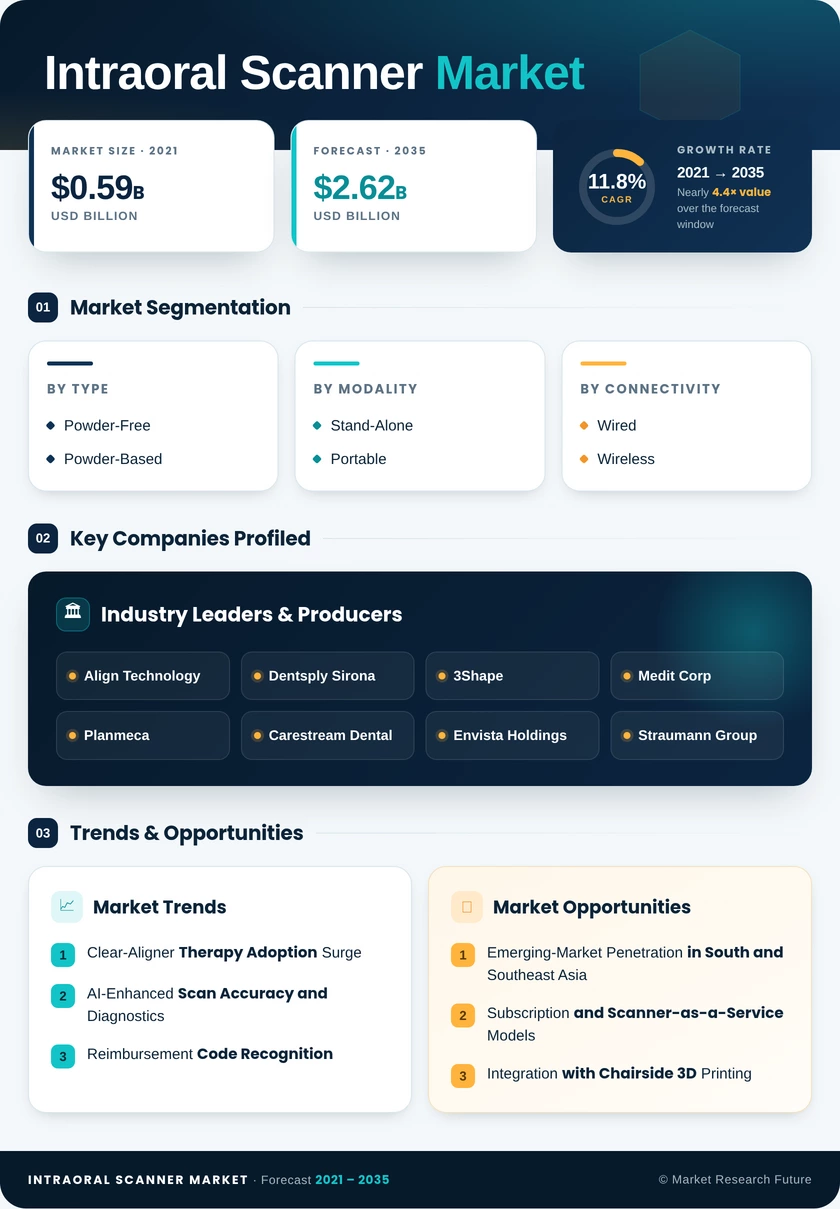
Segmentation Quick Reference
| Dimension | Sub-Segments | Dominant Segment | Fastest Growing Segment |
| By Type | Powder-Free, Powder-Based | Powder-Free | Powder-Based |
| By Modality | Stand-Alone, Portable | Stand-Alone | Portable |
| By Connectivity | Wired, Wireless | Wired | Wireless |
| By Application | Orthodontics, Restorative Dentistry, Implantology, Prosthodontics, Others | Orthodontics | Implantology |
| By End User | Hospitals, Dental Clinics, Other End Users | Hospitals | Dental Clinics |
| By Geography | North America, Europe, Asia-Pacific, South America, Middle East & Africa | North America | Asia-Pacific |
Market Segmentation Overview
By Type
| Sub-Segment | Key Trend |
| Powder-Free | Dominant technology; AI-stitching algorithms eliminate coating requirement |
| Powder-Based | Declining share; retained in budget-sensitive and educational settings |
Powder-free scanners account for the vast majority of new device shipments as OEMs phase out powder-dependent optics from flagship product lines. Cost-conscious buyers in emerging markets continue to adopt powder-based units where capital constraints outweigh workflow-efficiency priorities.
By Modality
| Sub-Segment | Key Trend |
| Stand-Alone (Cart-Based) | Preferred in multi-operatory hospitals and large group practices |
| Portable (Handheld) | Fastest-growing modality; wireless connectivity driving mobile-clinic adoption |
Cart-based systems offer larger screens, onboard processing, and multi-user access that suit high-throughput clinical environments. Portable units are gaining ground as battery life exceeds two hours and Wi-Fi 6E enables real-time scan rendering on tablet displays.
By Connectivity
| Sub-Segment | Key Trend |
| Wired | Stable installed base; preferred for latency-sensitive high-resolution scans |
| Wireless | Rapid adoption driven by clinical ergonomics and mobile-dentistry programs |
The connectivity mix is shifting as wireless protocols achieve the bandwidth necessary for real-time mesh rendering. By the early 2030s, wireless units are expected to approach parity with wired systems in revenue share.
By Application
| Sub-Segment | Key Trend |
| Orthodontics | Largest application; tied to clear-aligner production pipeline |
| Restorative Dentistry | Crown-and-bridge digital workflows replacing analog impressions |
| Implantology | Fastest growth; guided-surgery planning demands high-accuracy scans |
| Prosthodontics | Full-arch digital denture design expanding adoption |
| Others | Forensic dentistry, dental education, and research applications |
Orthodontics generates the highest scan volume per patient episode due to multi-stage aligner workflows. Implantology's rapid growth reflects the shift toward digitally planned and guided implant placement, which reduces surgical error and chair time.
By End User
| Sub-Segment | Key Trend |
| Hospitals | Largest end user; centralized procurement and multi-department utilization |
| Dental Clinics | Fastest-growing channel; mid-tier pricing unlocking solo-practice adoption |
| Other End Users | Academic institutions, mobile dental units, and community health programs |
Hospital procurement cycles and bulk-purchase agreements sustain the largest end-user share, while dental clinics — particularly those in suburban and semi-urban areas — represent the primary growth vector as scanner affordability improves and subscription financing models lower entry barriers.