Liquefied Petroleum Gas (LPG) Market (2026 - 2035)

ID: MRFR/EnP/10246-HCR
128 Pages
Anshula Mandaokar
Last Updated: July 01, 2026
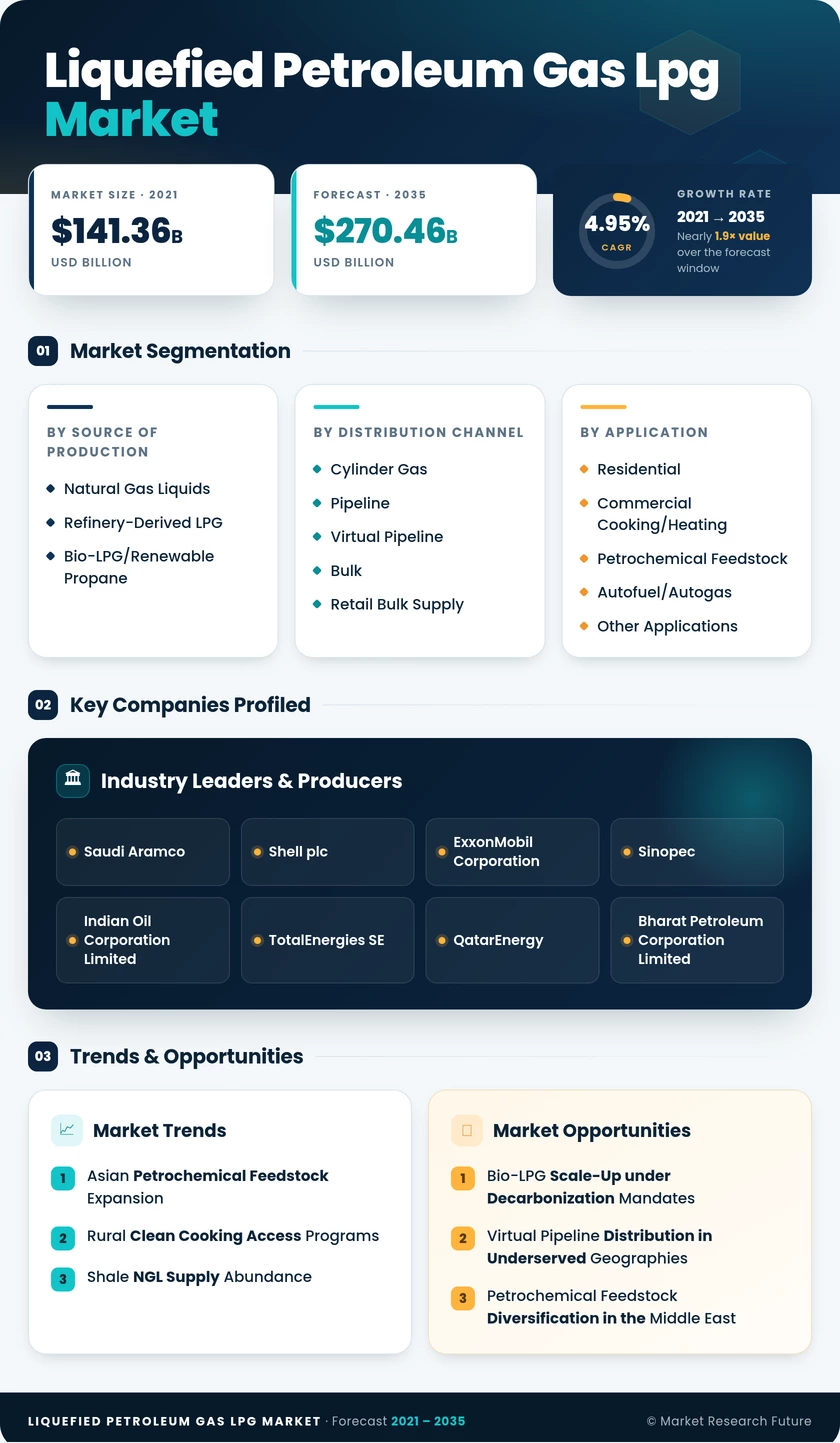
Liquefied Petroleum Gas (LPG) Market Size, Share & Growth Analysis Report By Source of Production (Natural Gas Liquids, Refinery-Derived LPG, Bio-LPG/Renewable Propane), By Distribution Channel (Cylinder Gas, Pipeline and Virtual Pipeline, Bulk and Retail Bulk Supply), By Application (Residential and Commercial Cooking/Heating, Petrochemical Feedstock, Autofuel/Autogas, Other Applications) and By Regional (North America, Europe, South America, Asia Pacific, Middle East and Africa) – Industry Growth & Forecast to 2035
Liquefied Petroleum Gas (LPG) Market
Market Size
Forecast Period2026-2035
CAGR (2026-2035)4.95%
2025 Market SizeUSD 166.82 Billion
2035 Market SizeUSD 270.46 Billion
Key Players
Saudi Aramco
Shell plc
ExxonMobil Corporation
Sinopec
Indian Oil Corporation Limited
TotalEnergies SE
Opportunities
  • Bio-LPG Scale-Up under Decarbonization Mandates
  • Virtual Pipeline Distribution in Underserved Geographies
  • Petrochemical Feedstock Diversification in the Middle East
  1. 1 Market Overview |
    1. 1.1 Study Assumptions & Market Definition |
    2. 1.2 Scope of the Study |
    3. 1.3 Research Methodology
  2. 2 Market Summary & Key Takeaways
  3. 3 Market Dynamics |
    1. 3.1 Market Drivers Analysis | |
      1. 3.1.1 Asian Petrochemical Feedstock Expansion | |
      2. 3.1.2 Rural Clean Cooking Access Programs | |
      3. 3.1.3 Shale NGL Supply Abundance | |
      4. 3.1.4 IMO 2020 Marine Fuel Switching | |
      5. 3.1.5 Bio-LPG Regulatory Incentives | |
      6. 3.1.6 Autogas Fleet Conversion Subsidies | |
      7. 3.1.7 Cold-Chain Logistics Expansion |
    2. 3.2 Market Restraints Analysis | |
      1. 3.2.1 Price Volatility and Subsidy Fiscal Burden | |
      2. 3.2.2 Electrification of Cooking and Heating | |
      3. 3.2.3 Cylinder Safety Incidents and Regulatory Tightening | |
      4. 3.2.4 Carbon Tax and Emissions Pricing Frameworks | |
      5. 3.2.5 Port and Terminal Congestion Bottlenecks |
    3. 3.3 Market Opportunity Analysis | |
      1. 3.3.1 Bio-LPG Scale-Up under Decarbonization Mandates | |
      2. 3.3.2 Virtual Pipeline Distribution in Underserved Geographies | |
      3. 3.3.3 Petrochemical Feedstock Diversification in the Middle East | |
      4. 3.3.4 Digital Supply-Chain Monetization | |
      5. 3.3.5 Autogas Fleet Conversion in Emerging Economies |
    4. 3.4 Industry Value Chain Analysis |
    5. 3.5 Porter's Five Forces Analysis
  4. 4 Global Liquefied Petroleum Gas Market Size & Forecast (2021–2035) |
    1. 4.1 Historical Market Size (2021–2025) |
    2. 4.2 Current & Forecast Market Size (2026–2035) |
    3. 4.3 Market Size by Revenue (USD Billion) |
    4. 4.4 Year-over-Year Growth Analysis
  5. 5 Segmentation Analysis Liquefied Petroleum Gas Market — Table of Contents & Market Segmentation Executive Summary
  6. 1 Market Summary
  7. 2 Key Report Takeaways
  8. 3 Market Size and Forecast (2021–2035)
  9. 4 Driver Impact Analysis
  10. 5 Restraints Impact Analysis
  11. 6 Opportunities
  12. 7 Regional Market Share and Country-Level Analysis |
    1. 7.1 North America |
    2. 7.2 Europe |
    3. 7.3 Asia-Pacific |
    4. 7.4 South America |
    5. 7.5 Middle East & Africa
  13. 8 Future Outlook (2026–2035)
  14. 9 Market Segmentation Analysis |
    1. 5.1 By Source of Production | |
      1. 5.1.1 Natural Gas Liquids | |
      2. 5.1.2 Refinery-Derived LPG | |
      3. 5.1.3 Bio-LPG/Renewable Propane |
    2. 5.2 By Distribution Channel | |
      1. 5.2.1 Cylinder Gas | |
      2. 5.2.2 Pipeline and Virtual Pipeline | |
      3. 5.2.3 Bulk and Retail Bulk Supply |
    3. 5.3 By Application | |
      1. 5.3.1 Residential and Commercial Cooking/Heating | |
      2. 5.3.2 Petrochemical Feedstock | |
      3. 5.3.3 Autofuel/Autogas | |
      4. 5.3.4 Other Applications
  15. 10 Competitive Landscape
  16. 11 Recent News & Developments
  17. 12 Report Scope and Methodology
  18. 13 Detailed Sources and Citations
  19. 14 Frequently Asked Questions
  20. 15 LIST OF TABLES |
  21. TABLE 1 Liquefied Petroleum Gas Market Summary Table |
  22. TABLE 2 Liquefied Petroleum Gas Market Market Size and Forecast, 2021–2035 |
  23. TABLE 3 Driver Impact Analysis |
  24. TABLE 4 Restraints Impact Analysis |
  25. TABLE 5 Regional Market Share Summary |
  26. TABLE 6 North America Country-Level Analysis |
  27. TABLE 7 Europe Country-Level Analysis |
  28. TABLE 8 Asia-Pacific Country-Level Analysis |
  29. TABLE 9 South America Country-Level Analysis |
  30. TABLE 10 Middle East & Africa Country-Level Analysis |
  31. TABLE 11 Liquefied Petroleum Gas Market Segmentation by Source of Production |
  32. TABLE 12 Liquefied Petroleum Gas Market Segmentation by Distribution Channel |
  33. TABLE 13 Liquefied Petroleum Gas Market Segmentation by Application |
  34. TABLE 14 Competitive Benchmarking Matrix |
  35. TABLE 15 Report Scope and Methodology |
  36. TABLE 16 Detailed Sources and Citations
  37. 16 LIST OF FIGURES |
  38. FIGURE 1 Liquefied Petroleum Gas Market Market Size Trend, 2021–2035 |
  39. FIGURE 2 Liquefied Petroleum Gas Market Year-over-Year Growth Outlook |
  40. FIGURE 3 Regional Revenue Share Analysis |
  41. FIGURE 4 Driver and Restraint Impact Matrix |
  42. FIGURE 5 Competitive Landscape Snapshot |
  43. FIGURE 6 Segment Share by Source of Production |
  44. FIGURE 7 Segment Share by Distribution Channel |
  45. FIGURE 8 Segment Share by Application

Segmentation Quick Reference

DimensionSub-SegmentsDominant SegmentFastest Growing Segment
By Source of ProductionNatural Gas Liquids, Refinery-Derived LPG, Bio-LPG/Renewable PropaneNatural Gas LiquidsRefinery-Derived LPG
By Distribution ChannelCylinder Gas, Pipeline and Virtual Pipeline, Bulk and Retail Bulk SupplyCylinder GasPipeline and Virtual Pipeline
By ApplicationResidential and Commercial Cooking/Heating, Petrochemical Feedstock, Autofuel/Autogas, Other ApplicationsResidential and Commercial Cooking/HeatingPetrochemical Feedstock


Market Segmentation Overview

By Source of Production

Sub-SegmentKey Trend
Natural Gas LiquidsRemains the dominant supply source, bolstered by expanded shale gas projects and infrastructure investments that keep production costs low.
Refinery-Derived LPGFaces pressure as refiners shift focus toward petrochemical production, leading to a pivot in fuel blending strategies.
Bio-LPG/Renewable PropaneProjected to see the fastest growth, driven by EU decarbonization mandates and industry efforts to integrate renewable feedstocks into existing supply chains.


By Source of Production segmentation follows the same taxonomy used in Section 9 of the RD, keeping the TOC and segmentation add-on aligned with the generated report content.


By Distribution Channel

Sub-SegmentKey Trend
Cylinder GasIncreasing adoption of smart tracking technologies and lightweight, safe composite cylinders is improving delivery efficiency and user experience.
Pipeline and Virtual PipelineGrowing demand in remote regions is driving the use of virtual pipelines as a flexible, cost-effective alternative to permanent infrastructure, with continued government support for expanding Piped Natural Gas (PNG) networks.
Bulk and Retail Bulk SupplyExpanding industrial and commercial demand is prompting significant growth in on-site bulk storage capacity and infrastructure modernization to ensure reliable, large-scale supply.


By Distribution Channel segmentation follows the same taxonomy used in Section 9 of the RD, keeping the TOC and segmentation add-on aligned with the generated report content.

By Application

Sub-SegmentKey Trend
Residential and Commercial Cooking/HeatingRapidly expanding due to government-backed clean cooking initiatives, increasing urbanization, and a shift away from traditional, high-emission biomass fuels.
Petrochemical FeedstockIncreasing preference for LPG as a cost-effective and cleaner feedstock in chemical processing to produce essential materials like ethylene and propylene.
Autofuel/AutogasGrowing adoption as a lower-emission, cost-competitive alternative to conventional gasoline and diesel, supported by expanding refueling networks and OEM factory-fitted vehicle options.
Other ApplicationsDiversified utility across sectors like agriculture, construction, and small-scale industrial heating, driven by the fuel's portability and ease of on-site use.


By Application segmentation follows the same taxonomy used in Section 9 of the RD, keeping the TOC and segmentation add-on aligned with the generated report content.

Download PDF ×

We do not share your information with anyone. However, we may send you emails based on your report interest from time to time. You may contact us at any time to opt-out.