Luxury Hair Care Market (2026 - 2035)

Luxury Hair Care Market Size, Share, Industry Trend & Analysis Research Report Information By Product Type (Shampoos, Conditioners, Hair Oils, Styling Products, Others), By Nature (Conventional / Synthetic, Natural / Organic), By End User (Women, Men), By Distribution Channel (Hypermarkets and Supermarkets, Specialty Stores, Online Retail Stores, Others), By Geography (North America, Europe, Asia-Pacific, South America, Middle East & Africa) – Forecast Till 2035

Forecast Period
2026-2035
CAGR
7.98%
2025 Market Size
USD 21.12 Billion
2035 Market Size
USD 45.53 Billion
Consumer and Retail ● Updated August 26, 2026 Report ID: MRFR/CG/20327-HCR | Pages: 128 | Author: Tejas Chaudhary

Luxury Hair Care Market Summary

The Luxury Hair Care Market was valued at USD 21.12 Billion in 2025 and opens the forecast window at USD 22.81 Billion in 2026, climbing to USD 45.53 Billion by 2035 at a 7.98% CAGR. Two catalysts anchor that trajectory. First, the U.S. Modernization of Cosmetics Regulation Act, whose facility registration and safety-substantiation obligations took full effect through 2024–2025, raised the compliance floor and pushed shelf space toward brands that can document what is inside the bottle [1]. Second, prestige beauty capital keeps flowing: the world's five largest beauty groups collectively reported more than USD 4.6 billion in annual R&D and brand-building outlays tied to haircare and scalp portfolios [4][6][7].

The genuine replacement narrative is situated within the field of formulation science. Silicone-heavy, sulphate-led legacy systems are being replaced by bond-building chemistry, peptide complexes, and biotech-derived actives that repair disulfide linkages rather than coating the cuticle. Between 2020 and 2024, the number of patent filings related to hair regeneration technology in the EU and U.S. offices nearly doubled. Additionally, the EU's Green Claims framework has mandated that marketers verify each "restores" and "strengthens" statement they publish [2][3]. The packaging counterpart is refill architecture and concentrate formats, which reduce the amount of plastic used per unit by up to 60%.

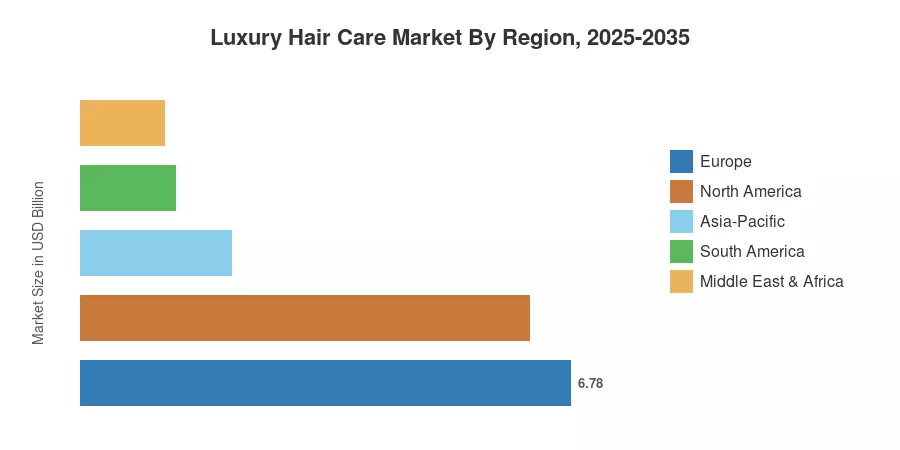
European professional salon density and a mature prestige distribution base sustain Europe's 32.1% share of the Luxury Hair Care Market. The development engine is Asia-Pacific, with a compound annual growth rate (CAGR) of 9.9%, driven by the premiumization of Chinese, Korean, and Indian products. North America is the second-largest market, with a 29.4% share. The distance between launch and scale has been reduced by creator-led discovery. The upcoming decade is reserved for brands that can demonstrate their efficacy, rather than merely implying it.


Key Report Takeaways

• By Product Type

  • Shampoos commanded 35.2% of the Luxury Hair Care Market in 2025, the single largest product pool
  • Hair oils are the fastest-expanding product line at an 8.7% CAGR through 2035
  • Styling products generated USD 3.40 billion in 2025 revenue

• By Nature

  • Conventional and synthetic formats retained a 66.6% share in 2025
  • Natural and organic products advanced at a 9.2% CAGR, the steepest curve in the dimension


• By End User

  • Men represent the faster-moving end-user cohort at an 8.6% CAGR

• By Geography

  • Europe led the Luxury Hair Care Market with a 32.1% share in 2025
  • Asia-Pacific posts a 9.9% CAGR, the fastest of any region
  • North America accounted for USD 6.21 billion in 2025


Market Size and Forecast (2021–2035)

Sizing draws on audited segment disclosures from twelve listed beauty groups, customs-level trade data for prestige haircare HS lines, salon-channel sell-through panels across nine countries, and a bottom-up build of price-tier-adjusted unit volumes. Historical years are reconciled against reported currency-neutral growth; forecast years apply channel-weighted elasticity to premium price points. Figures below express the Luxury Hair Care Market in USD Billion.
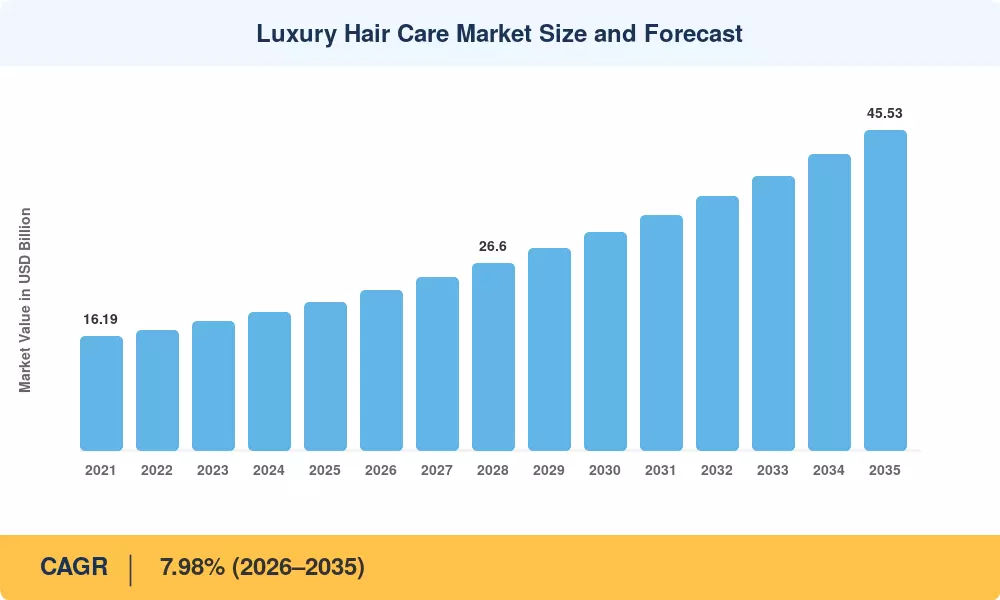
Luxury Hair Care Market Size and Forecast
Our Impact
Enabled $4.3B Revenue Impact for Fortune 500 and Leading Multinationals
Partnering with 2000+ Global Organizations Each Year
30K+ Citations by Top-Tier Firms in the Industry

Driver Impact Analysis

Driver ~% Impact on CAGR Geographic Relevance Impact Timeline
Rising affluent consumer base and disposable income +1.4 pp Global; strongest in Asia-Pacific Medium-term (2–4 yr)
Premiumization of the professional salon channel +1.1 pp Europe, North America Short-term (≤2 yr)
Ingredient transparency and clean-beauty demand +1.0 pp Europe, North America Medium-term (2–4 yr)
Social commerce and creator-led discovery +0.9 pp Asia-Pacific, North America Short-term (≤2 yr)
Molecular bond-building innovation +0.8 pp Global Long-term (≥4 yr)
Scalp-health category expansion +0.7 pp Asia-Pacific, North America Medium-term (2–4 yr)
Travel retail and duty-free normalization +0.5 pp Middle East & Africa, Asia-Pacific Short-term (≤2 yr)


Affluent Household Formation

Wealth creation sits underneath almost every prestige haircare purchase. The World Bank places the global upper-middle and high-income consumer pool at over 2.1 billion people, with Asia contributing the bulk of net additions since 2020 [10]. Prestige haircare behaves like an accessible luxury: a USD 48 conditioner substitutes emotionally for a deferred handbag. That substitution effect is why the category held positive volume growth through 2022–2023 inflation while discretionary hard goods contracted.

Regulatory Substantiation as a Competitive Moat

Compliance has quietly become a share driver. Under the Modernization of Cosmetics Regulation Act, U.S. marketers must maintain adequate safety substantiation and register manufacturing facilities, with adverse-event reporting obligations layered on top [1]. Europe's parallel tightening under Regulation 1223/2009 annex revisions removed several legacy preservatives and UV filters from acceptable use [3]. Groups with in-house toxicology and clinical panels absorbed those costs at low single-digit margin impact; smaller indie labels frequently exited categories entirely.

Efficacy Science and the Repair Narrative

Consumers now buy mechanisms, not fragrances. Bond-builders that reconnect broken disulphide bridges moved from a single patented chemistry in 2018 to more than forty commercialized variants by 2025, and clinical-style tensile-strength claims appear on roughly one in three prestige launches [2]. Growth in adjacent scalp care treatments has reinforced the trend, with dermatologist-cosigned microbiome propositions carrying price premiums of 35–50% over conventional prestige benchmarks [14].

Creator Commerce and Conversion Compression

Discovery cycles have collapsed. Beauty content generated an estimated 172 billion social video views in 2024, and prestige haircare converts from that traffic at roughly 2.4 times the rate of mass equivalents [13]. Brands running live commerce in China and Korea report first-purchase basket values well above their offline averages, which is why Asia-Pacific carries the highest digital allocation in the Luxury Hair Care Market.


Restraints Impact Analysis

Restraint ~% Impact on CAGR Geographic Relevance Impact Timeline
Price sensitivity and trade-down cycles −0.9 pp Europe, South America Short-term (≤2 yr)
Counterfeit and grey-market distribution −0.7 pp Asia-Pacific, Middle East & Africa Medium-term (2–4 yr)
Claim-substantiation and ingredient restrictions −0.6 pp Europe, North America Medium-term (2–4 yr)
Masstige encroachment compressing the premium gap −0.5 pp Global Long-term (≥4 yr)
Raw material and packaging cost volatility −0.4 pp Global Short-term (≥2 yr)


Trade-Down Behaviour in Soft Consumption Cycles

Elasticity bites hardest at the entry tier. Eurozone household consumption of personal care goods contracted in real terms across 2022–2023 while nominal spend rose, indicating volume sacrifice rather than category exit [8]. Shoppers stretch replenishment intervals, dilute usage, and shift one item in a three-step regimen to a masstige alternative. The Luxury Hair Care Market therefore shows resilient value but choppier unit growth during downturns.

Counterfeits and Channel Leakage

Diverted and counterfeit prestige haircare remains a structural leak. Customs seizure data across major economies show cosmetics and personal care consistently among the top five counterfeit categories by article count, with online marketplaces the dominant vector [15]. Beyond lost revenue, the reputational cost is severe when an adulterated product triggers scalp irritation attributed to the legitimate brand. Serialization and authentication programs are spreading, but coverage across salon wholesale networks stays incomplete.

Claim Risk Under Tightening Disclosure Rules

Regulators have narrowed the language available to marketers. The EU's substantiation regime requires evidence proportionate to the strength of the claim, and green or "free-from" positioning attracts particular scrutiny [3]. Reformulation cycles now run 14–22 months for prestige lines, which delays launch calendars and raises the cost of every incremental SKU.


Luxury Hair Care Market Opportunities

Diagnostic-Led Personalization

Instrumented scalp imaging and app-based hair diagnostics let brands sell a regimen rather than a bottle. Salons deploying diagnostic tools report attachment rates on take-home product roughly 30% above baseline [12]. The commercial prize is subscription replenishment tied to a measured condition, which converts a one-off transaction into a multi-year relationship.

Men's Prestige Grooming

Male consumers remain under-monetized relative to their stated willingness to pay. Men grow at an 8.6% CAGR inside the Luxury Hair Care Market yet still hold barely a third of value, and thinning-management propositions in particular carry premium price tolerance [14]. Barbershop-adjacent professional distribution is the underbuilt route to market.

India, ASEAN and the Middle East Premium Gap

Emerging premiumization is where headroom concentrates. India's prestige beauty penetration remains in the low single digits as a share of total haircare, while UAE and Saudi per-capita prestige spend already rivals Western European levels [11][17]. Local textured-hair and heat-protection formats, rather than imported Western regimens, will decide who wins these markets.

Refill Systems and Circular Packaging

Refillable architecture converts a sustainability obligation into a margin opportunity. Concentrate and pouch formats cut packaging weight materially and lift repeat-purchase lock-in, and EU packaging waste rules create a compliance deadline that rewards early movers [3][18].

First-Party Data Monetization

Regimen data is an asset. Brands operating diagnostic apps and replenishment subscriptions accumulate cohort-level efficacy evidence that shortens claim-substantiation timelines and feeds retail media inventory sold back to distribution partners [13]. Retail media networks in beauty already generate high-margin revenue streams that exceed the gross margin of the products they advertise.


Luxury Hair Care Market Future Outlook

Diagnostics and Algorithmic Regimen Design

Camera-based scalp analysis and machine-learning regimen engines will move from flagship stores to phone cameras. Prestige groups already run computer-vision diagnostics across thousands of retail doors, and cost curves for the underlying imaging hardware have fallen sharply [4]. By the early 2030s, the differentiator will be longitudinal data — brands that can show a customer measurable change over eighteen months will hold pricing power that a fragrance story cannot match.

Platform Economics and Retail Media

Distribution economics are being rewritten. Prestige beauty retailers now derive a meaningful share of profit from advertising inventory sold to the brands on their own shelves, and that shift transfers negotiating leverage toward whoever owns the customer relationship [13]. Direct-to-consumer subscriptions become defensive infrastructure rather than a growth channel.

Biotech Actives and Ingredient Supply

Precision fermentation is displacing petrochemical and agricultural feedstocks for high-value actives. Investment into biotech-derived cosmetic ingredients exceeded USD 1.8 billion cumulatively through 2025, and unit costs for fermented peptides have fallen roughly 40% since 2021 [2][16]. Cheaper actives let mid-tier prestige brands offer claims previously reserved for the top price band, compressing the efficacy gap.

Sustainability Disclosure and Circularity

Reporting obligations will harden. The EU Corporate Sustainability Reporting Directive extends detailed environmental disclosure to thousands of additional companies, and packaging regulation sets binding reuse and recycled-content targets across the decade [18]. Refill penetration in prestige haircare should move from low single digits toward the mid-teens by 2035, reshaping unit economics as much as consumer perception.


Luxury Hair Care Market Segmentation

By Product Type

The Luxury Hair Care Market segments by product type as follows.

Segment Metric (2025) Primary Demand Driver
Shampoos 35.2% share Regimen entry point and highest replenishment frequency
Conditioners 22.4% share Attachment purchase alongside shampoo; sensorial premium
Hair Oils 8.7% CAGR Heritage ritual formats and finishing-step adoption
Styling Products USD 3.40 Billion Salon-inspired finishing and heat-protection demand
Others (masks, serums, treatments) 11.5% share Weekly intensive repair and scalp regimen expansion


Shampoos with 35.2% share anchor the category because they gate every regimen: a consumer who upgrades their cleanser almost always upgrades the following step within two purchase cycles. Prestige shampoo pricing has held firm through inflation partly because concentrated formats let brands raise per-millilitre value while keeping shelf price stable.

The ‘’Other segment’’ including masks, serums and treatments, carries the steepest growth curve with a 11.5% share CAGR, and the reason is cultural rather than technical. Formats rooted in South Asian and Middle Eastern ritual have been repositioned as finishing and pre-wash treatments for Western consumers, giving brands a heritage story that survives scrutiny [11].

By Nature

Nature-based segmentation within the Luxury Hair Care Market reflects the ongoing clean-beauty transition.

Segment Metric (2025) Primary Demand Driver
Conventional / Synthetic 66.6% share Proven performance chemistry and cost-efficient scale
Natural / Organic 9.2% CAGR Ingredient transparency and dermatological sensitivity concerns


Conventional systems with 66.6% share retain the majority because performance still wins repeat purchase. Natural and organic lines have closed much of the efficacy gap through biotech-derived actives. Certification bodies such as COSMOS now cover thousands of haircare SKUs, which reduces consumer scepticism at the point of decision [3], and the organic segment is accelerating with a 66.6% share and 9.2% CAGR.

By End User

End-user structure in the Luxury Hair Care Market is shifting faster than headline shares suggest.

Segment Metric (2025) Primary Demand Driver
Women 63.1% share Multi-step regimens, colour-treated maintenance, salon loyalty
Men 8.6% CAGR Thinning management, scalp health, grooming normalization


Women segment with 63.1% share remain the volume core, with colour-treated hair driving the most valuable baskets — reconstruction and colour-protection products carry the highest average selling prices in the category. Men's growth comes off a small base but reflects genuine behavioural change: routine expansion from one product to three has been observed across North American and Korean cohorts [14].

By Distribution Channel

Channel structure in the Luxury Hair Care Market determines margin as much as reach.

Segment Metric (2025) Primary Demand Driver
Specialty Stores 36.5% share Assortment authority and trained advisory staff
Online Retail Stores 9.7% CAGR Subscription replenishment and creator-driven conversion
Hypermarkets & Supermarkets 24.3% share Prestige shop-in-shop formats and basket convenience
Others (salons, travel retail, pharmacies) USD 2.45 Billion Professional endorsement and duty-free discovery


Specialty retail leads because prestige haircare still benefits from explanation. Online is closing fast, and its advantage compounds: replenishment subscriptions convert a discovery moment into predictable revenue while generating usage data no physical retailer can match [13].


Regional Market Share Analysis

Region Metric (2025) Primary Investment Themes
North America USD 6.21 Billion Creator commerce, bond-repair launches, MoCRA compliance
Europe 32.1% share Professional salon density, clean reformulation, refill systems
Asia-Pacific 9.9% CAGR Live commerce, scalp diagnostics, premium local brands
South America USD 1.31 Billion Textured-hair specialists, direct sales networks
Middle East & Africa 5.5% share Travel retail, GCC prestige distribution
Total USD 21.12 Billion

Regional performance across the Luxury Hair Care Market splits between mature high-share territories and high-velocity emerging pools. Europe anchors value; Asia-Pacific supplies momentum.


North America

Country Metric Key Driver
US 78.4% of region Prestige specialty and creator-led launch velocity
Canada USD 0.84 Billion Salon professional channel and cross-border prestige demand
Mexico 7.3% CAGR Urban middle-class premiumization and modern trade expansion


Prestige haircare outperformed prestige colour cosmetics in U.S. dollar growth across 2023–2025, an inversion driven by regimen expansion rather than new users [12]. MoCRA implementation reshaped supplier rosters, with contract manufacturers reporting consolidation of orders toward facilities already carrying pharmaceutical-grade quality systems [1]. Canadian demand tracks U.S. launch calendars with a two-quarter lag.

Europe

Country Metric Key Driver
Germany 21.6% of region Professional salon chains and pharmacy prestige crossover
UK USD 1.29 Billion Prestige e-commerce depth and department store concessions
France 19.8% of region Domestic heritage houses and pharmacy dermocosmetic channel
Italy 8.7% of region Independent salon density and artisanal formulation brands
Spain 6.4% of region Tourism-linked retail and rising per-capita prestige spend
Nordic Countries 7.1% CAGR Clean formulation preference and refill adoption
Russia USD 0.34 Billion Parallel import channels and domestic premium substitutes
Rest of Europe 5.9% of region Central European modern trade rollout


Europe's leadership rests on the professional channel. The region hosts roughly one salon per 480 residents, the densest ratio globally, and salon endorsement remains the strongest single predictor of prestige haircare trial [12]. Regulation 1223/2009 amendments removed several legacy ingredients from acceptable use and forced portfolio-wide reformulation, which favoured groups with deep toxicology capacity [3].

Asia-Pacific

Country Metric Key Driver
China 31.7% of region Live commerce, scalp-health positioning, domestic premium brands
India 11.4% CAGR Urban affluence, oil-heritage premium formats, quick commerce
Japan USD 1.12 Billion Ageing-hair propositions and department store prestige
South Korea 14.2% of region Derma-brand crossover and export-led beauty innovation
ASEAN 10.6% CAGR Humidity-specific formats and rising modern trade penetration
Rest of Asia-Pacific USD 0.41 Billion Travel retail and Australian professional channel


China's NMPA registration overhaul, which tightened efficacy evidence requirements for cosmetic claims from 2021 onward, raised barriers for imported prestige lines while legitimizing science-forward domestic challengers [19]. India's growth reflects a different mechanism: quick-commerce platforms delivering prestige SKUs within 15 minutes have removed the distribution constraint that historically capped premium haircare outside metro department stores [11].

South America

Country Metric Key Driver
Brazil 54.8% of region Textured and treated-hair specialization; direct selling scale
Argentina USD 0.24 Billion Inflation-indexed premium pricing and salon channel resilience
Rest of South America 8.1% CAGR Chilean and Colombian modern retail premiumization


Brazil operates as a formulation laboratory for the wider category. High chemical-treatment prevalence created early domestic demand for reconstruction and thermal-protection systems, and Brazilian technical know-how now exports into global textured-hair portfolios [20]. ANVISA's post-2022 tightening of formaldehyde-related straightening rules accelerated the shift toward acid-based alternatives.

Middle East & Africa

Country Metric Key Driver
Saudi Arabia 26.3% of region Vision 2030 retail expansion and rising female workforce spend
UAE USD 0.29 Billion Travel retail hub status and high per-capita prestige spend
South Africa 15.1% of region Textured-hair prestige and specialty retail growth
Egypt 9.4% CAGR Urban premiumization despite currency pressure
Rest of MEA 18.7% of region Levant and North African distributor-led expansion


Gulf demand punches above population weight. Dubai and Doha airports together handle passenger volumes that make travel retail a primary rather than incidental channel, and haircare's share of duty-free beauty baskets has risen steadily since 2023 [9]. Saudi retail liberalization under Vision 2030 opened department store formats that previously had no local footprint [17].


Luxury Hair Care Market By Region, 2025-2035

Competitive Benchmarking

Concentration sits in the medium band. The top five groups control an estimated 40–46% of global value, producing an HHI in the 600–800 range — consolidated at the top, genuinely fragmented below it. Roughly 3,000 brands compete for the remainder, and independent challengers with a single patented chemistry can reach nine-figure revenue within five years, which keeps incumbents acquisitive.

Company Est. Revenue Share Range Key Offerings for Luxury Hair Care Market Strategic Positioning
L'Oréal Groupe ~14–17% Kérastase, Shu Uemura Art of Hair, Redken professional lines Salon channel dominance plus deepest R&D and diagnostics stack
Unilever PLC ~8–11% Living Proof, Nexxus, prestige haircare portfolio Science-led claims paired with global mass distribution muscle
The Estée Lauder Companies ~7–9% Aveda, Bumble and bumble Sustainability-forward positioning and specialty retail depth
Kao Corporation ~6–8% Oribe, Goldwell, premium Japanese haircare lines Craft-luxury and professional colour adjacency
Henkel AG & Co. KGaA ~4–6% Schwarzkopf Professional, Authentic Beauty Concept Salon-first B2B relationships across Europe
Shiseido Company ~4–6% Sublimic, premium Japanese scalp and treatment lines Dermatological credibility and Asian prestige heritage
Wella Company ~3–5% Nioxin, System Professional Thinning-management specialization and stylist education
Procter & Gamble ~3–5% Ouai and premium haircare portfolio Creator-native brand building at industrial scale
Olaplex Holdings ~2–4% Bond-building repair systems Patent-anchored single-technology leadership
Moroccanoil ~2–3% Argan-oil treatment and styling range Ingredient-story brand with strong salon loyalty
Amorepacific Corporation ~1–3% Ryo Premium, premium scalp lines K-beauty scalp science and regional distribution strength
Davines Group ~1–3% Essential and OI haircare collections B Corp certification and independent salon affinity


Recent News & Developments

  • L'Oréal Groupe (March 2024): Expanded its professional haircare diagnostics rollout to additional salon markets, tying in-salon scalp analysis to take-home regimen prescription and lifting attachment rates across pilot doors [4].
  • U.S. FDA (July 2024): Enforcement of MoCRA facility registration and product listing requirements began in earnest, reshaping contract manufacturing rosters for prestige haircare marketers [1].
  • Unilever PLC (October 2024): Announced a strategic separation of its ice cream business to concentrate capital on beauty and wellbeing, with prestige haircare named among priority growth pillars [5].
  • European Commission (January 2025): Advanced substantiation requirements for environmental marketing claims, forcing prestige beauty marketers to re-audit "natural" and "sustainable" packaging language [3].
  • Kao Corporation (April 2025): Extended its premium haircare distribution into additional Asia-Pacific markets, targeting salon-professional channels ahead of retail rollout [6].
  • Olaplex Holdings (June 2025): Broadened its scalp and pre-shampoo portfolio beyond core bond-building products, addressing the fastest-growing adjacent occasion in prestige haircare [12].
  • Saudi Arabia General Authority (September 2024): Approved further retail licensing reforms under Vision 2030, enabling international prestige beauty formats to open owned doors in tier-one cities [17].
  • Shiseido Company (February 2025): Reallocated marketing investment toward premium scalp and treatment lines in Japan and China, citing faster category growth than colour cosmetics [7].


Luxury Hair Care Market Report Scope

Parameter Detail
Market Scope Global luxury and prestige-tier hair care products across shampoos, conditioners, hair oils, styling products, masks, serums and scalp treatments, sold through specialty, online, grocery, salon, travel retail and pharmacy channels
Study Period 2021–2035 (Historical 2021–2024; Base Year 2025; Forecast 2026–2035)
CAGR 7.98% (2026–2035)
Market Size Checkpoints USD 21.12 Billion (2025); USD 22.81 Billion (2026); USD 45.53 Billion (2035)
Fastest Growing Segments Hair oils (product type); natural and organic (nature); men (end user); online retail stores (channel); Asia-Pacific (geography)
Companies Profiled 12 major players including L'Oréal Groupe, Unilever PLC, The Estée Lauder Companies, Kao Corporation, Henkel AG & Co. KGaA, Shiseido Company, Wella Company, Procter & Gamble, Olaplex Holdings, Moroccanoil, Amorepacific Corporation, Davines Group
Valuation Currency USD Billion, constant 2025 exchange rates

FAQs

What due-diligence red flags should investors screen for when evaluating targets in the Luxury Hair Care Market?
Watch for revenue concentration in a single hero SKU, patent expiry within five years, and salon receivables stretching past 90 days. Distributor-heavy international revenue often masks sell-through weakness [12].
How do private-label and salon-exclusive brands change competitive dynamics?
Salon-exclusive labels lock distribution through stylist commissions rather than consumer advertising, which makes them cheap to scale regionally but hard to export. They rarely threaten global leaders directly, though they cap regional share ceilings [12].
What procurement terms should a retailer negotiate when onboarding a prestige haircare brand in the Luxury Hair Care Market?
Insist on markdown protection, guaranteed tester and education budgets, and clear authenticity serialization. Exclusivity windows of 90–120 days are standard for hero launches and worth trading against volume commitments [15].
How does bond-building chemistry differ commercially from protein-based reconstruction?
Bond-builders sell on a patented mechanism and command roughly double the price per millilitre; protein reconstructors compete on formulation craft and face faster commoditization. Patent cliffs make the first group riskier long-term [2].
What integration challenges arise when a large group acquires an indie prestige haircare brand?
Founder-led communities often reject corporate reformulation, and migrating contract manufacturing risks batch-consistency complaints. Successful acquirers typically leave supply chain untouched for the first 24 months [5].
Which regulatory nuance most often delays launches in the Luxury Hair Care Market?
Claim substantiation, not ingredient approval. A compliant formula can sit unlaunched for months while clinical or instrumental evidence is generated to support performance wording under EU and Chinese rules [3][19].
Are refill formats commercially viable at prestige price points?
Yes, when the primary vessel is genuinely durable, and the refill saves the consumer 15–25%. Margin improves because packaging is the second-largest cost line after actives in most prestige haircare [18].   Note: Suitability of any product depends on individual hair and scalp condition; this report provides market analysis rather than product or medical recommendations.  
Author
Author
Author Profile
Tejas Chaudhary
Research Analyst Level II
I have a degree in Engineering (Civil), with masters in Business Administration (Marketing). With more than 4 years of experience in market research and consulting, I am involved in end-to-end process of market research, proposals, project kickoffs and delivery. I have research knowledge and expertise in consumer goods/packaging domain. Also I have worked for various other domains like construction & equipment. Effectively managed and delivered more than 60 report studies for regional as well as global clientele.
Share::
Request Free Sample
Download Free Sample

Kindly complete the form below to receive a free sample of this Report

* Please use a valid business email

Share::
Request Free Sample
Download PDF ×

We do not share your information with anyone. However, we may send you emails based on your report interest from time to time. You may contact us at any time to opt-out.
















