×
Request Free Sample ×

Kindly complete the form below to receive a free sample of this Report

* Please use a valid business email

Leading companies partner with us for data-driven Insights

clients tt-cursor
Hero Background

Sensor Market

ID: MRFR/SEM/2983-CR
302 Pages
Aarti Dhapte
October 2020

Sensor Market Size, Share and Research Report By Type (Image Sensors, Biosensors, Optical Sensors, Motion Sensors, Pressure Sensors, Temperature Sensors, Humidity Sensors, Radar Sensors, Touch Sensors, and Others), By Component (Microcontrollers, Transceivers, Amplifiers, and ADC & DAC), By Technology (MEMS, CMOS, and NEMS), By Verticals (Consumer Electronics, Automotive, Industrial IT & Telecom, Healthcare, Aerospace & Defense, Others) And Region (North America, Europe, Asia-Pacific & Rest Of The World)– Industry Forecast Ti... read more

Share:
Download PDF ×

We do not share your information with anyone. However, we may send you emails based on your report interest from time to time. You may contact us at any time to opt-out.

Sensor Market Infographic
Purchase Options

Sensor Market Summary

As per MRFR analysis, the Sensor Market Size was estimated at 250.2 USD Billion in 2024. The Sensor industry is projected to grow from 293.49 USD Billion in 2025 to 1447.6 USD Billion by 2035, exhibiting a compound annual growth rate (CAGR) of 17.3 during the forecast period 2025 - 2035.

Key Market Trends & Highlights

The Sensor Market is experiencing robust growth driven by technological advancements and increasing demand across various sectors.

  • The integration of IoT in sensor applications is transforming operational efficiencies in North America, the largest market.
  • Energy-efficient sensors are gaining traction in the healthcare segment, which remains the largest in terms of revenue.
  • Advancements in sensor technology are propelling growth in the automotive sector, recognized as the fastest-growing segment.
  • Rising demand for automation and a growing emphasis on safety and security are key drivers fueling market expansion in the Asia-Pacific region.

Market Size & Forecast

2024 Market Size 250.2 (USD Billion)
2035 Market Size 1447.6 (USD Billion)
CAGR (2025 - 2035) 17.3%

Major Players

Honeywell (US), Siemens (DE), Texas Instruments (US), Bosch (DE), Analog Devices (US), STMicroelectronics (FR), NXP Semiconductors (NL), Infineon Technologies (DE), Omron (JP)

Sensor Market Trends

The Sensor Market is currently experiencing a dynamic evolution, driven by advancements in technology and increasing demand across various sectors. The proliferation of the Internet of Things (IoT) has catalyzed the integration of sensors into everyday devices, enhancing their functionality and connectivity. This trend appears to be reshaping industries such as automotive, healthcare, and manufacturing, where real-time data collection and analysis are becoming essential. Furthermore, the growing emphasis on automation and smart technologies suggests that the Sensor Market will continue to expand, as businesses seek to improve efficiency and reduce operational costs. In addition to technological advancements, environmental concerns are influencing the Sensor Market. There is a noticeable shift towards the development of eco-friendly sensors that minimize energy consumption and reduce waste. This trend indicates a broader commitment to sustainability within the industry, as companies strive to align with global environmental goals. As the Sensor Market evolves, it is likely to witness further innovations that cater to both consumer needs and regulatory requirements, ultimately shaping a more interconnected and sustainable future.

Integration of IoT in Sensor Applications

The integration of the Internet of Things (IoT) into sensor applications is transforming how data is collected and utilized. Sensors are increasingly embedded in various devices, enabling seamless communication and data exchange. This trend enhances operational efficiency and provides valuable insights across multiple sectors.

Focus on Energy-Efficient Sensors

There is a growing emphasis on the development of energy-efficient sensors that consume less power while maintaining performance. This trend reflects a broader commitment to sustainability, as companies aim to reduce their environmental footprint and comply with stringent regulations.

Advancements in Sensor Technology

Technological advancements are driving innovation within the Sensor Market. Emerging technologies, such as artificial intelligence and machine learning, are being integrated into sensor systems, enabling enhanced data processing and analysis. This trend is likely to lead to more sophisticated applications and improved decision-making capabilities.

Sensor Market Drivers

Smart City Initiatives

The Sensor Market is significantly impacted by the proliferation of smart city initiatives worldwide. Urban areas are increasingly leveraging sensor technology to enhance infrastructure, improve public services, and optimize resource management. Sensors are deployed in traffic management systems, waste management, and energy conservation efforts, contributing to more efficient urban living. As cities aim to become smarter and more sustainable, the demand for sensors is expected to rise, supporting the market's growth trajectory. This trend aligns with the broader movement towards urbanization and the need for innovative solutions to address urban challenges.

Healthcare Sector Growth

The Global Sensor Industry is witnessing substantial growth due to the increasing adoption of sensors in the healthcare sector. Wearable health devices, equipped with advanced sensors, are becoming commonplace, enabling continuous monitoring of vital signs and health metrics. This trend is supported by the rising prevalence of chronic diseases and the need for remote patient monitoring solutions. As the healthcare industry continues to innovate, the demand for sensors is expected to surge, contributing to the overall market growth. The integration of sensors in healthcare applications is likely to enhance patient outcomes and streamline healthcare delivery.

Market Growth Projections

The Sensor Market is projected to experience robust growth over the next decade. With a compound annual growth rate (CAGR) of 13.95% anticipated from 2025 to 2035, the market is expected to expand significantly. By 2035, the market size is estimated to reach 1052.6 USD Billion, reflecting the increasing adoption of sensor technologies across various sectors. This growth is driven by factors such as technological advancements, rising demand for automation, and the need for enhanced data collection and analysis. The future of the Sensor Industry appears promising, with numerous opportunities for innovation and expansion.

Technological Advancements

The Sensor Industry is experiencing rapid growth driven by technological advancements in sensor technology. Innovations such as miniaturization, improved sensitivity, and enhanced connectivity are enabling sensors to be integrated into a wide array of applications. For instance, the rise of the Internet of Things (IoT) has led to increased demand for smart sensors in various sectors, including healthcare and automotive. As a result, the market is projected to reach 250.2 USD Billion in 2024, reflecting a growing reliance on sophisticated sensor solutions to enhance operational efficiency and data accuracy.

Rising Demand for Automation

The Sensor Industry is significantly influenced by the rising demand for automation across various sectors. Industries such as manufacturing, logistics, and agriculture are increasingly adopting automated systems to enhance productivity and reduce operational costs. Sensors play a crucial role in these automated systems by providing real-time data for monitoring and control. This trend is expected to contribute to the market's growth, with projections indicating a market size of 1052.6 USD Billion by 2035. The integration of sensors in automation processes is likely to streamline operations and improve decision-making capabilities.

Environmental Monitoring Needs

The Sensor Industry is also propelled by the growing need for environmental monitoring. Governments and organizations are increasingly focusing on sustainability and environmental protection, necessitating the use of sensors for monitoring air and water quality, as well as other environmental parameters. For example, sensors are employed in smart cities to track pollution levels and manage resources efficiently. This heightened awareness and regulatory pressure are likely to drive the market forward, as the demand for reliable environmental data continues to rise, supporting the industry's expansion.

Market Segment Insights

By Application: Industrial Automation (Largest) vs. Automotive (Fastest-Growing)

The application segment of the Sensor Market is significant, with Industrial Automation holding the largest share. This is due to the rise in automation processes in manufacturing and production industries, which require advanced sensor technologies for improved efficiency and precision. Following closely is the Automotive sector, which has rapidly integrated sensors for safety and performance enhancements, marking it as a notable contender in the market landscape.

Industrial Automation: Dominant vs. Automotive: Emerging

Industrial Automation has established itself as a dominant force in the Sensor Market, heavily influenced by the push towards smart factories and Industry 4.0 initiatives. The demand for sensors in this sector stems from the need for real-time monitoring and control of automated processes. On the other hand, the Automotive sector is emerging rapidly, driven by trends such as electric vehicles and autonomous driving technologies that rely heavily on sensor integration. As manufacturers innovate to enhance vehicle safety and user experience, the automotive application of sensors is poised for accelerated growth, attracting significant investment and development.

By End Use: Healthcare (Largest) vs. Smart Homes (Fastest-Growing)

The Sensor Market's end-use segment is diverse, with manufacturing dominating the landscape. Healthcare follows closely, benefiting from the rapid adoption of smart medical devices and monitoring systems. Transportation is also noteworthy, featuring significant usage of sensors for vehicle safety and efficiency. Agriculture employs sensors for precision farming, while smart homes continue to attract attention through emerging technologies that enhance security and convenience. The overall market is characterized by various applications spanning several industries, each contributing to the sector's health. The growth trend within the Sensor Market is driven by technological advancements and increasing demand for automation. Healthcare stands out with innovations in telehealth and wearable health monitors. Meanwhile, smart homes are on an upward trajectory, fueled by IoT devices that promise improved energy management and user convenience. This shift towards interconnectedness is reshaping the market, leading to greater efficiency and safety across segments.

Healthcare (Dominant) vs. Smart Homes (Emerging)

Healthcare sensors play a critical role in remote patient monitoring and diagnostic equipment, establishing themselves as a dominant presence in the Sensor Market. These sensors enhance the reliability and accuracy of health data, driving improved patient outcomes and operational efficiency in healthcare settings. In contrast, smart home sensors cater to the burgeoning demand for connected living environments, facilitating features such as automated lighting, security systems, and climate control. As an emerging segment, smart home sensors are gaining traction due to the expanding IoT ecosystem, transforming how consumers interact with their living spaces. This juxtaposition highlights the robust performance of healthcare alongside the promising growth potential of smart homes.

By Sensor Type: Temperature Sensor (Largest) vs. Motion Sensor (Fastest-Growing)

In the Sensor Market, Temperature Sensors hold the largest market share, primarily due to their ubiquitous applications across various industries such as HVAC, automotive, and manufacturing. The consistent demand for precise temperature monitoring increases their prevalence, particularly in industrial sectors. Other segment values like Pressure Sensors, Proximity Sensors, Light Sensors, and Motion Sensors are also significant but do not achieve the same level of dominance as Temperature Sensors.

Temperature Sensor (Dominant) vs. Motion Sensor (Emerging)

Temperature Sensors are widely recognized for their essential role across multiple applications, leading their segment within the Sensor Market. They are prominent in sectors that require critical temperature monitoring, ensuring efficiency and safety. In contrast, Motion Sensors are emerging rapidly, driven by advancements in smart home technology and increasing demand for automated security solutions. These sensors are versatile, finding usage in various applications from lighting systems to security alerts. Their growing adoption reflects a trend towards enhancing automation and improving user convenience.

By Technology: Digital Sensor (Largest) vs. Wireless Sensor (Fastest-Growing)

The sensor market showcases a diverse technology segment, where Digital Sensors hold the largest share. These sensors are preferred for their high accuracy, reliability, and ability to process data in real-time. Following closely are Analog Sensors, known for their simplicity and wide application range. Wireless Sensors, while currently smaller in market share, are quickly gaining traction due to the rise in IoT applications and the demand for remote monitoring solutions. The growth trends in the sensor market are heavily influenced by technological advancements and changing consumer preferences. Digital Sensors are leveraging innovations like machine learning for enhanced data processing, sustaining their dominance. In contrast, Wireless Sensors are experiencing the fastest growth, fueled by increasing connectivity and automation in industries such as smart homes, healthcare, and industrial automation, indicating a robust shift towards more intuitive and connected solutions.

Digital Sensor (Dominant) vs. Wireless Sensor (Emerging)

Digital Sensors are positioned as the dominant technology in the sensor market due to their capabilities in data conversion and processing efficiency. They excel in applications requiring precise measurements and real-time analytics, which positions them favorably in sectors ranging from consumer electronics to industrial automation. On the other hand, Wireless Sensors are emerging rapidly, driven by the rise of smart technologies and the need for remote data acquisition. Their flexibility and ease of installation make them ideal for applications in smart buildings and healthcare monitoring, appealing to the modern demand for automation and data accessibility. As industries evolve, the synergy between Digital and Wireless Sensors will likely create new opportunities, fostering innovation.

By Material: Silicon (Largest) vs. Metal (Fastest-Growing)

The sensor market exhibits a diverse material landscape with silicon being the largest contributor, holding significant market share due to its superior semiconductor properties. Its extensive applications in various sensor types, especially in consumer electronics and automotive sectors, establish it as the go-to material. Metal sensors, though historically less prevalent, have been gaining traction owing to their robustness and reliability in harsh environments, leading to a notable increase in their market share.

Sensor Materials: Silicon (Dominant) vs. Metal (Emerging)

Silicon is the dominant player in the sensor market, celebrated for its excellent electrical properties, scalability, and compatibility with integrated circuit technology, making it indispensable for a broad range of electronic sensors. On the other hand, metal sensors are emerging, favored for their durability and effectiveness in extreme conditions. Materials such as stainless steel and aluminum offer significant advantages in industrial applications due to their mechanical strength and resistance to corrosion. As industries increasingly adopt AI and IoT solutions, the adaptability of metal sensors positions them favorably for growth, while silicon continues to solidify its dominance through ongoing innovations in microelectronics.

Get more detailed insights about Sensor Market

Regional Insights

North America : Market Leader in Innovation

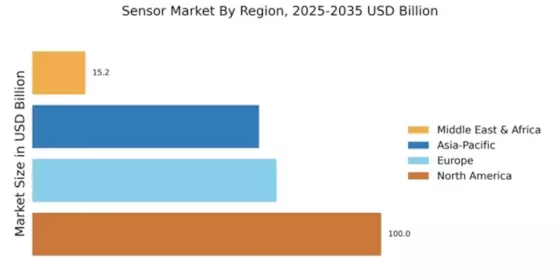
North America continues to lead The Sensor, holding a significant share of 100.0 in 2024. The region's growth is driven by rapid technological advancements, increasing demand for automation, and stringent regulatory standards promoting safety and efficiency. The automotive and healthcare sectors are particularly influential, pushing for innovative sensor solutions to enhance performance and reliability. The competitive landscape is robust, with key players like Honeywell, Texas Instruments, and Analog Devices dominating the market. The U.S. stands out as a hub for sensor innovation, supported by substantial investments in R&D. The presence of major corporations and a favorable business environment further solidify North America's position as a leader in the sensor market.

Europe : Emerging Hub for Sustainability

Europe's sensor market, valued at 70.0, is experiencing growth fueled by sustainability initiatives and regulatory frameworks aimed at reducing carbon footprints. The European Union's Green Deal and various national policies are catalyzing demand for advanced sensor technologies in energy management and environmental monitoring. This regulatory support is crucial for driving innovation and adoption across multiple sectors. Germany, France, and the UK are leading countries in this market, with companies like Siemens and Bosch at the forefront. The competitive landscape is characterized by a mix of established players and innovative startups, all striving to meet the increasing demand for smart and sustainable solutions. The region's focus on digital transformation further enhances its market potential.

Asia-Pacific : Rapid Growth in Emerging Markets

The Asia-Pacific region, with a market size of 65.0, is witnessing rapid growth in the sensor market, driven by urbanization, industrialization, and increasing consumer electronics demand. Countries like China and India are at the forefront, with significant investments in smart city projects and IoT applications. Regulatory support for technological advancements is also a key driver, fostering a conducive environment for sensor adoption. China is the largest market in the region, with major players like Omron and STMicroelectronics leading the charge. The competitive landscape is dynamic, with both local and international companies vying for market share. The region's focus on innovation and technology integration positions it as a critical player in The Sensor.

Middle East and Africa : Emerging Market with Potential

The Middle East and Africa (MEA) region, with a market size of 15.2, is gradually emerging as a potential market for sensors, driven by increasing investments in infrastructure and smart technologies. Governments are focusing on diversifying their economies and enhancing technological capabilities, which is fostering demand for advanced sensor solutions across various sectors, including oil and gas, healthcare, and smart cities. Countries like the UAE and South Africa are leading the charge, with significant projects aimed at integrating smart technologies. The competitive landscape is still developing, with opportunities for both local and international players to establish a foothold. As the region continues to invest in technology, the sensor market is expected to grow steadily in the coming years.

Key Players and Competitive Insights

The Sensor Market is currently characterized by a dynamic competitive landscape, driven by rapid technological advancements and increasing demand across various sectors, including automotive, healthcare, and industrial automation. Key players such as Honeywell (US), Siemens (DE), and Bosch (DE) are strategically positioned to leverage their extensive portfolios and innovative capabilities. Honeywell (US) focuses on integrating advanced sensor technologies into its automation solutions, enhancing operational efficiency for its clients. Siemens (DE) emphasizes digital transformation, utilizing its expertise in IoT to develop smart sensors that facilitate real-time data analytics. Bosch (DE) is heavily investing in R&D to pioneer next-generation sensors, particularly in the automotive sector, where safety and efficiency are paramount. Collectively, these strategies foster a competitive environment that prioritizes innovation and technological integration.

In terms of business tactics, companies are increasingly localizing manufacturing to mitigate supply chain disruptions and optimize logistics. This approach not only reduces operational costs but also enhances responsiveness to regional market demands. The Sensor Market appears moderately fragmented, with a mix of established players and emerging startups. The collective influence of key players shapes market dynamics, as they engage in strategic partnerships and collaborations to enhance their product offerings and market reach.

In November 2025, Honeywell (US) announced a partnership with a leading automotive manufacturer to develop advanced driver-assistance systems (ADAS) utilizing its latest sensor technologies. This collaboration is strategically significant as it positions Honeywell at the forefront of the automotive safety sector, potentially increasing its market share and reinforcing its reputation as an innovator in sensor solutions. The integration of these advanced sensors into vehicles is likely to enhance safety features, aligning with the growing consumer demand for smarter automotive technologies.

In October 2025, Siemens (DE) launched a new line of IoT-enabled sensors designed for industrial applications, aimed at improving predictive maintenance capabilities. This strategic move underscores Siemens' commitment to digitalization and reflects a broader trend towards smart manufacturing. By enabling real-time monitoring and data collection, these sensors can significantly reduce downtime and operational costs for manufacturers, thereby enhancing productivity and competitiveness in the market.

In September 2025, Bosch (DE) unveiled its latest automotive sensor technology, which incorporates AI algorithms to improve vehicle performance and safety. This development is particularly noteworthy as it highlights Bosch's focus on integrating artificial intelligence into sensor technology, potentially setting new industry standards. The ability to process data in real-time and make autonomous adjustments could revolutionize vehicle safety and efficiency, further solidifying Bosch's position as a leader in the automotive sensor market.

As of December 2025, current trends in the Sensor Market are increasingly defined by digitalization, sustainability, and AI integration. Strategic alliances among key players are shaping the competitive landscape, fostering innovation and enhancing product offerings. The shift from price-based competition to a focus on technological advancement and supply chain reliability is evident. Companies are likely to differentiate themselves through innovative solutions that address evolving consumer needs, suggesting a future where competitive advantage hinges on the ability to adapt and innovate in response to market demands.

Key Companies in the Sensor Market market include

Industry Developments

In March 2024, Honeywell International released a new sensor system that VR can be used to predict maintenance in industrial rooms IoT. improved connectivity and data processing outputs allow monitoring of equipment resulting in reduced downtimes.

In February 2024, Bosch Sensortec launched its latest wearable sensor that provides sport and health-related exercises. This ultra-low power device has motion tracking as well as biometrics literally matching the sophisticated requirements of smart wearables.

In January 2024, TE Connectivity released a new series of automotive high temperature sensors designed for the electric and hybrid automotive market. These sensors are aimed at ensuring the safety and functionality of the electric and hybrid vehicles by monitoring motors and battery systems.

In December 2023, Texas Instruments revealed new sensors expected to deliver accurate pressure measurements for a broad array of applications in the medical devices segment. Such products are meant to increase the efficiency of other medical diagnostic devices such as infusion pumps and respiration devices.

In October 2023, Sensirion AG introduced the compact gas sensor. Their primary target was industrial safety and HVAC systems. The device demonstrates excellent performance in the detection of toxic gases and meets the global safety standards which are becoming increasingly stringent.

In September 2023, Amphenol Advanced Sensors collaborated with a top EV manufacturer to create special thermal sensors. These sensors are designed to improve battery thermal management systems and the trend of incorporating sensors into EVs.

In August 2023, Infineon Technologies introduced a radar sensor specifically dedicated to autonomous driving uses. This sensor enhances object detection and situational awareness which are quite paramount in enhancing safety for autonomous vehicles.

In July 2023, Omron Corporation added a bioelectrical impedance sensor that undertakes body composition analysis into its healthcare sensor portfolio. The product aims the fitness and personal health device segments.

Future Outlook

Sensor Market Future Outlook

The Sensor is projected to grow at a 17.3% CAGR from 2024 to 2035, driven by advancements in IoT, automation, and smart technologies.

New opportunities lie in:

  • Development of smart home automation sensors
  • Integration of sensors in autonomous vehicles
  • Expansion of wearable health monitoring devices

By 2035, the Sensor Market is expected to achieve substantial growth, driven by innovation and diverse applications.

Market Segmentation

Sensor Market End Use Outlook

  • Manufacturing
  • Transportation
  • Healthcare
  • Agriculture
  • Smart Homes

Sensor Market Material Outlook

  • Silicon
  • Metal
  • Plastic
  • Ceramic
  • Glass

Sensor Market Technology Outlook

  • Analog Sensor
  • Digital Sensor
  • Wireless Sensor
  • Smart Sensor
  • MEMS Sensor

Sensor Market Application Outlook

  • Industrial Automation
  • Consumer Electronics
  • Automotive
  • Healthcare
  • Environmental Monitoring

Sensor Market Sensor Type Outlook

  • Temperature Sensor
  • Pressure Sensor
  • Proximity Sensor
  • Light Sensor
  • Motion Sensor

Report Scope

MARKET SIZE 2024250.2(USD Billion)
MARKET SIZE 2025293.49(USD Billion)
MARKET SIZE 20351447.6(USD Billion)
COMPOUND ANNUAL GROWTH RATE (CAGR)17.3% (2024 - 2035)
REPORT COVERAGERevenue Forecast, Competitive Landscape, Growth Factors, and Trends
BASE YEAR2024
Market Forecast Period2025 - 2035
Historical Data2019 - 2024
Market Forecast UnitsUSD Billion
Key Companies ProfiledHoneywell (US), Siemens (DE), Texas Instruments (US), Bosch (DE), Analog Devices (US), STMicroelectronics (FR), NXP Semiconductors (NL), Infineon Technologies (DE), Omron (JP)
Segments CoveredApplication, End Use, Sensor Type, Technology, Material
Key Market OpportunitiesIntegration of advanced sensors in smart home technologies enhances energy efficiency and user experience.
Key Market DynamicsRising demand for smart devices drives innovation and competition in the sensor market, influencing technological advancements.
Countries CoveredNorth America, Europe, APAC, South America, MEA

Market Highlights

Author
Aarti Dhapte
Team Lead - Research

She holds an experience of about 6+ years in Market Research and Business Consulting, working under the spectrum of Information Communication Technology, Telecommunications and Semiconductor domains. Aarti conceptualizes and implements a scalable business strategy and provides strategic leadership to the clients. Her expertise lies in market estimation, competitive intelligence, pipeline analysis, customer assessment, etc.

Leave a Comment

FAQs

How much is the sensor market?

The sensor market size was valued at USD 250.20 billion in 2024.

What is the growth rate of the market?

The market is projected to grow at a CAGR of 17.30% during the forecast period, 2025 to 2035.

Which region held the largest market share in the market?

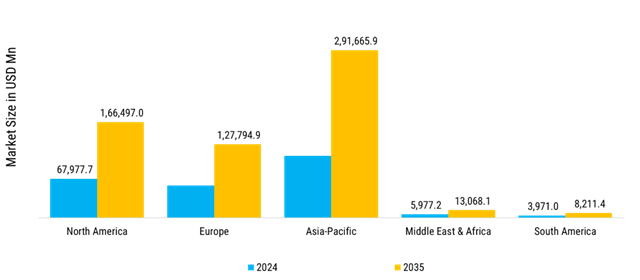
Asia-Pacific had the largest share of the market

Who are the key players in the sensor market?

The key players in the market are Robert Bosch GmbH (Germany), ABB Group (Switzerland), STMicroelectronics NV (Switzerland), and Honeywell International Inc. (US).

Which type led the market?

The image sensor category dominated the market in 2021.

Which component had the largest market share in the sensor market?

Microcontrollers had the largest share of the market.

Which technology had the largest market share in the market?

The CMOS had the largest share of the market.

Which verticals had the largest market share in the sensor market?

Automotive had the largest share of the market.

Download Free Sample

Kindly complete the form below to receive a free sample of this Report

Compare Licence

×
Features License Type
Single User Multiuser License Enterprise User
Price $4,950 $5,950 $7,250
Maximum User Access Limit 1 User Upto 10 Users Unrestricted Access Throughout the Organization
Free Customization
Direct Access to Analyst
Deliverable Format
Platform Access
Discount on Next Purchase 10% 15% 15%
Printable Versions