Counter UAS Market

反无人机系统市场报告信息,按应用(探测{雷达、射频扫描仪、光电/红外、声学系统、组合传感器}、拦截{干扰器、欺骗、激光、网络})、最终用途(军事和国防、商业、国土安全)、按技术(激光系统、动能系统、电子系统)、按系统配置(便携式、车载式、独立式)、按平台(空中、地面、海军)、按用途(基地保护、补充现有武器、机场空域保护、VIP 保护)按地区划分 - 2034
ID: MRFR/AD/5961-CR
128 Pages
Shubham Munde, Swapnil Palwe
Last Updated: June 29, 2026
Counter UAS Market
Market Size
Forecast Period2025 - 2035
CAGR (2025 - 2035)24.72%
2024 Market Size$ 1,610.23 Million
2025 Market Size$ 2,008.29 Million
2035 Market Size$ 18,289.23 Million
Key Players
Northrop Grumman
Raytheon Technologies
Lockheed Martin
Thales Group
Leonardo
BAE Systems
Opportunities
  • Regulatory Developments
  • Market Growth Projections
  • Technological Advancements

全球反无人机市场概况

2024年,反无人机市场规模为16.102337582166亿美元。反无人机市场行业预计将从2025年的21亿美元增长到2034年的146.6亿美元,在预测期内(2025-2034年)复合年增长率(CAGR)为24.7%。

 Counter UAS Market Overview1 

资料来源:二次研究、初步研究、MRFR 数据库和分析师评论

反无人机系统旨在检测、跟踪和压制未经授权的无人机 (UAV) 或无人机。由于无人机越来越多地用于各种目的,包括商业、娱乐和军事应用,这些系统是必要的。然而,无人机也可用于恶意目的,例如走私、间谍活动和恐怖袭击。 

反无人机系统通常结合使用传感器、雷达、摄像头和其他技术来检测和跟踪无人机。一旦被发现,这些系统就会使用各种方法来压制无人机,例如干扰其通信信号、用网或无人机捕捉器拦截无人机,或者用激光或其他武器将其击落。随着无人机使用的增长,反无人机系统的开发已成为许多军事和政府组织以及机场、发电厂和政府大楼等关键基础设施的优先事项。

目标是防止未经授权的无人机进入敏感区域并造成伤害或破坏。

应对无人机市场趋势

技术进步

技术的发展正在推动反 UAS(无人机系统)市场的创新,新的解决方案正在开发中,以检测、识别和消灭未经授权的无人机。先进的传感器,如雷达、声学和光电/红外 (EO/IR) 传感器,可以在更远的距离和更具挑战性的环境中更有效地检测和跟踪无人机。人工智能人工智能(AI)和机器学习也被用来开发更智能的反无人机系统,可以快速识别和消灭流氓无人机。这些系统的开发还考虑了网络安全,以防止未经授权的访问或控制无人机。

反无人机系统越来越多地与其他防御和安全系统(例如雷达、通信网络和监视系统)集成,以创建全面的防御策略。这些系统的监管环境也在迅速发展,新的法规正在实施,以管理无人机在不同行业和应用中的使用。这正在推动新的反无人机技术和解决方案的开发,以满足这些不断变化的监管要求。

反无人机市场细分洞察

反无人机应用洞察

反无人机市场细分,根据应用,反无人机市场已细分为(检测{雷达、射频扫描仪、EO/IR、声学系统、组合传感器}、拦截{干扰器、欺骗、激光、网络})。预计检测领域将在预测期内增长。反无人机系统正在与雷达、通信网络和监视系统等其他防御和安全系统集成,以创建全面的防御策略。网络安全措施也被纳入这些系统的开发中,以防止未经授权的访问或控制无人机。

此外,反无人机系统的监管环境正在迅速变化,新的法规正在实施以管理无人机在各个行业和应用中的使用。这促进了新的反无人机技术和解决方案的开发,以满足这些不断变化的监管要求。反无人机系统(反 UAS)采用各种传感器,包括雷达、声学和光电/红外 (EO/IR) 传感器来检测和跟踪无人机。这些传感器能够在较远的距离和恶劣的环境(例如城市地区或恶劣的天气条件)下检测无人机。

此外,人工智能和机器学习技术被用来创建更先进的反无人机系统,可以快速识别和消灭未经授权或流氓无人机。

图 1:2022 年按应用划分的无人机系统市场份额 (%)

COUNTER UAS MARKET SHARE BY Application 2022

反无人机最终用途见解

根据最终用途,反无人机市场已分为军事和国防

商业、国土安全。 2022年,军事和国防领域占据了最大的市场份额。反无人机系统(Counter UAS)已成为军事和国防领域的重点关注领域。这些系统专门设计用于保护军事人员、关键基础设施和其他高价值资产免受无人机构成的潜在威胁。军用级反无人机系统通常包含各种传感器,例如雷达、射频 (RF) 探测器和摄像头,用于检测和跟踪无人机。他们还可能集成更先进的技术,例如激光系统或电子对抗措施,以禁用或压制未经授权的无人机。

此外,军事和国防反无人机系统可以集成到更大的指挥和控制系统中,以便在发生与无人机相关的威胁时能够快速响应和协调。

反无人机技术见解

基于技术,反无人机市场已细分为激光系统、动能系统、电子系统。激光系统细分市场将在 2022 年占据市场份额。反无人机系统 (Counter UAS) 越来越多地采用激光系统作为消灭流氓无人机的手段。这些系统利用高能激光对飞行中的无人机进行物理禁用或摧毁。基于激光的反无人机系统通常通过使用雷达或摄像头等传感器跟踪无人机,然后将激光束射向目标。

一旦与无人机接触,激光束可能会破坏无人机的电子设备或损坏无人机本身,导致其坠毁。与其他无人机压制方法相比,基于激光的反无人机系统具有多种优势,包括执行更隐蔽任务的静音操作,以及与爆炸物相比造成附带损害的可能性更低。尽管如此,该领域正在进行的研究和开发旨在解决这些限制并提高基于激光的反无人机系统的有效性。

反无人机系统配置见解

根据系统配置,反无人机市场分为便携式、车载式、独立式。便携式细分市场在 2022 年占据最高市场份额。便携式反无人机系统(Counter UAS)本质上是便携式的,旨在快速部署以检测和消灭现场未经授权的无人机。这些系统通常由可以快速组装和拆卸的模块化组件组成,使其具有高度适应性和可运输性,可在不同的操作环境中使用。便携式反无人机系统可以集成各种传感器,包括雷达、摄像头和射频 (RF) 探测器,以识别和跟踪无人机。

它们还可能集成干扰或欺骗技术来破坏无人机的通信或 GPS 信号。此外,一些便携式系统可能包括手持式或肩扛式激光系统,以对无人机进行物理中和。便携式反无人机系统的紧凑和模块化设计使其非常适合在传统反无人机系统可能不实用的情况下使用,例如在偏远或崎岖的地形中,或在需要快速部署的情况下。因此,便携式反无人机系统通常与更大、更全面的反无人机系统结合使用,以提供针对流氓无人机的分层防御。

反无人机平台见解

根据平台,反无人机市场已细分为空中、地面、海军。 2022 年,空中领域占据了最高的市场份额。反 UAS 系统的空中部分涉及使用无人机 (UAV) 来检测、跟踪和压制非法无人机。这些无人机可以远程驾驶或自主飞行,并可能配备一系列传感器,包括雷达、光电/红外 (EO/IR) 传感器或其他技术,以定位和跟踪无人机。

一旦检测到流氓无人机,反无人机可能会使用各种方法来消除威胁,例如干扰或欺骗无人机的通信或 GPS 信号、物理拦截无人机、或部署网络或其他物理手段来捕获无人机。反无人机系统的空中部分具有多种优势,例如能够快速部署和应对大面积威胁。然而,空基反无人机系统可能会受到天气条件或空域限制等因素的限制,并且可能需要专门的培训和专业知识才能有效运行。

反无人机目的见解

根据目的,反无人机市场分为基地保护、补充现有武器、机场空域保护、贵宾保护和反走私行动。 2022年,基地保护细分市场占据最高市场份额。基地保护是反UAS(无人机系统)市场的重要组成部分。未经授权的无人机可能对军事基地、政府大楼和其他关键基础设施构成重大安全风险。基地保护反无人机系统通常由传感器、雷达、摄像头和其他检测和跟踪无人机的技术组合而成。

然后,这些系统可以使用各种方法来压制无人机,例如干扰其通信信号、用网或无人机捕捉器拦截它,或者用激光或其他武器将其击落。

反无人机区域洞察

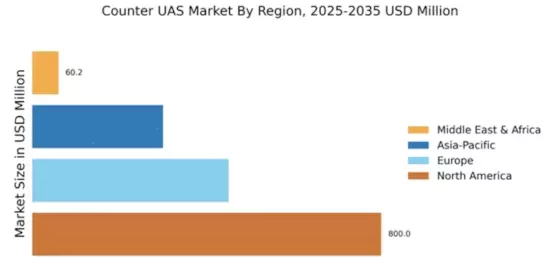
2022年,北美占据最大的市场份额。北美在军费开支和技术进步方面处于领先地位,因此对反无人机(C-UAS)的需求非常高。尽管加拿大投资开发反无人机系统,但该市场主要依赖美国。 2021财年,国防部(DOD)计划斥资约4.04亿美元用于反无人机研发,约8300万美元用于反无人机采购。

此外,该地区在2020年占据了最大的市场份额,这主要是由于波音公司、洛克希德·马丁公司、诺斯罗普·格鲁曼公司和雷神公司等主要制造商的存在。

2022年,欧洲占据第二大市场份额。欧洲一直处于反无人机技术发展的前沿,许多国家都投资于这些系统的研发。欧盟还积极参与制定管理欧洲无人机使用的法规。欧盟委员会发布了一系列有关无人机使用的指南,包括反无人机系统的使用。

图 2:2022 年各地区无人机市场份额 (%)

COUNTER UAS MARKET SHARE BY REGION 2022

资料来源:二次研究、初步研究、市场研究的未来数据库和分析师审查

反击无人机主要市场参与者和竞争洞察

反无人机市场的特点是存在许多全球、区域和本地供应商。市场竞争非常激烈,所有参与者都在争夺最大的市场份额。竞争激烈,政府政策频繁变化,航空服务法规是影响市场增长的关键因素。供应商根据成本、产品质量、可靠性和售后服务进行竞争。供应商必须为商业和军事应用提供经济高效且高质量的反无人机系统和解决方案,以在竞争激烈的市场环境中维持自己的地位。

反无人机市场的主要公司包括。

    • 诺斯罗普·格鲁曼公司
    • 洛克希德·马丁公司
    • 英国航空航天系统公司
    • 雷神公司
    • 泰雷兹集团
    • 以色列航空航天工业公司
    • 埃尔比特系统公司
    • 通用原子公司
    • 其他的

对抗无人机行业发展

2023 年 2 月:韩国顶级国防公司韩华宇航宣布投资美国空域安全公司 Fortem Technologies。

2022 年 11 月:诺斯罗普·格鲁曼公司的短程反无人机指挥和控制能力已在亚利桑那州尤马试验场为美国陆军完成了实弹测试。

反无人机市场细分

反无人机应用展望

    • 检测
      • 雷达
      • 射频扫描仪
      • 环氧乙烷/红外光谱
      • 音响系统
      • 组合传感器
    • 拦截
      • 干扰器
      • 欺骗
      • 激光
      • 网队

反无人机最终用途展望

反无人机技术展望

    • 激光系统
    • 动力系统
    • 电子系统

反无人机系统配置展望

    • 便携的
    • 车载式
    • 独立式

反无人机平台展望

    • 空气
    • 地面
    • 海军

反无人机用途展望

    • 基地保护
    • 赞美现有武器
    • 机场空域保护
    • 贵宾保护
    • 反走私行动
    • 其他的

反无人机区域展望

    • 北美
      • 我们
      • 加拿大
    • 欧洲
      • 德国
      • 法国
      • 英国
      • 意大利
      • 西班牙
      • 欧洲其他地区
    • 亚太
      • 中国
      • 日本
      • 印度
      • 澳大利亚
      • 韩国
      • 亚太其他地区
    • 中东和非洲
    • 南美洲

FAQs

What is the current valuation of the Counter UAS Market as of 2024?

The Counter UAS Market was valued at approximately 1610.23 USD Million in 2024.

What is the projected market valuation for the Counter UAS Market in 2035?

The market is projected to reach approximately 18289.23 USD Million by 2035.

What is the expected CAGR for the Counter UAS Market during the forecast period 2025 - 2035?

The expected CAGR for the Counter UAS Market during the forecast period 2025 - 2035 is 24.72%.

Which companies are considered key players in the Counter UAS Market?

Key players in the Counter UAS Market include Northrop Grumman, Raytheon Technologies, Lockheed Martin, Thales Group, Leonardo, BAE Systems, DroneShield, SRC Inc., and Elbit Systems.

What are the main application segments of the Counter UAS Market?

The main application segments include Military, Commercial, Homeland Security, Public Safety, and Infrastructure Protection.

How does the Military segment perform in terms of market valuation?

The Military segment was valued at approximately 6000.0 USD Million in 2024.

What is the valuation of the Commercial segment in the Counter UAS Market?

The Commercial segment was valued at approximately 3500.0 USD Million in 2024.

What technologies are utilized in the Counter UAS Market?
Key technologies include Electronic Warfare, Kinetic Interception, Cybersecurity, Detection Systems, and Countermeasures.
What is the market valuation for Detection Systems in the Counter UAS Market?
Detection Systems were valued at approximately 4000.0 USD Million in 2024.
Which end-use sectors are driving the Counter UAS Market?
End-use sectors include Defense Forces, Law Enforcement Agencies, Private Security Firms, Critical Infrastructure Operators, and Event Organizers.
作者
Author
Author Profile
Shubham Munde LinkedIn
Team Lead - Research
Shubham brings over 7 years of expertise in Market Intelligence and Strategic Consulting, with a strong focus on the Automotive, Aerospace, and Defense sectors. Backed by a solid foundation in semiconductors, electronics, and software, he has successfully delivered high-impact syndicated and custom research on a global scale. His core strengths include market sizing, forecasting, competitive intelligence, consumer insights, and supply chain mapping. Widely recognized for developing scalable growth strategies, Shubham empowers clients to navigate complex markets and achieve a lasting competitive edge. Trusted by start-ups and Fortune 500 companies alike, he consistently converts challenges into strategic opportunities that drive sustainable growth.
Co-Author
Co-Author Profile
Swapnil Palwe LinkedIn
Team Lead - Research
With a technical background as Bachelor's in Mechanical Engineering, with MBA in Operations Management , Swapnil has 6+ years of experience in market research, consulting and analytics with the tasks of data mining, analysis, and project execution. He is the POC for our clients, for their consulting projects running under the Automotive/A&D domain. Swapnil has worked on major projects in verticals such as Aerospace & Defense, Automotive and many other domain projects. He has worked on projects for fortune 500 companies' syndicate and consulting projects along with several government projects.
发表评论

Research Approach


Secondary Research

The secondary research process involved comprehensive analysis of defense procurement databases, aerospace & security journals, regulatory frameworks governing airspace management, and authoritative defense intelligence sources. Key sources included the US Department of Defense (DoD) Military Procurement Reports, Department of Homeland Security (DHS) Counter-UAS Strategy & Standards, Federal Aviation Administration (FAA) UAS Integration Office and Remote ID Regulations, European Union Aviation Safety Agency (EASA) Drone Strategy Reports, NATO Counter-UAS Capability Development initiatives, UK Ministry of Defence Defence Equipment and Support (DE&S) procurement data, Israeli Ministry of Defense Directorate of Defense Research, Defense Advanced Research Projects Agency (DARPA) technology assessments, Transportation Security Administration (TSA) aviation threat assessments, European Defence Agency (EDA) Counter-UAS Capability Development, National Center for Biotechnology Information (NCBI) journal repositories for sensor technology research, World Trade Organization (WTO) defense trade statistics, United Nations Office of Counter-Terrorism (UNOCT) reports on emerging unmanned threats, and national defense white papers from key markets. These sources were used to collect procurement statistics, regulatory framework updates, threat assessment studies, defense budget allocations, and market landscape analysis for radar-based detection, radio frequency (RF) jamming, electro-optical/infrared (EO/IR) systems, kinetic interception technologies, and directed energy systems.


Primary Research

During the primary research phase, both supply-side and demand-side stakeholders were interviewed to gather qualitative and quantitative information on detection capabilities, neutralization protocols, and challenges in security integration. Defense contractors, aerospace electronics manufacturers, and C-UAS solution providers provided supply-side sources, such as CEOs, VPs of Defense Programs, chief technology officers, and heads of unmanned systems divisions. Military procurement officers (Army/Air Force/Navy), chief security officers of international airports, critical infrastructure protection managers (nuclear facilities, power grids), homeland security agency directors, and law enforcement aviation unit commanders were all demand-side sources. Primary research confirmed market segmentation across the detection, identification, and neutralization layers, confirmed technology readiness levels (TRL) for new systems, and gathered information on the timelines for defense contract awards, the patterns of procurement authorization, and the frameworks for cross-border security cooperation.

Primary Respondent Breakdown:

By Designation: C-level Primaries (40%), Director Level (32%), Others (28%)

By Region: North America (38%), Europe (30%), Asia-Pacific (25%), Rest of World (7%)
 

Market Size Estimation

Global market valuation was derived through defense contract value analysis and deployed system volume assessment. The methodology included:

Identification of 45+ key defense contractors and security technology providers across North America, Europe, Asia-Pacific, Middle East, and Latin America

Technology mapping across radar detection, RF spectrum monitoring, EO/IR tracking, acoustic sensors, jamming/spoofing countermeasures, kinetic interception systems, and high-energy laser platforms

Analysis of reported defense contract values and modeled commercial security spending specific to C-UAS portfolios

Coverage of manufacturers and system integrators representing 72-78% of global market share in 2024

Extrapolation using bottom-up (system deployment volume × ASP by application: military defense, homeland security, commercial infrastructure) and top-down (prime contractor revenue validation) approaches to derive segment-specific valuations across detection, identification, and neutralization system categories

下载免费样本

请填写以下表格以获取本报告的免费样本

Download PDF ×

We do not share your information with anyone. However, we may send you emails based on your report interest from time to time. You may contact us at any time to opt-out.