×
Request Free Sample ×

Kindly complete the form below to receive a free sample of this Report

* Please use a valid business email

Leading companies partner with us for data-driven Insights

clients tt-cursor
Hero Background

Energy Storage Market

ID: MRFR/EnP/3062-CR
188 Pages
Anshula Mandaokar
October 2020

Energy Storage Market Research Report By Technology (Lithium-ion Batteries, Flow Batteries, Lead-Acid Batteries, Sodium-Sulfur Batteries), By End Use (Residential, Commercial, Utility, Transportation), By Application (Grid Storage, Renewable Energy Integration, Backup Power, Electric Vehicle Charging), By Energy Capacity (Small Scale, Medium Scale, Large Scale) and By Regional (North America, Europe, South America, Asia Pacific, Middle East and Africa)- Forecast to 2035

Share:
Download PDF ×

We do not share your information with anyone. However, we may send you emails based on your report interest from time to time. You may contact us at any time to opt-out.

Energy Storage Market Infographic
Purchase Options

Energy Storage Market Summary

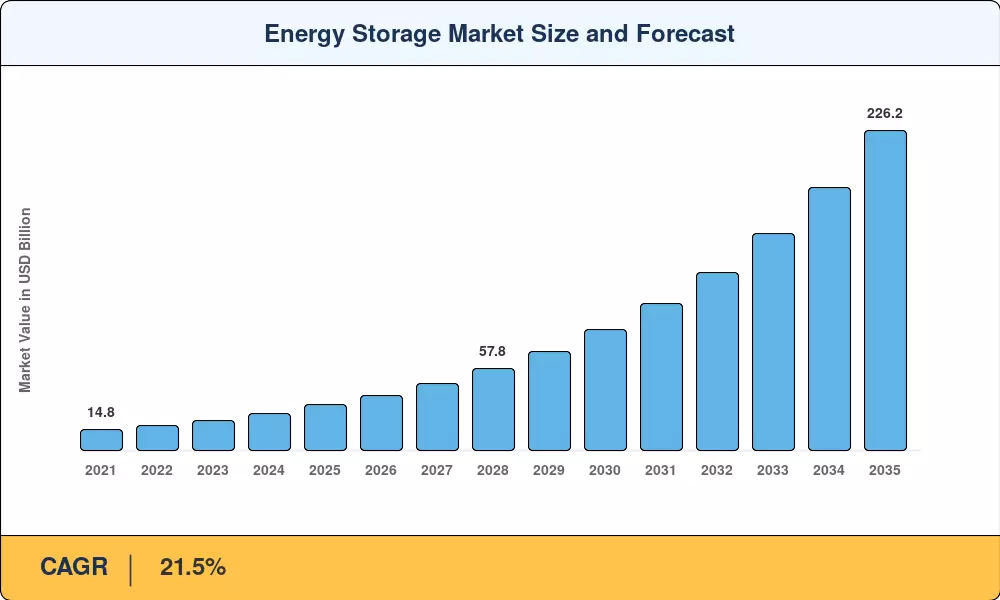
As per Market Research Future analysis, the Energy Storage Market Size was estimated at 39411.29 USD Billion in 2024. The Energy Storage industry is projected to grow from 49446.2 USD Billion in 2025 to 477810.67 USD Billion by 2035, exhibiting a compound annual growth rate (CAGR) of 25.46% during the forecast period 2025 - 2035.

Key Market Trends & Highlights

The Energy Storage Market is poised for substantial growth driven by technological advancements and increasing integration with renewable energy sources.

  • North America remains the largest market for energy storage solutions, driven by robust demand and regulatory support.
  • Asia-Pacific is emerging as the fastest-growing region, fueled by rapid urbanization and increasing investments in renewable energy.
  • Grid energy storage continues to dominate the market, while electric vehicle charging is the fastest-growing segment, reflecting changing consumer preferences.
  • Rising demand for renewable energy and government incentives are key drivers propelling the energy storage market forward.

Market Size & Forecast

2024 Market Size 39411.29 (USD Billion)
2035 Market Size 477810.67 (USD Billion)
CAGR (2025 - 2035) 25.46%

Major Players

Tesla (US), LG Energy Solution (KR), Samsung SDI (KR), Panasonic (JP), CATL (CN), BYD (CN), Siemens (DE), General Electric (US), Fluence (US)

Energy Storage Market Trends

The Energy Storage Market is currently experiencing a transformative phase, driven by the increasing demand for renewable energy sources and the need for grid stability. As nations strive to reduce their carbon footprints, energy storage solutions are becoming essential for integrating intermittent renewable resources like solar and wind into the energy mix. This shift not only enhances energy reliability but also supports the transition towards a more sustainable energy ecosystem. Furthermore, advancements in technology are fostering innovation in energy storage systems, leading to improved efficiency and cost-effectiveness. The market appears poised for substantial growth as stakeholders recognize the potential of energy storage in addressing energy challenges and enhancing energy security. In addition to technological advancements, regulatory frameworks are evolving to support the deployment of energy storage solutions. Governments are increasingly implementing policies that incentivize investment in energy storage, thereby creating a favorable environment for market expansion. This trend suggests a growing recognition of the strategic importance of energy storage in achieving energy independence and resilience. As the Energy Storage Market continues to mature, it is likely to attract diverse investments and partnerships, further propelling its development and integration into the global energy landscape.

Technological Advancements

Recent innovations in battery technology and energy management systems are enhancing the performance and affordability of energy storage solutions. These advancements are likely to drive wider adoption across various sectors.

Regulatory Support

Governments worldwide are increasingly recognizing the importance of energy storage in achieving sustainability goals. This regulatory support may lead to more favorable policies and incentives, encouraging investment in energy storage projects.

Integration with Renewable Energy

The growing emphasis on renewable energy sources is creating a strong demand for energy storage systems. This integration is essential for managing supply and demand fluctuations, thereby ensuring a stable energy supply.

Energy Storage Market Drivers

Market Trends and Projections

The Global Energy Storage Market Industry is characterized by dynamic trends and projections that indicate substantial growth in the coming years. With a market value of 13.2 USD Billion in 2024, the industry is on a trajectory towards reaching 40 USD Billion by 2035. This growth is driven by various factors, including technological advancements, government policies, and increasing demand for renewable energy. The anticipated CAGR of 10.58% from 2025 to 2035 suggests a robust expansion phase, highlighting the importance of energy storage in the global energy landscape. Charts illustrating these trends and projections can provide valuable insights into the market's future trajectory.

Rising Electric Vehicle Adoption

The rise in electric vehicle (EV) adoption is significantly influencing the Global Energy Storage Market Industry. As more consumers transition to electric vehicles, the demand for efficient energy storage solutions is increasing. EVs require robust charging infrastructure, which often relies on energy storage systems to manage energy flow and support grid stability. This interconnection between EVs and energy storage is fostering innovation and investment in both sectors. The anticipated growth in the energy storage market, with a projected CAGR of 10.58% from 2025 to 2035, reflects the potential for synergies between electric vehicles and energy storage technologies.

Government Incentives and Policies

Government policies and incentives are playing a pivotal role in shaping the Global Energy Storage Market Industry. Many governments worldwide are implementing supportive regulations and financial incentives to promote energy storage adoption. These measures include tax credits, grants, and subsidies aimed at reducing the financial barriers associated with energy storage systems. Such initiatives not only encourage investment in energy storage technologies but also stimulate innovation within the sector. As a result, the market is poised for growth, with projections indicating a value of 13.2 USD Billion in 2024, as governments recognize the importance of energy storage in achieving energy security and sustainability goals.

Growing Demand for Renewable Energy

The Global Energy Storage Market Industry is experiencing a surge in demand for renewable energy sources, driven by the global shift towards sustainability. As countries strive to meet their climate goals, the integration of renewable energy technologies such as solar and wind is becoming increasingly prevalent. Energy storage systems play a crucial role in balancing supply and demand, particularly during periods of low generation. This trend is expected to contribute to the market's growth, with projections indicating a market value of 13.2 USD Billion in 2024, and potentially reaching 40 USD Billion by 2035, reflecting the industry's pivotal role in facilitating the transition to cleaner energy.

Increasing Grid Resilience and Reliability

The need for enhanced grid resilience and reliability is a significant driver for the Global Energy Storage Market Industry. As extreme weather events and natural disasters become more frequent, the vulnerability of power grids is increasingly apparent. Energy storage systems provide a solution by enabling utilities to store excess energy during low-demand periods and release it during peak demand or outages. This capability not only stabilizes the grid but also ensures a continuous power supply, thereby enhancing overall reliability. The growing recognition of these benefits is likely to contribute to the market's expansion, with an expected market value of 40 USD Billion by 2035.

Technological Advancements in Energy Storage Solutions

Innovations in energy storage technologies are significantly impacting the Global Energy Storage Market Industry. Developments in battery technologies, such as lithium-ion and solid-state batteries, are enhancing energy density, efficiency, and lifespan. These advancements not only improve the performance of energy storage systems but also reduce costs, making them more accessible to consumers and businesses alike. As technology continues to evolve, the market is likely to witness increased adoption rates. The anticipated compound annual growth rate (CAGR) of 10.58% from 2025 to 2035 underscores the potential for technological breakthroughs to drive market expansion and reshape energy storage solutions.

Market Segment Insights

By Application: Grid Energy Storage (Largest) vs. Electric Vehicle Charging (Fastest-Growing)

In the Energy Storage Market, Grid Energy Storage emerges as the largest segment, capturing significant market share due to its critical role in stabilizing energy supply and demand. This segment encompasses various technologies and applications, ensuring that energy generated from renewable sources can be efficiently stored and utilized during peak demand times. The growth of smart grid technologies and increased investments in renewable energy infrastructure further bolster this segment's significance in the overall market. Electric Vehicle Charging has been recognized as the fastest-growing segment within the Energy Storage Market. The rapid proliferation of electric vehicles and the concomitant need for reliable charging solutions are driving this growth. Additionally, government initiatives promoting electric mobility and advancements in charging technologies are fostering the establishment of widespread charging infrastructures. As the transition to greener transportation systems accelerates, the demand for robust energy storage solutions within this segment will continue to rise.

Grid Energy Storage (Dominant) vs. Electric Vehicle Charging (Emerging)

Grid Energy Storage is characterized by its ability to provide reliable energy supply, enabling utilities to effectively manage the grid's stability and balance intermittent renewable energies like solar and wind. Technologies such as lithium-ion batteries, pumped hydro storage, and advanced flywheels are commonly utilized in this segment. As governments focus on reducing carbon emissions, grid energy storage remains a dominant player, facilitating the integration of renewable sources into national grids. In contrast, Electric Vehicle Charging is an emerging segment that supports the growing electric vehicle market through the development of fast-charging networks and energy management systems that enhance the charging experience. This segment's success is closely tied to advancements in battery technology, which enable quicker charging times and increased vehicle ranges, thus presenting a complementary growth pathway alongside grid energy storage solutions.

By Technology: Lithium Ion Battery (Largest) vs. Lead Acid Battery (Fastest-Growing)

The Energy Storage Market showcases a diverse array of technologies, with lithium-ion batteries taking the lead as the largest segment due to their high energy density, efficiency, and decreasing costs. In contrast, lead-acid batteries, traditionally a common choice for energy storage, are experiencing a resurgence as newer technologies evolve to improve their performance and sustainability factors, making them formidable contenders in specific applications.

Technology: Lithium Ion Battery (Dominant) vs. Lead Acid Battery (Emerging)

Lithium-ion batteries are renowned for their dominance in the energy storage market, largely due to their versatility and efficiency in various applications, from electric vehicles to renewable energy integration. They offer significant advantages in terms of recharge cycles and energy density, leading to their prevalent use in modern energy storage systems. Conversely, lead-acid batteries, while older technology, are emerging strongly due to rising demands for affordability and reliability in applications like backup power and renewable energy systems. Their improved performance characteristics, coupled with ongoing innovations aimed at enhancing their lifecycle and efficiency, position them as a crucial player in the evolving energy storage landscape.

By End Use: Residential (Largest) vs. Transportation (Fastest-Growing)

In the Energy Storage Market, the distribution of market share among the end-use segments highlights that the residential sector occupies the largest share. This is attributed to the increasing adoption of solar energy storage systems and home battery solutions, driven by rising energy costs and growing consumer awareness. The commercial and utility segments also demonstrate considerable market presence, as businesses and utilities seek efficient energy management solutions, but they trail behind residential in total market share.

End Use: Residential (Dominant) vs. Transportation (Emerging)

The residential energy storage segment is characterized by user-friendly systems that provide homeowners with energy independence and cost savings through enhanced energy efficiency and utilization of renewable sources. As consumers increasingly turn to renewable energy solutions such as solar panels, the demand for residential energy storage is expected to remain robust. Conversely, the transportation segment is emerging rapidly, driven by the shift towards electric vehicles and the necessity for efficient power storage solutions. As technological advancements reduce battery costs and improve performance, transportation is anticipated to witness accelerated growth, positioning itself as a key area of innovation in the energy storage landscape.

Get more detailed insights about Energy Storage Market

Regional Insights

North America : Market Leader in Energy Storage

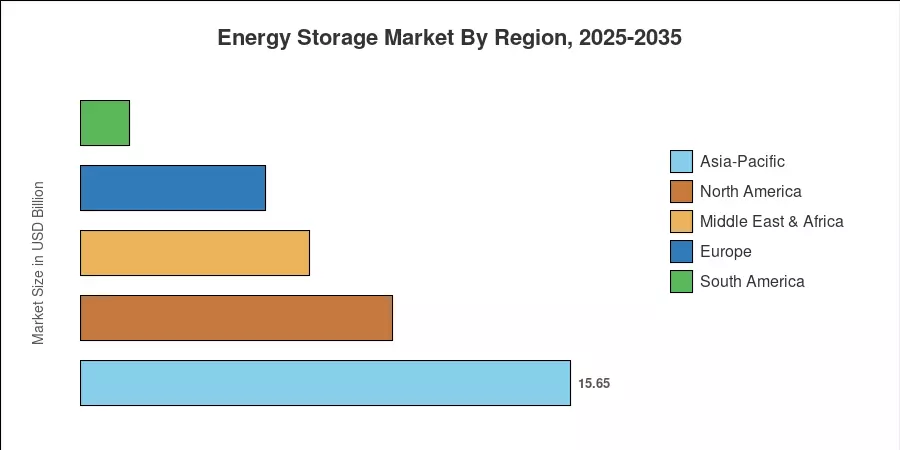
North America is poised to maintain its leadership in the energy storage market, with a market size of $19705.65 million in 2025. The region's growth is driven by increasing investments in renewable energy, supportive government policies, and technological advancements. Regulatory frameworks are encouraging the adoption of energy storage solutions, enhancing grid reliability and efficiency. The United States is the primary player, with significant contributions from states like California and Texas. Key players such as Tesla, General Electric, and Fluence are at the forefront, driving innovation and competition. The presence of established companies and emerging startups fosters a dynamic market landscape, ensuring continued growth and development in energy storage solutions.

Europe : Emerging Energy Storage Hub

Europe is rapidly evolving into a significant player in the energy storage market, with a market size of $10583.57 million projected for 2025. The region's growth is fueled by ambitious climate goals, increasing renewable energy capacity, and supportive EU regulations. Initiatives aimed at reducing carbon emissions are driving demand for energy storage systems, enhancing grid stability and energy efficiency. Leading countries include Germany, the UK, and France, where companies like Siemens and LG Energy Solution are making substantial investments. The competitive landscape is characterized by a mix of established firms and innovative startups, all vying to capture market share. The European market is expected to see continued growth as it aligns with sustainability goals and technological advancements.

Asia-Pacific : Rapidly Growing Market Potential

Asia-Pacific is witnessing a surge in energy storage demand, with a market size of $8000.0 million anticipated by 2025. The region's growth is driven by increasing energy consumption, government initiatives promoting renewable energy, and advancements in battery technology. Countries are focusing on energy security and sustainability, leading to a robust demand for energy storage solutions. China, Japan, and South Korea are the leading countries in this market, with major players like CATL and Samsung SDI leading the charge. The competitive landscape is vibrant, with numerous local and international companies striving to innovate and capture market share. As the region continues to invest in renewable energy, the energy storage market is expected to expand significantly.

Middle East and Africa : Emerging Market Opportunities

The Middle East and Africa region is emerging as a potential market for energy storage, with a projected market size of $1222.07 million by 2025. The growth is driven by increasing energy demands, government initiatives to diversify energy sources, and investments in renewable energy projects. The region's unique energy landscape presents opportunities for innovative storage solutions to enhance energy security and reliability. Countries like South Africa and the UAE are leading the charge, with investments in solar and wind energy projects. The competitive landscape is still developing, with both local and international players exploring opportunities. As the region continues to embrace renewable energy, the energy storage market is expected to gain momentum, attracting further investments and innovations.

Key Players and Competitive Insights

The Energy Storage Market is currently characterized by a dynamic competitive landscape, driven by the increasing demand for renewable energy integration and grid stability. Major players such as Tesla (US), LG Energy Solution (KR), and CATL (CN) are at the forefront, each adopting distinct strategies to enhance their market positioning. Tesla (US) continues to innovate with its battery technology, focusing on efficiency and sustainability, while LG Energy Solution (KR) emphasizes strategic partnerships to expand its global footprint. CATL (CN), on the other hand, is heavily investing in research and development to maintain its leadership in lithium-ion battery production, thereby shaping a competitive environment that is increasingly focused on technological advancement and sustainability.

Key business tactics within the Energy Storage Market include localizing manufacturing and optimizing supply chains to enhance operational efficiency. The market structure appears moderately fragmented, with a mix of established players and emerging companies vying for market share. The collective influence of key players is significant, as they drive innovation and set industry standards, which in turn influences the competitive dynamics across the sector.

In November 2025, Tesla (US) announced the launch of its new battery recycling program aimed at reducing waste and promoting sustainability. This initiative is strategically important as it not only enhances Tesla's commitment to environmental responsibility but also positions the company as a leader in the circular economy within the energy storage sector. By reclaiming valuable materials from used batteries, Tesla could potentially lower production costs and improve supply chain resilience.

In October 2025, LG Energy Solution (KR) entered into a partnership with a leading renewable energy provider to develop integrated energy storage solutions. This collaboration is likely to enhance LG's product offerings and expand its market reach, particularly in regions with high renewable energy penetration. Such strategic alliances may facilitate the development of innovative solutions that cater to the evolving needs of energy consumers, thereby strengthening LG's competitive position.

In September 2025, CATL (CN) unveiled its latest generation of high-capacity batteries designed for large-scale energy storage applications. This development is crucial as it addresses the growing demand for efficient energy storage solutions that can support grid stability and renewable energy integration. By advancing its technology, CATL is not only reinforcing its market leadership but also setting a benchmark for performance in the energy storage industry.

As of December 2025, current competitive trends in the Energy Storage Market are increasingly defined by digitalization, sustainability, and the integration of artificial intelligence (AI) into energy management systems. Strategic alliances are playing a pivotal role in shaping the landscape, enabling companies to leverage complementary strengths and accelerate innovation. Looking ahead, competitive differentiation is expected to evolve, with a pronounced shift from price-based competition to a focus on technological innovation, reliability of supply chains, and sustainable practices. This transition underscores the importance of adaptability and forward-thinking strategies in navigating the complexities of the energy storage market.

Key Companies in the Energy Storage Market market include

Industry Developments

Recent developments in the Energy Storage Market highlight significant advancements and partnerships among key players. Panasonic has been expanding its battery production capabilities, focusing on sustainable energy solutions. AES Corporation announced an initiative for renewable energy storage projects across the Americas, reinforcing their commitment to clean energy. Saft has been active in enhancing its lithium-ion battery technology for electric vehicles. Tesla continues to lead with its energy storage solutions, continuously upgrading its battery technology, while Schneider Electric is pushing towards integrated energy solutions to optimize energy use.

Byd is expanding its production facilities to meet the growing demand for electric vehicle batteries.

Samsung SDI is making strides in battery recycling, and SunPower is emphasizing solar storage innovations. Enphase Energy reported significant growth in its storage systems, while Siemens is collaborating with various companies to promote energy transformation. In recent years, Contemporary Amperex Technology Co Limited made headlines with its expanded manufacturing capabilities, facilitating global supply. In March 2023, LG Chem acquired a 50% stake in a US-based battery recycling firm to enhance its sustainability efforts. These initiatives reflect a dynamic and rapidly evolving market poised for growth as global demand for energy storage solutions increases.

February 2023:Gore Street Capital acquires 200MW battery storage project in California, UK-listed Gore Street Energy Storage Market Fund has acquired its first asset in California, a 200MW/400MWh battery energy storage system project from developer Avantus.The two-hour duration project, called Big Rock, is in Imperial County which borders Mexico and will provide power on the electricity market operated the California ISO, or CAISO. The construction-ready project is scheduled to get a grid connection in the second half of 2024 and will start commercial operations shortly after. Battery cell supply agreements and engineering, procurement and construction (EPC) contracts have been secured.

Future Outlook

Energy Storage Market Future Outlook

The Energy Storage Market is projected to grow at a 25.46% CAGR from 2024 to 2035, driven by renewable energy integration, technological advancements, and increasing demand for grid stability.

New opportunities lie in:

  • Development of advanced lithium-sulfur battery technologies
  • Expansion of energy-as-a-service business models
  • Implementation of large-scale grid storage solutions for renewable energy

By 2035, the Energy Storage Market is expected to be a cornerstone of global energy infrastructure.

Market Segmentation

Energy Storage Market End Use Outlook

  • Residential
  • Commercial
  • Industrial
  • Utility
  • Transportation

Energy Storage Market Technology Outlook

  • Lithium Ion Battery
  • Lead Acid Battery
  • Flow Battery
  • Sodium Sulfur Battery
  • Nickel Cadmium Battery

Energy Storage Market Application Outlook

  • Grid Energy Storage
  • Electric Vehicle Charging
  • Renewable Energy Integration
  • Uninterruptible Power Supply
  • Consumer Electronics

Report Scope

MARKET SIZE 2024 39411.29(USD Billion)
MARKET SIZE 2025 49446.2(USD Billion)
MARKET SIZE 2035 477810.67(USD Billion)
COMPOUND ANNUAL GROWTH RATE (CAGR) 25.46% (2024 - 2035)
REPORT COVERAGE Revenue Forecast, Competitive Landscape, Growth Factors, and Trends
BASE YEAR 2024
Market Forecast Period 2025 - 2035
Historical Data 2019 - 2024
Market Forecast Units USD Billion
Key Companies Profiled Tesla (US), LG Energy Solution (KR), Samsung SDI (KR), Panasonic (JP), CATL (CN), BYD (CN), Siemens (DE), General Electric (US), Fluence (US)
Segments Covered Application, Technology, End Use
Key Market Opportunities Integration of advanced battery technologies enhances grid stability and renewable energy utilization in the Energy Storage Market.
Key Market Dynamics Rising demand for renewable energy drives innovation and competition in the energy storage market.
Countries Covered North America, Europe, APAC, South America, MEA

Market Highlights

Author
Anshula Mandaokar
Team Lead - Research

Anshula Mandaokar holds an academic degree in Chemical Engineering and has been contributing to the field for more than 5 years. She has expertise in Market Research and Business Consulting and serves as a Team Lead for a reputed Market Research firm under the Chemicals and Materials domain spectrum. She has worked on multiple projects, generating explicit results in a quick turnaround time. Her understanding of data interpretation justifies her role as a leader.

Leave a Comment

FAQs

What is the expected market size of the Energy Storage Market in 2024?

The Energy Storage Market is expected to be valued at 13.23 USD Billion in 2024.

What is the projected market size of the Energy Storage Market by 2035?

By 2035, the Energy Storage Market is anticipated to reach a valuation of 40.0 USD Billion.

What is the expected CAGR for the Energy Storage Market from 2025 to 2035?

The expected compound annual growth rate (CAGR) for the Energy Storage Market from 2025 to 2035 is 10.58 percent.

Which region is projected to have the largest market value in 2035?

North America is projected to have the largest market value, expected to reach 15.8 USD Billion in 2035.

What will be the market value of Lithium-ion Batteries in 2035?

The market value of Lithium-ion Batteries is projected to be 20.0 USD Billion in 2035.

What market value is expected for Flow Batteries by 2035?

The expected market value for Flow Batteries by 2035 is 7.5 USD Billion.

Who are the key players in the Energy Storage Market?

Major players in the market include Panasonic, Tesla, Samsung SDI, Siemens, and AES Corporation.

What is the anticipated market size of the Energy Storage Market in Europe by 2035?

The anticipated market size for the Energy Storage Market in Europe is expected to be 11.0 USD Billion by 2035.

How is the market size for Lead-Acid Batteries expected to change by 2035?

The market size for Lead-Acid Batteries is projected to grow to 6.0 USD Billion by 2035.

What is the expected market value of Sodium-Sulfur Batteries in 2035?

The expected market value for Sodium-Sulfur Batteries is projected to reach 6.5 USD Billion by 2035.

Download Free Sample

Kindly complete the form below to receive a free sample of this Report

Compare Licence

×
Features License Type
Single User Multiuser License Enterprise User
Price $4,950 $5,950 $7,250
Maximum User Access Limit 1 User Upto 10 Users Unrestricted Access Throughout the Organization
Free Customization
Direct Access to Analyst
Deliverable Format
Platform Access
Discount on Next Purchase 10% 15% 15%
Printable Versions