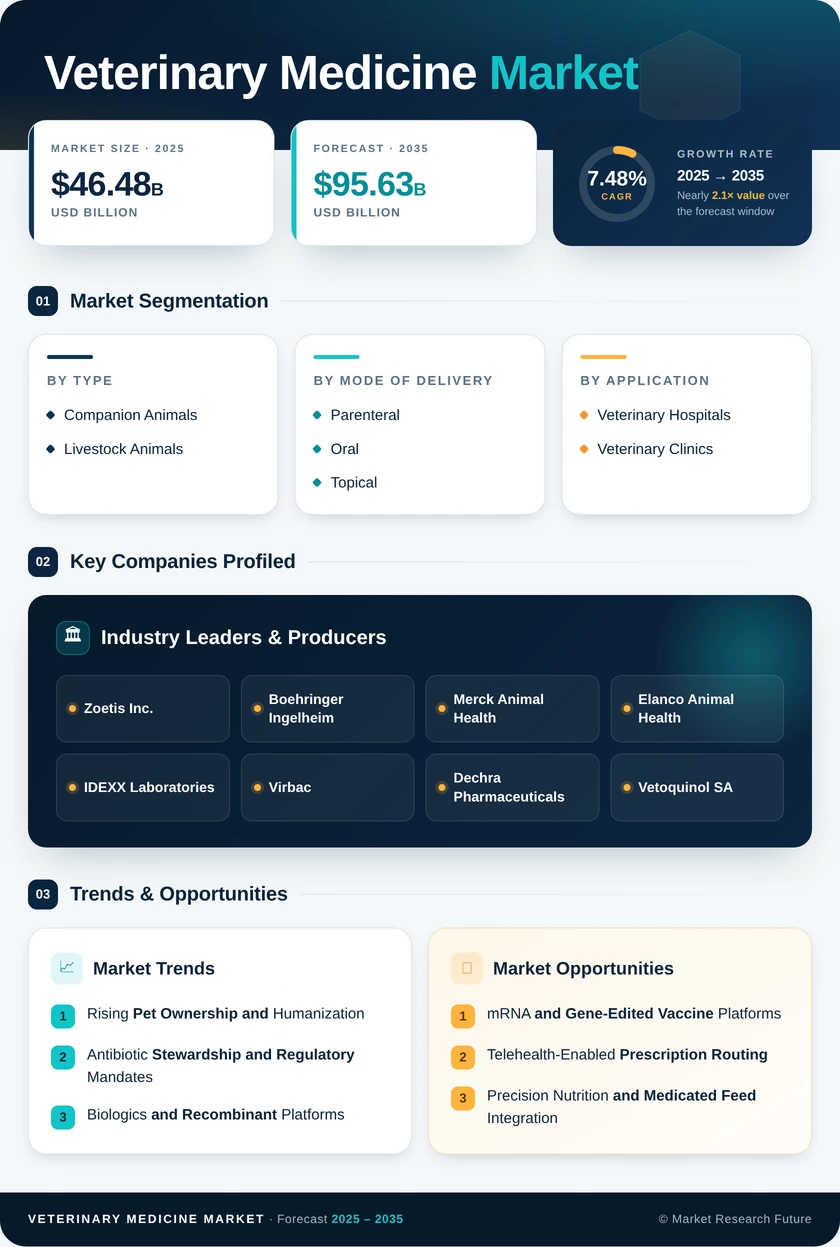
Segmentation Quick Reference
| Dimension | Sub-Segments | Dominant Segment | Fastest Growing Segment |
| Product Type | Drugs, Vaccines, Medicated Feed Additives | Drugs | Vaccines |
| Animal Type | Companion Animals, Livestock Animals | Companion Animals | Livestock Animals |
| Mode of Delivery | Parenteral, Oral, Topical | Parenteral | Topical |
| End User | Veterinary Hospitals, Veterinary Clinics | Veterinary Hospitals | Veterinary Clinics |
| Geography | North America, Europe, Asia-Pacific, South America, Middle East & Africa | North America | Asia-Pacific |
Market Segmentation Overview
By Product Type
| Sub-Segment | Key Trend |
| Drugs | Anti-infectives and parasiticides maintain the majority share; isoxazoline-class products drive companion animal repeat revenue |
| Vaccines | Recombinant and mRNA platforms shorten development timelines; regulatory mandates accelerate prophylactic adoption |
| Medicated Feed Additives | Antibiotic-alternative formulations grow as stewardship rules restrict conventional medicated feed inclusions |
The product-type dimension reflects the ongoing transition from reactive, antibiotic-driven treatment to proactive, vaccine-led prevention across both companion and livestock segments.
By Animal Type
| Sub-Segment | Key Trend |
| Companion Animals | Pet humanization and insurance penetration elevate per-animal pharmaceutical spend toward chronic-care management |
| Livestock Animals | Industrial poultry and swine operations standardize vaccination-first biosecurity, driving rapid volume growth |
Companion animals generate the largest absolute revenue, while livestock animals represent the higher-growth opportunity as emerging-market producers formalize veterinary care protocols.
By Mode of Delivery
| Sub-Segment | Key Trend |
| Parenteral | Injection-based vaccines and biologics remain the clinical standard for both large-animal and companion species |
| Oral | Flavored chewable parasiticides achieve high owner compliance in companion animal segments |
| Topical | Spot-on and collar-based flea/tick formulations reduce veterinary visit dependency, expanding consumer self-care |
Delivery-mode innovation is shifting toward owner-administered formats that reduce practitioner bottlenecks.
By End User
| Sub-Segment | Key Trend |
| Veterinary Hospitals | Complex diagnostics and surgical bundling sustain the majority of pharmaceutical spend per visit |
| Veterinary Clinics | Telehealth-routed prescriptions redirect chronic-care and refill volumes to lower-overhead clinic settings |
Clinic-based care is growing faster as digital consultation platforms decouple prescribing from in-person hospital visits.